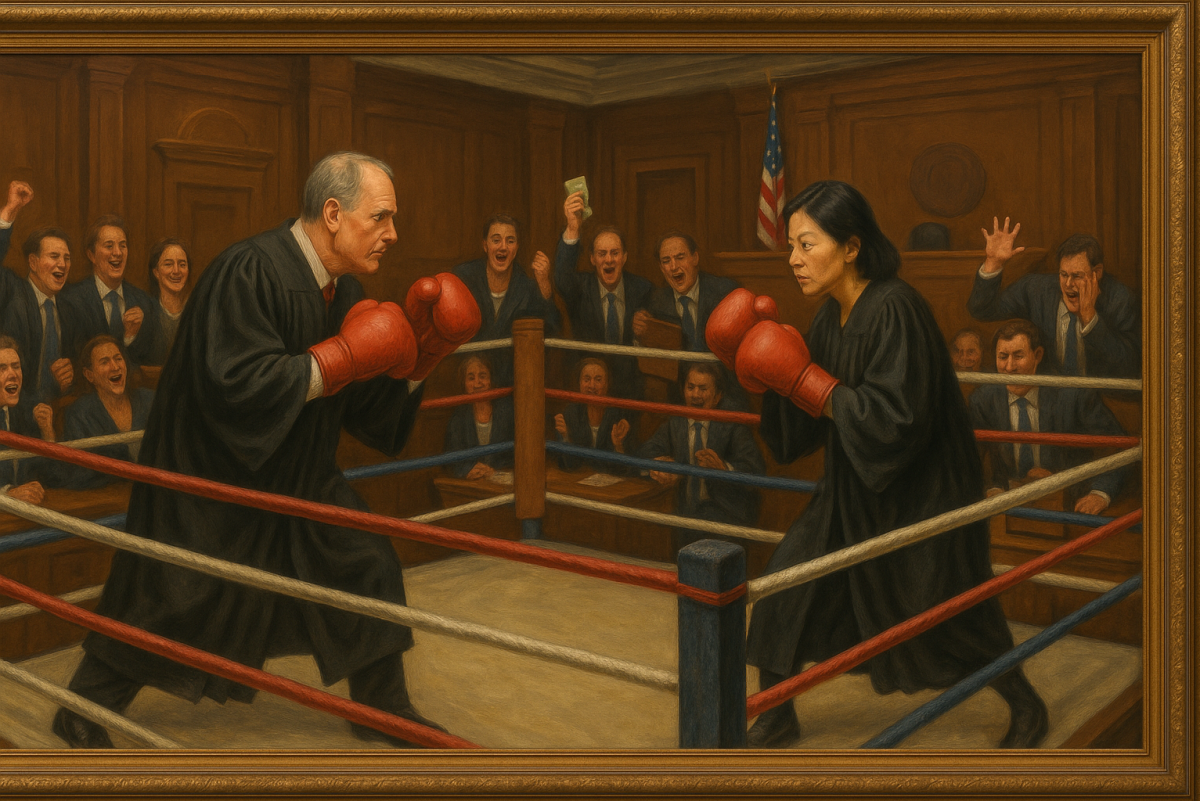
Self interest or political stand?

One strand of criticism of media coverage of the 2016 election was that outlets such as CNN only called out Donald Trump’s behavior when he started criticizing and attacking the press and its members. The institutional media, it was argued, was not a bulwark of liberty; it was a bulwark of the First Amendment, committed to criticizing attacks on free speech because they directly affected reporters and the press as an institution.

I had the same thought reading this piece by Dahlia Lithwick arguing that Trump’s staunchest allies may be pushing back against his excesses, if not outright abandoning him. Her evidence: 1) the Boys Scout’s apology for Trump’s Jamboree speech; 2) the Joint Chiefs’ announcement that they would give no effect to Trump’s tweet announcing that transgendered people no longer could serve in the military; and 3) statements by the Suffolk County Police Department, and other departments and police associations, disavowing Trump’s encouragement of unnecessary force against arrestees. Dahlia wonders whether “it’s fair to ask whether everyone’s had enough of all this racist, homophobic, lawless, and violent “truth-telling,” and whether this trend of American institutions holding Trump to account for his spoken words might continue.”

Bracketing the military example for now, it is difficult to view the others as examples of standing up to Trump as opposed to institutional self-interest and self-preservation. BSA issued a passive-voice sort-of apology (“sincere apologies to those in our Scouting family who were offended by the political rhetoric that was inserted into the jamboree”). It neither accepted responsibility for a predictable occurrence, assigned responsibility to the President for overstepping, nor apologized for behavior (e.g., booing the former President) that departed from the organization’s avowed principles. BSA did not abandon the President; it distanced itself from the negative reaction to his speech. This half-statement reflected the minimum necessary to assuage angry current members and to attract potential new members. As for the Suffolk County P.D. and other police organizations, their statements were necessary to avoid the appearance of endorsing excessive force in order to avoid legal liability, both for themselves as municipalities and for their officers. People recognized that speech might become an issue in future excessive-force cases; these statements were the minimum to rebut a suggestion of condoning what the President described and the officers cheered.

It is telling that none of these statements mentioned or criticized the President or his specific words or actions or the organizations’ members. BSA did not say it was not ok to boo the former President; Suffolk County P.D. did not criticize its officers for cheering the use of force. The statements were abstract and passive–political rhetoric was asserted into the Jamboree, stories about using excessive force were told–designed to express disagreement with an idea, but not criticism of the idea or the person who expressed it. We will be where Dahlia suggests only when that begins happening. Until then, it strikes me as wishful thinking to see this as more than self-interest.

Posted by Howard Wasserman on July 31, 2017 at 08:51 AM

Comments

What’s weird to me about this piece is that it argues that statements by (1) the Boy Scouts, (2) the Joint Chiefs, and (3) the Suffolk County (New York) Police Department are evidence that Trump’s closest allies are beginning to desert him. Now, which of these groups, if any, are among Trump’s closest allies?

Posted by: Asher Steinberg | Jul 31, 2017 2:22:32 PM

In pursuit of ratings and page clicks the liberal media as a collective has overplayed its hand on Trump. Intentionally or not they have given him a powerful weapon in his next election. Outlets such as the Washington Post and Slate have been hounding him since the day he took office and have made every possible attempt to delegitimize his presidency. On one hand all is fair in love and war, on the other hand the perception among the public that Trump has been treated unfairly is itself a power weapon for him to wield. Trump can say with all sincerity and honesty that they never gave his administration a fair chance and that’s why he deserves four more years.

The liberal medias attacks on Trump have been greedy and myopic, in my view.

Posted by: Daniel | Jul 31, 2017 12:10:41 PM

I agree with your reasoning that responses do not amount to standing up to Trump or holding him accountable. Self-directed apologies simply are not the same as condemnation. However, I would take your wishful thinking diagnosis one step further.

1) There is no need for a BSA apology in the first place. The transcript shows that the President is talking about success and momentum in the same train of thought as reinforcing the BSA values. http://time.com/4872118/trump-boy-scout-jamboree-speech-transcript/. Arguing that the notably rambling Mr. Trump’s speech was wrongly political that should be condemned a) assumes that it is possible for a president’s public speech to not be construed as political, and b) assigns disproportionate value to what was actually said. It would seem that the apology is only necessary because of prior disdain for the speaker in the first place.

2) The transgender/military tweet was never an official action. The national response to this event is amazing. Mr. Trump tweets, and the population takes that statement as law. My very first thought was “okay, so he said something, but it carries no legal weight.” Without any executive order, without any documentation or official requests, why /would/ the Joint Chiefs give weight to Mr.Trump’s statement? At that point, clarification of current status quo for eligibility is sufficient. Either the mass population does not understand processes to government, or has gotten to a point where it does not trust that process to take place. I am more inclined to say that the majority fall in the prior. Furthermore, statements beyond addressing the current eligibility would be arguably improper. Reassurance that there is a process is more comforting than a divisive executive branch leaping to sides.

3)I would apply the same reasoning in #2 to the Suffolk County P.D. Mr. Trump, who considers himself the “law and order candidate,” and who ran on this idea of “supporting police officers,” says in his usual lax and irreverent manner

“And when you see these towns and when you see these thugs being thrown into the back of a paddy wagon — you just see them thrown in, rough — I said, please don’t be too nice. (Laughter.) Like when you guys put somebody in the car and you’re protecting their head, you know, the way you put their hand over? Like, don’t hit their head and they’ve just killed somebody — don’t hit their head. I said, you can take the hand away, okay?”

http://www.newsday.com/news/nation/transcript-remarks-by-president-trump-to-law-enforcement-officials-on-ms-13-1.13863979 .

What is missing from the transcript is encouragement to use excessive force, or any force, in any way. Therefore apologies and calls condemnation are not only unnecessary, but misleading. At most what is necessary, is the policy clarification, which I would also argue is in response to the mass re-construing of the speech instead of the speech itself. The high official says don’t be too nice, the direct supervisor says continue to do your job to the standards we hold you to.

As for excessive force/ municipal liability claims, I am unpersuaded that a political aside in the context of the entire transcript should defeat immunity at the municipal level. A judge that takes this into account for a Monell claim would hopefully have the entire transcript at hand, and would see that the language is disconnected from any realistic support of known custom. If anything, it was a statement encouraging deviance from a custom.

tl;dr: the BSA had nothing to apologize for. The Joint Chiefs were correct to clarify the status quo and mass interpretation of the tweet as having legal force was irresponsible. The Suffolk County P.D. also had nothing to apologize for, and arguably only had to reiterate the status quo due to mass response.

Posted by: overton windows | Jul 31, 2017 10:46:59 AM

Excessive force

Following the President’s speech today, the Suffolk County Police Department found it necessary to announce to the public (and remind their officers) about the Fourth Amendment and strict department policies regarding use of force and handling of prisoners and the lack of tolerance for roughing up prisoners. So the higher-ups realize there is at least a perception problem. (The International Association of Police Chiefs also issued a statement, declaring that treating all people with dignity and respect is the “bedrock principle behind the concepts of procedural justice and police legitimacy”). On one hand, the exchange shows institutions pushing back against presidential lawlessness. On the other, the disconnect between police executives and rank-and-file is striking.

But I could see discovery in the next excessive-force civil rights claim against the Department becoming interesting, because a good plaintiff’s lawyer could make hay out of this event. Cane she use the video and the department response to suggest the officer knew the force was wrong and used it anyway, defeating qualified immunity? Does the cheering rank-and-file show a departmental custom? What if the next involved officer is one of those sitting behind the President, identifiable, and visibly cheering/laughing/clapping officers are identifiable–can that be used to overcome immunity? Can a plaintiff’s lawyer make a failure-to-[blank] claim by showing that the department did nothing to discipline or retrain the officers who visibly cheered/laughed/clapped?

Posted by Howard Wasserman on July 28, 2017 at 07:04 PM

Comments

It should, which is why this department (and a bunch of others across the country) tweeted as they did. But the broader point is it has to do that and it is running into a fact question of whether what it did was sufficient. As plaintiff’s attorney, I would argue that two tweets are insufficient. And I am not sure that eliminates the qualified immunity problem.

Posted by: Howard Wasserman | Jul 29, 2017 7:04:05 PM

If the police/sheriff department conducts “refresher” training for all uniformed officers on its written policies and procedures related to handling persons in custody, does that action effectively shield (pun intended) the department from charges of excessive force.

I believe the “larger” issue is that the President does not know the contents of the Constitution and has conveniently “forgotten” his oath of office.

Posted by: Paul | Jul 29, 2017 6:47:06 PM

Governors and the Failure of ACA Repeal: Federalism as Safeguard Against National Partisan Politics

Now that the efforts to repeal ACA have come to naught, it is worthwhile reflecting on the role of governors and federalism in halting a national partisan movement. In an age of programmatic and polarized parties, governors managed to forge bipartisan coalitions to stop a dominant national party’s chief policy priority.

That is not supposed to happen. According to Jessica Bulman-Pozen’s theory of partisan federalism, states are just enclaves in which the national parties test their national policies. Republican governors ought to be staunch backers of ACA repeal, while Democratic governors ought to be cheerleaders for Schumer’s rearguard defensive maneuvers. As David Schleicher has explained, state politicians’ marching in lockstep with their national counterparts is predicted as well by the theory of second-order elections.

Why did Bulman-Pozen’s theory misfire? As David Schleicher explains, the theory of second-order elections is at its weakest when dealing with high-visibility executive officials who have the salience to craft their own political identity separate from national parties agendas. I would add that the task of street-level implementation allows executives to buck the slogans and memes of national parties. Sandoval and Kasich have lots of chances to make their reputations and build coalitions beyond a handful of roll call votes: They have less to fear from primary loudmouths and echo chambers.

Whatever the reason, I raise a glass to anti-partisan federalism. As I have elsewhere argued, the trans-partisan tendency of high state officials should be cultivated. In an age of increasingly kitschy, vulgar, empty-calorie identity politics of Coast versus Interior, the governors and mayors can bring the public’s attention back to policy outcomes and compromise. In a reversal of the Wechsler thesis, state politics, thank Madison, can be safeguards of the national government.

Posted by Rick Hills on July 28, 2017 at 11:46 AM

Comments

I thank Rick Hills for bringing his post to my attention. Although I also bemoan the state of our politics, I don’t think his anti-partisan-federalism thesis makes good sense of the health care debate. For the last decade, health care policy has been dominated by partisan federalism–not only in the challenges to the individual mandate and exchange subsidies, but more powerfully in the refusal of nineteen red states to adopt the Medicaid expansion. Leaving this kind of federal money on the table would have been unthinkable until recently. And the Republican governors of such states were not part of the reverse-Wechsler coalition Rick toasts. On Thursday night, it also looked like the Republican Congress might rely on red states to dismantle the ACA through waivers, rather than provide directly for such dismantling in federal law. The waiver approach may yet prove undead.

But I do agree with Rick that governors played an important role in this debate, and one that was not entirely to partisan type; indeed, Sandoval and Kasich, whose states expanded Medicaid (through some tricky gubernatorial maneuvering on Kasich’s part), did not carry Heller’s and Portman’s votes. We should be attending more closely to high-level state officials because, with intense polarization and a dysfunctional Congress, negotiations between state and federal executive officials have been increasingly shaping national policy (as I describe at much greater length here: http://www.virginialawreview.org/volumes/content/executive-federalism-comes-america). Although partisanship informs these negotiations, they allow for more play in the joints, including relatively nuanced forms of compromise. Governors will be even more important than they were these past weeks if the repeal/replace agenda in Washington (whether in Congress or at HHS) turns back to waiver.

Posted by: Jessica Bulman-Pozen | Jul 30, 2017 8:35:55 PM

Why the “Plain Statement Rule” for Statutory Interpretation is Normatively Justifiable But Practically Impossible

As Will Baude and Ryan Doerfler note

Comments

Unfortunately, I don’t have time (or free hands) to give these generous responses the time they deserve right now, but I am very happy that our article has sparked fascinating responses like these. Provoking real reflection about the plain meaning rule was our goal, more than anything else.

That said, two thoughts:

1, I think Rick’s process-based theory relies on an additional assumption, which is that legislators can at least tell when they are getting closer or further from qualifying for what he sees as the plain-meaning “prize.” That might be right, but I’m not positive — for instance, sometimes courts find ambiguities precisely because of Congress’s attempts to say things an extra time and make doubly sure. If members of Congress don’t know whether a given amendment will move things closer or further from clarity, then the “prize” could be discounted all the way to zero.

Now maybe Rick’s assumption is right in at least some predictable set of cases, I’m not sure, and suspect we would need more systematic research to find out. And for the reasons Rick comes to, it may not matter in the end.

2, As for Asher’s suggestion, if the result of our piece is to prove that we are all still intentionalists (or perhaps “new purposivists”) I think that would be interesting enough. But I rather doubt that the kind of intentionalism he describes would lead to the kind of thresholds and epistemic cut-offs that *purport* to mark the plain meaning rule.

It’s important to remember that “ambiguous” texts include not just those that are genuinely in equipoise, but those where one side has the better of it, but only by a modest margin. The question for plain-meaning-rule defenders is why there are some margins where extra-textual evidence is worth looking at, and others where it is not.

But if they have an answer to that question, perhaps they can help tell us where that margin is — a point on which current judges of the D.C. Circuit apparently are widely divided.

Posted by: William Baude | Aug 6, 2017 12:36:01 PM

I think I disagree with most of this post. In the first place, I find Baude and Doerfler’s criticisms of the plain-statement rule thoroughly unconvincing and see no common-sense problem with lexical priority of textual meaning whatsoever. The argument assumes that the reason extra-textual evidence of meaning is given no weight when text is clear is that there’s something, as you say, “pernicious” about it, but that needn’t be the case for lexical priority to be right; actually, unless every judge who considers that evidence when a statute is ambiguous but not when it’s plain (which is pretty much every judge in America, less a handful of ultra-textualist judges) has been hopelessly confused for the past few decades or maybe the last century (the plain-statement rule predates the advent of modern textualism by quite a ways), what we should be looking for is a theory on which extra-textual evidence isn’t pernicious at all, but is merely less reliable than textual evidence of meaning, which is conclusive when sufficiently clear.

Now, there’s nothing logically incoherent in theory about that kind of priority between two different types of evidence; eyewitness testimony, for example, isn’t so unreliable that it should be categorically discarded, but if you have physical or video evidence of a certain quality, it would be irrational to side with the eyewitness testimony if physical or video evidence contradicts it. District-court opinions are perfectly probative though inconclusive evidence of the law, so to speak, until they’re contradicted by a Supreme Court opinion, in which case they’re not. The question we should be asking is whether there’s at least a plausible theory of legal meaning, or linguistic meaning, which contributes to legal meaning but isn’t necessarily the same thing, on which textual evidence and extra-textual evidence of statutory meaning have this kind of relationship. I’ll briefly suggest why I think there is a perfectly plausible theory of linguistic meaning, and perhaps legal meaning, of this kind.

It strikes me that by and large most judges continue to be intentionalists; otherwise the vast majority of judges wouldn’t continue to consult legislative history, or at least they’d do it for very different and more limited purposes (as weak evidence of what words mean, on a par with other indicia of usage). It also strikes me that outside of the law and literature we’re all intentionalists about meaning; to the extent your post or my comment is ambiguous, people who want to know what they mean will puzzle over what we meant by them, or perhaps ask us. They won’t try to work out ambiguities by figuring out what’s the most conventional meaning of ambiguous language in these writings. That being said, people who are intentionalists about meaning have had to concede that purely intentionalist accounts of meaning must bow to conventions to the extent we write some words that are intended to convey one thing but don’t convey it on any conventional understanding of those words.** If you privately intended this post to mean that the plain-statement rule is great and should be retained, no one would say that that’s what the post meant. If the post is ambiguous between two possible meanings that the words you used can conventionally bear, however, many people would say your post means whichever one you intended. I’m extremely reluctant to reject this theory of meaning as incoherent because it’s how most people think about meaning, and I believe it’s what explains the plain-statement rule, which I don’t think is primarily a creature of textualist theory but rather is a very old rule that’s coexisted for centuries with a frankly intentionalist approach to statutory interpretation.

Now, as to the objection that the rule can’t stop courts from thinking about extra-textual stuff, that’s true, and it’s also true that courts may adjust their clarity thresholds if the statute’s apparently clear meaning is a policy disaster. I do think, though, that the rule meaningfully deters courts from relying on, though not looking at, legislative-history materials when a statute is clear, meaningfully deters courts from relying on policy misgivings they have or litigants raise when a statute’s clear and the policy concerns raised don’t rise to the level of King v. Burwell-like disaster, and do make outcomes somewhat more predictable. The fact that clarity/ambiguity determinations can be tough doesn’t mean that a great many aren’t easy, and even if they were very frequently tough, it seems to me that freeing courts to balance clear text against other things would be a whole lot less predictable than handicapping the threshold question of whether a statute’s clear or not. Take, for example, Easterbrook’s famous opinion in In re Sinclair, where Congress enacted a new chapter under which family farmers could file, said the law “shall not apply . . . to [bankruptcy] cases commenced . . . before the effective date of this Act,” and a pre-effective-date chapter 11 filer tried to convert his case into the new, more generous chapter because the conference report equally clearly said that cases pending at the time of enactment could be converted. Now, I don’t find the clarity/ambiguity determination in that case hard at all and I can’t imagine anyone who would, but I couldn’t begin to predict the outcome of the case were it permissible to consider the conference report in spite of the statute’s clarity.

** See pages 163-66 of this textbook:

https://books.google.com/books?id=Gfv-sJXUPpYC&pg=PA173&lpg=PA173&dq=max+black+grice&source=bl&ots=jzV7ObfRvb&sig=-kU356x5xQ_Ca6UfRpFpMDPF9vk&hl=en&sa=X&ved=0ahUKEwiCgu7G1q_VAhUJ4iYKHVDIAbcQ6AEIYzAO#v=onepage&q=max%20black%20grice&f=false

Posted by: Asher Steinberg | Aug 1, 2017 8:53:03 PM

Inazu responds to Horwitz’s review of “Confident Pluralism”

A few days ago, Paul posted his review – “Positive Pluralism Now” (U. of Chicago Law Review) — of Prof. John Inazu’s still-recent book, Confident Pluralism. What follows is a guest-post response, by John, to that review:

Is Pluralism a Good Thing?

Paul Horwitz has written a thoughtful and engaging review of my book, Confident Pluralism, for the University of Chicago Law Review. Paul is an ideal interlocutor, having written widely about pluralism and the First Amendment. I have a few comments in response, most of which have to do with his definition of pluralism.

Paul notes that the term “pluralism” is “susceptible of multiple understandings—and to one big distinction: between pluralism as purely descriptive and pluralism as a good in itself.” I tend to think of the “big distinction” somewhat differently: there is pluralism as a fact of the world (let’s call this Definition 1) and there is pluralism as a political response to that fact of the world (let’s call this Definition 2). One can have normative views (positive or negative) about either of these meanings of pluralism. . . .

[More after the jump]

Paul calls himself a “positive pluralist” and suggests that positive pluralists seek “a shift away from thinking about pluralism as a fact to be managed . . . and toward a view of pluralism as a positive value and a good in itself.” He suggests that I may be, or at least should be, a fellow traveler. But I’m not so sure, in part because I’m unclear about what Paul means by pluralism being “a good in itself.”

Let’s start with Definition 1. If positive pluralists view pluralism as a fact of the world as a “good in itself,” then I am not a positive pluralist. As I write in the introduction to Confident Pluralism:

Not all of our differences are problematic. Most of us think some difference is good, that this variety of perspective makes life more interesting. I think the world is a better place because I pull for the Duke Blue Devils and some of my friends cheer for lesser basketball teams. March Madness would be less interesting if everybody liked Duke and nobody cheered against them. We might reach a similar conclusion about beauty, taste, and humor. Some of these differences enrich our lives. Some of them lead to sharper thinking and greater creativity.

On the other hand, most of us do not think that all difference is good. We can all name things that we think the world would be better off without. This is especially true when it comes to our moral beliefs. We might prefer a society in which everyone agreed about what counts as a justifiable homicide, a mean temperament, or a good life. To complicate matters, we also disagree over the nature of our disagreements, and over how much disagreement is a good thing. Moreover, at least some of our most important beliefs cannot be reconciled with one another. It cannot be the case that the act of abortion is both morally acceptable and morally intolerable. It cannot be the case that God exists and that God does not exist. And these differences matter far more than basketball allegiances.

My normative views about Definition 1 also come through in my characterizations of tolerance (which “does not impose the fiction that all ideas are equally valid or morally harmless”) and humility (which “should not be mistaken for relativism” and “leaves open the possibility that there is right and wrong and good and evil”) (pp. 88-89).

Here’s another way to make the point: I would be perfectly content if everyone in the world were persuaded to share my views of right and wrong, good and evil, and ultimate things. That doesn’t mean that I think everyone should hold all of my views about everything. As I mentioned above, I think that some beliefs and preferences do not implicate morally significant questions. And on some morally significant questions, I lack the information or wisdom to have reached a view with confidence. But there are at least some questions about which I think I hold the correct view, enough to orient my life around the implications that follow from that view. Because I believe the correct answers to these questions matter a great deal, and that they matter ultimately for everyone, I do not think that different views about them is a good thing. In other words, at least with respect to many of our differences, I think Definition 1 is normatively bad—the fact of our deep differences is indeed a “problem to be managed,” rather than a “good in itself.”

Let’s turn to Definition 2, which is pluralism as a political response to the fact of our differences. More specifically, Definition 2 is a set of political arrangements that maximizes our ability to live peacefully given the fact of our deep differences. Paul suggests that positive pluralists should be “forthright about advocating pluralism for its own sake, rather than as a kind of conflict resolution device.” If this is right, then I am not a positive pluralist under Definition 2, either. Pluralism “for its own sake” sounds like a positive pluralist would find Definition 2 intrinsically valuable. My view is that Definition 2 is instrumentally valuable as what Paul calls “a kind of conflict resolution device” (or more precisely, conflict management, or conflict mitigation).

One reason that I find instrumental value to Definition 2 is that I doubt we will overcome our deep differences short of transcendent intervention. And left to our own devices, the method of engagement across difference matters to me. Like many people, I prefer persuasion over coercion, even if that preference decreases the short-term likelihood of reducing the aspects of Definition 1 that I think are normatively bad. And I am generally wary of state power, based both on my own family’s history (to which Paul alludes in his review) and the influence of intellectual mentors, including the theologian Stanley Hauerwas (whose connections to the law I explore in this volume of Law & Contemporary Problems).

Note that both the positive pluralist and I can view Definition 2 pluralism as normatively good. For example, Paul writes that positive pluralists of an earlier era “saw smaller groups and institutions within the nation as having a value of their own, rather than wanting to set universal rules that would had a final victory to one side or the other.” And he suggests that positive pluralism “moves away from . . . an overly state-centered approach to our social and political structures” and encourages “the possibility that the ‘official’ legal versions of these values do not apply everywhere or with equal strength or meaning in different legal and non-legal contexts.” I think that both of these political arrangements are instrumentally valuable insofar as I believe that both of them facilitate our ability to live together across our deep differences. But I would not characterize either as “a good in itself.” I advocate for strong protections for the private groups of civil society, but not because I think the diversity of beliefs and practices represented in those groups is a good thing. To the contrary, I think some of the private groups of civil society are terrible, and I think the world would be better off without them. But I also think we need something like confident pluralism as a kind of mutual nonaggression pact. I’m worried about the people in power, whoever they are, and whether they are closer to “my side” or “the other side.” And I think a great strength of our country has been its capacity to check the people in power and work to persuade rather than coerce those with whom we disagree. That doesn’t mean we always get it right. Like Paul, I recognize that Definition 2 pluralism has at times been abused in the course of the American political experiment. But I prefer it to other political alternatives.

There’s much more to Paul’s review, and I encourage you to read the whole thing.

Posted by Rick Garnett on July 24, 2017 at 11:51 PM

Comments

Which, of course, only reprises the debate in Richard Rorty’s book from twenty years ago–Achieving Our Country–between liberals who promote a unverisalist conception of rights and those who promote a cultural conception of rights. Rorty was clearly in the later camp–the camp that the first poster calls a “terrible evil”. (What the first poster calls political pluralism Rorty would have have called cultural pluralism. Not having consistent definitions makes conversation difficult).

See Rorty’s “Human Rigts, Rationality, and Sentimentality” where he argues that univeralist conceptions of pluralism inevitably make the world a more cruel place. BTW, the idea as pluralism as a “good in itself” would have earned Rorty’s ire.

Posted by: Daniel | Jul 29, 2017 4:48:13 PM

class pluralism (i.e., equal opportunity)–people of all economic groups have access to high-quality education and job-training so they can compete relatively evenly (minus connections)–is a better thing.

Posted by: hard-working redneck | Jul 25, 2017 2:11:13 AM

cultural pluralism (i.e., universal rights)–people of all ages get to believe what they want, say what they want, wear what they want, eat what they want-is a good thing.

political pluralism (i.e., minority persecution)–some countries have equal rights, free speech, and due process, and others don’t–is a terrible evil.

Posted by: Individualist Communitarian | Jul 25, 2017 1:48:24 AM

Update on late-game fouling and the “Elam Ending”

In April I wrote about the proposal from Nick Elam to eliminate late-game fouling basketball by making the end of the game untimed and playing to a target score (+7 of the leading team when the clock is turned off in the final minute). The Basketball Tournament implemented the Elam Ending for its 16-team pre-tournament; it now reports on the results–there was no late-game fouling, some exciting comebacks, and the final time time lasted between two and five minutes of game time.

Posted by Howard Wasserman on July 22, 2017 at 04:13 PM

Comments

As long as there is a game clock, trailing teams must be able to foul in the final minutes–there simply is no other way to come back when the leading team has no incentive to shoot. At best, shortening the shot clock delays the point at which teams feel they need to start fouling. But at some point the shot clock is going to be turned off and a trailing team cannot do anything else but foul.

Hack-a-Shaq is not a problem in the final minutes–teams are not targeting bad FT shooters off the ball. The fouls are always on the person with the ball, who is usually the team’s best ballhandler and FT shooter.

Posted by: Howard Wasserman | Jul 29, 2018 11:39:29 AM

I think the Elam Ending takes away one of the essential elements of any game: playing to the whistle. Sure, some folks run out the clock, but that’s a time honored tradition. The notion of just playing to points turns games into playground ball, and it rubs me the wrong way.

I think a much better way is to tweak the rules to discourage fouling: 1. All fouls in the last two minutes are 2 shots (no fouls to give, no 1 and 1) 2. More draconian: fouled team gets to choose who shoots (no hack a Shaq) 3. Really draconian: 3 shots on a foul 4. To even it up, shot clock is 7 seconds shorter from 2:00 to 1:00 and 10 seconds shorter from 1:00 to 0:00.

This would force play, eliminate fouls, and keep the essential time element of the game intact.

Posted by: Michael Risch | Jul 29, 2018 10:48:10 AM

Interesting idea. But I am not sure it is simpler. There can be lead changes, which could create confusion for officials and players as to when the clock should be on or off. It also may be over-inclusive, if the clock is off in a one-point, when the trailing team has no incentive to foul.

Posted by: Howard Wasserman | Jul 28, 2018 3:49:04 PM

The Elam Ending is a good idea, but here’s a better, simpler and less radical way to eliminate multiple deliberate fouls by a trailing team in the closing minutes of a game. This way would also keep buzzer beaters and overtime as part of the game. One new rule is all that’s needed. During then last 2 minutes of the second half and the last 2 minutes of any overtime period, the game clock would stop when a team with a lead has possession of the ball. The game clock would run normally when a team that was trailing has the ball and when the score is tied. The shot clock rule would not change; it would be in effect all the time.

Posted by: Sheldon Burke | Jul 28, 2018 3:03:35 PM

I’d like to see data on whether the EE gives an advantage to the team that’s leading before the untimed section. We’d test that by seeing how often the leading team wins using EE vs without EE. My guess is that EE would give the leading team an advantage, so then the question is whether doing that is worth the time saved for viewers.

Posted by: RaffD | Jul 27, 2017 11:35:49 AM

It’s an interesting solution, but I wonder how this could end up impacting game play. We have to presume that teams would recruit and practice with the tournament structure in mind. For instance, this might end up favoring teams with fewer superstar athletes but a stronger bench. It’s not necessarily a bad thing, but I think we should be careful of how the game might be altered when changing the rules to make it more exciting for the audience.

Another approach (though only during the regular season; this wouldn’t work for tournaments) would be a modified-win/modified-loss point structure for games that end with a very small margin of victory. Say a team wins by 5 or fewer points, they are awarded 0.6 match wins, while the loser receives 0.2.

I may be misunderstanding the dynamics of the intentional foul, but it seems to increase both the chances of a comeback, as well as the chance for a runaway victory by the team that started ahead (assuming they make their free throws). The chance to receive some points from a modified loss could discourage teams from intentionally fouling and potentially losing those fractional wins. Meanwhile, it would encourage the winning team to continue playing aggressively to receive a full win, and presumably this aggressive play would open up more opportunities for the trailing team to catch up.

Posted by: Derek Tokaz | Jul 24, 2017 9:16:00 AM

Why does it have to be all or nothing? There are benefits to the sport being timed (mainly that games would take too long and the natural structure in the game’s organization would be lost), so that is the general rule. Many believe that those benefits are outweighed in the final minutes because intentional fouling is the only way a team can come back. So this rule seeks to redraw the balance only in that small period in which timing leads to other problems. But taking away the clock in the 2-minute window in which fouling is a problem does not mean we should eliminate the clock for the other 46 minutes, when we don’t have that problem.

Posted by: Howard Wasserman | Jul 23, 2017 11:20:49 PM

If this sort of play is your goal, why not just eliminate the clock for the entire game? It then just becomes like games on the playground: first team to 20 baskets (or whatever arbitrary number you choose) wins. If you want to keep the free throws and/or 3-point shots in the game, then make it the first team to 60 points wins.

Why do the rules need to change at the end? (I’ll admit, however, that I thought hack-a-Shaq was a sound strategy.)

Posted by: HokieEngineer | Jul 23, 2017 10:13:17 PM

It is great to hear that it worked out well, I hope it is tested in more tournaments. Now, if only someone could invent a way to get rid of the 3-pt shot.

Posted by: Jr | Jul 23, 2017 4:14:11 PM

Anything to improve the unwatchable, lame ending of current NBA and NCAA games. This is a GIANT improvement

Posted by: Anon | Jul 22, 2017 5:23:51 PM

Anything to improve the unwatchable, lame ending of current NBA and NCAA games. This is a GIANT improvement

Posted by: Anon | Jul 22, 2017 5:23:50 PM

CFP: National Conference of Constitutional Law Scholars

The Rehnquist Center is pleased to announce the inaugural National Conference of Constitutional Law Scholars. The conference will be held at the Westward Look Resort in Tucson, Arizona, on March 16-17, 2018. Its goal is to create a vibrant and useful forum for constitutional scholars to gather and exchange ideas each year.

Adrian Vermeule will deliver a keynote address. Distinguished commentators for 2018 include:

  • Jamal Greene
  • Aziz Huq
  • Pamela Karlan
  • Frank Michelman
  • Cristina Rodriguez
  • Reva Siegel
  • Robin West

All constitutional law scholars are invited to attend. Those wishing to present a paper for discussion should submit a 1- to 2-page abstract by September 15, 2017. All constitutional law topics are welcome, and both emerging and established scholars are strongly encouraged to submit. Selected authors will be notified by October 15, 2017. Selected papers will be presented in small panel sessions, organized by subject, with commentary by a distinguished senior scholar.

Please send all submissions or related questions to Andrew Coan ([email protected]). For logistical questions or to register for the conference, please contact Bernadette Wilkinson ([email protected]). The Rehnquist Center will provide meals for all registered conference participants. Participants must cover travel and lodging costs. Hotel information will be provided as the date approaches.

Register here.

Conference Organizers

Andrew Coan, Arizona

David Schwartz, Wisconsin

Brad Snyder, Georgetown

The Rehnquist Center

The William H. Rehnquist Center on the Constitutional Structures of Government was established in 2006 at the University of Arizona James E. Rogers College of Law. The non-partisan center honors the legacy of Chief Justice Rehnquist by encouraging public understanding of the structural constitutional themes that were integral to his jurisprudence: the separation of powers among the three branches of the federal government, the balance of powers between the federal and state governments, and among sovereigns more generally, and judicial independence.

Posted by Howard Wasserman on July 22, 2017 at 11:19 AM

Sponsored Post: Introducing students to legal research

The following post is by Robert C. Berring, Jr. (Berkeley) and is sponsored by West Academic

The first-year law student encounters a daunting task. If she did not spend a few years working as a legal assistant or did not grow up in a family of talkative lawyers, she will be at sea. Where does one begin to approach the legal system? In the common law courses the student is expected to work with the judicial system and its complex authority structure from day one. Civil Procedure calls upon an understanding of statutory sources. Research and Writing classes help, but their task is equally challenging. Mostly focused on writing, such courses may include a lecture or two on the workings of the system, but things move fast and such courses can hardly be expected to start from the very beginning. Much like someone who arrives late for a movie, our neophyte law student seems to be missing some plot points. Of course, she can pick things up as she goes, but it is a waste of precious student and professor time.

If you want your students to do some research as part of your course, but you don’t have time to teach them the basics, our new book and videos, The Legal Research Survival Manual with Video Modules, 2d can help get your students off to a good start. The new student needs a simple, straight-forward explanation of how the system works. If she understands the structure of the court system, how a judicial opinion is written, how to check the authority of that opinion, how a statute becomes law and how secondary sources work, she stands a fighting chance of putting the bits and pieces of casebook opinions and statutes together into something more coherent.

This information is the spinach of legal education. Good for one but well, it can be boring. The answer is a tool that presents the essential information in a form that stands a chance of being read and watched by a student in the second decade of the century. It has to be short, glib and to the point. That led us to create a short, readable book accompanied by short, pithy streamed lectures.

Posted by Howard Wasserman on July 22, 2017 at 11:15 AM

Hiring Committees 2017-2018

Please share in the comments the following information related to the 2017-2018 law school faculty hiring season:

(a) your school; (b) the chair of your hiring committee (please note if you have different chairs for entry level and lateral candidates–we hope that this information will be useful for both entry level and lateral candidates); (c) other members of your hiring committee (again, please note if there is a distinction between entry level and lateral committees); and (d) any particular subject areas in which your school is looking to hire.

Additionally, if you would like to share the following information, candidates might find it helpful to know:

(e) your committee’s feeling about packets/individualized expressions of interest (affirmatively want to receive them, affirmatively don’t want to receive them, or don’t care one way or the other); (f) your committee’s preferred way to be contacted (email, snail-mail, or phone); and/or (g) the number of available faculty positions at your school.

I will gather all this information in a downloadable, sortable spreadsheet. (Click on that link to access the spreadsheet and download it; you can also scroll through the embedded version below.)

If you would like to reach me for some reason (e.g., you would prefer not to post your committee information in the comments but would rather email me directly), my email address is sarah dot lawsky (at) law dot northwestern dot edu.

Remember, you cannot edit the spreadsheet directly. The only way to add something to the spreadsheet is to put the information in the comments or email me directly, and I will edit the spreadsheet.

Posted by Sarah Lawsky on July 21, 2017 at 02:35 PM

Comments

In addition to the Penn State Law hiring information that I just posted, I wanted to also note that Penn State’s School of International Affairs and College of Education (also both located on the University Park campus) have searches that may be of interest. I have included the key pieces of the ads with the link to the full ads. I would encouraging applying in the next few days if any of these are of interest.

1. The Penn State School of International Affairs (www.sia.psu.edu), an interdisciplinary professional school, seeks a candidate for an open rank (assistant/associate/full) position to research and teach in the area of International Energy and Environmental Policy, especially as related to questions of global development. A strong focus on the international dimensions of these questions is important. A Ph.D. is required in fields relevant to the social science dimensions of the environmental sciences, which might include Sociology, Law (J.D.), Political Science, Economics, Agricultural Economics, or any other relevant field. Any inquiries regarding the position can be directed to Johannes Fedderke, [email protected]. For full consideration, please apply by September 22, 2017 at https://psu.jobs/job/73874.

2. The Penn State School of International Affairs (www.sia.psu.edu), an interdisciplinary professional school, in conjunction with the Penn State Rock Ethics Institute (rockethics.psu.edu), seeks an Associate Professor (with tenure) to research, teach and collaborate on the intertwined roles of ethics and global development. We are particularly interested in scholars who examine choices made in the distribution, management, and development of renewable and nonrenewable resources (particularly Water, Food and Energy), as they relate to sustainability issues of the environment. A strong focus on the international dimensions of these questions is important. A Ph.D. is required in fields relevant to Environmental Sciences, which might include Geography, Geology, Engineering, Agricultural Sciences, or any other relevant field. Any inquiries regarding the position can be directed to Johannes Fedderke, [email protected]. For full consideration, please apply by September 22, 2017 at https://psu.jobs/job/73872.

3. The College of Education`s Department of Education Policy Studies seeks to hire an Assistant/Associate Professor of Education, Higher Education Program, with an appointment in the Center for the Study of Higher Education (specialization: higher education law and legal issues) beginning fall semester 2018. This is a tenure track, 36-week appointment with the possibility of supplementary summer appointments in research and/or teaching. Full University benefits apply. Penn State has a strong commitment to the diversity of its workforce and encourages applications from individuals of diverse backgrounds. Responsibilities include: teach courses, on campus and on line, to students with interests in higher education; advise master’s and doctoral students; perform nationally and internationally recognized research and scholarship in areas related to higher education; seek and secure external support for research; provide service to the University, profession, and community; and actively contribute to the welfare of the higher education program. Required qualifications include an earned doctorate in Higher Education, political science, public policy, cultural studies, or a related discipline and/or an earned Juris Doctorate (or the equivalent) with a specialization in higher education law and legal issues; evidence of a commitment to developing a significant program of research with a focus on higher education law and legal issues, commensurate with experience; evidence of a commitment to working with individuals from diverse backgrounds, commensurate with experience; evidence of a commitment to excellence in teaching and advising, commensurate with experience; and evidence of a commitment to carrying out the mission of a land-grant institution to promote the public good. Desired qualifications include scholarship that extends and strengthens the expertise of current faculty to address issues of college access, affirmative action, equity, college financing and financial aid policy; faculty, staff, and students’ civil rights and safety; free speech and the intensifying problem of hate speech; governance, leadership, and collective bargaining; and intellectual property, technology transfer, privatization, and privacy. Applicants must submit a letter of application documenting qualifications for the position, a current curriculum vitae, copies of official transcripts of graduate and professional study, up to three representative reprints or preprints of scholarly publications (if available), and at least three names, mail and e-mail addresses, and telephone numbers of academic references. Applications received by September 15, 2017, are assured full consideration at https://psu.jobs/job/74124; however, applications will be received until the position is filled.

Posted by: Hari Osofsky | Oct 16, 2017 12:33:08 PM

(a) Penn State Law (located at Penn State’s University Park campus) (b) Tiya Maluwa heads our unified committee at Penn State Law (c) Other committee members are Victor Romero, Katrice Copeland, Eileen Kane, Julia Lee, and Hari Osofsky (ex officio)

(Penn State Law (University Park) anticipates hiring at least two tenure-track professors to begin during the 2018-19 academic year as part of an ambitious plan to strategically grow our law school over the next five years. One of these positions will be a joint hire with the Penn State College of Medicine, and we will be looking at specialists in health law, ideally with an interdisciplinary research agenda. For the other position/s, we are looking broadly at both lateral and entry level candidates in all subject areas who will be excellent additions to our faculty. We have a particular interest in candidates whose work is interdisciplinary, especially in areas that complement Penn State University’s excellence in the STEM (Science, Technology, Engineering, and Math) fields, such as energy and cyberlaw. Entry-level candidates must have a J.D. and/or Ph.D., a distinguished academic record, and the potential to create outstanding scholarship and deliver excellent teaching at a leading research university. Because the Appointments Committee will be attending the AALS Faculty Recruitment Conference, interested applicants are strongly encouraged to participate in the AALS Faculty Appointments Register. Any further inquiries should be addressed to Tiyanjana Maluwa, H. Laddie Montague Chair in Law and Professor of Law and International Affairs at [email protected]. For information on Penn State Law, please visit our website at https://pennstatelaw.psu.edu/. Please apply via the following link: https://psu.jobs/job/75094.

Posted by: Hari Osofsky | Oct 16, 2017 10:44:35 AM

Does anybody know who is on UC Irvine’s Appointments Committee this year?

Posted by: Question | Oct 12, 2017 11:29:56 AM

School: William & Mary Law School Chair: Jeffrey Bellin Other Members: Aaron Bruhl, Vivian Hamilton, Allison Larsen, Linda Malone, Tim Zick Subject area: flexible Communication: e-mail [email protected]

Posted by: W&M | Sep 19, 2017 1:44:16 PM

(a) Arkansas – Fayetteville (b) Annie Smith (c) Leeds, Clowney, Matthews, Woods, A. Killenbeck (d) Con Law, Immigration Clinic (g) Two Positions Available

Posted by: Steve Clowney | Sep 18, 2017 2:35:54 PM

School: Oklahoma State University, Spears School of Business

Chair: Lee Adkins

Subject Areas–From the announcement: Successful applicants will be expected to teach the legal and regulatory environment of business and other business law courses. The teaching load is two classes each semester.

Packets: Please submit applications at:

https://okstate.csod.com/ats/careersite/jobdetails.aspx?site=8&c=okstate&id=3895

Positions Available: One tenure track position

Posted by: Mike Schuster | Sep 15, 2017 10:49:19 AM

School: Elon University School of Law

Chair: Steve Friedland, [email protected] (both entry-level and lateral)

Subject areas: Criminal Law/Evidence and Property/T&E. Up to two t/t positions. We are also hiring a Director of Residencies and a Director of Academic & Bar Support. We are particularly interested in candidates who will add to the diversity of our faculty.

Packets: welcome, via email

Posted by: Enrique Armijo | Sep 14, 2017 11:56:21 AM

(a) Hofstra: Maurice A. Deane School of Law at Hofstra University

(b) Professor Linda Galler, Chair, Faculty Appointments Committee

(d) Candidates must have a strong commitment to serious scholarship. We will consider all subject areas but primarily seek candidates interested in teaching one or more required or “core” courses. We are particularly interested in candidates who will enhance the diversity of our faculty.

(e) We are happy to receive packets/individualized expressions of interest. (f) We prefer to be contacted by email.

(g) We seek to fill up to four tenure track positions.

Posted by: Linda Galler | Sep 11, 2017 5:44:13 PM

School: Saint Louis University School of Law Chair: Sidney Watson (Unified Committee) Other Committee Members: Chad Flanders, Dean Bill Johnson, Amy Sanders, Lisa Taylor, Molly Wilson Subject areas: Our primary area of interest is health law. Packets: We are happy to receive individualized expressions of interest from candidates via email with supporting documents in a single PDF. Communications: Email Sidney Watson, at [email protected], Subject Line: Attn: FAC [your name] Positions Available: We have one position which can be filled at the entry level or as a lateral hire.

Posted by: Sidney Watson | Sep 6, 2017 3:21:31 PM

School: American University Washington College of Law

Chair: Amanda Frost (unified committee)

Other committee members: Jonas Anderson, Angela Davis, Lia Epperson, Heather Hughes, Jenny Roberts, Brenda Smith, and Robert Tsai

Subject areas: A focus on business law, criminal law, evidence, and property, but open to hiring in other areas as well. Entry level and junior laterals preferred, but open to considering senior laterals.

Communication: AUWCL is using Interfolio’s ByCommittee* to coordinate the submission of application materials. Applicants to this position receive a free Dossier account and can send all application materials, including confidential letters of recommendation, free of charge. Please submit applications via: https://apply.interfolio.com/43695. If you have any general questions regarding the application process, contact Brian Coffill, Faculty Coordinator, at [email protected] or (202) 274-4139.

Positions available: 2 or 3.

Posted by: Amanda Frost | Sep 4, 2017 7:22:54 PM

School: Washburn University School of Law

Chair: Mary Ramirez (unified committee)

Other Committee Members: Rory Bahadur, Burke Griggs, Tonya Kowalski, Joseph Matrosimone

Subject areas: Commercial Law, Secured Transactions, Payment Systems, and Taxation, Estate and Gift Tax, Law and Accounting.

Packets: No particular preference. Our search is mostly focused on the entry level but we are open to expressions of interest from lateral candidates.

Communication: Interested candidates should send a resume, listing three references, and a cover letter to Professor Mary Ramirez, Chair, Faculty Recruitment Committee, Washburn University School of Law, 1700 College Avenue, Topeka, Kansas, 66621. E-mail: [email protected]

Positions available: one, or possibly two tenure-track faculty positions (one for Commercial Law and possibly one for Tax) commencing in the 2018-19 academic year.

Posted by: Mary Kreiner Ramirez | Sep 4, 2017 1:03:51 PM

School: University of Maryland (Carey Law)

Chair: Peter Danchin

Other Members: Taunya Banks, Richard Boldt, Mark Graber, Lee Kovarsky, Michael Pinard ,Kevin Tu, Marley Weiss Desired subject areas: Hire 1 for Business (senior lateral; junior lateral; entry-level, including experienced practitioners); Hire 2 is Open with preference for candidates who teach first-year and upper-level core courses (junior lateral; entry level)

Contact: Peter Danchin (Chair) at [email protected]

Preferred Channel: Email

Available Positions: 2

The University of Maryland has a strong commitment to diversity. We welcome applications from persons of color and other members of historically disadvantaged groups.

Posted by: Lee Kovarsky | Sep 1, 2017 10:04:22 AM

School: Boston College Law School Chair: Vlad Perju Committee members: Renee Jones, Alfred Yen, Diane Ring, Joseph Liu

Subject areas: Open

Position: Entry-level or junior lateral.

Communication: [email protected]

Posted by: Vlad Perju | Sep 1, 2017 9:28:33 AM

School: Northern Kentucky University Chase College of Law Chair: Jack B. Harrison

Other Committee Members: Amy Halbrook, Jennifer Kreder, Michael Mannheimer, David Singleton, Jeffrey Standen

Subject Areas: We are seeking stellar candidates with great teaching and scholarly potential. We are open to candidates in all subject areas who will contribute to the scholarly excellence and intellectual diversity of Chase. Although we are not limited by subject, we seek to include in our candidate pool individuals who would add to our strength in the fields of Criminal Law, Elder Law, Evidence, Health Law, Intellectual Property, Property, Race and the Law, Torts, Trusts & Estates, and Uniform Commercial Code.

Communications: Email [email protected] Number of Positions: Up to two entry-level or junior lateral, tenure-track, J.D.-credentialed faculty members to begin in the 2018-2019 academic year

Posted by: Jack Harrison | Aug 31, 2017 9:10:06 AM

…. I sent one cover letter with a typo when I was on the market, and that school ended up making me an offer. I wouldn’t stress.

Posted by: 1984 World Series Champion | Aug 30, 2017 5:52:53 PM

Mentioning the typo plants a flag on it. (I personally don’t care about a single typo but I know others do.) Consider (1) changing a few other things in the letter as well and (2) resubmitting, stating in your cover email that an “updated” cover letter is attached, and that while the changes are not major, you want to be sure the committee has the most up to date copy of your materials. If you just sent them the cover letter yesterday, I would do (2) without (1).

Posted by: anon | Aug 30, 2017 10:20:53 AM

(a) School: CAMPBELL UNIVERSITY SCHOOL OF LAW

(b) Chair: Lucas Osborn

(c) Committee: Tuneen Chisolm, Kevin Lee, Sarah Ludington, Dan Tilly

(d) Subjects: Corporate Law and related courses, including international courses, Trial Advocacy, Criminal Procedure, Evidence (and related areas)

(e) ALL applications must be submitted through the University’s website: http://chp.tbe.taleo.net/chp01/ats/careers/requisition.jsp?org=CAMPUNIV&cws=1&rid=1324

(f) Questions should be directed to Lucas Osborn at [email protected]

(g) Number of positions: We currently plan to hire one tenured or tenure-track position

Posted by: Lucas Osborn | Aug 30, 2017 10:09:40 AM

Yes, I would resubmit with a note that you noticed a typo. It would impress me that you cared that much about putting your best foot forward.

Posted by: AnonHiringChair | Aug 29, 2017 12:35:34 PM

I just applied to a law school that has a need in my field. And of course I just noticed a minor typo in the cover letter. Will this kill my chances? Do I resend?

Posted by: argh! | Aug 29, 2017 11:42:34 AM

School: VERMONT LAW SCHOOL

Chair: Stephanie Willbanks (unified committee)

Other committee members: Margaret Barry, Stephanie Farrior, Greg Johnson, David Mears, Sean Nolon

Subject areas/three positions: (1) Environmental Law; (2) Director, South Royalton Legal Clinic; (3) Legal Writing

Packets: Via e-mail; no hard copies, please.

Communication: [email protected]

Posted by: Stephanie Farrior | Aug 28, 2017 5:38:29 PM

School: University of Tulsa College of Law

Chair: Bob Spoo (unified entry-level and lateral committee) Other Committee Members: Tamara Piety, Matthew Lamkin, Johnny Parker, and Stephen Galoob

Subject Matter: cyberlaw/cybersecurity; energy & natural resources; social justice; human rights; health law; constitutional law; civil procedure; property

Individualized expressions of interest (including job market packets) are welcome via email; these materials should be sent to [email protected].

We anticipate hiring two positions for the 2018-2019 academic year.

Posted by: Stephen Galoob | Aug 28, 2017 3:47:46 PM

Would it be possible to re-post this? The spreadsheet seems slim and we’re getting close to the FAR submissions. Thanks very much!

Posted by: anon | Aug 28, 2017 12:04:49 PM

Can we get another thread going for questions/answers? This is just for committees. Thank you.

Posted by: anon | Aug 27, 2017 11:14:20 AM

Responding to a few questions here:

There is really no downside to applying directly and filling out the FAR. I would see the direct application as a sign of special interest.

At my school, being in the FAR gives you no advantage over a direct application. We will review all candidates.

We won’t be calling people for interviews until late Sept. or early Oct. Keep in mind that we will have a ton of applications to look through, and we don’t get access until Sept. 7.

We require direct applications before the interview, but we will review the FAR candidates and ask people to apply directly if we are interested.

Never give up hope. I only had 3 interviews at AALS the year I was hired. The school that actually hired me called me after the AALS when they had a surprise opening.

Posted by: AnonChair | Aug 26, 2017 9:10:33 PM

For state schools that require separate applications: will they still be able to review FAR forms and ask certain candidates to apply? Or are they unable to even consider applicants unless they independently complete a job application?

Posted by: anon | Aug 26, 2017 7:17:09 AM

I have done FAR multiple times so far. this is the first year it is so late. I started hearing from schools about 1-2 weeks after the FAR and everything was pretty much over by Sept 10 except for the top schools which were like Sept 20. The dynamics are different this year so I expect most school committee will meet on Sept 10, and ask people for more materials. They then won’t decide on applicants until late September/early October I suppose, delaying everything two weeks.

There were years when I submitted direct applications instead of paying the fee. Schools still look at them, especially if you have a connection to a local school. I got interviews and requests for more info from direct applications. Especially when there is a formal application process as many state schools have.

If you are geographically limited or not really gunning for the very top schools, it makes little sense to have U of KY calling you up if you realistically can’t go there. Alot of people say be in the FAR because momentum counts alot and I think that is true to some extent but really only at schools that are not pigeonholed by hiring needs and only at the top schools. I think the FAR makes it alot more complicated for everyone because i it is waste of money and time for many people who can’t realistically “go anywhere” plus the perception of “momentum” encourages people to take up slots at schools they can’t realistically go to. I know people who know they can’t move because of spousal situations yet do bunches of FAR interviews they know they can’t take just because of the perception it helps you get other jobs. It did not help any of them. I am guilty of this as anyone as I can’t move but I think the whole process would be better if people only went to schools they realistically would move for. I decided last year that it was unfair for me to take up spots for other applicants for schools I can’t go to so I canceled them. But I think that is a minority position because of the perception of momentum.

Apply direct if you are only interested in certain schools and/or have advisors willing to make calls to those schools. FAR only helps I think if you are a candidate for top schools or you are really in a position to go anywhere in the US. Or if money is no object.

I also think people underestimate the extent to which schools really are only hiring in certain fields. The list this year is populated by securities and business for most schools. If you are not that field it will be a tough market because even if you have Harvard Law Review most schools aren’t going to care because they have specific hiring needs. That’s another reason why the FAR Is overrated – unless you are a business person, you simply won’t be considered for most jobs anyway.

Posted by: anon | Aug 25, 2017 9:04:44 PM

University of Connecticut School of Law

Chair: James Kwak

Subject areas: Many, and I quote from the job description: “Inequalities related to race and ethnicity, advanced constitutional law, criminal procedure, commercial law, intellectual property, trusts and estates, evidence, and other areas of specialization.” We intend to hire up to two people under this job posting, either tenure-track or tenured.

All applications must go through the UConn system. You can get there via http://web2.uconn.edu/uconnjobs/faculty/schools_colleges/school_law.php

For questions, please email James Kwak at [email protected].

Posted by: James Kwak | Aug 25, 2017 8:51:38 PM

My school likes to have offers out by Thanksgiving. Always has.

Posted by: AnonHiringChair | Aug 25, 2017 6:03:52 PM

Word to the wise: Be very wary of advice given here.

Example: “Most schools . . . want to have offers out by Thanksgiving.”

Um, no.

Posted by: Marcus Neff | Aug 25, 2017 5:36:13 PM

First time with AALS process. I submitted for the first FAR distribution. The website says the forms will go out to schools on Sept. 7. About how long does it take schools to reach out to schedule interviews? ie, at what point do I give up hope?

Posted by: anothercandidate | Aug 25, 2017 2:21:14 PM

I’m on the hiring committee at my school and there are upsides to having the FAR be later. It gives schools more time to figure out their hiring needs before they invite candidates for interviews, and it gives candidates more time to place a piece for those who are submitting in the Fall cycle and wish to list that on the FAR form.

Posted by: anon | Aug 25, 2017 2:08:10 PM

That’s very helpful, thank you.

Posted by: also aspiring | Aug 25, 2017 2:03:48 PM

Most schools realize that the best candidates get offers fast, so they want to have offers out by Thanksgiving. The timing of AALS this year makes that impossible. Thus, if you’re interested in a school, I suggest you apply directly.

Posted by: anonprof | Aug 25, 2017 1:54:01 PM

Any advice–from hiring schools or otherwise–for how to balance direct applications with the FAR? On the one hand, those of us on the market want to make sure the schools not participating in the conference see our materials. On the other, I’d like to not incur any bad will by doubling up with the FAR and a direct application. Without the ability to see which schools are participating at the conference before direct application deadlines, what should I (we) do?

Posted by: also aspiring | Aug 25, 2017 1:44:52 PM

anonprof: I believe that you’re reporting the facts accurately, but I don’t understand why a late AALS conference would lead schools to forgo entry-level hiring. Why do schools care that much about a few weeks’ difference? They’ll still be able to finish the process well before the next academic year. (Many of the big hiring conferences in other disciplines don’t take place until January.)

If timing really does matter that much, why not just solicit applications directly (e.g., by advertising on PrawfsBlawg), conduct screening interviews by Skype in September or October, and then conduct campus visits as usual?

Posted by: Candidate | Aug 25, 2017 1:43:25 PM

The $475 AALS fee is particularly unfair in such a lousy market.

Posted by: lawprof | Aug 25, 2017 1:21:37 PM

One of the thing REALLY hurting entry-level hiring this year is the AALS’s mind-boggling decision to not hold the hiring conference until November. I know that has prompted MANY schools to just skip it and pursue laterals.

Posted by: anonprof | Aug 25, 2017 1:13:58 PM

Any thoughts on whether hiring will continue to decline this year? Seems like the market can’t get much weaker. Or perhaps the strong stock market will entice more faculty to retire, creating more openings? (Unlikely, but one could hope…)

Posted by: anon | Aug 25, 2017 12:37:35 PM

School: University of Dayton School of Law

Chair: Jeff Schmitt

Other Committee Members: Thaddeus Hoffmeister, Blake Watson, Denise Platfoot-Lacey, Dalinyebo Shabalala

Subject areas: Our curricular needs are diverse, so we will consider outstanding candidates in any field. We have a special interest in candidates who express a willingness to teach Criminal Law, Contracts, Commercial Law, Business Associations, Constitutional Law, Property, International Law, Evidence, Civil Procedure, Tax, Trusts and Estates, or Intellectual Property.

Communication: Applications must be submitted through the University of Dayton electronic employment site: http://jobs.udayton.edu/postings/24049 Inquiries may be directed to Jeff Schmitt at [email protected].

Positions available: Two tenure-track positions at the assistant professor level. We are interested in both entry-level and junior lateral candidates.

Posted by: Jeff Schmitt | Aug 24, 2017 8:33:43 AM

Tennessee is not doing any entry-level hiring this year.

Posted by: anon | Aug 24, 2017 8:00:04 AM

Any school we know for sure that are not hiring this year? That would be helpful to know for potential applicants.

Posted by: aspiringprof | Aug 23, 2017 6:32:57 PM

School: Wake Forest University School of Law

Chair: Omari Simmons

Other Committee Members: Rebecca Morrow, John Knox, Michael Green, Dean Suzanne Reynolds (ex officio), and Assoc. Dean Jonathan Cardi (ex officio)

Subject Areas: We are particularly interested in Civil Procedure, Torts, Contracts, but will consider other subject areas including: Family Law, Negotiations, Environmental Law, Land Use Planning, Natural Resources, Energy, and related subjects.

Packets: We are happy to receive individualized expressions of interest from candidates via email.

Communication: Applications should be sent via email to [email protected] and should include: a cover letter, curriculum vitae, statement of research interests, and the names of three references.

Positions Available: One. An entry-level tenure-track, assistant professor to begin in the 2018-19 academic year.

Posted by: Omari Simmons | Aug 20, 2017 11:10:06 PM

School: University of North Carolina School of Law

Chair: John Coyle (Unified Committee)

Other Committee Members: Carissa Hessick, Bill Marshall, Kathleen Thomas, Mark Weidemaier, Erika Wilson

Subject Areas: (1) Tax Law, and (2) Property Law/Trusts and Estates.

Packets: No preference. Email, no hard copies.

Communication: Applications should be submitted electronically to the University of North Carolina online employment database at: https://unc.peopleadmin.com/postings/125276.

Positions Available: One to Two.

Posted by: John Coyle | Aug 18, 2017 3:16:41 PM

School: Drake Law School

Chair: Mark Kende (Unified Committee)

Other Committee Members: Ellen Yee, Anthony Gaughan, Jerry Anderson, Robert Rigg, Brent Pattison

Subject Areas: Executive Director of the Drake Legal Clinic or Associate Dean for Experiential Learning (which encompasses the Clinic position)

Packets: We are glad to receive email or hard copy expressions of interest

Commmunication: Applicants should submit a letter of interest, CV, and three references to Committee Chair

Positions available: We are looking for a tenure track or tenured professor. Could be associate or full professor level. 3 years experience doing clinical activities (involving supervision, evaluation, fundraising, etc. in collaborative way) or similar work as a litigation supervisor at firm. Person will also be expected to teach a clinic presumably and perhaps doctrinal class if time permits.

Posted by: Mark Kende | Aug 17, 2017 5:37:07 PM

School: University of Oregon School of Law

Chair: Stuart Chinn (Unified Committee)

Other Committee Members: Elizabeth Frost, Susan Gary, Michelle McKinley, and Mary Wood

Subject Areas: (1) Criminal Law and (2) Land Use/Transportation/Green Development

Packets: We are happy to receive individualized expressions of interest from candidates via email.

Communication: Applicants should submit a letter of interest, a current resume and references to Stuart Chinn, Chair, Appointments Committee, c/o Jill Elizabeth, Academic Affairs Manager, at [email protected].

Positions Available: Two. The University of Oregon School of Law invites applications for an assistant or associate professor (with tenure) for both positions.

Posted by: Stuart Chinn | Aug 17, 2017 12:20:07 PM

School: University of Kentucky College of Law

Chair (unified): Scott Bauries

Other Committee Members: Jennifer Bird-Pollan, Josh Douglas, Melynda Price, Cortney Lollar, Brian Frye, and Andrew Woods

Subject Areas: Constitutional Law (with possible emphasis on First Amendment Speech Law and/or Civil Rights Law) and Criminal Law/Procedure. We also may consider candidates with interests in Business/Commercial Law.

Positions available: 3 (2 at the entry level and one lateral). To receive consideration for these positions, applicants must apply through the University of Kentucky’s Integrated Employment System. The College seeks two entry-level faculty, so entry-level candidates should be sure to apply for both openings here: https://ukjobs.uky.edu/postings/155090 and https://ukjobs.uky.edu/postings/155088. The College seeks one experienced faculty, and candidates for that position should apply here: https://ukjobs.uky.edu/postings/155091. The University of Kentucky is an Equal Opportunity University that values diversity and inclusion. Individuals with disabilities, minorities, veterans, women, and members of other underrepresented groups are encouraged to apply. For further information, please email the Administrative Assistant to the Committee, Tomeia Luke, at [email protected].

Posted by: Scott Bauries | Aug 17, 2017 8:02:49 AM

School: Suffolk University Law School in Boston Chair: Joseph Glannon (Co-Chair) Other Committee Members: Lorie Graham (Co-Chair) Subject areas: Criminal Law, Constitutional Law, Evidence, Constitutional Criminal Procedure, Civil Rights, and Federal Courts Packets: Yes, via http://jobs.jobvite.com/suffolkuniversity/job/o5bN5fwS Contact: [email protected] or http://jobs.jobvite.com/suffolkuniversity/job/o5bN5fwS Positions available: 1 or 2

Posted by: Richard Buckingham | Aug 14, 2017 10:52:40 AM

School: Texas A&M University School of Law Chair: Gabriel Eckstein (Unified committee) Other Committee Members: Michael Green, Fatma Marouf, Tim Mulvaney, and Vanessa Casado Perez Subject areas: Uncertain at this time Packets: no preference, but no hard copies Communication: [email protected] Positions available: Uncertain at this time

Posted by: Gabriel Eckstein | Aug 9, 2017 12:12:26 PM

School: ASU

Chairs: Mary Sigler & Erik Luna (unified committee)

Committee: Sue Chessler, Laura Coordes, Zack Gubler, Rhett Larson, Kaipo Matsumura, Victoria Sahani, Zak Kramer (ex officio)

Subjects: Open, with special interest in criminal law, constitutional law, and IP. Also looking to hire for a spot in our Indian Legal Program.

Packets: No preference. Email, no hard copies.

Posted by: Zachary Kramer | Aug 8, 2017 4:20:40 PM

School: University of Akron School of Law

Chair: Tracy Thomas

Committee: Dan Brean, Willa Gibson, Camilla Hrdy, Stefan Padfield

Subjects: One position in International Law, with a preference for private law

Applications should be submitted electronically to the University of Akron online employment database at http://www.uakron.edu/jobs, job #9816.

Preferred form of communication: Questions or inquiries please email chair at [email protected]

Posted by: Tracy Thomas | Aug 3, 2017 10:04:16 AM

School: St. John’s University School of Law Chair: Christopher Borgen Other Committee Members: Dean Michael Simons (ex officio), Anita Krishnakumar, Kate Levine, Michael Perino, Cheryl Wade, Ray Warner Subject Areas: We are interested in entry-level applicants and pre-tenure laterals in all areas, with particular needs in corporate and transactional courses (including Business Organizations), Immigration Law, Evidence, Administrative Law, Trusts and Estates, Contracts, and Torts.

Contact: [email protected] or St. John’s University School of Law, 8000 Utopia Parkway, Jamaica, NY 11439.

Packets: Please send via e-mail.

Posted by: Chris Borgen | Aug 2, 2017 3:35:21 PM

School: University of Kansas School of Law

Chair: Lou Mulligan

Other Committee Members: Chris Drahozal, Laura Hines, Elizabeth Kronk-Warner

Subject Areas: We are particularly interested in evidence, but will consider other subject areas including: employment law, health law, real estate/commercial land use/housing law.

We are currently authorized to make one hire.

Applications should be made online at https://employment.ku.edu/academic/9594BR and should include cover letter, a curriculum vitae, a detailed statement of research interests and future plans, and the names of three references.

The law school will participate in the AALS Recruitment Conference in D.C. November 2-4, 2017.

For further information, contact Professor Lou Mulligan, University of Kansas School of Law, 1535 West 15th Street, Lawrence, KS 66045-7608, 785-864-9219, [email protected]

Posted by: Lou Mulligan | Aug 2, 2017 2:33:24 PM

Tulane Law School has a unified committee. Stephen Griffin is the chair. Communication: [email protected]. Other members: Martin Davies; Onnig Dombalagian; Jancy Hoeffel; Ron Scalise; Saru Matambanadzo. We have three positions available. Looking at all subject areas. Digital submissions are best.

Posted by: Stephen Griffin | Aug 2, 2017 7:59:20 AM

School: The Wharton School Chair: William Laufer Committee: Eric Orts, Diana Robertson, David Zaring Subject Areas: From the announcement: Applicants must have a demonstrated research interest in an area of law relevant to the Wharton School’s business education and research missions. Examples of such fields include, without limitation, corporate law, employment and labor law, financial regulation, securities regulation, and global trade and investment law. Communications: [email protected], apply through https://facultyrecruiting.wharton.upenn.edu/ApplicationPage.aspx?form_id=30088

Posted by: David Zaring | Aug 1, 2017 11:39:55 AM

School: Temple Law School

Chair: Brishen Rogers

Committee: Jonathan Lipson (chair search only); Rick Greenstein, Ellie Margolis, Lauren Ouziel (entry level and junior laterals only); Jaya Ramji-Nogales (both searches); Brishen Rogers (chair, both searches).

Subject Areas: We are seeking to fill an endowed chair in business law. For that position, we particularly invite applications from established, tenured faculty whose scholarship and/or teaching focus on commercial law, broadly construed (e.g., secured transactions, sales, bankruptcy, consumer protection, e-commerce, and related fields). We also invite highly qualified applicants from other areas of business and transactional law to apply.

We are also looking on the entry-level and junior lateral fields, where our subject matter interests include intellectual property, law & technology, and criminal law.

Communications: [email protected]

Packets: email is best. No hard copies please.

Number of positions: 2

Posted by: Brishen Rogers | Jul 31, 2017 2:31:43 PM

School: Brooklyn Law School

Chairs: Minor Myers (entry levels); Alex Stein (laterals)

Committee Members: Bill Araiza, Julian Arato, Miriam Baer, Jocelyn Simonson (entry levels); Dana Brakman Reiser, Christopher Beauchamp, Robin Effron (laterals)

Subject Areas: securities regulation and corporate law; academic success; and potentially civil procedure, constitutional law, labor law, antitrust, and torts

Communications: [email protected]; [email protected]

Number of positions: 2

Direct applications by email are welcome

Posted by: Minor Myers | Jul 31, 2017 11:36:04 AM

School: Stetson University College of Law Co-Chairs: Mark Bauer and Ann Piccard (unified committee) Committee: Darryl Wilson, Joe Morrissey, Candace Zierdt Subjects: Tax Law and (separately) Legal Research and Writing. We are also looking for a Visiting Assistant Professor (entry level VAP program) with an interest in Business Law. Packets: We are particularly interested in experienced lateral candidates for Tax and Legal Research and Writing and will accept individual letters. Communications: Confidential expressions of interest may be sent to [email protected] Positions available: Two tenured or tenure-track positions available for candidates with a strong desire to teach and write in Tax Law and Legal Research and Writing (particularly interested in experienced candidates). One Visiting Assistant Professor position for an entry level candidate interested in Business Law.

Posted by: Mark D. Bauer | Jul 26, 2017 9:35:23 AM

School: California Western School of Law Chair: William Aceves (unified committee) Committee: William Aceves, Hannah Brenner, Nancy Kim, Joanna Sax Subjects: Particularly interested in candidates with a strong desire to teach civil procedure, family law, immigration law, tax, or trusts/estates. Packets: digital copies preferred Preferred form of communication: emails should be sent to [email protected] Positions available: one position

Posted by: William Aceves | Jul 25, 2017 11:50:28 AM

School: University of Nevada, Las Vegas – Boyd Law

Chair: Francine Lipman

Committee Members: Rachel Anderson, Ian Bartrum, Mary Beth Beazley, Lydia Nussbaum, Jeff Stempel

Subject Areas: All

Communications: [email protected]

Number of positions: Up to two.

Happy to get individual letters/packets.

Posted by: Ian Bartrum | Jul 24, 2017 9:02:36 PM

School: Florida State University College of Law Chair: Hannah Wiseman Other committee members: Jeffrey Kahn, Jake Linford, Wayne Logan, Kelli Alces Williams Subject areas: health law and voting rights, but looking in all areas

Communications: e-mail [email protected] Number of positions: two entry-level or lateral

Posted by: Hannah Wiseman | Jul 24, 2017 3:38:41 PM

»

Opinions About Giving Legal Opinions

Nowadays, news reports resemble the sorts of crazy hypotheticals that law professors love (and law students loathe). And since we love far-fetched hypotheticals, many law professors have taken to giving our legal opinions about the political news item of the day.

In addition to having our own opinions about the latest news, law professors are often confronted by the opinions of their colleagues. Newspapers, blogs, and Twitter are full of divergent opinions on these topics, and many of us end up having strong opinions about our colleagues’ opinions.

Given the ubiquity of legal opinions (and opinions about those legal opinions), I’d like to offer five opinions about how I think law professors ought to share their legal opinions with the public.

First, be careful when you offer opinions that are available to the general public. It used to be that law professors had to wait for a media call or have an op ed accepted in order to share their views on the legal topic of the day. Not so anymore. Blogs and Twitter allow us to give our opinions easily – perhaps too easily at times. And although these platforms might seem like social media, it is important to remember that the opinions you give in these fora are public statements. Even if you have only 70 followers, and most of those are your family and college friends, something that you tweet could be shared and read by total strangers with no background in the law and no sense of who you are.

I say “be careful,” not only because you are stuck with whatever reputational fall out might occur from a publicly expressed opinion, but also because your public statements come with an implicit aura of authority. When we identify ourselves as law professors, that signals that we are experts whose opinions ought to be taken seriously. We should remind ourselves about that explicit claim of expertise when offering a public opinion. And if you aren’t actually claiming that expertise—say if you are offering an opinion outside of your field—make sure to offer that qualification, and seriously consider whether you ought to share the opinion publicly at all.

Second, certainty when expressing a legal opinion is rarely warranted. Just as we often respond to student questions by saying “it depends,” we should also acknowledge the same uncertainty in our public statements. I’ve found it useful, for example, to remind myself that a legal opinion is no more than a prediction about how a court will rule in a given situation. I don’t mean to suggest that legal opinions should be nothing more than psychological predictions about how certain judges will rule. (I personally find those sorts of opinions a little tedious and somewhat presumptuous.) But most legal opinions are offered in circumstances that are not identical to prevailing Supreme Court case law, and so all that we are offering is a guess about how courts will decide a case using existing statutes and case law.

There is real temptation to project certainty. It may make us feel more confident to sound certain. Or we may want to impress the journalist who has called us. Sometimes reporters are just looking for a sound bite to drop into their article, and at least some of them want you to speak definitively in that sound bite. But a journalist’s job is to inform the public; and if we make it seem as though the law is clear in areas where it isn’t, then we are misleading the reporter (and in turn, the public) rather than informing them.

Third, be willing to rethink your opinions and to admit your mistakes. The law professors that I admire the most are those who have changed their minds. For what it is worth, this is easier to do if you don’t initially express your opinions with too much certainty. If you couch your opinion in terms of “here is what I think at this point,” you leave your ego plenty of room to walk away from that opinion after further reflection or after new information comes to light.

Fourth, be measured and thoughtful when you disagree with the legal opinions expressed by others. Law professors are human, and they are more likely to engage with you on the substance of an issue if you are respectful in your disagreement. I don’t just mean avoid being a jerk. I mean you should go out of your way to frame your disagreement terms that couldn’t possibly be mistaken as hostile or aggressive. It is easy to mistake tone online, so you are better off saying “I really enjoyed this interesting post. Do you have any thoughts on X?” where X is a piece of information that contradicts a factual point the other professor made, or where X is an opinion by someone else that goes the other way. A less conciliatory tone is likely to get the other professor’s hackles up, and if someone’s hackles are up, then he or she is less likely to engage your substantive concerns.

Fifth, don’t assume that people are acting in bad faith when they give legal opinions. In particular, please stop accusing people of giving legal opinions only because those opinions happen to align with their political preferences. This sort of finger pointing gives further ammunition to non-lawyers who insist that law and politics are indistinguishable. That isn’t true, and it is extremely corrosive to the legal academy when those legal naysayers can point to law professors accusing each other of partisan hackery in their expert opinions.

We should, of course, all be careful to push ourselves on our own opinions to ensure that those opinions are impartial predictions of legal outcomes rather than partisan preferences. (There is evidence suggesting that confronting our biases can lessen or eliminate their influence.) But we should assume that our colleagues are smart enough and honest enough to have done this themselves. And if you are genuinely worried that someone’s opinion can’t be supported as anything other than political wishful thinking, I recommend trying to have that exchange with him or her in a non-public forum.

There you have it – my five opinions about how to give legal opinions. I’m interested to hear your opinions on legal opinions. And I am quite open to being convinced that my own opinions are wrong. (Except for number four — I feel quite certain about that one.)

Posted by Carissa Byrne Hessick on July 20, 2017 at 09:12 AM

Comments

“This sort of finger pointing gives further ammunition to non-lawyers who insist that law and politics are indistinguishable. That isn’t true….”

With respect, must beg to differ. What passes for “law” in America has become fiercely partisan, even in the academy. Liberals champion a “living Constitution,” which is hard to distinguish from no constitution at all. Pandering to the Koch brothers and their rapacious allies, modern conservatives have perverted originalism to the point where it is reliably outcome-driven. Candidates for the bench are no longer even considered unless they are known as reliable partisan hacks. Antonin Scalia was about as faithful to his originalism as Tiger Woods was to ex-wife Elin, and judging by his tweets, it is difficult to tell where Randy Barnett’s politics end and his constitutional interpretation begins.

When you can predict the outcome of a case by knowing only who put the judge on the bench, “law” ceases to be anything but partisan politics. Election law and hot-button social questions have always invited partisanship, but the Roberts Court has added business and civil rights law to that list, all but defenestrating the Bill of Rights in the process.

We presently endure an oligarchy, where the oligarchs and their handmaidens control the courts. Bivens has been narrowed into oblivion, and the Seventh Amendment jury trial has become an anachronism. The quality of justice you get is a function of your exchequer, as the rights of poor men are routinely interred in non-precedential (unpublished) opinions. Those who still think that we enjoy the rule of law have been cloistered in their ivory towers too long.

Posted by: Scalia2.0 | Jul 21, 2017 8:58:00 AM

My suggestion is that professor-pundits give some thought to whether they’re advocating or they’re assisting the audience to make up its own mind—and to be transparent about that. It might help to invoke some standards from legal ethics. In an adversarial setting, an advocate can tell his or her side of the story so long as they don’t misrepresent fact or law. But in ex parte settings the advocate “shall inform the tribunal of all material facts known to the lawyer that will enable the tribunal to make an informed decision, whether or not the facts are adverse.” (MR 3.3(d)) It’s fine for professor-pundits to adopt either role, or to do a little of both, depending on the situation. But it’s disappointing to see a professor-pundit presented as the latter and acting as the former.

Posted by: John Steele | Jul 20, 2017 12:35:50 PM

The lawyer, the addict, and the law professors

What did people think about The Lawyer, the Addict in last weekend’s New York Times? The piece was written by the ex-wife of a lawyer who died of an overdose; in investigating her husband’s drug use and death, the author found a legal profession with high rates of substance abuse.

For now, I want to focus on one small section of the piece, sub-titled “The Law School Effect,” which suggests that law school is part of the problem. Prior to law school, future law students are healthier than the general population–they drink less, use less drugs, have less depression, and are less hostile; they also begin with a stronger sense of self and values. Then it all changes in law school, which “twists people’s psyches and they come out of law school significantly impaired, with depression, anxiety and hostility.” Following the start of law school, students show “a marked increase in depression, negative mood and physical symptoms, with corresponding decreases in positive affect and life satisfaction.”

The piece points to a few factors. One is the way law school encourages students to remove emotions from their decisions. Another is the focus, and the shift in student focus, to status, comparative worth and competition, looking at things such as grades, honors, and potential career income, and away from the idealism that had motivated them to come to law school. The result is that young lawyers succumb to substance abuse when “the reality of working as a lawyer does not match what they had pictured while in law school.”

I focus on this because it is the one part of this I might affect in my professional life. But I wonder what we as law professors can or should do about this. Start with the three big things mentioned in the article:

• I am not sure law school encourages students to remove emotion from their decisions as much as to learn that emotion cannot be the basis for the decision. I like when students feel passionately about something. The problem–and the thing law school must teach–is that the whole of the analysis cannot be emotion and emotion cannot get in the way of everything else; they must move past emotion and go where the law does, can, or should lead, which is what I think law school tries to do. I also believe many professors and courses try to get students to think not only descriptively but also prescriptively about what the law should be or about how they would counsel a client to behave. But if it is all emotion–this is how I feel it should be–we are doing cable news or Twitter, not law.

• Is law school more focused on grades, honors, and career income than other professional schools? Also, is this focus coming from law schools or from the profession? And, in any event, what can we do about it? Students go to law school to get jobs as lawyers–a central criticism of legal education is that we are producing too many lawyers who will not get jobs (or at least not good jobs) as lawyers. So career focus seems seems built into the education process. As to grades and honors, those are the signals that the job market uses in giving out jobs as lawyers. I suppose it would be nice not to give grades (grading is every prof’s least-favorite part of the job), but that obviously is not happening. Students are aware of the import of grades and honors because they know they are the keys to getting jobs. At least within the curriculum, most professors are focused on students learning the subject rather than getting good grades, although the two ideally run together.

• Loss of idealism is inevitable and, by definition, unrealistic. This is not unique to law or law school. (The author’s ex-husband worked as a chemist before law school, but found the work tedious–I imagine it departed from what he expected when he went to grad school for chemistry). Loss of idealism seems akin to the removal of emotion–idealism should not be eliminated, but it cannot control the game. We live, and will practice law in, the real world.

Another obvious factor, not mentioned in the article, is that law school is a lot of work–a lot of reading, a lot of preparation, and a lot of assignments going on at once. And it is not structured passively, with students sitting and listening to us lecture, so it is difficult to just skate by (at least in first year). Again, however, so is legal practice. Even if one wants to argue that the traditional law school classroom is ineffective and should be replaced by other methods, those other methods still require to read and be prepared for class, so the amount of work and preparation does not change. And, again, is law school more work than med school, engineering school, etc.?

So what can law schools and legal education do to not be a gateway that, by its nature and structure, starts students into this potential danger (according to the article)? (In answering, we must assume no changes to the legal profession or what life is like for practicing lawyers–law schools cannot make unilateral changes that would create more of a disconnect between education and the profession).

Posted by Howard Wasserman on July 19, 2017 at 12:28 PM

Comments

Derek writes:

“My point about Pass/Fail is that if grades are just there to rank students for employment purposes, the school wouldn’t really have a reason to object to a student taking more classes Pass/Fail if they don’t care to compete in that particular market. I don’t want to be a criminal lawyer, so I’ll take Crim Pro Pass/Fail, and just be ranked on my Contracts and Corporate Law classes. Or, it’s 3L year, I’ve already got an offer in hand, so I’m out of the race entirely. Why not just let me take all my 3L classes P/F?”

Maybe I’m not expressing myself well, but you can’t rank order without ranks. Taking lots of classes pass/fail makes rankings useless. And because learning outcomes aren’t the point, a grade in criminal law for a wannabe criminal lawyer has no particular relevance. An applicant’s legal reasoning ability is independent of the subject matter, so a high or low grade in a particular subject doesn’t tell you anything.

“The school’s only real interest is in making sure the student has completed the required course of study to earn their degree, which Pass/Fail does fine. If a student wants to opt-out of the rat race, they should be allowed to. Mandating that students be graded A-F would make as much sense as mandating that students interview with a minimum number of employers during OCI.”

No, the school’s interest is in rank ordering students. The exception is if a school is so highly ranked that individual student rank doesn’t matter, which is why the top 3 schools, Y, H, and S, can go (more or less) without grades.

“If the exam really is there to let employers better decide who to hire, would you be willing to hand over the exam questions, student answers, and a model answer (if it exists) to prospective employers? And would you be willing to require that as a condition of taking your class all students sign a FERPA waiver allowing you to give their exam answers to any employer who requests it? Not that many employers would want to read through a bunch of exams, but some might. If they did, what reason could you have to object?”

Derek, again, employers don’t care about individual exams. They get hundreds of resumes from dozens of different law schools covering different courses taught by different professors. It would be practically impossible to read through all of the exams of all of the applicants in every subject taught by different professors — and to relearn those subjects themselves, and perhaps to take the class from that professor as well to learn how that professor teaches it, as every course is different– just to be able to rank order students. Rather, they rely on the schools to do that for them by rank ordering students using grades.

Posted by: Orin Kerr | Jul 22, 2017 1:03:33 PM

Orin,

My point about Pass/Fail is that if grades are just there to rank students for employment purposes, the school wouldn’t really have a reason to object to a student taking more classes Pass/Fail if they don’t care to compete in that particular market. I don’t want to be a criminal lawyer, so I’ll take Crim Pro Pass/Fail, and just be ranked on my Contracts and Corporate Law classes. Or, it’s 3L year, I’ve already got an offer in hand, so I’m out of the race entirely. Why not just let me take all my 3L classes P/F?

The school’s only real interest is in making sure the student has completed the required course of study to earn their degree, which Pass/Fail does fine. If a student wants to opt-out of the rat race, they should be allowed to. Mandating that students be graded A-F would make as much sense as mandating that students interview with a minimum number of employers during OCI.

If the exam really is there to let employers better decide who to hire, would you be willing to hand over the exam questions, student answers, and a model answer (if it exists) to prospective employers? And would you be willing to require that as a condition of taking your class all students sign a FERPA waiver allowing you to give their exam answers to any employer who requests it? Not that many employers would want to read through a bunch of exams, but some might. If they did, what reason could you have to object?

Posted by: Derek Tokaz | Jul 22, 2017 7:56:22 AM

Three things I would like to add to this conversation.

First, at the risk of self-promotion, the Survey of Law Student Well Being (SLSWB) provides the most recent empirical data on the extent to which law students are using alcohol and drugs (including prescription drugs) and are dealing with mental health issues. David Jaffe (Associate Dean for Student Affairs at the American University Washington College of Law) and I, with grant support from the ABA Enterprise Fund and the Dave Nee Foundation, surveyed students at 15 law schools across the country in Spring 2014, with over 3000 responses, a response rate of roughly 30%. Results of the SLSWB were published last year in the Journal of Legal Education — Suffering in Silence: The Survey of Law Student Well-Being and the Reluctance of Law Students to Seek Help for Substance Use and Mental Health Concerns, http://jle.aals.org/home/vol66/iss1/13/.

Second, while I am not going to summarize all the data here, I will highlight three data points. Alcohol — roughly 22% of respondents indicated that they engaged in binge drinking twice in the two weeks prior to completing the survey. Prescription Drugs — roughly 14% of respondents had used prescription drugs without a prescription (most commonly stimulants) in the prior 12 months. Mental Health — roughly 37% of respondents screened positive for moderate to severe anxiety and 21% had a diagnosis of anxiety sometime in their life (with 30% of those being diagnosed since starting law school). One of the key challenges the data highlighted involves the reluctance of respondents to seek help, particularly those respondents most in need of help. Thus, I want to reiterate Debby Merritt’s point about the importance of making your students aware of the Lawyers Assistance Program in your state and of encouraging your students to seek help (and to encourage their classmates to seek help).

Third, I think the “hidden curriculum” in law school does profoundly preference thinking over feeling and discourages students from processing their own emotions and integrating their values into who they are going to be as lawyers in ways that can exacerbate addiction or mental health concerns. The practice of law is not an “emotion-free” experience (for the reasons Debby suggests), but as legal educators we generally don’t help our students engage and process emotions. With our profound emphasis on facts and critical thinking and analysis (the “first apprenticeship” described in “Educating Lawyers”) some students believe they need to suppress their values and their emotions (the impoverished “third apprenticeship” of professional identity). In her book, The Language of Law School, Learning to “Think Like a Lawyer,” Elizabeth Mertz documents this empirically noting that law school training changes student values and “unmoor[s] . . . the self” and has the effect of marginalizing fairness, justice, morality, emotional life, and caring for others.

Law school is a formative experience. We have to be more intentional about the way our students are socialized into the profession if we want to ameliorate some of the problems reflected in the NYTimes story.

Posted by: Jerry Organ | Jul 21, 2017 4:27:08 PM

I agree that law school grades primarily function as a ranking/signaling device (for employers and whoever else makes decisions based on grades), and not as a reflection of a quantity of knowledge or skills developed (otherwise, there is no point to curves, and the mean grade in my Evidence course every year would wiggle up and down, instead of being identical every year under our forced curve, whether the class as a whole performed better or worse than the previous semester’s class).

But the idea that grades are a ranking/signaling device does not convince me that a single, end-of-semester exam should represent 100% of the rank/signal with regard to “legal thinking.” I don’t believe Orin has argued in defense of a single exam as 100% of the grade, but it’s a widespread practice, and I find it hard to defend within the framework of grades as ranking/signals.

A more meaningful ranking/signal would be a grade that was arrived at as a result of several different assessments of “legal thinking” over time, so that the grade-assignor could be more confident of a student’s place in the rank order with respect to “legal thinking.”

Posted by: Kevin Lapp | Jul 21, 2017 2:52:12 PM

My third suggestion for addressing addiction and mental health disorders among lawyers is a broader one; it relates to the complaint about loss of emotion and values during law school. When students say this, I don’t think they don’t mean that they want to decide cases based on their emotions or personal values. What they usually mean is:

“We’re talking about these appellate cases with brief statements of fact. But someone died here, or was tortured, or lost their life savings. I understand that my emotions can’t dictate the legal rule, but what am I supposed to do with those emotions? And how would I relate to the client in a case like this? Would I just talk about abstract legal principles to someone who has been raped? Or had their child killed by a drunk driver? Would I recognize their emotions in some way? If so, how?”

Questions like this are very real for most lawyers. Appellate lawyers are unusual in being one step removed from the emotions of law practice. By focusing so heavily on appellate opinions and statutes, law school tends to glide over the emotional side of law practice. Clinics help a little, but we leave our graduates largely unprepared to integrate emotions, values, and law.

The traditional approach in law and medicine was to simply shut off the practitioner’s emotions. Doctors learned to treat the patient as just one more gunshot wound or terminal cancer case. Lawyers tried to treat their clients as just another defrauded consumer, rapist, or polluter. Doctors, however, have learned that this doesn’t work. Humans can shut off their emotions for only so long; at some point they, to put it in every day language, crack up. Doctors slide into depression, treating patients half heartedly, or they begin to abuse drugs or alcohol. No matter how well your surgeon was trained, you really don’t want her cutting you open while suffering from a hangover.

Medicine is somewhat ahead of us in recognizing this problem. We can’t cope with the stresses of either profession simply by cutting off emotion. Instead, we have to develop ways to recognize our emotions and personal values, show appropriate empathy for our clients, and also apply the logical rules of law (or medicine).

We could do much more to cultivate this balance in law school. In my criminal defense clinic, I devote one two-hour session to the special stresses that defense lawyers suffer–and the coping mechanisms they use. I hold a similar class for the students in the prosecution clinic. I’m still working to improve the content of these classes, but I think they’re important.

That sort of class isn’t appropriate in every doctrinal course, but it could be added to a large number of them. What are the stresses that family lawyers feel when interacting with real clients? What about corporate lawyers handling mergers and acquisitions? The types of emotion and stress may be different, but they exist in almost every type of law practice. The variation in types of stress makes it particularly useful (and interesting) to add to individual courses. What are the special stresses that a patent lawyer like “Peter” suffers? If I were still teaching that Patent Law, I’d bring in a particularly reflective practitioner or two to talk about those issues.

But we don’t even need to go that far. It can help to pause in class, when discussing a case with particularly distressing facts, to acknowledge the pain that the plaintiff or defendant must have felt. It can also be interesting to talk about how the lawyers handled their emotions at the early stage of the case, before everyone got to the appellate court. I wouldn’t do this by asking a student, in front of 70 peers, “how would you have felt about this case? What would you have done if the client broke down in tears in your office–or started throwing things at the wall?” Trying to address emotion in that manner leads to fairly limited responses (“I guess I would keep some Kleenex on my desk”) and ends up marginalizing the role of emotion in real law practice.

Instead, we can try approaches like this: Rather than always asking students, “what would opposing counsel argue?” we can ask things like, “Imagine you represented the plaintiff from the beginning of this case. When you first met the plaintiff, what do you think her primary concerns would have been? How do you think she would have felt about what happened to her? Let’s brainstorm how you would you have begun to channel those goals and feelings into an appropriate legal action.” Those questions are as likely to challenge the student’s doctrinal knowledge as much as the standard “what would you argue?”

Another option is: “I want you to articulate the argument for the plaintiff in this case. But before you do, let’s step for a moment into the defendant’s shoes. Not his lawyer’s shoes, but his shoes. What do you think he wants? What do you think he is feeling?”

Questions like these have two pay-offs. First, they introduce students to the emotional whirlwind they will face in practice, and give them some foundation for dealing with those winds. Equally important, these questions lead to good legal analysis. I co-teach both prosecution and defense clinics and we never talk to opposing counsel before we have helped the students think about what the opposing party wants and feels about the case. (On the defense side, the opposing party includes both the victim and the amorphous notion of the state.)

There’s still more we can do–and, yes, one of those things relates to final exams and grades. But just taking the three steps outlined so far would help some students and their future clients. I’m curious to hear from others if they have used approaches like this. And if I have time, and people are still reading this thread, I hope to post some ideas on some of the still broader issues.

Posted by: Deborah Jones Merritt | Jul 21, 2017 12:07:41 PM

Derek, I mean it as a positive statement. But it’s also normatively pretty sensible, I think.

You write:

“If the purpose of exams was to sort students for employers, then I think we’d have radically different exams. Most classes would be offered pass/fail and there’d be a much higher limit on how many P/F classes a student could take.”

No, because if the purpose of exams is to rank order students, you need a rank in order to rank order them. A grade is the rank.

“Large regional employers would submit questions to be included in the exam, and professors would provide full exam responses to firms to do their own evaluation.”

No, because no employers don’t have a specific question to ask (again, this isn’t about learning outcomes). They just want to know who is more or less skilled in legal thinking, and they rely on law schools sort that out through exams and grades.

“I imagine most professors would balk at having law firms write and grade their exams (though maybe they’d accept the grading part…) and we’d hear a lot of complaints about academic freedom if a school told a professor to do this.”

? Law professors would absolutely love for someone else to write and grade their exams.

Posted by: Orin Kerr | Jul 21, 2017 11:57:50 AM

I am on the board of directors of my state’s lawyers assistance program, and I can assure you that alcoholism, substance abuse, and mental health disorders are a serious problem for lawyers. (If you don’t know what a lawyers assistance program is, keep reading!) No one knows whether our problem is more serious than in other professions, but that doesn’t really matter. In fact, exchanging ideas with other professions can be helpful: we have a doctor on our board who has developed some innovative programs for health care workers, and we are trying to apply them to lawyers.

Alcoholism, addiction, and mental illness stem from many causes, but I think we (like doctors) have a special obligation to think about the ways in which our profession contributes to those diseases. The work we do has tremendous impact on the public, and we are a self regulating profession. If we don’t take action to help afflicted lawyers (and, where possible, to reduce factors that contribute to these diseases), then the public–along with the lawyers and their families–suffers tremendous harm.

One of the complications in treating these disorders among lawyers is that we are very intelligent, high functioning people who are accustomed to keeping things secret. A clinically depressed lawyer can commit suicide before anyone realizes there is a problem; an addicted one, like the lawyer in the Times story, will overdose before others identify the problem. And along the way, families and clients will suffer.

There are a lot of things that law schools and individual professors could do to attack this problem. I’ll start here with the smallest ones and, if time allows later today, discuss some more ambitious changes.

1. Know about your state’s lawyers assistance program (“LAP”). These programs provide completely confidential assistance to lawyers with any type of alcohol, substance abuse, or mental health problem. The programs don’t offer counseling or rehab, but they do an initial assessment and then work with lawyers to get them appropriate help. Any lawyer or law student can approach a LAP for help. So can any concerned family member or colleague. In fact, LAPs often organize interventions to help a firm deal with an affected employee; they also play a special role with judges who have developed substance abuse or mental health problems. The LAP’s services are free, although lawyers do pay for the treatments they undertake.

Once you know about your state’s LAP, talk about it! If they have a poster, put one outside your door. Remember that our profession has three intertwined problems: (1) the underlying health issues; (2) the reluctance of individual lawyers to admit (even to themselves) that they need help; and (3) our group silence about these issues.

2. Talk to students about family members, colleagues, or friends who have suffered from a mental health problem or addiction. You can do this without disclosing names, although some survivors are very happy to have their stories told. I tell students–in class even–about my mother’s struggles against alcoholism and her proud sobriety for the last eleven years of her life. I tell them that my son suffered from OCD and was successfully treated. Don’t do this just when talking to students who you think have a problem; weave these points into more general comments. The point is to normalize discussion about these very prevalent health problems–so that lawyers will feel more comfortable seeking help. When you look at your casebook, I think you’ll be surprised at how many cases hint (or refer directly) at some underlying addiction or mental illness in one of the parties. Note how common these problems are and mention your friend or family member.

If you’re starting to think: “Wait a minute, that’s not the purpose of my course! I teach Evidence, Criminal Procedure, Secured Transactions…not Professional Responsibility or Personal Hygiene,” stop and reflect for a minute. Our society allows only the people we teach to assist others with the rules of evidence, criminal procedure, and secured transactions–and we affect people’s lives with our use of those rules. Devoting 10 minutes of a semester to a personal story that might help a student seek help down the road–and thus avoid harming a client with his/her use of the legal rules we have taught–surely is worth as much as another twist on a hypothetical. The bonus is, the student probably will remember the anecdote when s/he is 30 and needs help, much more than s/he will remember that hypothetical.

More soon, Debby

Posted by: Deborah Jones Merritt | Jul 21, 2017 11:10:45 AM

Orin,

Do you mean that as a normative or positive statement?

If positive, fair enough, that’s probably the most use anyone gets out of them.

But if normative …I don’t know if that theory would hold water. If the purpose of exams was to sort students for employers, then I think we’d have radically different exams. Most classes would be offered pass/fail and there’d be a much higher limit on how many P/F classes a student could take. Large regional employers would submit questions to be included in the exam, and professors would provide full exam responses to firms to do their own evaluation.

I imagine most professors would balk at having law firms write and grade their exams (though maybe they’d accept the grading part…) and we’d hear a lot of complaints about academic freedom if a school told a professor to do this.

Posted by: Derek Tokaz | Jul 21, 2017 8:54:57 AM

Longtime reader, infrequent poster.

My sense is that law school is much more about indexing, structurally and culturally than medical school. It certainly seems more than most purely academic graduate programs, even though those grads are sometimes also competing for similar jobs. Part of this, I think, is that law schools and elite law firms for the most part, are administered by people who did well in the current system. To some extent, their status and economic interests are contingent on that sorting being considered meaningful and relevant.

I think also, the stakes of law school and law practice have elevated as tuition (and accordingly, student debt). Medical students might also have this stress, but it seems like the compensation baseline is higher for doctors, as well as the prestige baseline, although I may be mistaken.

Posted by: Kevin | Jul 20, 2017 8:50:11 PM

Howard, my sense is that it’s really different. I’ve never been to med school, but my sense is that the pressures of med school for the most part are not about whether they will get their dream job. Doctors specialize right away, and that means they don’t often aren’t competing with each other, and the number of spots in school is artificially limited. In law school, lots of people admitted and a lot of them are chasing after the same brass ring. My sense, at least.

Posted by: Orin Kerr | Jul 20, 2017 7:29:19 PM

The question remains: Is law school, law school grading, and the pressure to succeed in law school, in all the respects described in the comments, qualitatively different than medical school or any other professional school? If my dream job is to be a neurosurgeon at the Mayo Clinic, it can be tough to handle when I found out that job is going to the one person at the very top of the class.

Posted by: Howard Wasserman | Jul 20, 2017 7:03:06 PM

To bring my comment above back to the point of the thread, I do think that the purpose of law school exams can be really tough on law students. For students who come to law school with a dream job in mind — advocating international human rights as a law firm partner etc. — realizing that students are being compared to each other and ranked, with that dream job (if it exists) probably going to the one person at the very top of the hierarchy, can be really tough to handle. My 2 cents, at least.

Posted by: Orin Kerr | Jul 20, 2017 6:37:30 PM

Derek, the basic idea in my swallowed comment is that I think you’re operating from a wrong assumption, that the point of law school exams is measuring and encouraging “learning outcomes.” As I see it, that’s not right. Law school is a professional school. As I see it, the main point of law school exams (with a few exceptions) is to tell prospective employers how strong students are at legal thinking, relative to each other, so the employers can help compare possible hires when they are deciding who to employ. Maybe the popular one-exam format isn’t the best way to measure that. But I think criticisms of the current approach should at least be premised on that reality.

Posted by: Orin Kerr | Jul 20, 2017 6:25:06 PM

Also, to play captain obvious here… perhaps the law school and legal practice culture just involves too much social drinking? Especially if you’re at a school that’s being courted by BigLaw, there’s going to be a ton of alcohol flowing. Just a thought that maybe supplying law students with a ton of alcohol might push some of them towards alcohol abuse. And alcohol being a depressant, seems like it could contribute to depression.

Posted by: Derek Tokaz | Jul 20, 2017 3:01:48 PM

Derek,

I agree with both your points. First, students learn much more if the class uses frequent formative assessment with prompt feedback.

Second, law schools need to require a class in professional identity development that connects law school with a meaningful purpose. A couple of years ago, I wrote a text for such a class–Developing Your Professional Identity: Creating Your Inner Lawyer (2015).

Posted by: Scott Fruehwald | Jul 20, 2017 2:46:32 PM

Orin,

I’m pretty hard to offend with snark, so no worries. And I do actually think it was helpful. It’s a pretty fair example of the ex-post rationalization I’ve seen for law school structure (whether you intended it to be or not). Trials culminate in a single big, stressful, and comparatively graded test of skill, so a final exam helps to prepare students for legal practice…

Such thinking is a trap though (not that it’s what you intended, just that the comment happens to fit the mold). We could give students two weeks to learn to juggle and if they drop one of the balls they get kicked by Jose Aldo and lose 1/3 of a letter grade, because after all, legal practice requires you to quickly learn new things, perform under pressure, and has high stakes consequences for failure. Thus our juggling assessment model helps prepare you for legal practice. Of course that’s ludicrous.

I think any serious assessment regime needs to take an ex ante approach. Figure out what the learning outcome of the class is and then craft assignments which help advance that aim. I’d be seriously shocked to see this approach result in a final exam which counted for more than 25% of a student’s grade.

Of course now this is getting into the pedagogical weeds. Going back to the OP, my point is that I think a lot of the dissatisfaction (and thus depression, drug abuse, etc) stems from how the day to day of law school is so disconnected from a meaningful purpose.

Posted by: Derek Tokaz | Jul 20, 2017 2:13:50 PM

(Ugh, I just wrote a long followup to my snarky comment above, as my snark probably wasn’t helpful, but I had a VPN on and it went into the spam filter. Anyway, just ignore my snark above — if I have time I’ll rewrite my prior comment.)

Posted by: Orin Kerr | Jul 20, 2017 1:56:43 PM

“And wow, the final exam, which in most of my classes was the only grade. I have no idea what purpose that is supposed to serve other than to just recreate some sort of romanticized trial by fire. It’s terrible for classes aimed at imparting subject matter expertise, and it’s terrible for classes aimed at developing reasoning skills. If a professor was creating a class from scratch with a clear idea of what the learning objectives were, I couldn’t imagine him thinking a single end of semester exam would serve any sort of useful purpose.”

Fortunately, the legal system doesn’t hinge bar admissions on a single exam, or make determinations of guilt or innocence hinge on a single trial.

Posted by: Orin Kerr | Jul 20, 2017 1:29:02 PM

1. Whether classroom methods impact student distress or not, presuming that they are the sole or even substantial causes of the problem is a flawed assumption. Other factors are also relevant and possibly more predominant. For instance, employment rates out of law school are lower than other similar professions. Also, law students arrive into an environment that’s likely more detrimentally competitive than any they’ve experienced in the past. (And, now they’re competing against better students than in their past.) Lastly, law school arguably introduces (or suggests) to students the zero-sum-game that the practice of law (supposedly) entails, undermining their belief in their ability to become change agents.

I could go on, but my point is that focusing on classroom methods not only ignores other likely and more substantial causes but also invites debate on an issue upon which most aren’t likely inclined to change their minds.

2. The comments I’ve seen seem to presume that any remedy to the problem (if a remedy is possible) involves changing law school methods significantly or abandoning them altogether. What’s less discussed, though, is not what to change but what to add. There are ways to prepare students to mitigate the impact of the stresses involved in the practice of law that lead to depression, etc. See Petersen, The Happy Lawyer: The Centerpiece of a Course Every Law School Should Teach (discussing the impact of instruction on positive psychology upon law student and lawyer well-being; also detailing the evidence of the efficacy of positive psychology).

Posted by: Louis Schulze | Jul 20, 2017 1:12:43 PM

There’s a factor at work here that exacerbates (probably doesn’t cause) everything else: * For the students, law school is about learning a process. * For the students, (virtually) all evaluations in and related to law school are about a monolithic thing — the single exam per course, the bar exam, the initial employment decision (something for which, one might add, all of those “things” are at best door openers/closers, and frequently years behind current capability).

These are not congruent. And if you try to tell me, earnestly, that evaluation metrics have no feedback effect on those being evaluated because the metrics are inherently objective expert opinions, I will gently point you in the direction of virtually all research on evaluations (which uniformly says otherwise), and on practical examples such as military readiness statistics in the 1970s and 1980s and their effect on actual mission preparedness…

Posted by: C.E. Petit | Jul 20, 2017 12:02:32 PM

There are a number of studies finding evidence that (1) law students suffer from depression to greater degrees than the general population or med students/ grad students, etc.; and (2) lawyers suffer from substance abuse to greater degrees than the general population:

1. Reifman, et al., Depression and Affect Among Law Students During Law School, A Longitudinal Study (2008) (finding that compared to pre-law levels, law students’ depression levels were elevated during law school; law students’ depression rates were twice that of med students and more akin to depression in the unemployed, those experiencing divorce, and those recently diagnosed with HIV).

2. Dammeyer, M. M., & Nunez, N., Anxiety and depression among law students: Current knowledge and future directions. Law and Human Behavior, 23(1), 55-73 (1999) (reviewing literature on empirical studies suggesting that law student depression is greater than that of the general population, pre-law students, and medical students).

3. Benjamin et al., The Role of Legal Education in Producing Psychological Distress Among Law Students and Lawyers, Am. B. Found. Res. J, 225 (1986) (finding that law students experienced elevated levels of depression even after graduation).

4. Andrew H. Benjamin et al., The Prevalence of Depression, Alcohol Abuse, and, Cocaine Abuse Among United States Lawyers, 13 INT’L J. L. & PSYCHIATRY 233 (1990) (finding that lawyers are twice as likely as general population to experience drug and/ or alcohol abuse).

5. Hellman, et. al, Stress and depressed mood in medical students, law students, and graduate students at McGill University.

6. Stemming the tide of law student depression: What law schools need to learn from the science of positive psychology, Petersen & Petersen, 9 Yale J. Health Pol’y L. & Ethics 357 (2009) (reviewing literature on heightened levels of law student depression and investigating potential mitigating efforts).

Posted by: Louis Schulze | Jul 20, 2017 11:40:28 AM

Howard,

Calling on students to give case details was pretty common in my classes, at least in the first year. Sometimes it’d be random, though a couple profs would give advance notice for who’d be on call that day. They also ask students to provide the arguments and court’s analysis for the case, in addition to just the factual background, which is probably more relevant to their education, but it’s still a lot of high stress memorization of stuff that doesn’t really need to be memorized.

And wow, the final exam, which in most of my classes was the only grade. I have no idea what purpose that is supposed to serve other than to just recreate some sort of romanticized trial by fire. It’s terrible for classes aimed at imparting subject matter expertise, and it’s terrible for classes aimed at developing reasoning skills. If a professor was creating a class from scratch with a clear idea of what the learning objectives were, I couldn’t imagine him thinking a single end of semester exam would serve any sort of useful purpose.

Posted by: Derek Tokaz | Jul 20, 2017 10:44:16 AM

Recent Grad: So here is where mileage may vary. The law-school experience you describe and which may be anxiety-inducing bears no resemblance to my experience as a law student, to what I do as a professor, and to what most of my colleagues do. (The exception is final-exam-only, which is a product of the past decade for most professors). I don’t know what happens at other schools. But I have never seen a class in which students were on the hook to give factual details of the hair hand case except when I watched The Paper Chase.

Posted by: Howard Wasserman | Jul 20, 2017 10:23:33 AM

I find it hard to believe that the aspects of law school that a great majority of students find overwhelming, depressing, or anxiety-inducing are hard to uncover, grasp, or even directly address by faculty. Rather, faculty (mostly — this is of course a generalization, though I believe an accurate one) simply are not willing to take the small, concrete steps to alleviate these problems in their own classrooms. Others in this thread have already mentioned a few — pointless memorization of the details of old cases, a binary between passive lectures or aggressive cold-calling, an entire semester’s worth of material tested on a single exam at the end of the term, sliced-and-diced conveyor-belt-like office hours where students feel like they have exactly 7 minutes to talk with the professor before the next student comes in, each feeling like they’re holding the professor back from what s/he would rather be doing.

These are things faculty could easily fix, if pedagogy was more of a priority (which it manifestly is not, at least at top schools where some professors seem to spend more time writing up articles for current events online). It’s not hard to shift over to teaching a course with both a midterm and a final exam, in order to make material more digestible and less anxiety-inducing. It’s not hard to take more care in presenting material in a dynamic way, rather than relying on the same lecture notes one has been using since one received tenure 10 years ago. It’s not hard to cut down on the case reading to eliminate obscure cases that law professors cut their teeth on in their own days as students (and so may be fond of), but that don’t serve a useful or valuable purpose now.

It is true that the problems the article addresses require efforts made by every player in the game. But if the quality of legal education is going to improve, law professors have to do their part in the classroom, not just pontificate about the large, abstract, structural aspects of it online.

Posted by: Recent Grad | Jul 20, 2017 9:46:24 AM

Howard,

I don’t think the workload itself would at all contribute. If anything, having a lot to do can ward off depression and certain drug abuse (although it’d likely increase amphetamine use). I’d say it’s not so much the volume but the nature of the workload. I certainly didn’t find the workload of my masters program depression inducing.

A ton of the work in law school seems pointless. If you have Paper Chase style socratic lectures, you’ll be staying up late memorizing all the finer details of an obscure case so that you can immediately recite them if randomly called upon. That’s not exactly a productive use of one’s life. And I don’t just mean not a good use of your time, because we’re not talking about a couple hours of busy work. We’re talking about work that consumes the majority of your waking hours for three entire years in what ought to be your prime. It’s not a good use of your life, and I don’t think it’s a big intuitive leap to think that could contribute to depression and drug abuse. Take all that investment in time, energy, money and the huge opportunity cost of it all, and then find out that the job you get at the end of it is much closer to being a white collar garbage man than a member of an esteemed learned profession, and you’ve got quite the recipe for disaster.

What can law schools do to improve themselves? I think a very good start would be to honestly assess what it is they think their core mission is. And we know the familiar refrain, they train student “how to think like a lawyer.” But, I’ve seen very few reasonable discussions of what “thinking like a lawyer” is that describe anything beyond what I was taught in Philosophy 105 my first semester of undergrad. Even more rare is an explanation of how what happens in the classroom is at all tailored towards reaching that goal. Instead it’s typically shoehorned theories about how literally everything that happens in a class helps you to think like a lawyer. Lawyers do a lot of work, so giving you a lot of work (of any type) helps you to think like a lawyer. Lawyers have a lot of stress and tight deadlines, so piling up the work into a tiny window helps you think like a lawyer. Law is complicated, so giving you something complicated but otherwise unrelated to legal practice helps you think like a lawyer. …It’s bogus. If the main goal was really to teach you how to think, the 1L curriculum wouldn’t have classes that are all built around arcane nuances of particular subject matter areas. The courses would have names like Symbolic Logic, Rhetoric, and Behavioral Economics of Dispute Resolution, rather than Contracts, Property, and Torts.

Realistically, what law schools can do to help the situation is hammer home the idea that law school is a pie eating contest where the prize for first place is more pie. If nothing else, they can at least try to manage expectations.

Posted by: Derek Tokaz | Jul 20, 2017 8:51:48 AM

Thanks for looking into this, Miriam.

Posted by: Orin Kerr | Jul 19, 2017 7:55:12 PM

The story is of course very sad, and one cannot help but feel horrible for the writer and her family. I can imagine that the qualities that made the deceased a very effective lawyer also allowed him to function despite his addiction. I can further imagine that his law practice generated the type of pressure that might cause a person to abuse substances. But it’s one thing to say that law practice begets anxiety and sometimes drug or alcohol abuse, and quite another to say legal education is responsible for that result.

Since this blog post cites the NYT article’s tie between law and “substance abuse,” several additional points are in order: the 2016 ABA study that the NYT author discusses reports a noticeable amount of “problem drinking,” depression, and anxiety among those attorneys surveyed. I decided to look up the Report myself (published in the 2016 Journal of Addiction), rather than just read the figures cited in the NYT article. Two points of interest: First, the study was co-funded by the Hazelden Betty Ford Foundation (perhaps not a big deal). Second, Peter Krill, the lead author of the report, who is also quoted separately in the NYT article, is himself an addiction treatment counselor and now leads his own law firm consulting service. The online version of the Times article actually links to the Krill website, which struck me as an almost inappropriate form of advertising but perhaps that’s just me.

As to the 2016 Report itself (which I realize, might itself by subject to stronger criticism from those with more expertise in this subject), there are several important points the NYT article omits. First, the alcohol abuse among survey participants correlated quite strongly with age, duration working in the profession, and gender. Men, those younger than 30, and those who were just starting out in the field were more likely to answer positively the various alcohol-abuse questions than other cohorts. This is consistent with a number of narratives but it has little to do with the author’s husband, who entered law school slightly later in life, developed his drug addiction as he grew older, and ultimately died of that addiction a number of years after he had made partner.

With regard to drug use, only 26.7% of those surveyed even answered the drug abuse questions. Contrary to what the NYT article claims, 3 percent of those who admitted drug use did not report “severe” concerns with their usage. Rather, 3 percent reported “substantial” concern, which in the 2016 Report represents one step less extreme than “severe.” (See Report under “Drug Use” section). As it turns out, only .1% reported “severe” concern. Why, one might ask, did the NYT’s fact-checkers fail to catch this mistake?

As noted above, only 26.7% of those surveyed even answered the 2016 Report’s questions on drug use. Why did three quarters of the survey participants skip these questions? The benign explanation is that they thought the questions didn’t apply to them. The NYT article, however, recites Mr. Krill’s opinion that participants withheld their answers because they feared they might get in trouble with their bar associations. This explanation is at odds with the 2016 Report’s recounting of how the (voluntary) survey was conducted: “Participants were not asked for identifying information, thus allowing them to complete the survey anonymously.” (See Report under the “Procedures” section). In fact, several local bar associations who distributed the survey asked that IP and geo-location data not be collected.

And finally, in regard to the information it did actually collect on drug use, the 2016 Report concludes: “Data collected [from the survey] were found to not meet the assumptions for more advanced statistical procedures. As a result, no inferences about these data can be made.” The remainder of the 2016 Report focuses its discussion on alcohol use and mental health. The NYT article makes no mention of the 2016 Report’s disclaimer regarding its drug data and in fact recites portions of that data.

Again, I don’t doubt the great sadness this family experienced. Nor do I doubt the need for sustained study of attorney drug use and alcohol abuse. But I wouldn’t extrapolate any general conclusions about legal education from this article.

Posted by: Miriam Baer | Jul 19, 2017 7:02:22 PM

Paul: The Times story mentions some studies. My wife glanced at them and said they were not as solid or as persuasive as the article suggests.

Is this worse in law school than, say, medical school. Lots of smart people hit Harvard Law School and find they are no longer the smartest kids in the room or that they lack medical talent.

Posted by: Howard Wasserman | Jul 19, 2017 5:31:20 PM

I agree with many of Asher’s points. Some of my classmates as a 1L had never received anything other than an A. I suspect that this is not atypical and the rank ordering of law school classes challenges many students self-identity as one of the smartest people they know.

And, to Howard’s question: I thought Heather’s piece was very “rah rah” law school (as you might expect from a Dean). And the Times article was depressing (which is also unsurprising, as it’s in line with their other recent coverage). I was simply struck by the juxtaposition of how two people looking at the same system seemed to have very different takeaways about the merits of law schools.

Posted by: Matthew Bruckner | Jul 19, 2017 5:16:09 PM

I don’t find it all surprising that law students, in the aggregate, leave law school more depressed than when they enter it. But I don’t think that law schools can do much about that, outside of non-pedagogical reforms they’re unlikely to adopt. It’s depressing for many law students to learn that their legal careers will be limited, that they won’t get to do the sort of work they imagined they’d do, or that they lack legal talent. It’s depressing for other law students to not learn these things quite so definitively but to feel great anxiety about whether they’re the case. I think these are the main drivers of post-law-school depression and that law schools can do very little to avoid them other than imposing hard test-score/grades barriers to admission, shutting down/getting de-accredited if they can’t attract meaningful numbers of students who are bright enough to be successful lawyers, and, collectively, not admitting vastly many more students than there are good legal jobs available. (That isn’t, to be clear, a proposal, though I don’t reject the idea out of hand; for purposes of this comment I’m only saying that fewer law students would become depressed if so many of them weren’t cognitively ill-equipped to succeeding in law, if so many of them didn’t attend law schools that employers don’t respect, and if there weren’t so many more of them than there were good legal jobs.) The rest is mostly atmospherics, and I don’t see what training law students to think un-emotively about the merits of legal disputes has to do with their depression and anxiety, or that law school trains them to think less emotively about non-legal areas of their lives.

The problems the article identifies with large firms seem much more curable. Firms probably don’t feel they can do this and compete for talent, but I think a large firm that hired 20% more associates, cut hours 20% and was generally more flexible about parents going to see their kids’ violin recitals and that sort of thing, and cut base pay 20% to pay for the additional associates would attract very talented people who would happily forego 20% of a large salary to work 20% fewer hours.

Posted by: Asher Steinberg | Jul 19, 2017 5:08:24 PM

Is there any actual evidence that lawyers are in fact more likely to suffer from substance abuse, suicidal thoughts etc.?

Posted by: PaulB | Jul 19, 2017 4:53:03 PM

In what sense? That she finds a benefit–respect for free speech–in the very things the Times article identifies as the cause of lawyer problems–busy, focused on grades and not safe spaces, reason over emotion, loss of idealism?

Posted by: Howard Wasserman | Jul 19, 2017 4:01:40 PM

I thought the contrast with Heather Gerkin’s recent piece (http://time.com/4856225/law-school-free-speech/) was notable.

Posted by: Matthew Bruckner | Jul 19, 2017 2:30:51 PM