Did Anything Happen While I Was Away?

I’ve been traveling and off the grid for the past two weeks. I see that there was news. More on that some other time.

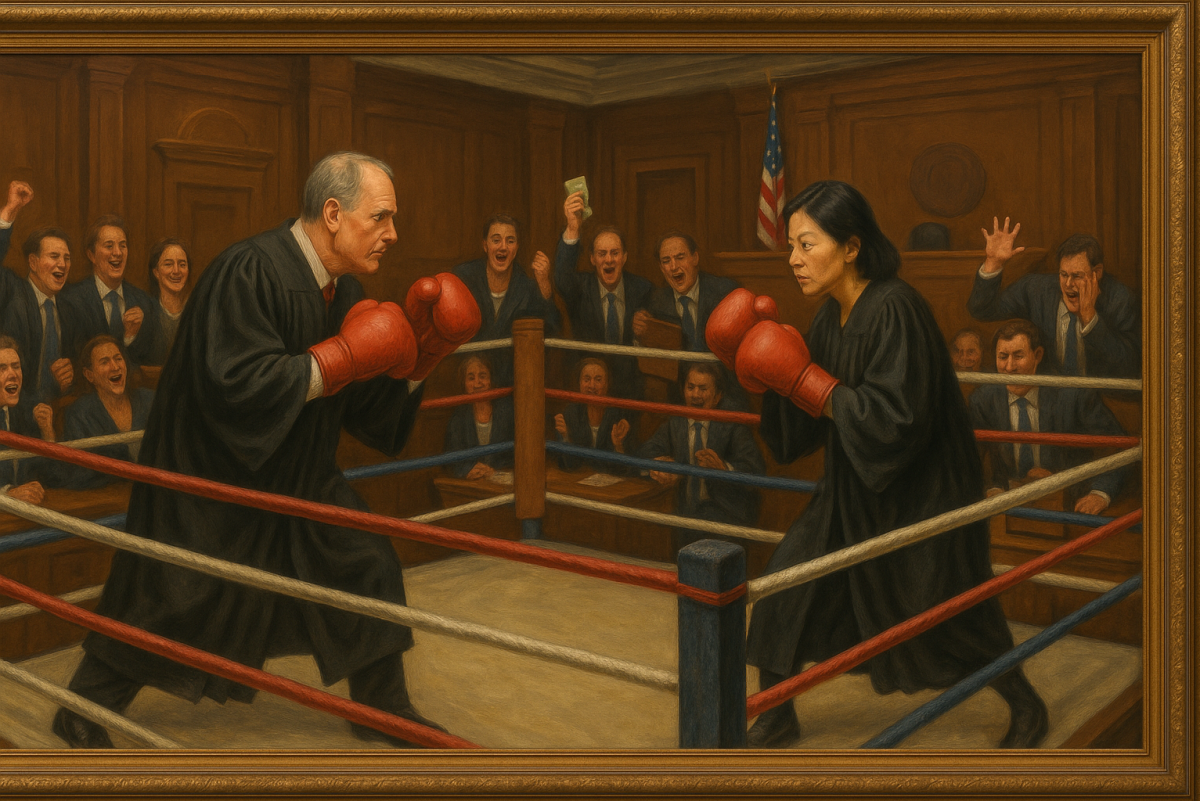
I do have one pearl of wisdom to offer now though. When I was a young lawyer, the older partner that I worked with would sometimes describe a witness by saying: “He doesn’t want to answer a question. He wants to make a speech.” I find that this quote works well in many contexts. Sometimes it’s a person in a meeting. Sometimes it’s a politician. Sometimes it’s a federal judge writing an opinion. Feel free to add your own examples.

Posted by Gerard Magliocca on April 11, 2023 at 02:25 PM

BILETA Amsterdam/Tilburg this week

Any of our readers in the Netherlands? and even if not — this event is hybrid:

38th Annual BILETA CONFERENCE Cyberlaw: Finally getting its Act(s) together?

HYBRID: Vrije Universiteit Amsterdam (Amsterdam Law and Technology Institute) and Online

Thursday 13th APRIL – Friday 14th APRIL 2023 (The AGM and informal dinner on Wednesday 12 April, end of the afternoon)

BILETA Directions – Online instructions are sent by e-mail

Final Program

See an overview of accepted abstracts. (Call for abstracts, obsolete) (BILETA prizes, obsolete)

And a day earlier on the 12th, Tilburg University is holding an event for The Equality Machine. Also it is super rainy here in Holland, and if you have recommendations on what to do in the rain besides museums and brewery tours, please send them over!

Posted by Orly Lobel on April 10, 2023 at 12:01 PM

Comments

In my opinion, this is a piece full of useful information that demonstrates a high level of knowledge.

Posted by: slope | Dec 1, 2023 4:32:28 AM

Lading Logistics manages the movement and storage of goods, services, and information within supply chains. We handle all or some of the logistics to meet client needs.

Posted by: lading logistics | Apr 21, 2023 12:35:29 AM

Bill to Strengthen California’s NonCompete Ban

California has had a longstanding policy against noncompetes and other restraints on pursuing one’s profession (or another way I prefer to describe it – a longstanding policy to allow talent to be free and flowing and to support labor market competition). And yet, the research pervasively shows that even in California many employees are asked to sign noncompetes. A new bill I helped draft creates an enforcement mechanism when employers unlawfully insert clauses into contracts that are void under California’s 16600. The bill also clarifies/codifies the caselaw, as the California courts have long held, that employees have the right to compete in California even if they had signed in the past a noncompete outside of the state. A group of law professors from various fields: IP, contracts, employment and labor law, antitrust law are joining together to send a letter to the California legislature in support of the bill – hearing is set for tomorrow.

If you are interested in joining the letter, email me for more details [email protected]. [and also if you are interested in joining a comment to the FTC in support of the proposed rule to nationally ban noncompetes, email me on that too, but less time-sensitive].

Posted by Orly Lobel on April 10, 2023 at 11:57 AM

Comments

Thank you so much for bringing this article to my attention since I think it is just incredible. It is precisely what I had been looking forward to finding, and I genuinely hope that you will continue to contribute content of such high quality in the years to come.

Posted by: quordle game | Dec 28, 2023 3:16:58 AM

The bill also clarifies/codifies the caselaw, as the California courts have long held, that employees have the right to compete in California even if they had signed in the past a noncompete outside of the state.

Posted by: snow rider 3d | Nov 12, 2023 9:35:48 PM

So, in accordance with the terms of this Act, is a non-disclosure of trade secret information agreement that forbids its use and provides for injunctive remedies a non-compete agreement? It serves that goal. Its purpose is to stop someone from stealing intellectual property and opening a business to compete with the property’s owner. That is one of the UTSA’s goals. This phrasing strikes me as being overly general and ambiguous. I do concur with the inclusion of the clause stating that a non-compete is void in California even if it is legal elsewhere. However, I see pointless legal disputes sparked by trade secret bounties and expenses.

Posted by: geometry dash | Apr 12, 2023 11:39:58 PM

So, under this act’s language is a non-dislcosure of trade secret information agreement, which includes a prohibition of its use including injunctive relief, a non-compete agreement? That is its purpose. It is to prevent someone from misappropriating intellectual property and setting up shop to compete with the owner of the property. That is a purpose of the UTSA. It seems to me that this language is too broad and vague. I do agree with including the language that a non-compete is void in California even if it is permissible in another jurisdiction. But, I foresee needless litigation spurred by bounties and fees in the trade secret area.

Posted by: John L Romaker | Apr 10, 2023 8:11:02 PM

Should Joe Biden Run in 2024? [UPDATED]

It seems generally understood that Although not yet an official announcement, Pres. Biden said today that he plans to run for re-election in 2024, and the nomination is certainly his if he wants it. I think Biden has been a fine president, and I will enthusiastically vote for him if he runs, with the expectation that he will defeat former Pres. Trump or any other Republican. The great unknowable, of course, is whether he may suffer an adverse health event during the campaign, which might influence voters to prefer a younger, more energetic candidate (if the Republicans nominate such a person). The risk cannot be waved away, so I looked at some numbers.

The mortality rate for Americans 75-84 is roughly 5% per year, reaching over 15% for those 85 and over. Biden is currently 80. He would be 82 on inauguration day in 2025, and 86 at the end of his second term. Median life expectancy at 80 for an American male is 7 years, meaning that half die below the median age (though those with excellent medical care of course tend to live longer).

That is just mortality. The likelihood of a disabling illness or event is greater, although I cannot find statistics for disability after age 65 (which is when disability insurance coverage ends) when it appears to be 30%.

The following presidents were older than 65 at inauguration: William Henry Harrison (68); James Buchanan (65); Ronald Reagan (73); Donald Trump (70); Joe Biden (78). Of these, only Harrison died in office.

Here are the ages of the presidents who died in office, other than by assassination: William Henry Harrison (68); Zachary Taylor (65); Warren Harding (57); FDR (63).

At least two presidents also had debilitating health incidents in office, though they were largely concealed at the time, with ages at their most recent inauguration: Woodrow Wilson (60 at second inauguration; stroke at 62); Dwight Eisenhower (62 at first inauguration; heart attack at 64; reelected at 66).

Posted by Steve Lubet on April 10, 2023 at 08:09 AM

Preemption Procedure: A Comment on the Shugerman-Kovarsky Debate in People v. Trump

Is People v. Donald J. Trump, No. 71543-23 (N.Y. Co. Sup. Ct.) preempted? This question has generated much debate, but is unlikely derail the ongoing state prosecution, at least procedurally.

The defendant is charged with 34 counts of falsifying business records. The offense is raised to the level of a felony, the indictment charges, because the “intent to defraud includes an intent to commit another crime or to aid or conceal the commission thereof.” The issue is that underlying facts may involve a federal election offense. Prof. Jed Shugerman has pointed out that the federal election law has an express preemption provision, and New York State election law has a separate provision acknowledging the primacy of federal law. Accordingly, there is a potential preemption problem which, according to Prof. Shugerman, might mean that “the case is headed to federal court for a year.” Prof. Lee Kovarsky responded with a persuasive argument that states can sometimes use even preempted federal offenses for their own purposes. No one questions, for example, that a New York attorney convicted of an offense within exclusive federal jurisdiction could nevertheless be disbarred. Prof. Kovarsky writes: “To my knowledge, in no case has a court even suggested that a federal crime can’t be an element of a different state offense just because the federal crime falls within the scope of preemptive federal authority.” This seems a hard question. If I were in the NY Co. DA’s Office, I would strive mightily to elide it and find safe, state crime.

Nevertheless, whatever the ultimate merits, I do not see how the defendant gets an injunction. True, earlier proceedings related to this very matter, namely, a New York grand jury subpoena, were subject to a prolonged stay as the Supreme Court considered the case. On the merits, the Court ultimately allowed the subpoena. Critically, the stay was based on a circumstance no longer present: Trump was then President. The Court explained: “The Supremacy Clause prohibits state judges and prosecutors from interfering with a President’s official duties. . . . federal law allows a President to challenge any allegedly unconstitutional influence in a federal forum, as the President has done here.” Trump v. Vance, 140 S. Ct. 2412, 2428–29 (2020). Vance is not precedent for an injunction to protect a private citizen. There was also the stay of enforcement of a House of Representatives subpoena. But there, the question was not preemption, but “whether the subpoenas exceed the authority of the House under the Constitution.” Trump v. Mazars USA, LLP, 140 S. Ct. 2019, 2029 (2020).

Instead, the case now seemingly presents an ordinary claim of preemption in a state prosecution of a private citizen. In that context, 28 U.S.C. § 2283 provides: “A court of the United States may not grant an injunction to stay proceedings in a State court except as expressly authorized by Act of Congress, or where necessary in aid of its jurisdiction, or to protect or effectuate its judgments.”

The possibility that a state prosecution is preempted, standing alone, is not a ticket to federal court:

[A] federal court does not have inherent power to ignore the limitations of § 2283 and to enjoin state court proceedings merely because those proceedings interfere with a protected federal right or invade an area pre-empted by federal law, even when the interference is unmistakably clear. Rather, when a state proceeding presents a federal issue, even a preemption issue, the proper course is to seek resolution of that issue by the state court.

Bess v. Spitzer, 459 F. Supp. 2d 191, 201–02 (E.D.N.Y. 2006), as amended (Jan. 30, 2007) (quoting Chick Kam Choo v. Exxon Corp., 486 U.S. 140, 149–50 (1988)).

Another judicially recognized exception exists where the defendant proves that a prosecution was “brought in bad faith or is only one of a series of repeated prosecutions,” or that there is otherwise “irreparable injury, above and beyond that associated with the defense of a single prosecution brought in good faith.” Schlagler v. Phillips, 166 F.3d 439, 442 (2d Cir. 1999) (citations omitted). See also Jordan v. Bailey, 570 F. App’x 42, 44 (2d Cir. 2014). “Bad faith” in in this context means “without hope of obtaining a valid conviction.” Perez v. Ledesma, 401 U.S. 82, 85 (1971).

No exception seems to exist. There appears to be no act of Congress providing for federal judicial intervention, and no past or present litigation of these facts for a federal court to protect. Although there is debate about what is required to convict of the offense of falsifying business records, and even more mystery about what the People plan to prove, there is no indication that the prosecution has no chance of success, or is the latest in a series of failed, harassing prosecutions. Accordingly, any preemption issue should be addressed “by the state court.” State rulings would be “subject, of course, to review by . . . [the Supreme] Court or, in a proper case, on federal habeas corpus.” 401 U.S. at 85.

One circumstance which neither constitutes bad faith nor tends to support a separate defense is the selective prosecution argument which may be in the offing. Federal constitutional law precedents allow selection of prominent individuals for prosecution. As Wesley Snipes learned to his dismay in a tax case, “[s]ince the government lacks the means to investigate and prosecute every suspected violation of the tax laws, it makes good sense to prosecute those who will receive, or are likely to receive, the attention of the media.” United States v. Snipes, No. 5:06-CR-22-OC-10GRJ, 2007 WL 2572198, at *3 (M.D. Fla. Sept. 5, 2007) (quoting United States v. Catlett, 584 F.2d 864, 868 (8th Cir.1978)). See also United States v. Edenfield, 995 F.2d 197, 200 (11th Cir. 1993) (“For law enforcement officers to choose to investigate prominent offenders is nothing unusual or evil.”)

The limited New York authority on prosecuting celebrities I could find is to the same effect: “assuming the decision to prosecute was based on the fact that the defendants were prominent and newsworthy, this is also not an impermissible basis for selection . . . Publication of the proceedings may enhance the deterrent effect of the prosecution and maintain public faith in the precept that [others] are not above the law.” People v. DiLorenzo, 153 Misc. 2d 1021, 1029–30, 585 N.Y.S.2d 670, 675 (Crim. Ct. Bx. Co.1992) (citing People v. Barnwell, 143 Misc.2d 922, 541 N.Y.S.2d 664 (Crim. Ct. N.Y. Co. 1989)). There is also one lower court case more or less endorsing the the proposition that it is permissible to target individuals for enforcement because they are suspected of other crimes. See People v. Mantel, 88 Misc. 2d 439, 443, 388 N.Y.S.2d 565, 569 (Crim. Ct. N.Y. Co. 1976) (citing United States v. Sacco, 428 F.2d 264, 271 (9th Cir. 1970) (“selection of this defendant for intensive investigation was based on his suspected role in organized crime”) Stuart Green has written thoughtfully about whether prosecuting celebrities and the prominent is consistent with criminal law principles, but the doctrine seems to allow it. Stuart P. Green, Uncovering the Cover-Up Crimes, 42 Am. Crim. L. Rev. 9, 42 (2005).

If the defendant could show that other, similarly-situated offenders who were members of different political parties were not prosecuted by the same office, then that would raise a substantial issue. United States v. Hastings, 126 F.3d 310, 313 (4th Cir. 1997) (citing, inter alia, United States v. Berrios, 501 F.2d 1207, 1211 (2d Cir.1974)). But such claims have historically proved difficult to establish. United States v. Lazzaro, No. 21-CR-0173 (PJS/DTS), 2022 WL 16948157 (D. Minn. Nov. 15, 2022); United States v. Woods, 319 F. Supp. 3d 1124, 1141 (W.D. Ark. 2018), aff’d sub nom. United States v. Paris, 954 F.3d 1069 (8th Cir. 2020), and aff’d, 978 F.3d 554 (8th Cir. 2020); United States v. Young, 231 F. Supp. 3d 33, 43 (M.D. La. 2017); United States v. Cameron, 658 F. Supp. 2d 241, 243 (D. Me. 2009).

Posted by Jack Chin on April 9, 2023 at 09:53 PM

Comments

There appears to be no act of Congress providing for federal judicial intervention, and no past or present litigation of these facts for a federal court to protect.

Posted by: drift boss | Nov 8, 2023 10:45:58 PM

I am genuinely thankful to the holder of this web page who has shared this wonderful paragraph at at this place

Posted by: tunnel rush | Jul 6, 2023 3:16:36 AM

Crowd-Litigating The People v. Donald J. Trump (N.Y. Sup. Ct.)

Correct me if I am wrong. But it appears that People v. Donald J. Trump, No. 71543-23 (N.Y. Co. Sup. Ct), will be the first major case in U.S. legal history to be crowd-litigated. Interventions of law professors and litigators with something to say are not coming on appeal. Instead amicus briefs are being filed now, complete with citation to cases and statutes, and factual analysis, on Twitter, blogs, and op-eds. Major examples are the series on JustSecurity, Prof. Lee Kovarsky’s Lawfare post on preemption, and Prof. Jed Shugerman’s New York Times oped to which Prof. Kovarsky is responding. Eric Columbus maintains an indispensable running list on Twitter. It is reasonably apparent that these writings are not only intended to educate the public, but to communicate with the prosecutors and defense attorneys involved in the case. This is entirely appropriate; if the prosecution is defective, it should end promptly; if it is righteous, the best case for it should be made.

This is a case where, as it happens, there is no shortage of genuine expertise. Defender organizations and prosecutor’s offices who work in the state courts in New York are unusually productive of legal scholars. A quick Google search shows that among many others, alumni of the Criminal Defense Division or Criminal Appeals Bureau of Legal Aid Society of New York include Barry Scheck, Sheri Lynn Johnson, and JaneAnne Murray; veterans of the New York County DA’s Office include Deborah Tuerkheimer, Jeannie Suk Gersen, and Sandra Guerra Thompson. Alan Michaels seems to have been a prosecutor in a now-important New York County decision invlolving the statute at issue in the prosecution.

While none of the above are necessarily following the Trump case, for this crowd litigation to occur, it is necessary for there to be a body of lawyers who are expert in New York practice. Although the criminal laws of no two states are identical, New York law is unusually distinctive. Unlike many states, it does not model its laws on the Federal Rules of Evidence or Criminal Procedure, but instead has its own complicated amalgam of evidence and criminal procedure statutes and rules, along, of course, with caselaw. The New York Penal Law is an early version of the Model Penal Code, but, to keep things interesting, New York courts regularly find dispositive cases decided under the repealed and supplanted codes. Without a background in New York criminal practice, general smartness or criminal law experience elsewhere may well be unhelpful—inaccurate–in commenting on a New York prosecution, unless it is preceded by full research.

I suspect this continuous workshopping of the case will primarily aid the defense. The prosecution had years to prepare the case, and if they did not think hard about the potential roadblocks and defenses, then their reputations will justifiably be marred. For that reason, given their resources, I assume the case was carefully prepared and war-gamed. The lead defense attorney, Todd Blanche, is richly experienced, but his website suggests he is now a sole practitioner after years of working with large firms and the U.S. Attorney’s Office in the Southern District of New York. The scrum of lawyers seen at counsel table at the arraignment may be more in the vein of too-many-cooks rather than a coordinated team.

As a game-theoretic question, I assume the actual prosecutors and defenders will at least glance at these materials. Conceivably, every lawyer or professor comment will be something already spotted and evaluated. But it would be embarrassing to be surprised, or to lose, on a point which had already been addressed and discussed in the legal community.

Posted by Jack Chin on April 9, 2023 at 06:53 PM

Comments

Joe, There have undoubtedly been many talking heads on numerous situations. And there are a ton of generalizations, assumptions, and ideas in those situations. But I can’t think of any instances when high-level academics and practitioners conducted in-depth statutory and caselaw study and blogged about it in such detail. There may be some. The significance of the case is another aspect of it, at least for me.

Posted by: drift boss | Apr 12, 2023 11:42:34 PM

Joe, There have been lots of talking heads on lots of cases, to be sure. And lots of broad arguments, predictions and thoughts in those cases. But I do not recall any cases with the level of Tweeted and blogged statutory and caselaw research and focused analysis by high-level scholars and practitioners. Maybe there are some. Another part of it for me anyway is the importance of the case.

El Roam, good point on the unknown nature of the facts. But, just as the defense has to gear up based on what they know now, there is enough out there to make some broad assumptions about the factual claims, and therefore the potential legal issues. To be sure, there remains a substantial degree of speculation.

Jack

Jack

Posted by: Jack Chin | Apr 9, 2023 10:11:11 PM

We are talking “major” here indeed.

But, is this really the first time something like this happened?

We had blogs, Twitter, etc. for a long time. There were other big cases.

Posted by: Joe | Apr 9, 2023 9:35:30 PM

Bit funny, I must admit.

But, the point is, that although there is indeed bunch of commentators writing over and over on it and trying to predict the chances of success here in that prosecution, the simple fact is, that we still don’t really know, what is all about (ironically).

Well drafted or phrased by that article in Lawfare (written by Lee Kovarsky, and linked in the post) and I quote:

“…..commentators should be more willing to acknowledge that much of the prosecution’s theory remains unknown. And, crucially, it is unknown not because the case is necessarily weak, but because New York law blesses the prosecution with the strategic advantage of withholding the information. Just ask Manhattan lawyers who do this type of litigation regularly. They seem to be saying that there’s nothing particularly unusual about the indictment—other than the defendant.

Briefly, we still don’t know, what is the dominant legal theory or doctrine, on which, the indictment is founded or based in fact. Not really. The rest, is yet mere speculation.

Thanks

Posted by: El roam | Apr 9, 2023 8:34:15 PM

Saturday Music Post – You’ve Been a Good Old Wagon

“You’ve Been a Good Old Wagon (Daddy but You’ve Done Broke Down)” is a classic Bessie Smith blues number, recorded in 1925, introduced to many in the 1960s (including me) by Dave Van Ronk. It turns out, though, that the song was first a ragtime tune, composed by Ben Harney in the 1890s. Harney misleadingly boasted that he was” the father of ragtime,” but it does seem that “You’ve Been a Good Old Wagon” may have been the first published ragtime sheet music.

The Faculty Lounge clips are here.

Posted by Steve Lubet on April 8, 2023 at 05:51 AM

Pico as Derelict

Dissenting, in Lambert v. California (1957), Justice Frankfurter predicted that the 5-4 ruling would “turn out to be . . . a derelict on the waters of the law.” Whatever the merits of Justice Frankfurter’s prediction, I was reminded of it by Howard’s recent post about a federal district court order in Texas that invoked Pico to require (quoting the post) “Llano County to return twelve books to the public library shelves and enjoined further book removals.”

Let’s put aside debates about the Marks rule, or about the semantic content of the Pico opinions by Justices White and Blackmun, or about the wisdom of the Llano County removal decision, or about the tiresome-ness of newspaper reports that refer to the removed books as “banned.” It seems to me that Pico is the among the most derelict-ish rulings of my lifetime. (Lopez and Morrison, bless their hearts, might be the most, but put them aside, too!)

The federal court in Texas invoked, from a Fifth Circuit case quoting the Pico plurality, a “First Amendment right to receive information” which prevents libraries from “remov[ing] books from school library shelves ‘simply because they dislike the ideas contained in these books.’” But . . . there is no general “First Amendment right to receive information” and libraries are entirely free to roam through their collections and ditch stuff they have decided isn’t worth keeping. If a local librarian in Llano County were to decide (correctly) that Ayn Rand’s novels are not only badly written, but pernicious, there is no constitutional prohibition on tossing them all to make room for more Piketty. (Yes, I realize that the preceding two sentences are inconsistent with, well, Pico.)

Whatever rule or principle the Brennan opinion in Pico might be applying — besides “this seems hinky” — has not been consistently applied (if it has been applied at all) to “government decisions about what it does with its stuff.” No one really thinkgs that federal courts are authorized by the First Amendment to review the shelf-culling decisions of 2023 librarians regarding the shelf-stocking decisions of their 1953 predecessors. If the “Pico principle” were taken seriously, I suppose the government would be obligated — not merely in a nondiscrimination, Carson-type sense, but in a positive, obligatory sense — to fund parents’ decisions to send their kids to parochial schools. [Ed.: Sounds good, Rick. What’s your point?]

Posted by Rick Garnett on April 6, 2023 at 06:44 PM

Pico and public libraries

Judge Pitman (W.D. Tex.) ordered Llano County to return twelve books to the public library shelves and enjoined further book removals. The court said Pico applies with greater force to public school libraries, because schools receive uniquely great deference and public libraries are “designed for freewheeling inquiry.” The county has appealed.

During law school, I interned at the American Library Association’s Office of Intellectual Freedom. One of my tasks was drafting letters to library boards about limits on the power to remove stuff from the library because of disagreement with content (back then, we worried about internet filters). The letter was usually enough and we never litigated these cases. We are in new times.

Posted by Howard Wasserman on April 5, 2023 at 09:31 AM

SCOTUS Gift Disclosures

If you are looking for a break from indictment and election news, you may be interested in my essay on the new gift disclosure rules for the Supreme Court, and why the justices may not comply with them.

Here is the gist:

The Hill

Will the Supreme Court justices comply with new rules on gift disclosure?

By Steven Lubet, Opinion Contributor – 4/05/23

Sen. Sheldon Whitehouse (D-RI) recently claimed a small victory, when, as he put it, the Judicial Conference of the United States “adopted new, stricter rules requiring far more disclosure of free trips, meals, and other ‘hospitality’ accepted by federal judges and Supreme Court justices.”

Under the old Judicial Conference rule, “judicial officers” were required to report the receipt of gifts worth over $415, with a broad exception for “personal hospitality.” The term “personal” had apparently been interpreted to mean something like “extended by an individual” rather than by a business or corporation, thus allowing the undisclosed acceptance of resort vacations and private jet travel, so long as the invitations were made by acquaintances, even if some other entity was underwriting the expense.

Whitehouse may have spoken too soon.

Chief Justice John Roberts has made it clear that the justices are jealous of their individual prerogatives and do not feel bound by outside constraints.

In his 2011 Year-End Report on the Federal Judiciary, Roberts denied the authority of the Judicial Conference, stating that its “committees have no mandate to prescribe rules or standards” for the Supreme Court.

There is no record, of course, of privately funded travel or vacations that the justices have withheld under a loose interpretation of the “personal hospitality” exemption.

Whitehouse deserves congratulations for prompting the new gift rule, but he has much work ahead of him. The Supreme Court needs its own ethical code, with no hedging or reservations, and the sooner the better.

You can read the full essay at The Hill.

Posted by Steve Lubet on April 5, 2023 at 08:40 AM

At Least He Didn’t Claim It Was Rigged

In Wisconsin, Milwaukee County judge Janet Protasiewicz defeated former Supreme Court Justice Dan Kelly for an open seat on the state supreme court. It was the second double-digit defeat in two years for Kelly, who was appointed to the court by former governor Scott Walker, as he lost to now-justice Jill Karofsky in 2020. He has not taken it well.

As reported by the Milwaukee Journal-Sentinel:

After the race was called for Protasiewicz, Kelly refused to call his opponent to concede the race, saying he respected the voters’ decision but not her.

“I wish in a circumstance like this I would be able to concede to a worthy opponent. But I do not have a worthy opponent to which I can concede,” Kelly told supporters at a campaign event in Green Lake, calling Protasiewicz a “serial liar.” “I wish Wisconsin the best of luck, because I think it’s going to need it.”

He called Protasiewicz’s campaign “dishonorable and despicable,” and said he was concerned for the future of the state.

“She’s demeaned the judiciary with her behavior,” he said, referring to Protasiewicz’s partisan appeals to voters on the issues of abortion and redistricting. “This is the future we have to look forward to in Wisconsin.”

The Wisconsin Supreme Court will now have a 4-3 liberal majority for the first time in 15 years. Issues facing the court include abortion and partisan gerrymandering.

The Journal-Sentinel story is here.

Posted by Steve Lubet on April 5, 2023 at 06:38 AM