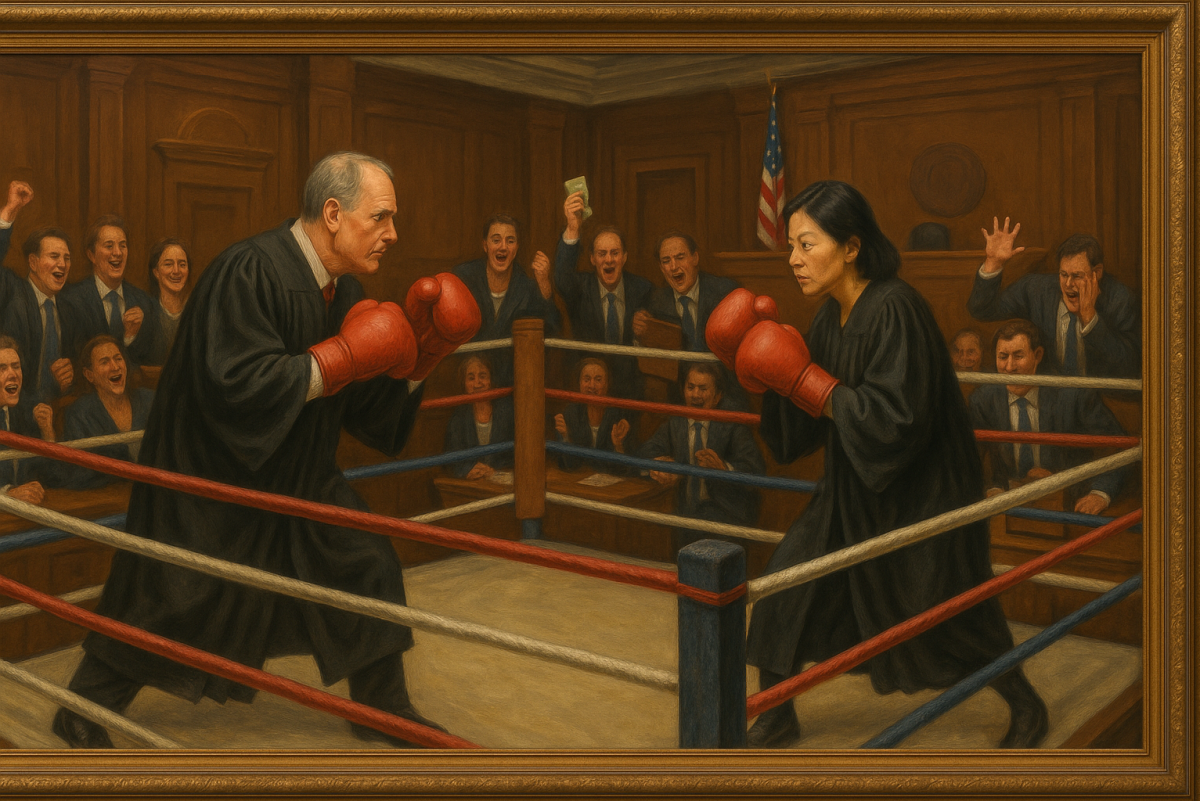
Biblical References in Constitutional or Political Argument

Justice Jackson’s Youngstown concurrence refers to Pharaoh’s dreams that Joseph was asked to interpret. There was no citation. Abraham Lincoln’s Second Inaugural quoted the King James Bible. John Bingham said that the Equal Protection Clause embodied the Golden Rule. Martin Luther King, Jr. often quoted Scripture, including in the “I Have a Dream Speech.”

Today you wonder if such references (outside of a case that involves religious expression or conduct) would be acceptable. First, would people even understand those references? The speakers or writers that I just listed could safely assume that the audience would know a Biblical quote or idea. It’s harder to make that assumption now. Second, would people think that such expressions have a place in legal reasoning on secular topics? Not everyone would agree on that, of course. But it’s hard to imagine a President delivering a speech like Lincoln’s Second Inaugural today.

Posted by Gerard Magliocca on August 31, 2023 at 01:44 PM

Judicial departmentalism in Tennessee (Updated)

In June, a judge in the Western District of Tennessee declared the state’s drag-show ban constitutionally invalid and enjoined the Shelby County D.A. from enforcing the law. The D.A. of Blount County, located in the Eastern District of Tennessee, announced intent to enforce the law there with the help of police, including against the organizers and hosts of an upcoming pride event. Organizers of the upcoming event and a drag performer sued local officials and the state A.G. Chris Geidner and FIRE are dismissive of and outraged by the actions of the Blount County officials.

Update: A judge in the Eastern District issued a TRO that includes prohibiting defendants from interfering with Blount Pride Fest, scheduled for Saturday. More below.

Let’s break this out.

On the surface, this is an easy case, without full-bore judicial departmentalism. The W.D. Ky. order “ENJOINS District Attorney Steven J. Mulroy from enforcing the AEA within his jurisdiction in SHELBY COUNTY, TENNESSEE.” The Blount County prosecutor was not a party to that case and not bound by the injunction. Nor should he be bound by the declaratory judgment, which declares the rights of “the parties.” Accepting that non-judicial actors must adhere to judicial precedent (i.e., rejecting departmentalism in favor of judicial supremacy), district court opinions do not establish binding precedent, within the district and certainly not outside the district. The district court’s declared the law invalid in general. But the law of precedent dictates the effect of its declaration beyond the parties; the law of precedent says district court decisions are persuasive on other courts. There is no good argument that a district court opinion should have greater effect on executive officials than on other courts. And in a judicial-departmentalist world (where judicial precedent does not bind non-judicial actors), the fact that the precedent comes from an out-of-district trial court means the Blount County DA does not even face the guaranteed judicial loss (and attorney’s fees) as if he pursued new enforcement in the face of binding judicial precedent.

On the surface, things are proceeding as they should. One group of rights-holders successfully sued to stop enforcement by one official against them; a second executive official pursued enforcement against a second group of rights-holders; the second group of rights-holders sues the second executive and raises the same (strong) constitutional arguments, including pointing to the prior district court opinion as persuasive authority; and we see what happens. My guess is they would get a TRO or preliminary injunction allowing this weekend’s event to occur, have the law declared invalid (because First Amendment law is clear, even without the prior district court opinion on this law), and recover attorney’s fees.

Here is where the case gets complex. Blount Pride, the plaintiffs in the second action, argue (¶¶ 85-90 in the Complaint) that the Blount County DA and all state executive officials are bound by the prior DJ. They argue that county DA’s act as the state in enforcing state laws, thus the DJ against the Shelby County DA binds all state officials who enforce this law on behalf of the state–the AG (who litigated the first case, although not named as a party) and every county DA. Although they do not specify, I think they are using this for a preclusion argument.

But the scope-of-judgment problem is not about the defendants bound in the first case–it is about the plaintiffs protected in the second case. The first action declared the rights of and protected that plaintiff, Friends of Georges. Although the injunction used typically sloppy language, we know that DJ’s declare the rights of “the parties” and injunctions should extend no further than necessary to protect the plaintiff–again, so long the plaintiff (and its members*) are protected, the injunction goes no further. The plaintiffs thus argue that the prior DJ as to Friends of George dictates to every official who enforces the anti-drag law that it is constitutionally invalid and cannot be enforced against Blount Pride.

[*] See also Michael Morley and Andrew Hessick’s forthcoming piece arguing against associational standing.

This argument fails on three points:

1) If Blount Pride believes it is protected by the existing WD Tenn. judgment, its move should be to return to that court for further relief where the DJ has been ignored. My guess is Blount Pride knows its rights had not been declared.

2) Given # 1, this lawsuit attempts to use non-mutual preclusion–a new plaintiff, not party to the prior case, using preclusion against a prior party. But governments (and government officials sued in their official capacities) are not subject to non-mutual preclusion.

3) The preclusion argument ignores Doran–“[N]either declaratory nor injunctive relief can directly interfere with enforcement of contested statutes or ordinances except with respect to the particular federal plaintiffs, and the State is free to prosecute others who may violate the statute.” That is this case. The prior DJ and injunction stops enforcement of the anti-drag law “with respect to” Friends of George and its members; it cannot directly interfere with enforcement of the anti-drag law against anyone else, such as Blount Pride. Even if every DA and the AG were parties to the first case, that judgment has no direct effect on the efforts to enforce the law against new individuals.

Michael Dorf wrote a post considering what it means to say § 3 is self-executing:

However–and this is an obvious but crucial point–that does not mean that it is literally self-executing. State and local election officials who attempt to place Donald Trump’s name on a primary or general election ballot will not find their hands stayed by a mysterious force field or a lightning bolt.

Section 3 is self-executing in the way that other self-executing provisions of law are, not in the way that laws of nature are. To say that Section 3 is self-executing is to say only that government officials can and indeed must give it effect even absent implementing legislation.

I would add that effect will be given when disputes–likely multiple disputes–over attempted application reach court for the court to resolve.

We can say the same about the First Amendment. No mysterious force field or lightning bolt stops the Blount County DA from attempting to enforce the anti-drag law, even if the First Amendment protects drag performance. When the DA and a drag performer dispute whether the law is valid, the case must move to court to resolve that particular dispute. That is what happened when Friends of George disputed with the Shelby County DA. It now happens separately when Blount Pride disputes with the Blount County DA.

Again, things in Tennessee are playing as they should within the judiciary–certainly if you are a judicial departmentalist and even if you are a judicial supremacist. Adjudicating constitutional rights requires litigation. That process is long and cumbersome and not as clean as the First Amendment “protects your right to dress and perform in drag” and “First Amendment protections apply everywhere.” But it gets where we are supposed to be.

Update: Two words on the new TRO. First, as always, the court overdid the order, prohibiting defendants from “enforcing, detaining, arresting, or seeking warrants or taking any other action to enforce or threaten to enforce T.C.A. § 7-51-1407 pending further order of this Court,” without limitation to the plaintiffs (the festival organizers and one drag performer). This is not a class action and such breadth is not necessary to protect these plaintiffs.* Second, the court in no way believed that the prior district court opinion controlled. The court called the opinion “well-written, scrupulously researched, and highly persuasive,” “well-reasoned,” providing “an adequate basis for [a] decision,” and reflected the analysis “the Court is likely to adopt” in this case. But–contrary to plaintiffs’ arguments and shouts from FIRE, Geidner, and others–defendants’ enforcement threats did not violate or ignore that order, nor did defendants do anything a priori wrong in threatening enforcement.

[*] A few years ago, I spoke (with Suzette Malveaux) to the National Association of Attorneys General about universal injunctions. A point I thought of, but did not get a chance to make, is that they, among all litigants, should be circumspect on this. While they may love universality when suing the federal government, universality could and would come back to bite them as defendants in challenges to state law. That point, unmade, stands.

Posted by Howard Wasserman on August 31, 2023 at 10:44 AM

An Apt and Half-True Statement

In one of those rare instances in which the letters section of the New York Review of Books generates light and not just heat, this letters exchange concerning naming and unnaming at universities (which features an ingenious and suspiciously convenient mechanism for preserving Stanford University’s name while renaming its constituent parts) offers a lovely quote about the purpose of the university: “The perennial chance to rethink things embodied by the next generation is, after all, the crucial feature of universities.”

Nice. But surely and rather precisely incomplete. The perennial duty to understand and pass along things embodied by past generations is an equally crucial feature of universities, is it not? Especially, but far from exclusively, in their teaching role?

It strikes me as both common and deeply unfortunate that in discussing universities and their role, and scholarship and its role, half the politically engaged commentariat tends to overemphasize the first feature, and the other half tends to overemphasize the second. (Within the legal academy and most of the rest of the academy, surely the overemphasis on the first is even more lopsided.)

Posted by Paul Horwitz on August 31, 2023 at 08:55 AM

More merits and standing overlaps

The Third Circuit rejected a First Amendment challenge to Pennsylvania’s anti-discrimination/anti-harassment PR rule (ABA Model Rule 8.4(g)), concluding that the lawyer plaintiff (Zachary Greenberg) lacked standing. Given the definitions of harassment and discrimination, the plaintiff’s planned speech (teaching CLE classes in which he would oppose hate-speech bans, repeat racist epithets in discussing cases, support due process protections for people accused of sexual misconduct, and support the right to express intolerant racist views) did not violate the rule and did not face a credible threat of enforcement.

This strikes me as good illustration of standing constitutionalizing an obvious merits issue. The plaintiff did not suffer an injury because his planned speech did not violate the rule and thus he did not risk liability for it. But that is the same as saying the rule does not violate his First Amendment rights by imposing liability on him for his protected speech. In fact, that is how the First Amendment would be raised and adjudicated in an enforcement action–the state initiates disciplinary proceedings against Greenberg; Greenberg defends by arguing that his speech does not constitute harassment or discrimination or that if it does, the statute is constitutionally invalid because his speech is protected by the First Amendment; and the disciplinary proceeding fails on the merits (either before the Bar or before the Pennsylvania Supreme Court).

If that analysis goes to the merits in an enforcement action, it should go to the merits (and not jurisdiction) in a pre-enforcement action. A pre-enforcement action allows a rights-holder to determine her substantive rights without having to violate the law and risk sanction. That pre-enforcement action should mirror the enforcement action. If jurisdiction is not an issue in one, it should not be in the other. The counter might that the question of the scope of the law and whether it reaches speech (the first defense in an enforcement proceeding, independent of the constitutionally protected nature of the speech) is a question of state law and that the federal court lacks jurisdiction to address state law. But courts do not fine-grain the standing analysis in that way.

Greenberg tried to argue that he would alter his speech based “on his perception of the social climate, which he sees as infested by ‘[w]idespread illiberal impulses for ‘safetyism,’”” citing studies of public distaste for offensive speech. But the court refused to find injury, traceable to the rule, from Greenberg’s discomfort in speaking freely or in losing professional reputation, job opportunities, and speaking opportunities. This is important. The PR rules should not sanction lawyers for protected-but-obnoxious speech. The First Amendment should have nothing to say about social consequences for being publicly obnoxious.

Posted by Howard Wasserman on August 30, 2023 at 12:23 PM

The Peer Review Follies

Law professors all know about the problems with law reviews, but peer reviews in other fields have their own problems, one of which is interminable delay and ridiculous amounts of make-work for reviewers.

Because I have published interdisciplinary work in history, sociology, and medical ethics, I am sometimes asked by social science, humanities, and medical journals to peer review submissions. I got one such request from a flagship humanities journal in early autumn 2021. I read the draft and recommended publication, with a few suggestions for making it better, in November 2021. Other than a thank-you note, I heard nothing more from the journal until about a week ago.

On August 21, 2023, I got an email asking me to review a revision of the article. Other reviewers had evidently been less enthusiastic about the article – apparently have recommended a “revise and resubmit,” or R&R – although it seemed to me that 21 months was an exceptionally long time between my report and the requested revision review.

Now, it is possible that the author was responsible for some of the lengthy delay, although it seems more likely that at least one of the other reviewers (there are usually three) was tardy in submitting their report, followed by more delay from the journal editor. But that was the smallest part of the problem.

I was willing to read the revision, but having recommended publication of the original – which of course I hadn’t read for nearly two years – I asked to see the R&R recommendations. Otherwise, it would be impossible for me to assess whether the changes resolved the other reviewers’ reservations.

As I explained in my reply,

I already recommended publication of this article. I cannot review the revisions unless I understand why they were required. Was this an R&R? If so, was there another review besides mine? If so, I will need to see it in order to evaluate the new version. If there was no other review, what am I supposed to be evaluating?

I received this message in response:

We appreciated very much your report on the first submission of this manuscript. At that time, we received a number of reports and, as you surmised, asked the author to revise and resubmit their manuscript. We understand that you already thought it deserved publication from the strength of the first version but would be interested in knowing whether you thought this version remained as strong.

However, we do not distribute the reports of other readers when we ask people to consider whether a revised piece deserves publication. We completely understand if you feel this prevents you from being able to evaluate the revised piece.

The revised article is 42 pages long. The editors evidently wanted me to reaffirm my positive review – which would no doubt take two days or so – without knowing what perceived shortcomings were supposed to be remedied.

And to what end? My original recommendation was evidently insufficient to outweigh the R&R recommendations, so renewing it obviously would not matter if the other reviewers remain unsatisfied. If my evaluation wasn’t good enough then (and I am not saying it should have been), why would it be good enough now?

And that is why I declined the review. It was (1) impossible to do competently without seen the other recommendations, and (2) pointless under the circumstances.

Meanwhile, the author – who might well be an assistant professor who needs the publication for promotion – is stuck waiting over two years for an answer. And they cannot submit it anywhere else until then, because non-law journals do not permit multiple submissions.

Comments are open and will be monitored for relevance and civility.

Posted by Steve Lubet on August 30, 2023 at 06:27 AM

Comments

P.S.

It is important to note:

“Implementation It is unclear whether Section 3 is self-executing, which, if it is not, would leave federal and state courts or election authorities without power to determine the eligibility of candidates unless Congress enacts legislation to permit it.”

Not to mention Due Process Of Law- which I suppose would mean to say Section 3 is self executing is to ignore Section 1 and 5.

https://crsreports.congress.gov/product/pdf/lsb/lsb10569

Posted by: N.D. | Sep 10, 2023 4:43:16 PM

F.Y.I.

Useful information on how to not Folly by following original intent with the understanding that The Spirit Of The Law serves to complement The Letter Of The Law:

“originalism ə-rĭj′ə-nə-lĭz″əm noun The theory that the US Constitution should be interpreted based on the intent of its authors, as determined by examining evidence of their understanding of the meaning of its wording in its historical context. The view that a text should be interpreted according to the intent of its original authors. The belief that the United States Constitution should be interpreted in the way the authors originally intended it.”

https://constitutionalcommentary.lib.umn.edu/article/amnesty-and-section-three-of-the-fourteenth-amendment/

And:

https://legalknowledgebase.com/has-the-14th-amendment-section-3-ever-been-used

Posted by: N.D. | Sep 10, 2023 4:01:23 PM

“whole process

collocation in English MEANINGS of whole and process

a series of actions that you take in order to achieve …”

In closing, “How did American legal education become unmoored from the classical tradition”, which one could argue resulted in many a Folly?

Perhaps it was due to “mereology”, that moment in time when American Legal Education no longer recognized the self-evident Truth that God, The Most Holy And Undivided (Blessed )Trinity ( see Treaty Of Paris that ended The Revolutionary War), Is The Author Of Love, Of Life, And Of Marriage, and thus The Author Of Our Inherent Unalienable Right to Life, to Liberty, and To The Pursuit Of Happiness, the purpose of which can only be what God intended, and began to render onto Caesar what belongs to God, separating our inherent Unalienable Rights from The Author And The True God Who Endows us with our inherent Unalienable Rights from the moment we were created and brought into being, equal in Dignity, while being Complementary as a beloved son or daughter, at conception, and thus we are wholly equal before the Law.

Posted by: N.D. | Sep 9, 2023 4:20:52 PM

Two thoughts about Follies in general or how to avoid Follies in general:

https://plato.stanford.edu/entries/mereology/

When one considers The Fourteenth Amendment one must consider the various sections and how they relate to the whole as in, for example how section 3 relates to section 5, or section 1 relates to both citizens and non citizens in regards to not depriving any person of Life, Liberty, or Property without due process of Law, as every son or daughter of a human person from the moment of conception can only be, in essence, a wholly human person.

“Fourteenth Amendment Explained”

Section 1

“All persons born or naturalized in the United States, and subject to the jurisdiction thereof, are citizens of the United States and of the State wherein they reside. No State shall make or enforce any law which shall abridge the privileges or immunities of citizens of the United States; nor shall any State deprive any person of life, liberty, or property, without due process of law; nor deny to any person within its jurisdiction the equal protection of the laws.”

Section 2

“Representatives shall be apportioned among the several States according to their respective numbers, counting the whole number of persons in each State, excluding Indians not taxed. But when the right to vote at any election for the choice of electors for President and Vice-President of the United States, Representatives in Congress, the Executive and Judicial officers of a State, or the members of the Legislature thereof, is denied to any of the male inhabitants of such State, being twenty-one years of age, and citizens of the United States, or in any way abridged, except for participation in rebellion, or other crime, the basis of representation therein shall be reduced in the proportion which the number of such male citizens shall bear to the whole number of male citizens twenty-one years of age in such State.”

Section 3

“No person shall be a Senator or Representative in Congress, or elector of President and Vice-President, or hold any office, civil or military, under the United States, or under any State, who, having previously taken an oath, as a member of Congress, or as an officer of the United States, or as a member of any State legislature, or as an executive or judicial officer of any State, to support the Constitution of the United States, shall have engaged in insurrection or rebellion against the same, or given aid or comfort to the enemies thereof. But Congress may by a vote of two-thirds of each House, remove such disability.”

Section 4

“The validity of the public debt of the United States, authorized by law, including debts incurred for payment of pensions and bounties for services in suppressing insurrection or rebellion, shall not be questioned. But neither the United States nor any State shall assume or pay any debt or obligation incurred in aid of insurrection or rebellion against the United States, or any claim for the loss or emancipation of any slave; but all such debts, obligations and claims shall be held illegal and void.”

Section 5

“The Congress shall have the power to enforce, by appropriate legislation, the provisions of this article.”

Posted by: N.D. | Sep 8, 2023 11:22:44 AM

Folly is as Folly does ; I wonder how often a Folly is due to sheer intellectual laziness in regards to using one’s critical thinking skills or just a lack of developing those skills due to a lack of practice?

Posted by: N.D. | Sep 1, 2023 11:49:18 AM

The law review peer review system is completely broken. I was recently a reviewer for a law review that purports to have strong peer review and recommended against publication because the empirics were not robust, spending about 3 hours on a review. I never even received a response from the journal and I see now that the article was published.

Many law reviews only give 24-48 hours notice as well which is plainly insufficient. For empirical or indisciplinary articles there needs to be more robust peer review. I cannot tell you how many empirical articles in law review are just plain out wrong – mistakes that a first year grad student in the social sciences or statistics would know. It’s all the more troubling when empirical works in law reviews are cited by courts or newspapers to advance policy agendas. Indeed, it’s dangerous that much empirical work in law reviews are not done very well, and then claims based on dubious statistics are then advanced to make policy points or – even scarier – by judges to make law. Something needs to change as even prestigious law reviews who purport to do peer review often do not do a meaningful job of evaluating pieces.

At the very least, it needs to change for empirical articles.

Posted by: Anon | Sep 1, 2023 11:31:20 AM

The norm in social science I think is that almost no articles are automatically accepted on the first pass. This is not a norm in law so I could see why the author of this post would be confused. Especially when the work is empirical, it can always be improved so in much of economics or political science, journals just are not use to any reviewer hitting the accept button on the first pass. I think I read the statistics for a top social science journal at some point and it was like under 5% were accepted without an R&R.

If you think the paper should be published, the norm at many journals is to give it an R&R. Scholars celebrate when they get an R&R, because, for the most part, if they make the revisions, it will probably be accepted. So many journals are used to having the reviewers review it again to make sure the revisions were made. It’s weird here that the journals did not provide the other reviews. I have mostly received the other reviews so I can then assess whether changes were made, in addition to the changes I recommended. There really is no “privacy” reason not to provide the other review. In any event, because the editor probably forgot or didn’t know that the blog post author didn’t have any comments to the paper.

The purpose of peer review is to provide comments to the paper, not just to say accept it. Perhaps that is a norm that should be changed that would speed things up, but for the most part, if you are doing peer review, and you like the paper for most journals you say R&R, give some comments, and then when you get it back a few months later, check to see whether the changes were made. Often, the author of the article will do a memo responding to the reviewers. The blog post author should have been able to see this memo as well as the other reviews.

Posted by: Anon | Sep 1, 2023 11:24:50 AM

I also agree with Jason. You probably should have recommended publication again.

Posted by: Scott | Aug 31, 2023 11:01:27 PM

My comments are not unique, as others have posted similar comments already, but I wanted to offer some response based on my experience. My experience as a reviewer has varied across journals and disciplines. Generally, however, I am offered at least the author’s “response to reviewers” document if not the text of the other reviews at the second review stage. This journal’s lack of providing any context for the added review seems odd to me, and unhelpful to reviewers who most commonly volunteer their time for this process. I agree viewing the response from the author to others’ comments can be helpful, especially when the other reviewers’ perspectives may come from different fields than my own (which can cause me to reflect on ideas I had not considered in my own initial review, potentially helping me make an even more thoughtful recommendation the second time around). But I also agree with earlier comments that a quick scan through could have confirmed your initial recommendation, and thus provided at least one positive review on the paper’s merits. And, a period of delay between reviews of almost 2 years seems very long. Unless the author was the cause of much of the delay, it seems there are some structural problems at play (not least of which may be that finding reviewers seems to have gotten much harder in the past few years).

Posted by: Bryce Newell | Aug 31, 2023 3:56:44 PM

My reaction is the same as Jason’s. If you thought it was worthy of publication to begin with, you should just be able to do a quick pass-through to confirm that nothing has happened to the paper that renders it now unpublishable. Whether the other reviewers will change their minds upon resubmission is up to them.

Posted by: AB | Aug 31, 2023 11:30:09 AM

It does strike me as a valid point, albeit some level of dissatisfaction with a process may require or make reasonable a refusal to cooperate notwithstanding the effect on the author. The suggested short note also strikes me as a reasonable response. It also strikes me that even if Steve’s choice was mistaken, it was reasonably mistaken, and that such choices are hardly uniquely the province of cranky old men. His choice was not itself especially cranky in any event, although one is welcome to think the post-event commentary was. (I take no strong view on that, other than that Steve has written and thought about academic practices a good deal, so it should be read in that context; it’s not as if it’s some one-off display of distemper.) But even if it were, crankiness obeys no age limits. (The larger point–that our own practices are out of step with the rest of the academy and even with the legal academy outside the United States, and are an embarrassment to our “discipline”–is both true and a drum many of us have been beating for a long time.)

Posted by: Paul Horwitz | Aug 31, 2023 11:18:59 AM

Jason raises good points. Perhaps I was wrong to decline the second review, though I continue to think (1) that a blandly renewed approval would have been irrelevant if the negative reviewers were still dissatisfied, (2) it would have been unnecessary if they were satisfied, and (3) the only way to write an effective review required access to the other reports and revision memo.

In the future, however, I will delete comments that include ad hominem insults, especially of the ageist variety.

Posted by: Steve L. | Aug 31, 2023 10:35:41 AM

I think that Steve’s response is inappropriate. He screwed over the author, who now presumably has to wait for the journal to find another reviewer, and that new reviewer may reject the article for issues that none of the other reviewers raised or thought were significant. Journals often ask reviewers if they are willing to review a revised submission when they submit their first revision, but even if the journal here didn’t specifically ask Steve that question, I think there is an understood norm, especially for reviewers of flagship journals, to of course agree to review a revised article. And I question how difficult it would have been for Steve to simply read the article quickly, and, presuming that nothing stood out as especially or, best he could remember, newly problematic, to send a short response to the editor: “I’ve read the revised version of the article and I continue to recommend publication.” To refuse to do that strikes me as cranky-old-man behavior.

Posted by: Jason Yackee | Aug 31, 2023 10:13:24 AM

“However, we do not distribute the reports of other readers when we ask people to consider whether a revised piece deserves publication. We completely understand if you feel this prevents you from being able to evaluate the revised piece.”

The fact that the revised piece may have been revised due to a clarification of previous information that may have been erroneous or incomplete, and yet you have not been allowed to review this information before evaluating the revised piece is troublesome.

No doubt, when Time is of the essence, we can Trust, but should still verify, because in the whole scheme of things, while Truth begets Truth, error begets error.

If there is one thing that proved to be lacking in the days of Covid 19, it is our critical thinking skills.

We can know through both Faith and reason rightly ordered to Truth, that the battle against the atheist materialistic, over population alarmist globalist, is not a cultural battle, it is a spiritual battle, “against the rulers of darkness”, so “put on the full armor of God”, which includes your God given critical thinking skills, “the sword of The Spirit”, and never cease Praying for Wisdom, “to judge the things of the world in light of the highest end of man-The Contemplation of God”, The fullness of Life-affirming and Life-sustaining Perfect Love.

Godspeed!

Posted by: N.D. | Aug 31, 2023 7:35:04 AM

Anon is spot on. Long past time for law to join the rest of the academy.

Posted by: Anon2 | Aug 31, 2023 1:07:40 AM

I hope this doesn’t come across as contrarian — I’m a practicing lawyer with no direct experience of the peer-review process and limited experience with publication, so am genuinely curious . . .

My (perhaps erroneous) impression is that peer review is intended to identify quality scholarship that contributes to the field or is otherwise worth publishing on its merits. If that’s even close to correct, then I’m struggling to understand why it would be particularly valuable, much less necessary, to review the revision history under these circumstances.

I can understand the benefits in terms of efficiency — you took the time to review the previous version and concluded that it was worthy of publication, so it would save time to look only at the changes to assess whether those alter your conclusion. The passage of time and faded memory of that previous version would seem to diminish that rationale, but even if it were in full force, the introduction of some inefficiency doesn’t seem to be your primary concern.

The idea that it would be necessary to see how the author addressed another reviewer’s concerns also seems a bit odd to me. The objective of peer review does not seem to be to assess the author’s growth, but rather the merits of the article. Perhaps the interest in the comments of other reviewers and the author’s reactions to those are based on a sense of collaboration and value placed on the insights of another reviewer? I can see some logic in such a position, but only some. You were willing to participate in the process at the initial stage without visibility into other reviewers’ comments, so it’s not clear why a second round would be treated as collaborative or bust.

All of this is to wonder: if the point of peer review is to assess the merits of an article, why couldn’t you make such an assessment of the updated article in the same way you made the assessment of the original, which was likewise without regard to its revision history?

Posted by: Curious reader | Aug 30, 2023 9:32:01 PM

In sociology, FYI, reviewers always get to see the other reviews – even if the article is rejected or accepted as is. And when there is a revision we get to see the author’s revision memo. The practice you describe here is stupid and terrible.

Posted by: Philip N. Cohen | Aug 30, 2023 5:06:36 PM

Are you leaving a comment to draw attention to yourself, or to add to the conversation? As with most everything else in social media, blog comments work best as a way to Indirectly promote yourself. Write a comment that others find value in, and that encourages others to check out your blog, follow you on Twitter, etc.

Posted by: East Sussex | Aug 30, 2023 2:02:39 PM

Thanks, Jeff. A redlined version was only possible if the author had submitted one. I didn’t ask and the editors didn’t offer, so my supposition is that the revisions were indeed structural.

A colleague of mine outside the law school tells me that social science journals regularly provide all of the reviews when asking for second round reads. That has been my experience, too, when peer reviewing for social science and humanities journals, so this journal — one of the top five or six in all humanities — seems to be an outlier.

Posted by: Steve L. | Aug 30, 2023 11:50:51 AM

If the revisions were not structural, perhaps the editors could have given you a redlined version with the changes indicated? Then at least you would know what changed and could fairly quickly figure out whether to amend your original view.

FWIW, my experience (in terms of turnaround and quality of response) with peer-reviewed “law &” journals has been good. Weeks at most, and never anything like what you described.

Posted by: Jeff Lipshaw | Aug 30, 2023 11:42:50 AM

As you probably know, a good peer-reviewed journal will require an author who submits a R&R to additionally provide a “response to reviewers” document. Therein, the author addresses both the reviewer’s/reviewers’ original concerns and how the author has sought to address some/all of them (and if not some of them, why not).

I’ve never received the other reviewers’ reports, and don’t think an anonymous reviewer should either. However, with a “response to the reviewers” document (which, as far as I can recall, I’ve always received when dealing with someone’s R&R) you should be able to learn at least some of the other reviewer’s/reviewers’ issues, and so be able to decide for yourself whether they are valid, important, spurious, etc.

You also don’t know why this process took two years. (Economics journals are– apparently–notorious beasts, though.) The turnaround time for the top journals in my areas at least (in the social sciences and humanities) are usually quite good.

Your annoyance with the process is valid, but still pales in comparison to the lack of professionalism and scholarly rigor that is the American law review system. No other academic discipline, and no other country, would ever (want to) emulate it–and for very good reasons.

Posted by: Anon | Aug 30, 2023 9:06:31 AM

The Power of SSRN

Imagine that twenty years ago I was writing a paper on an important and pressing public issue. What could I do with that paper to make a difference? The answer was basically nothing. I could have tried emailing it to journalists, elected officials, or other scholars, but the odds that anyone would read the draft and respond were very low. Even if someone did, that would not get the draft into circulation. At best, I could write only a summary or an abstract for, say, a magazine or newspaper.

Today. of course, you can make the entire draft ready whenever you want. That’s a huge change. Baude and Paulsen’s paper on Section 3 of the Fourteenth Amendment could not have had anything like the same influence in 2003. Only a published article could have done that.

UPDATE: Orin Kerr points out that SSRN did exist in 2003. What’s funny is that I didn’t know that then and I didn’t know that now. Shows you why my career developed slowly.

Posted by Gerard Magliocca on August 29, 2023 at 09:37 PM

Law School Hiring Spreadsheet and Clearinghouse for Questions, 2023-2024

I. The Spreadsheet

In the spreadsheet, you can enter information regarding whether you have received

(a) a first round interview at a school (including the subject areas the school mentioned, if any, as being of particular interest, and whether the interview offer was accepted);

(b) a callback from a law school and/or accepted it; or

(c) an offer from a law school and/or accepted it; feel free to also leave details about the offer, including teaching load, research leave, etc. A school listed as “offer accepted” may have made more than one offer and may still have some slots open.

Law professors may also choose to provide information that is relevant to the entry-level market.

Anyone can edit the spreadsheet; I will not be editing it or otherwise monitoring it. It is available here:

II. The Comment Thread

In this comment thread to this post, you can ask questions about the law teaching market, and professors or others can weigh in.

Both questions and answers can be anonymous, but I will delete pure nastiness, irrelevance, and misinformation. If you see something that you know to be wrong, please feel free to let me know via email, sarah*dot*lawsky*at*law*dot*northwestern*dot*edu.

You may want to take a look at the many questions and answers in the threads from 2014-2015, 2015-2016, 2016-2017, 2017-2018, 2018-2019, 2019-2020, 2020-2021, 2021-2022, 2022-2023. In general, there’s quite a cache of materials relevant to the law job market under the archive categories Getting a Job on the Law Teaching Market and Entry Level Hiring Report.

Posted by Sarah Lawsky on August 28, 2023 at 09:00 AM

Comments

How long does it take after an in-campus interview to get an offer? Especially if you’re the last candidate ?

Posted by: Anxious | Mar 20, 2024 10:38:51 PM

First call for info: https://prawfsblawg.blogs.com/prawfsblawg/2024/03/lawsky-entry-level-hiring-report-2024-call-for-information.html

Posted by: Sarah Lawsky | Mar 14, 2024 8:59:16 AM

Good call, I will go ahead and do that now.

Posted by: Sarah Lawsky | Mar 14, 2024 8:44:42 AM

Just curious when the spreadsheet with entry-level hires for 2024 will be posted?

Posted by: Spreadsheet? | Mar 14, 2024 12:50:33 AM

Just curious when the spreadsheet with entry-level hires for 2024 will be posted?

Posted by: Spreadsheet? | Mar 14, 2024 12:50:33 AM

Re: the comment about housing, I raised this as an issue post-offer and received a significantly better revised offer as a result. I think framing the issue correctly really matters too…. you’re more likely to have success if you genuinely want to pursue the new opportunity and express the desire/need to break even financially as something holding you back.

Posted by: Housing | Dec 13, 2023 1:17:33 PM

Are offered salaries coming in higher than in the recent past? A candidate who owns a house and would need to move – the typical lateral candidate, in other words (and some entry-levels) – would likely need to give up a favorable mortgage and go get a new loan at 7% or more.

Posted by: anon | Dec 13, 2023 12:08:01 PM

I will delete comments not relevant to this thread, and if they continue, I will close the comments.

Posted by: Sarah Lawsky | Nov 30, 2023 7:55:48 AM

It’s worth breaking out rough hiring timetables by elite vs. non-elite schools and entry-level vs. lateral.

At elite schools, my sense is that entry-level offers are extended in the spring semester almost exclusively. I don’t have a sense of lateral market timing at these schools. My overall perception (as someone who doesn’t teach at one) is that they do not feel bound by external constraints unless, perhaps, a candidate they want tells them about an offer or gears turning at a peer elite school.

At non-elite schools, entry-level offers are normally made in the fall but my sense is there’s more variation in timing for both entry-level and lateral offers in general. It may not be clear whether a line exists, for example, and if so whether it needs to be for a particular subject matter (it usually does, but sometimes the focus changes). Also, even if offers are extended in the fall, they have a lower yield rate than at elite schools, so the search may continue into spring. I have seen lateral offers extended in the late spring or early summer.

Posted by: another anon | Nov 28, 2023 8:07:55 PM

“At our school this year, we probably won’t make offers for some of our FT faculty lines until late February or March. This is completely normal, in my experience–although it varies a lot by school.”

I have to say that after having done this process many times from both sides of the table, this makes no sense to me. Most candidates will be searching for jobs in the fall and, once the cycle has played out, will accept their best option. I don’t understand how you could start after the end of the fall cycle and have people who are still available. Why not start earlier? This makes no sense.

Posted by: Anon | Nov 28, 2023 3:29:57 PM

At our school this year, we probably won’t make offers for some of our FT faculty lines until late February or March. This is completely normal, in my experience–although it varies a lot by school. The timing of callbacks and offers varies based on (1) the number of positions a school is hiring for in a given year (if many lines, then there may not be enough time in the fall semester to complete Zoom interviews and in-person callbacks for everyone), and (2) the timing of university approval of FT faculty lines, among other factors.

We’ve made many offers fairly late in the spring semester in some years, particularly when we have to dip back into the applicant pool after losing out on other candidates. So at least at our school, the process isn’t anywhere near over.

Posted by: faculty administrator | Nov 27, 2023 3:30:20 PM

In my experience, at most schools the majority of offers are made in the spring semester, as appointments committees usually start in the summer and bring in candidates in the fall and early spring. It can vary by school, but that’s a common pattern. So no, it’s not over at most places.

Posted by: Orin Kerr | Nov 27, 2023 2:24:23 AM

Yesteryear, I appreciate your response. To be sure, I’ve been a professor for over ten years, and am up for a job at another school. So I’ve “been around the block,” so to speak. I’ve never heard of the timeline you suggest. But I’m happy to hear that I may still be in the game!

Posted by: anon | Nov 25, 2023 11:00:39 PM

anon – Some schools may be done, but overall, definitely not. Some schools hold most of their job talks in the Spring semester. Schools that have held callbacks may make offers over the next month or in January.

Posted by: Yesteryear | Nov 25, 2023 2:11:01 PM

Do we think schools are done making offers?

Posted by: anon | Nov 25, 2023 12:47:11 PM

“Monday, November 13, 2023. The 1861 Joint Session of Congress. Posted by Gerard Magliocca.”

So… was the election of 1860 also stolen…?

Posted by: A non | Nov 13, 2023 9:12:30 AM

Can’t decide if the innumeracy or the unfounded arrogance is more hilarious

Posted by: Lol | Nov 8, 2023 7:49:15 AM

@Math Whiz, hope YOU are joking. Assuming independent events, with 12 screeners you have about a 65% chance of getting a job, and 0% if you incorrectly correct anybody’s pretend math on the appointments committee.

Posted by: Lawyers Shouldn’t Math | Nov 7, 2023 10:30:04 AM

AspiringLawProfessor, TT job perhaps in law, but not in math…. Hope you are joking. Assuming independent events, you have a one in twelve chance of getting a job, and zero in twelve if anybody on the appointments committee asks you about models or quantitative analysis.

Posted by: Math Whiz | Nov 6, 2023 1:47:01 PM

So if I get 12 screeners, I’m guaranteed a TT job? Math checks out!

Posted by: AspiringLawProfessor | Nov 6, 2023 10:59:54 AM

Ballpark might be 1 in 4 screening interviews lead to a callback, and maybe 1 in 3 callbacks lead to an offer? That would be my ballparkish guess, at least.

Posted by: Orin Kerr | Nov 3, 2023 7:26:04 PM

I’m sure it varies, but does anyone have a ballpark sense of what percentage of screeners turn into cllbacks, and what percentage of callbacks turn into offers? I’m just trying to gauge what one should expect, on average.

Posted by: anon | Nov 3, 2023 12:42:34 PM

Does anyone know if Boston College Law School has begun reaching out for callbacks for their clinical teaching positions?

Posted by: Anonymous | Oct 30, 2023 12:57:12 AM

There’s no specific formula. It the question involves pushback, it helps to show that you understand the pushback and to offer a thoughtful response. What is a thoughtful response depends on what’s in the paper and what the question is. It could take any number of forms. Acknowledging a limitation. Acknowledging a limitation but showing that the overall argument is still valid and valuable. Responding with information that’s responsive to the pushback. Etc. Less helpful are responses that show that the candidate doesn’t understand the pushback. Responses that are defensive without attempting to respond substantively. Responses that refuse to acknowledge a limitation even when it is clearly there. Responses that show a lack of understanding of the relevant field. Responses that show that the candidate has not given any thought to a major part of their argument.

If the question calls for thinking outside the paper (“I wonder what the implications are for {other area of the law}?”) it helps to sound enthusiastic about the challenge and at least game to give it a shot. Not good: “Oh, tax is not my field.” Better: “I’m not familiar with this particular law, but based on what you’re saying my initial thought is . . .” or “I haven’t thought about that before, but it seems to me that . . .”

Posted by: AnonInterviewer | Oct 26, 2023 2:41:13 PM

“Orin and AnonInterviewer, can you perhaps share a couple points on what makes a good response or is a good overall approach/manner of responding to pushback during the screening interview? I realize that there are already posts on here on this topic, but I was hoping to hear one or two specific points that you might have in mind.”

The unhelpful answer is to act like an experienced law professor. The maybe-slightly-less-unhelpful answer is to be aware of your paper’s claims and its limits; open to criticisms of your arguments but aware of limits of those criticisms; and generally playful with ideas.

If a committee member says, “the problem with your paper is that it doesn’t realize X,” it helps to respond, “I’ve thought a lot about X and here’s why I decided not to discuss it, although maybe I should say more on this in the paper” and then engage on it. Don’t ignore the criticism, or be defensive, or say you have no interest in X. A candidate who will respond to that kind of question by starting a really interesting and open-minded conversation about X and the limits of X will make a positive impression. A candidate who doesn’t want to acknowledge that the paper has potential weaknesses (every paper does!) is less likely to do so. My 2 cents.

Posted by: Orin Kerr | Oct 26, 2023 2:29:48 PM

Orin and AnonInterviewer, can you perhaps share a couple points on what makes a good response or is a good overall approach/manner of responding to pushback during the screening interview? I realize that there are already posts on here on this topic, but I was hoping to hear one or two specific points that you might have in mind.

Posted by: curious | Oct 25, 2023 10:25:14 PM

Yes, and the differences among candidates are great. Some candidates are able to discuss their paper thoughtfully, respond to pushback, handle questions that call for thinking beyond the paper. Others can’t. And especially in entry level hiring where there isn’t much of a publication history to go by, these differences are almost the only thing that matters.

Posted by: AnonInterviewer | Oct 24, 2023 5:32:01 PM

The 30-minute screening interview do have a significant role in determining who gets a callback, at least in my experience. If done correctly, it’s 30 minutes of intense q&a about a prospective candidate’s work. The committee member have read the work, and they ask critical questions about what they perceive as its biggest weaknesses. The candidate then gets to respond to those critiques of their work. If done well, it’s like a good oral argument that gets to the core of the candidate’s scholarship really quickly.

Posted by: Orin Kerr | Oct 24, 2023 4:32:17 PM

“Relatedly, since screeners are quite short, I’m curious what role they play in determining callbacks. Do schools really decide who to call back on the basis of your answers to 4-5 questions, or do they already come into screeners with a pretty strong sense of which candidates they will move to the next round?”

I’ve always wondered about this too. It seems crazy to judge someone with years of experience on 30 minutes of interview, especially if the questions are canned as they sometimes can be.

Posted by: Anon | Oct 24, 2023 2:56:08 PM

I’m curious what the general ratio of screeners to callbacks is. I’ve heard 3:1, but I have no idea if that’s true.

Relatedly, since screeners are quite short, I’m curious what role they play in determining callbacks. Do schools really decide who to call back on the basis of your answers to 4-5 questions, or do they already come into screeners with a pretty strong sense of which candidates they will move to the next round?

Posted by: Applicant | Oct 24, 2023 12:32:49 PM

AnonAspirant,

Is an “expression of interest” a letter/package applying for an entry-level position? I don’t think there’s ever a harm in doing that, although I would guess it’s too late to make any difference at most places.

Posted by: Orin Kerr | Oct 22, 2023 4:08:05 PM

Is it too late to send in “expressions of interest” now? What is it best to put in them at this stage?

Posted by: AnonAspirant | Oct 19, 2023 2:35:54 AM

If a committee has requested reference letters for a candidate (and presumably, other candidates), how long after that do they typically vote, and begin making offers?

Posted by: Anon | Oct 18, 2023 2:53:40 PM

Has anyone scheduled a screener with Catholic, yet? I don’t see any notes in the spreadsheet, but I know that the spreadsheet is incomplete. Thanks!

Posted by: AnonAnon | Oct 17, 2023 10:30:27 AM

AnonCandidate,

There again is no hard and fast rule. The dean may be gone and unable to make the call, or there may be some other reason to wait. I think, generally, calls go out the same day–sometimes good or bad. But not getting a call doesn’t necessarily mean you’re out.

Posted by: anon | Oct 16, 2023 10:17:24 AM

How long after the faculty vote will candidates be informed of the outcome? Is it a bad sign if you know they voted on Monday and two days later you have not heard anything?

Posted by: AnonCandidate | Oct 15, 2023 8:52:14 PM

We do it for all candidates in the pool. If if we think a candidate did poorly and there’s a chance the committee might not put them forward for a vote, we still call references in case the faculty decide they’d like to have that candidate included.

Posted by: AnonHiringChair | Oct 13, 2023 1:20:47 PM

Do you contact references for multiple candidates under consideration or just the ones you intend to hire?

Posted by: Anon | Oct 13, 2023 12:48:16 PM

When we start contacting references, it just means that we’re getting ready for the meeting where we’ll vote on the candidates.

Posted by: AnonHiringChair | Oct 13, 2023 10:30:35 AM

AnonCommitteeMember | Oct 10, 2023 10:15:33 AM

Thanks for the insight. Does your school have separate committees for lateral and entry candidates? And if so, do you have different procedures for giving callbacks to lateral and entry candidates?

Posted by: Anon123 | Oct 13, 2023 10:17:09 AM

What’s it mean if schools start contacting your references?

Posted by: Anon | Oct 12, 2023 10:32:12 PM

Another take about callback procedures: I can only speak as to schools where I have taught, and committees I have served on, but the usual practice I have seen is for entry-level callback decisions to be made together (in one batch) while lateral callback decisions are made on a rolling basis. But I wouldn’t be surprised if this varies a lot.

Posted by: Orin Kerr | Oct 12, 2023 5:47:21 PM

Re: callback procedures. I can only speak for my school (really only my committee), but we’re hoping to hire a couple people this year at the entry level and a couple more laterals. We’re moving through both groups now and have scheduled a mix of callbacks for this fall. However, we may not be done – we don’t know how these visits will go, if we will lose candidates to other schools, etc. We are still conducting initial screeners (we’ve been doing them in small batches) and may do another round of callbacks after the winter break. This is why we haven’t issued rejections – if someone had/has a screener with us, we genuinely haven’t said no yet. Other schools likely operate differently – they have a single line, in a specific subject area, will invite 3-4 people for that slot, and make one offer. But I hope this is helpful for understanding that some places have a different approach.

Posted by: AnonCommitteeMember | Oct 10, 2023 10:15:33 AM

A procedural question for committee members: do you typically send out all your callback invitations at once, or do they roll out over a period of time? It seems like screeners come in batches but I’m wondering if the same is true for callbacks.

Posted by: anon | Oct 5, 2023 1:54:06 PM

Another | Oct 5, 2023 11:20:04 AM

There is no answer to this question. It depends on how many interviews have taken place, what the school’s priorities are, and when the faculty vote is scheduled. It could be within a week or more than a month. If you interviewed early, the school typically waits to interview all candidates for that slot, meaning a vote might not take place for at least 2-3 weeks.

Posted by: anon | Oct 5, 2023 12:09:20 PM

Question for any faculty member with knowledge: What would you estimate is the standard length of time it takes for a school to extend an offer after a callback interview? Two to three weeks? A month or more? I’m sure this will depend on many many factors and will thus vary case to case. But any general thoughts are appreciated!

Posted by: Another | Oct 5, 2023 11:20:04 AM

Just bumping

Posted by: Bump | Oct 3, 2023 12:01:42 PM

@anon: Ahh! I should have been more clear. I’m on the other side of this process, and the new jobs listing was posted today. That document is (afaik) just a big word file with all of the jobs ever listed included in it.

Posted by: Cross-Referencing | Sep 27, 2023 7:51:42 PM

“Why in the world do the subsequent FAR updates not indicate which listings are new? (Or, perhaps, if they do, why in the world am I not noticing the indications?)”

At the top of the page, there is a way to screen the results to deliver only the newest FAR applicants.

Posted by: Anon | Sep 27, 2023 5:55:15 PM

Why in the world do the subsequent FAR updates not indicate which listings are new? (Or, perhaps, if they do, why in the world am I not noticing the indications?)

Posted by: Cross-Referencing | Sep 27, 2023 2:36:18 PM

We don’t affirmatively know who we’re *not* hiring until we’ve (1) made our available offers; (2) had those offers accepted; and (3) know that we’re not getting any additional lines from the university. We regularly return to the FAR after making an offer or two, to do some extra review (sometimes resulting in additional screeners and callbacks). And we’ve sometimes had an additional hiring line open up in the late fall or even spring, which often means essentially starting the process from the beginning (particularly when that line has subject matter or other restrictions attached to it).

This is all pretty typical. I hope it helps shine a light on why many schools don’t send out a ton of rejections, particularly early in the process. It’s not that we don’t care enough about applicants to send a rejection; it’s that we truly haven’t rejected anyone yet.

Finally, we’re pretty forthcoming with candidates — particularly candidates who we’ve interviewed — about their chances when it becomes pressing. This, too, is typical. If you’ve interviewed elsewhere and have an offer with a deadline, but you’d prefer us, it’s accepted (/expected) that you would tell us about your deadline.

Posted by: anon committee member | Sep 26, 2023 2:59:40 PM

This will be very harsh, but enough is enough.

Dual appointment Professor here (law school and business school) on a top 50 university, and I am terribly disappointed that law schools treat candidates poorly. Why is it so hard to be fair and respectful?

For instance, some time ago I chaired one of our business school’s hiring committee. We had more than 90 applicants, and after the first round of screening we simply drafted a respectful email and asked our admin assistant to email it to those who didn’t get a screening. Most of you also have an admin assistant, what is the big deal to let people know where they stand? I understand you want to “keep options open”, but grow up and act professionally, you make a decision and you go with it. Treat people with respect, it’s their life and their careers. I just heard two days ago from a colleague who interviewed for a screening with a law school as a lateral and one of the faculty members had a sleeveless shirt on (Brooklyn, I’m talking about you!). I mean, really? I understand you do it from home, but show some respect to the people you meet with and put a dress shirt on.

Most law schools don’t pay well enough already, this is also why you see less applications to be a law professor, but that’s not the only reason, another reason is that many law schools treat people poorly. Stop this. Don’t be a part of the problem. This isn’t Skadden, Cravath, or Kirkland. It’s academia. You don’t pay enough to treat people this way and still get the best people to join you. No need to treat people this way.

You work hard and think you don’t have time to send updates to candidates? Well, that’s life, sometime work is really hard and time consuming. But it’s just an cause for you to treat people poorly, because you don’t care enough about the candidates life and careers.

Bottom line, many of you walk around campus feeling high and mighty, but you have no reason for that. You can learn a lot from other colleges and try to be more academia and less industry.

Also, sorry for the typos, it’s early.

Posted by: ProfessorMad | Sep 26, 2023 9:37:06 AM

Most law schools are pretty terrible at letting candidates know their status. For the most part, the reason is that it’s uncomfortable for committees to give bad news, and committee members are doing this as an “extra” rather than as their jobs. An additional reason that is more legitimate is that sometimes schools aren’t sure whether to move on a candidate. Any one person may be in the “don’t move” pile right now, but changing considerations may shift them into the “do move” pile next week, and schools don’t want to call up a candidate they already dinged and say, “actually, we changed our mind.”

For both of these reasons, silence becomes the default. But yes, it’s frustrating. I had a first round interview with Georgetown in the fall of 2000, and I still haven’t heard anything. I thought of following up and asking them if they have made a decision on me, but then I don’t remember who was on the committee then and the chair from 2000-01 is probably retired by now.

Schools really should let everyone know their timing, and post on a public website what stage of the process they are currently undergoing. That way there is as much transparency as possible. But schools are terrible at this, unfortunately.

Posted by: Orin Kerr | Sep 26, 2023 3:09:18 AM

I would also add that in the wardman park days, it was pretty obvious you didn’t get a screener because the physical conference was happening and you never heard. Since we don’t have the AALS conference anymore, it would be nice if committee chairs perhaps emailed candidates (even a group email or post here) that they have evaluated the AALS book and decided not to proceed or post here you are done with screeners. But law schools get use to doing things a certain way, so since rejections before screeners were hardly ever done in wardman park days, I doubt many schools are going to affirmatively change there habits and email rejections now. Schools are also on different timelines, so many schools might just be getting started now.

Posted by: anon | Sep 26, 2023 12:43:52 AM

I think it’s way too early to affirmatively email places on updates. You really should reserve updates for when you need to know – you are about to accept another offer or maybe even if you have call backs arranged and you might cancel some of the callbacks you have scheduled if you got that school. If the only reason you want to know is to satisfy your curiosity and you have no new info to impart, I think it would seem weird to email for an update, especially in the pre-screener stage.

For the most part, if the committee is finished making decisions, silence is your answer -you didn’t get a screener. This board has been pretty good about letting people know whether committees have started handing out callbacks. But if you want to know whether they are finished yet – I don’t think the committee chairs would be really ready to say so this early – many schools want to keep options open, so you probably won’t get a direct answer – they would likely just tell you “we are in the process” of doing screeners to keep options open.

Many schools never tell you anything. I didn’t even get rejections on CALLBACKS sometimes when I flew to the school, went out to dinner and interviewed with 10 people. It’s not like the school is going to forget to call you if you got an offer or they want to schedule a callback so little really is accomplished to email the hiring chair unless there is a pressing need or you have info to share. In the wardman park days, they were pretty good about telling you that you didn’t get a callback after a screener, but even then, many schools did not do so for over a month. And if you were not picked for even a screener, I hardly ever got rejections- sometimes I would get an auto rejection months later in the spring if I applied on the school’s HR website. But hardly any schools ever wrote me that I didn’t get a screener – I think one school wrote me a letter in the mail one time that I did not get picked for a screener.

Posted by: anon | Sep 26, 2023 12:30:46 AM

On etiquette:

Would it be a good idea to contact the Chair or members of a hiring committee to determine whether one’s candidacy has been assessed but not proceeded upon?

Rationale:

Simple. Committees don’t typically send thanks but no thanks emails. A candidate may potentially wait months with accompanying anxiety with respect to an invite that may never come. If institutions are serious about commitments to mental health, ding notifications should be sent the moment that decision is taken. Or at the very least, it should not be inappropriate to contact committee members or chairs for an update. It’s not pushy if respectfully phrases and again appreciating the anguish many applicants feel throughout the process.

Thoughts?

Posted by: InquiringMind | Sep 25, 2023 9:13:38 PM

Anyone received callbacks from Belmont, Samford, or Albany Law School? Thanks!

Posted by: anon | Sep 23, 2023 7:44:24 AM

Did anyone hear from Oregon or Ole Miss? Thanks!

Posted by: LateralAnon | Sep 15, 2023 8:31:58 AM

Is there a common practice of sending update emails? I have a new publication and was wondering whether I should mention that to universities to which I sent direct applications but have not invited me (yet) to screening interviews

Posted by: anoncandidate | Sep 14, 2023 11:56:19 AM

@Idiosyncratic: I’m a fellow candidate, but I’d suspect that many schools (perhaps a minority, but a good number) have not yet extended screener invitations. And I suspect that some schools that have done so will extend more in the coming weeks. Anecdotally, when I sent some updated materials to several schools recently, a couple of hiring chairs suggested in their acknowledgement emails that they’re still reviewing applications. So, take heart; we’re still relatively early in the process.

Posted by: AnonC | Sep 13, 2023 3:45:58 PM

»

Two Reasons Why Trump’s January 6 Defense Is Unlikely to Work

My new essay on CNN.com explains why Trump’s defenses in the January 6 case are not going to work.

Here is the gist:

Opinion: Why Trump’s January 6 defense is even worse than it seems

August 28, 2023

Trump defense lawyer John Lauro, however, told NBC News, among others, that Trump, who has denied any wrongdoing, “believed in his heart of hearts that he had won that election.”

Trump’s lawyers may well advise him to stay off the witness stand and avoid the risks of cross examination — but demure silence is hardly

Comments

Keeping posting here, Steve!

Posted by: AspiringLawProfessor | Aug 28, 2023 9:41:41 AM

Stop posting here, Steve.

Posted by: Anon | Aug 28, 2023 9:13:26 AM

Saturday Music Post – One Offs, Part Two

I considered using today’s songs– featuring Paul McCartney, Freddy Fender, Gene Chandler, Joe Cocker, and others — for Saturday posts, but I couldn’t find enough interesting covers, so this is the second compilation of random one-offs (not necessarily the originals). I’m not saying there are no other versions, just not enough for an entire post.

The clips are at The Faculty Lounge.

Posted by Steve Lubet on August 26, 2023 at 05:58 AM

What makes a career?

Congratulations to Jenny Martinez on her appointment as provost at Stanford. According to the Chronicle of Higher Education (paywalled), Martinez’s main accomplishment as dean and main qualification for the job was “defending free speech” in the Judge Duncan debacle. In fact, “[b]y elevating Martinez to its top academic post, Stanford is making a statement in the continuing free-speech debate. Leaders across the country will look to Martinez to uphold that stance, particularly as she assumes jurisdiction over not only the law school but also Stanford’s entire student body.”

I praised Martinez’s letter at the time, particularly for recognizing the expressive nature of heckling and in-the-room protest. But the idea that this one event was central to her appointment or that education leaders nationwide will read this as some endorsement of an approach to campus speech is laughable.

Posted by Howard Wasserman on August 25, 2023 at 07:04 AM

303 Creative as “fake case” (Updated)

I have never understood the “fake case” criticism of 303 Creative. The fact that Smith had never designed a wedding site or been asked to do so and the supposed fake email request from a same-sex couple struck me as red herrings.

In attempting to write (without success, thus far) on the case, I looked at the lower-court orders. The district court denied standing because Smith could not show that any couple, much less a same-sex couple, would seek her services (this is where the notorious email comes in). The court of appeals reversed, relying on Susan B. Anthony List, the controlling case on pre-enforcement First Amendment challenges that the district court did not cite. SBA adopts a forgiving approach, at least in First Amendment cases–plaintiff must show “an intention to engage in a course of conduct arguably affected with a constitutional interest, but proscribed by a statute, and there exists a credible threat of prosecution thereunder.” Smith satisfied the first prong because “[a]lthough Appellants have not yet offered wedding website services, Ms. Smith has been employed as a graphic and web designer in the past. Appellants have also provided clear examples of the types of websites they intend to provide, as well as the intended changes to 303 Creative’s webpage.” The court would not assume that, if Smith offered the intended wedding-site services, no customer would request her services or that only opposite-sex couples and no same-sex couples would do so. To require the latter proof would eliminate pre-enforcement challenges, requiring rights-holders to violate the law and create active enforcement situations. That all seems right to me.

Standing’s ideological drift increases daily–the left wants to ratchet it up and the right wants to swing open the federal courthouse doors. But imagine A wants to open a drag club in Tennessee–she has not begun business, but has run clubs in the past and lays out her business plan for the club. I imagine critics of 303 who support LGBT+ rights would want that business owner to be able to file a pre-enforcement action and not be forced to open the business, put on a show, and have some unknown customer complain.

Update: As if on queue , Richard Re has an essay (forthcoming in Notre Dame Law Review Reflections) showing why the criticisms are wrong, if one accepts pre-enforcement litigation, and how the case indicates an ideological realignment on standing.

Posted by Administrators on August 23, 2023 at 01:57 PM

Former Law School Faculty Member Elected to the Baseball Hall of Fame as a Player [UPDATED]

It is pretty cool that the Chicago Public School system has finally named a school after Minnie Minoso, though I wonder if any current elementary school students have even a vague idea of who he was.

We old-time Chicagoans (and baseball fans everywhere) remember him fondly. He was the first Afro-Latin player in the major leagues, and a nine-time all-star with Cleveland and the White Sox.

Minoso was also once an ex officio member of the Northwestern law school faculty, and my teammate for several years in the student-faculty softball game (more on that after the jump).

Just plain bizarre, however, is that the elementary school was previously named after Civil War General George B. McClellan, who (1) was connected to Chicago for only a few years as president of the Illinois Central Railroad; (2) was famously disrespectful of Lincoln, calling him a “baboon” and “gorilla,” (3) was fired by Lincoln for insufficient aggressiveness, to be replaced by U.S. Grant; (4) ran as a Democrat against Lincoln in 1864 on a platform that opposed abolition and called for a negotiated peace with the Confederacy; although (5) he repudiated his own platform, destroying his chances in the election, which Lincoln won in a landslide. McClellan was an overt racist who accepted the validity of enslavement under the Constitution. He died in 1885. Why did Chicago still have a school named for him 135 later? Or ever?

More on Minoso’s connection to Northwestern after the jump.

Posted on The Faculty Lounge, December 6, 2021:

Former Law School Faculty Member Elected to the Baseball Hall of Fame as a Player [UPDATED]

I am pleased to report that Minnie Minoso has finally been elected to the Baseball Hall of Fame, making him the only former member of a law school faculty in Cooperstown (and making Northwestern the only law school faculty represented by a player in the Hall). Minnie was represented by Dennis Ferrazzano, who was the William H. Trumbull lecturer and adjunct professor at Northwestern University Pritzker School of Law from 1979 to 1999 (and was awarded the Robert Childres Memorial Teaching Award in 1985). Dennie brought Minnie to several of the student-faculty softball games in the 1980s, and we voted him an honorary member of the faculty instanter. As it was with the White Sox and other MLB teams, his performance was legendary. The adjoining photo is from 1987.Minoso

Orestes “Minnie” Minoso (1925-2015) was one of the great players in major league baseball. He was the first Black player on the White Sox in 1951 (two years before Ernie Banks broke the color line on the Cubs) and the first Black Latino player in the major leagues in 1949. You can read more about him here, here, and here. He had a lifetime batting average of .299 and played in nine All-Star Games (in seven seasons). He had over 2000 hits and over 1000 RBI. He was hit by pitches 16 times in his first season (a shameful statistic that shows what he had to endure, in addition to name calling by opposing players).

Minoso began his professional career in Cuba, and then played for the New York Cubans in the Negro League for two years. He was signed by Cleveland in 1948, and played in MLB in five separate decades, mostly for the White Sox, making his last plate appearance with the White Sox in 1980 (before retiring and playing for the NULS Faculty All-Stars).

There may be HOF managers and executives who have taught law school classes, but I believe Minoso is the only player ever voted onto a law school faculty.

UPDATE: It turns out that Hank Greenberg was briefly appointed our honorary dean for the 1960 softball game — recruited by then-3L Jerry Reinsdorf (not yet the owner of the Bulls and White Sox). So it turns out that we have two former faculty members in the Hall of Fame.

Posted by Steve Lubet on August 23, 2023 at 04:32 AM