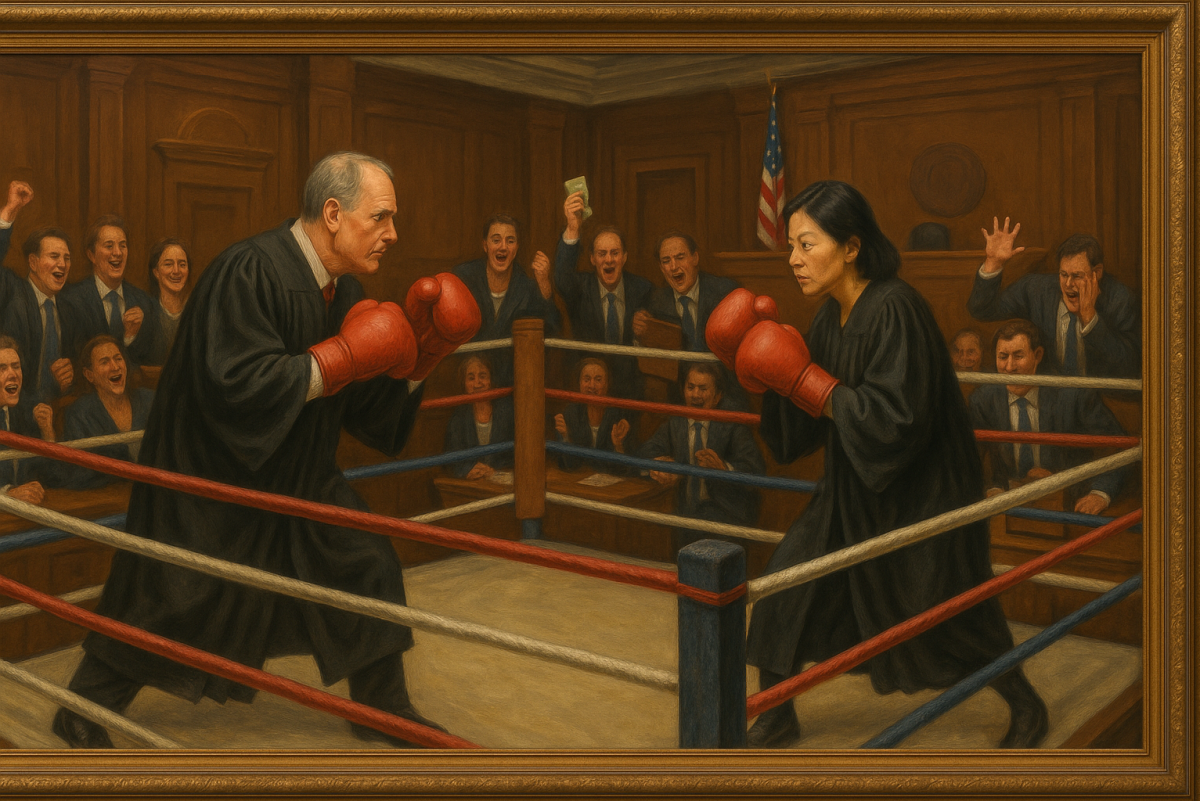
303 Creative, Exclusive Private Enforcement, and Blue State Revenge

My latest with Rocky Rhodes, in the Journal of Legislation. We argue that a Blue State wanting to create a real counterpart to S.B. 8 and its copycats should enact an exclusively privately enforced public accommodations law, targeting the First Amendment opt-out recognized in 303 Creative.

Abstract after the jump.

Red states have made exclusive private enforcement schemes targeting locally unpopular but constitutionally protected conduct a cornerstone of culture-war legal strategy. Laws such the Texas Heartbeat Act (“S.B. 8”) in 2021 and anti-“WOKE” laws forego public enforcement in favor of private enforcement; this forces targeted federal rights-holders to vindicate their rights by raising the law’s constitutional invalidity as a defense to liability rather than through pre-enforcement offensive litigation against the government or government officials responsible for enforcing the law. This threatens rights-holders with a wave of costly and burdensome litigation and liability.

Blue states and liberal scholars and advocates have sought a progressive counterpart targeting a favored conservative right. This Article finds that counterpart in 303 Creative v. Elenis (2023), in which the Supreme Court recognized a (not clearly defined) First Amendment right for expressive businesses to decline to provide expressive goods and services related to same-sex marriage and not to be compelled to express messages violating their religious, political, or ideological beliefs. The decision angered liberals, who criticized the “fake case” and “legal performance art” that produced the decision, and delighted conservatives, who had long sought recognition of such a First Amendment right. We hypothesize a Blue state enacting the Discrimination Is Not Expression Act, a public-accommodations law prohibiting such First Amendment opt-outs and compelling all businesses to provide all services, including expressive ones. By removing any public enforcement mechanism and relying on exclusive private enforcement, this law places business owners seeking to exercise a conservative-favored federal right in the same bind that S.B. 8 placed abortion providers and patients seeking to exercise a liberal-favored right.

This paper, the fifth in a series on the procedure of exclusive private enforcement, details this privately enforced public-accommodations law as a response to 303 Creative. It explores how the law offers Blue states “revenge” for S.B. 8 and other anti-abortion laws by burdening a conservative-favored right; how it might fare in constitutional litigation of any posture; how it exposes procedural inconsistency in the face of substantive preferences; and why the prospect of this law might cause both sides of the spectrum to abandon private-enforcement schemes and the burdens they impose.

Posted by Howard Wasserman on January 28, 2025 at 02:26 PM

“Palpably unfair acts” and the Infield Fly Rule

Because I do not watch actual football games, I am late to the discussion of another example of Infield Fly-like rules in other sports, this time in the Eagles-Commanders game.

The Eagles had the ball about a yard from the goal line. Everyone knew they would run the “Tush Push” (three players in the backfield push the quarterback on a sneak), which has become nearly unstoppable. The Commanders tried to time the snap and get to the QB before he had the ball and the pushers had a chance to push, including by a player jumping over the top of the line. They mistimed it three times, earning an offsides penalty each time. After the third infraction, the official announced that he would, if the Commanders did not cut the crap, call a palpably unfair act, which allows an official to award a score.

This is an IFR-type situation: The Commanders engaged in conduct contrary to ordinary expectations (intentional infractions); the Eagles could not counter (they cannot stop a player from encroaching repeatedly); it secured the Commanders an overwhelming advantage (the Eagles never had a chance to snap the ball); and the Commander had the incentive to keep doing it because it incurred no risk to keep doing it and thus hoped to time it right that one time.* The palpably unfair conduct call eliminates the incentive to keep trying the play by imposing a cost–the touchdown they are trying to stop.

[*] An offside infraction is harmless with the ball inches from the goalline–the the penalty is half the distance to the goal line (Zeno’s Paradox applied to football) and no new set of downs.

I addressed the palpably unfair rule as a limiting rule in the IFR book when discussing Super Bowl XLVII between the Ravens and 49ers. The Ravens had a safety kick with seconds remaining on the clock. Ravens players were recorded on the sideline saying that if the 49ers returner broke free, they should run onto the field and tackle him to keep him from scoring. Such a play would earn a palpably unfair call and likely the officials awarding the touchdown. And the Ravens’ planned strategy fits the IFR elements–contrary action according an overwhelming advantage that the opponent cannot counter, with the team having every incentive to try it.

Interestingly, some have argued for a different limiting rule–ban the tush-push. This argument sees the IFR-type problem in reverse: The offense enjoys an overwhelming-and-non-c0unterable advantage (the mass of bodies and momentum is impossible to defend) and an incentive to do this every time in that short-yardage situation. Eliminating the tush-push eliminates the unfair disadvantage on the defense. And, in turn, eliminates the defense’s incentive to commit palpably unfair acts.

Update: Whether the tush-push should be banned is an interesting one. Most limiting rules arise because the structure of the game creates the overwhelming imbalance–the runners in an infield fly situation are stuck and will be put out whether they run or stay; the time the offense loses running a futile play against extra defenders cannot be recovered. We can debate whether the imbalance from the tush-push is structural. On one hand, this is one team taking advantage of its bigger-and-stronger players to overwhelm the defense; we did not ban peak Earl Campbell from running through over-matched defenders (watch some old clips). And we allow multiple defenders to tackle one runner; that does not differ from a collective “runner” moving forward as a giant blob. It also is telling that only the Eagles use this move to the same degree. On the other, one could define the structure of football as one ball carrier against the defense, not an offensive collective against the defense.

Posted by Howard Wasserman on January 28, 2025 at 12:19 PM

LaForte Fractures

Sharing for no good reason: We have been watching The Pitt, Noah Wylie’s new not-ER hospital drama. In the second episode, they treat a guy who hit a car door while riding on a scooter and face-planted, suffering a LaForte Fracture, in which the top of his face comes lose from the bottom jaw (they refer to it as a “floating face”). They show (because this is not a network show) the doctors moving the top of his face back into place.

This development excited us because I suffered a similar injury in a bicycle accident a couple years ago. Mine was a LaForte II (only the upper jaw was loose), as opposed to the LaForte III on the show. Still, it took us back. (My Fed Courts students from that semester sent me a get-well card wishing me a speedy recovery from my “concrete and particularized injury.” They learned something.)

I had one nitpick: They made a big point of saying that the guy was not wearing a helmet, intimating that this worsened the accident and “this is what happens when you’re stupid and don’t wear a helmet.” This is nonsense. I was wearing a helmet. A helmet does not help when you slam face-first in the pavement.

Posted by Howard Wasserman on January 27, 2025 at 04:23 PM

International Holocaust Remembrance Day

Today is International Holocaust Remembrance Day, as designated by the United Nations in 2005. Israel and many Jews around the world commemorate the Holocaust on Yom HaShoah, the 27th of Nisan on the Hebrew calendar, which will by May 5 this year.

Here is the explanation of International Holocaust Remembrance Day from the U.S. Holocaust Memorial Museum website:

On November 1, 2005, the UN General Assembly adopted resolution 60/7 to designate January 27 as International Holocaust Remembrance Day (IHRD). The date marks the liberation of Auschwitz-Birkenau and is meant to honor the victims of Nazism. The same resolution supports the development of educational programs to remember the Holocaust and to prevent further genocide.

Resolution 60/7 not only establishes January 27 as “International Day of Commemoration in memory of the victims of the Holocaust,” it also rejects any form of Holocaust denial. The resolution encourages member states of the UN to actively preserve sites that the Nazis used during the “Final Solution” (for example, killing centers, concentration camps, and prisons.) Drawing from the Universal Declaration of Human Rights, the resolution condemns all forms of “religious intolerance, incitement, harassment or violence against persons or communities based on ethnic origin or religious belief” throughout the world.

I do not know the politics behind the U.N. decision to select a day other than Yom HaShoah, or the date of the Warsaw Ghetto Uprising, also commemorated in Israel, which began on the 17th of Nisan.

Posted by Steve Lubet on January 27, 2025 at 08:08 AM

Westerfield Fellowship – Loyola New Orleans College of Law – 2025

From Loyola University New Orleans:

Loyola University New Orleans College of Law is accepting applications for a Westerfield Fellow to begin August 1, 2025. This position is designed for individuals pursuing a career in law teaching. Applicants should have strong academic credentials and excellent communication skills. Fellows are responsible for teaching two sections of a three-credit writing course each semester, and Fellows teach this course with the support of an experienced director and professors in a program in which the director and professors coordinate the content and pace of the classes. Fellows also have the opportunity to create and teach a seminar on a topic of interest in the second year. Fellows have a student teaching assistant and faculty mentor in addition to other professors in the program. One-year contracts may be renewed, and typical fellowships are two years. Westerfield Fellows have been successful in obtaining tenure track positions at ABA-accredited law schools.

All applications must be submitted through the following webpage:

https://www.schooljobs.com/careers/loyno/jobs/4796990/westerfield-fellow

Posted by Sarah Lawsky on January 27, 2025 at 06:14 AM

Craven, cowardly, and clueless

Republicans in the Idaho legislature are pursuing a resolution urging SCOTUS to overrule Obergefell. The exercise is performative bullshit. SCOTUS resolves lawsuits, not requests from random people to do things. The article quotes Tobais Wolff (Penn) as saying “the Supreme Court will no more respond to a letter from the Idaho Legislature than they would a letter from me.” It also quotes one legislator emphasizing the need to make a statement about protecting rights.

The clueless part is that the legislators could make a statement that would have actual legal effect: Pass a law limiting marriage to one man and one woman (presumably a new version would specify cis-man and cis-woman) and set up a lawsuit by a couple denied a license; then they can marshall their legal brilliance to argue to the Court why it should overrule its precedent. They cannot claim a belief in judicial supremacy; the proposed resolution begins “[s]ince court rulings are not laws and only legislatures elected by the people may pass laws.” Such a view of the balance between the judicial and legislative powers suggests the legislature can (and should) pass a law reflecting the views of the people of Idaho and let the legal controversy play out.

The answer is the cowardly part. They do not want the political blowback to enacting a law contradicting SCOTUS precedent. They likely fear being lumped with Massive Resistance and the authors of the Southern Manifesto–who, to their (limited) credit, offered a procedurally and substantively coherent vision of constitutional judicial review. They also likely fear the hundreds of thousands of dollars in attorney’s fees they will pay for litigating two guaranteed losses in the lower courts and a likely loss in SCOTUS (which I do not believe is so anxious to overrule Obergefell, as opposed to limiting its application). But these people will not put their money or their power where their mouths are.

And so we get the craven part–a legally, procedurally, and practically meaningless performative gesture.

Posted by Howard Wasserman on January 26, 2025 at 11:39 AM

Saturday Music Post – I Fall to Pieces

“I Fall to Pieces” was written by the team Hank Cochran and Harlan Howard and first offered to Brenda Lee, who turned it down. It was then offered to Patsy Cline in 1961. She initially had misgivings about it as insufficiently country, but her producer prevailed (with the incentive of backup vocals by the Jordanaires), and it became the beginning of her crossover success. The clips are at The Faculty Lounge.

Posted by Steve Lubet on January 25, 2025 at 06:09 AM

Nazi jokes and Nazi salutes

I have no real use for the ADL and less for Jonathan Greenblatt. I have long believed they see antisemitism lurking around every corner, often in a way the conflicts with my views on First Amendment protection for hate speech. So I am not the group’s target audience. And October 7 produced a genuine uptick in antisemitic speech and incidents, so I began to see a bit of the group’s point.

But Greenblatt and the group’s response to Elon Musk’s adventures destroys any credibility. First, it was a Nazi salute; it did not just “appear to be,” as so many outlets (including The Forward) described it. And it was made on stage at an inaugural even by a person with an office in the West Wing and the ear of the new President. Minimizing it as “an awkward gesture in a moment of enthusiasm” is absurd. Greenblatt exacerbated the problem by condescendingly telling everyone who disagrees with him (those who are “on edge”) to chill out by “giv[ing] one another a bit of grace, perhaps even the benefit of the doubt, and take a breath” and “hop[ing] for healing and work[ing] toward unity in the months and years ahead.” As if Musk and the president he supports are not expressly targeting those they do no like. Demanding that one side give the benefit of the doubt and work toward unity–while the other runs roughshod–is offensive nonsense.

Greenblatt made himself look worse by chastising Musk over bad puns about Nazi leaders, taking umbrage about the Holocaust as a unique event that should never be joked about. (Maybe have a word with Mel Brooks?). One might see this as attempted compensation–chastising the joke to overcome the criticism for his response to the salute. But I think Greenblatt sincerely sees the latter as worse than the former. And that reflects bizarre priorities–an online joke deserves strident condemnation but a political speech celebrating a president set to pursue some problematic policies is no big deal. Of course, it is consistent with the view that the pro-Palestinian shouts of an Oberlin student represent an existential threat to Jews but government policy that harms Jewish interests is no big deal.

To be clear, both of Musk’s actions warrant condemnation. And both are constitutionally protected, so nothing (besides cementing my negative opinion about him) should befall Musk. Greenblatt’s disparate treatment reflects more about the ADL than it does on Musk’s character. That is sad.

Update: From Jodi Rudoren at the Forward. She makes a point I considered after posting–the subsequent jokes should lend some “context” to the salute, strengthening the view that it carried an antisemitic message. Also, Greenblatt’s quotations are moronic–“we don’t know anything, but I can say it was not a Nazi salute.”

Posted by Howard Wasserman on January 24, 2025 at 03:48 PM

Review of “Interrogating Ethnography” by Andrew Gelman

Andrew Gelman is a highly regarded statistics and political science professor at Columbia, and the force behind the widely-read “Statistical Modeling, Causal Inference, and Social Science” blog. I was delighted to see that he has posted a short review of my book Interrogating Ethnography. It is a little unusual to have a book noticed over six years since publication, but a positive review from Gelman is welcome any time. He has given me permission to reproduce it below:

I came across this book from 2018, Interrogating Ethnography: Why Evidence Matters, by law professor Steven Lubet. It’s a crisp (137 pages) and fascinating discussion of the role of evidence in qualitative social science, and I think it should be of interest to many of you, as it parallels so many discussions we’ve had over the years regarding the role of evidence in quantitative research.

Sometimes I’ve had negative reactions to writings by law professors on social science, but in this case Lubet’s expertise is relevant, as so many legal cases turn on evidence.

Lubet discusses several examples, focusing on sociologist Alice Goffman’s controversial 2015 book On the Run. As we discussed a few years ago, it’s a problem of trust. Goffman offers no documentation for her extraordinary claims and thus must rely on her readers and colleagues to trust her statements and treat them as fact. In this case, trust is brittle, and once the trust is gone, not much remains.

One reason Lubet’s book is interesting is that he gets into the details and presents things very carefully. Just for example, from page 131:

It is unfortunate that ethnographers have so seldom essayed revisits to others’ research sites. Despite the obvious difficulties, there are cases in which the impediments can be readily overcome. It would not take long for an ethnographer to interview personnel at the hospitals in West Philadelphia where Alice Goffman claims to have seen police cordons at the entrances. Moreover, there are only six hospitals in Philadelphia with maternity services, so it would be possible, even now, to fact-check Goffman’s story of having observed the arrests of three new fathers on the same ward in a single evening.

I’m guessing that this maternity ward falls into the same category as Marc Hauser’s monkey tapes, Brian Wansink’s bottomless soup bowl and his 80-pound rock, Diederik Stapel’s survey forms, Mary Rosh’s survey forms, Michael Bellesiles’s probate inventories, Matthew Walker’s National Geographic video, the Surgisphere dataset, and Dan Ariely’s paper shredder. But all things are possible.

The other thing notable about Lubet’s book is its even tone. Some of the stories in the book are funny, others are kinda shocking, and Lubet manages to convey all this without himself ever expressing amusement or outrage. There’s nothing wrong with expressing amusement or outrage—I do it all the time!—; it’s just impressive to me how he wrote this entire book with a straight face. I recommend it.

There are also 12 comments on his post, which can be read here.

Posted by Steve Lubet on January 21, 2025 at 06:16 PM

In Support of the American Historical Association’s Executive Council Veto of Gaza “Scholasticide” Resolution

On January 6, the annual business meeting of the American Historical Association passed a resolution condemning Israel’s so-called “scholasticide” in Gaza. The AHA Executive Council, however, exercised its authority to veto the resolution because it contravened the association’s bylaws. Members of the Executive Council and staff have since been subjected to harassment and abuse for their principled decision. In support of their principled action, I am posting the explanation here:

Update as of January 17, 2025: The AHA Council deplores any intentional destruction of Palestinian educational institutions, libraries, universities, and archives in Gaza. The Council considers the “Resolution to Oppose Scholasticide in Gaza,” however, to contravene the Association’s Constitution and Bylaws, because it lies outside the scope of the Association’s mission and purpose, defined in its Constitution as “the promotion of historical studies through the encouragement of research, teaching, and publication; the collection and preservation of historical documents and artifacts; the dissemination of historical records and information; the broadening of historical knowledge among the general public; and the pursuit of kindred activities in the interest of history.” After careful deliberation and consideration, the AHA Council vetoes the resolution. The AHA Council appreciates the work of Historians for Peace and Democracy and recognizes the diversity of perspectives, concerns, and commitments among AHA members.

Update as of January 6, 2025: The “Resolution to Oppose Scholasticide in Gaza” was passed by members attending the business meeting. As per the AHA’s Constitution, article 7(3–5), all measures passed by the business meeting shall come before the AHA Council for acceptance, nonconcurrence, or veto. The AHA Council has begun a thoughtful and vigorous conversation and will make a decision at its next meeting, which will take place within the month.

The vote on the Executive Council was 11-4 with one abstention. New York Times coverage is here.

Posted by Steve Lubet on January 20, 2025 at 12:21 PM

[Guest Post]: Markey call to extend Tik Tok deadline, annotated

This document is from my FIU colleague Hannibal Travis; he annotated Ed Markey’s speech. The annotations are for law students, legal journalists, scholars, and members of the public.

Posted by Howard Wasserman on January 20, 2025 at 11:31 AM

MLK Day and Inauguration Day

Random trivia: Today marks the second time that a presidential inauguration has fallen on MLK Day. Bill Clinton’s Second Inauguration in 1997, eleven years after it became a holiday, was the first time. It will next happen in 2081. So maybe today is also the last time they coincide.

Posted by Howard Wasserman on January 20, 2025 at 10:31 AM