
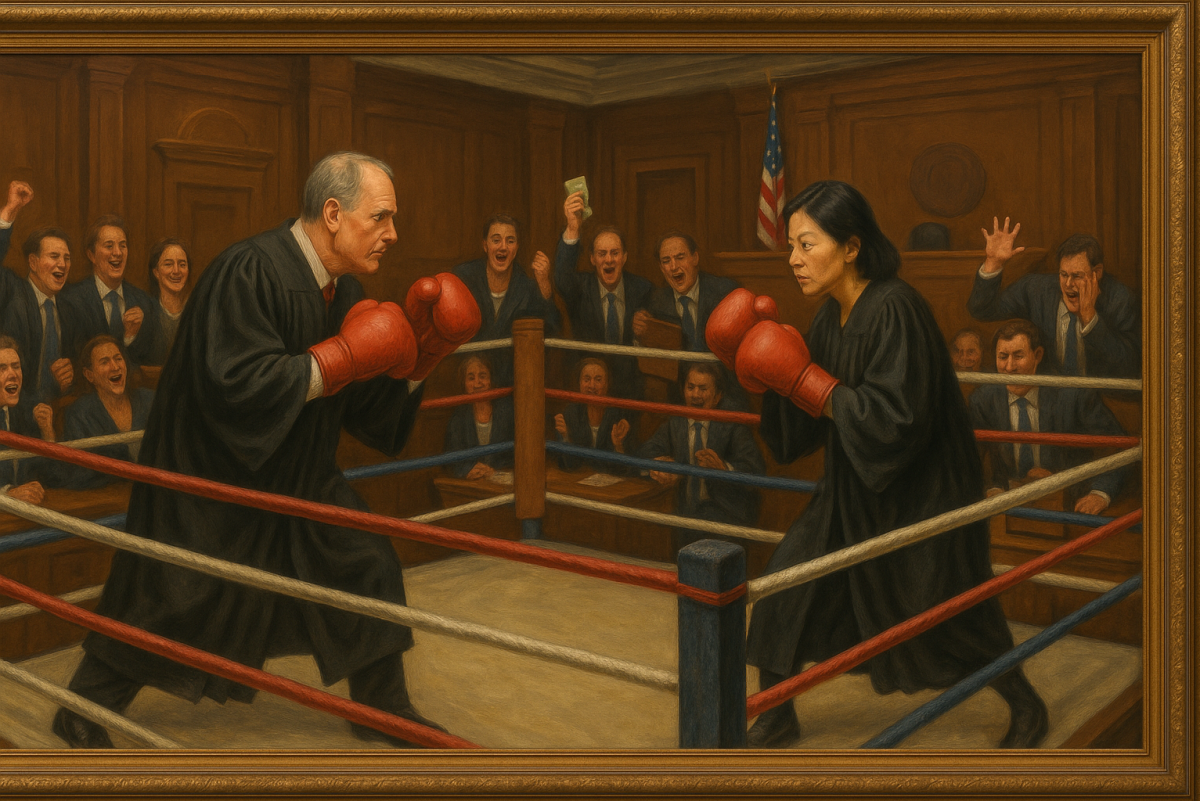
AmosAnon1 on Lifetime Tenure for Judges
People such as TVC’s Lindgren, et al., tout the basic idea of eighteen year judicial term limits for four basic reasons. Supposedly, it would:
(1) stop judges from retiring based upon political considerations;
(2) open nominations to distinguished older lawyers and judges, who are now shut out as a result of every president’s interest in shaping the Court for decades;
(3) ensure that bad justices can’t haunt us for more than eighteen years;
(4) limit the partisan rancor that currently pervades the nomination process by reducing the stakes of a nomination.
As Ethan says below, the first benefit is undeniable.
But …
couldn’t it just as easily be accomplished by a mandatory retirement age of, say, 70? 65?
As for the second supposed benefit, I wasn’t aware that underqualified young people were getting Supreme Court jobs because older, better qualified people couldn’t be considered. This must be the only field in which a 45 or 50 year old is considered “untested” and “young.” If you are high profile enough to be in line for a nomination at age 45, then you are a star. Maybe you went to a top law school, maybe you clerked or published. In other words, you are qualified; and if you aren’t qualified, it isn’t because only the old people were qualified.
With respect to the prospect of “bad judges” haunting us for 20+ years, just flip it on its head: implementing 18 year term limits would deprive us of the best judges after 18 years of service.
The fourth supposed benefit is really what mystifies me. First, I don’t see Ted Kennedy standing up and saying, “Well, since it is only for eighteen years, we should confirm Mr. Bork.” But let’s assume that Ted would. The result would be more ideologues—from the right and the left—sitting on the Court. And it would make every presidential election revolve around the Court to an even greater degree than it already does. I don’t view these as positive effects.
Put differently, how does increasing the number of times politicians get to debate judicial nominations depoliticize of the process? That’s just crazy talk.
Finally, this would destabilize the Court. Every issue would be up for reconsideration every few years. Whatever you think about the Court’s stances on abortion, affirmative action, enemy combatants, sentencing guidelines, and whatever else, do you really want the Supreme Court re-debating it every four years? Bad decisions should be overturned, of course, but we’d end up with a situation in which Congress, agencies, businesses, and individuals couldn’t act, because the law would be in a constant state of flux.
One of the only things the Court has going for it is its stability and mystique. The moment it becomes just another political branch, reconsidering every foundational position every few years, is the moment the people will rebel against it.
So mandatory retirement age? Sure. Term limits? No way. —
Posted by Administrators on April 8, 2005 at 02:56 PM
Comments
People also seem to have forgotten that we are living in an anomolous age. This is, I believe, the longest stretch of time the US has ever gone without a USSC opening. For some reason, the entire political climate seems to be approaching individual situations as representative of endemic problems. The problem with the judiciary isn’t that we have an aging set of judges, but it is that we are not retaining some of the best and the brightest of them through to retirement. The Chief Justice and Stephens (I think) made a report a few years back requesting an increase in the pay scale for Federal judges because too many Judges were using the judiciary as a stepping stone in tehir careers instead of as a capstone. Lets focus on retaining the good people before we arbitrarily decide we don’t like jurists over a certain age.
Posted by: Joel | Apr 8, 2005 4:03:27 PM