
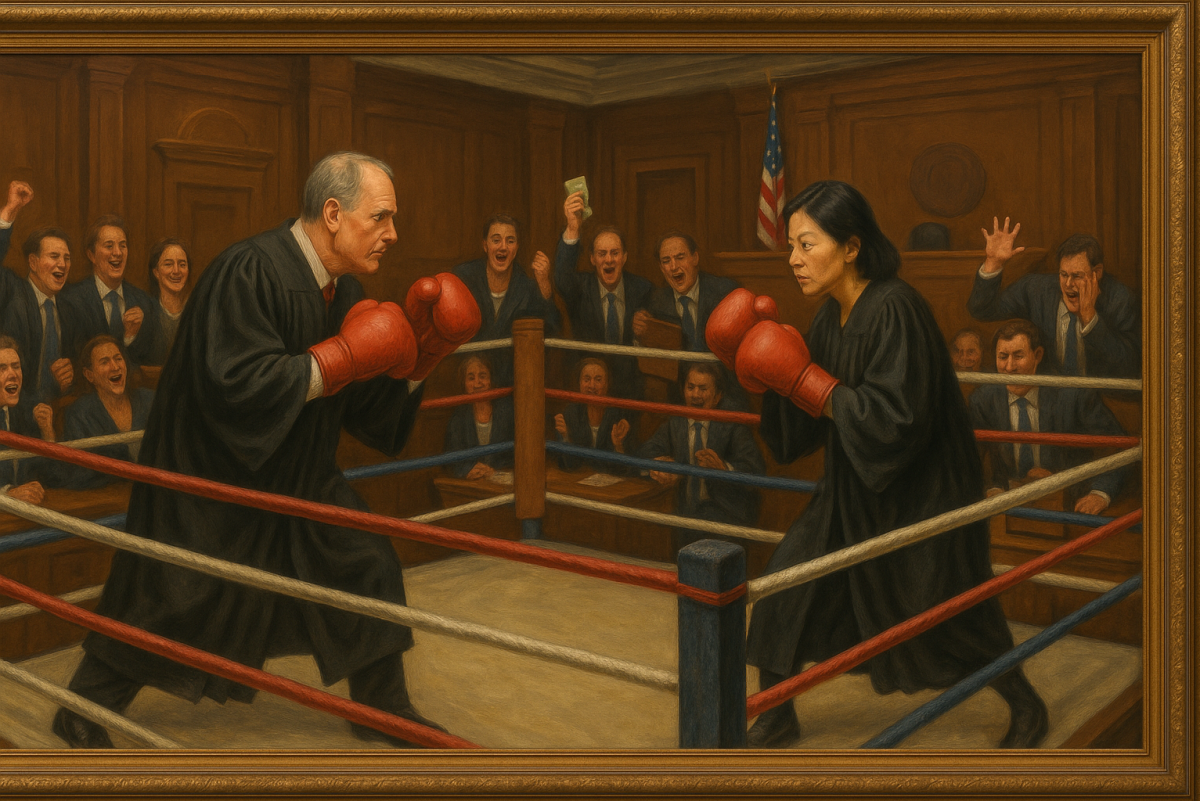
[Note: this post edited to reflect that the judge’s name is Judge Boyce Martin, not Judge Boyce. I wasn’t trying to be too familiar!] How Appealing has this link to a new opinion by Judge Martin of the Sixth Circuit, dissenting from the rejection of a habeas challenge to a capital sentence, in which he writes:
I have no delusions of grandeur and I know my place in the judiciary. My oath requires me to apply the law as interpreted by the Supreme Court of the United States. I will continue to do as I am told until the Supreme Court concludes that the death penalty cannot be administered in a constitutional manner or our legislatures abolish the penalty. But lest there be any doubt, the idea that the death penalty is fairly and rationally imposed in this country is a farce.
Powerful statement. But is he right? Where does either his constitutional oath or his judicial oath demand that he apply the law as interpreted by the Supreme Court of the United States? My research on the history and meaning of the federal judicial oath (which necessarily also discusses the so-called “constitutional” oath to support the Constitution) is still ongoing, so I offer no strong arguments or conclusions here. But it is certainly not clear to me that an oath to “support this Constitution” automatically and necessarily translates into an oath to “support [the Supreme Court’s interpretations of] this Constitution.” It may do so– especially if, when one says “this Constitution,” one means the Constitution and all its implications, which may include authoritative interpretation by the Supreme Court. But it need not do so. There are good non-oath-related reasons for a lower court to respect Supreme Court precedent — not least that reversal is embarrassing to the judge and onerous to the parties. But a judge might also conclude that his or her oath to support “this Constitution” requires him to rebel against the Court’s precedents. This may just be a quibble — but months of research into the oath, puncuated by instances in which I have read judges making occasional, unnecessary, and seemingly undertheorized references to the oath, inclines me to quibble.
Posted by Paul Horwitz on October 4, 2005 at 02:37 PM
Comments
To refer back to Roberts and the overused (undertheorized) comparison to an umpire or ref:
Balls and constitutional strikes, they ain’t nothin’ until the Supreme Court _calls them into being_. That is, what is there left for the trial court to do as a matter of first impression? The Constitution which he is sworn to uphold is no blank canvas; others have trod upon it with paint-covered boots, the Supreme Court the most heavily.
So, can a judge disagree with the Supreme Court? Constitutionally? In conformity with the Judiciary Act, or with the oath of office she or he took? I might argue not – but I’d want to look at the oath, and some precedents, before I committed to it.
Posted by: Eh Nonymous | Oct 5, 2005 11:50:07 AM
Paul, you’ve read Schauer & Alexander on this exact question, as applied to non-judicial officials, no? Alexander has a later piece with Solum, as well.
Posted by: BDG | Oct 5, 2005 10:32:55 AM
Also, assuming this is an accurate text of the judicial oath, maybe Judge Boyce is referring not to his constitutional oath but his judicial oath? That oath appears to require that a judge discharge the duties of his position as set forth in the laws of the united states. I assume (am I wrong?) that some provision of the judiciary act makes clear that lower courts obey higher ones.
Posted by: Will Baude | Oct 4, 2005 3:40:00 PM
Certainly Akhil Amar’s answer to this exact question in class has been that the word “inferior” is in the Constitution to which the judge swears, and inferiority in this sense was understood since time immemorial to require obeying one’s constitutionally-created-superiors.
But if you haven’t turned anything like this up in your research, I have little to offer.
Posted by: Will Baude | Oct 4, 2005 3:20:49 PM
Speculating: Maybe it’s a reference to the way in which the constitution creates a supreme court, and allows for the creation of inferior courts. I agree there are major problems today that arise from lawyers and legislators not following their oaths to uphold the constitution. The oath doesn’t say “uphold the constitution once a court has specificly ordered me to.” We’ve gotten judicial review upside down, and lost part of our system of checks and balances.
Posted by: arbitrary aardvark | Oct 4, 2005 3:18:48 PM