
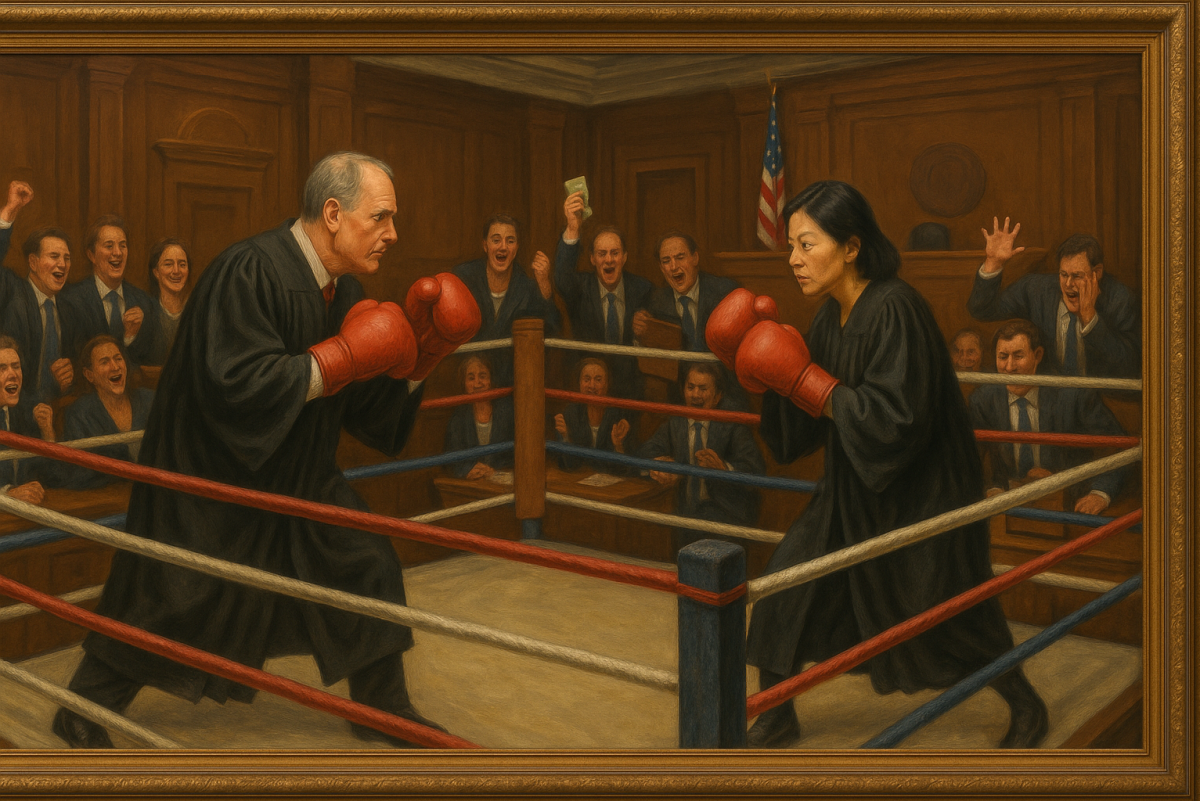
Essential reading: Richard Primus’s just-published review of Akhil Amar’s new book, America’s Constitution: A Biography. The review, which came out this week in TNR, is available here. Primus begins by commending Amar for recognizing that Reconstruction ought to be viewed as a second American revolution with fundamental constitutional significance. But after that point the two begin to part ways. Put simply, Primus argues that Amar is a textualist because he is a radical democrat: He emphasizes the text because only the document itself was enacted by the people—if not at the Founding, then during Reconstruction. Here is where the review really gets going:
Amar’s theory of constitutional history and his theory of constitutional authority are . . . two parts of an internally coherent whole. The Constitution is the paramount legal authority because it is the most democratic, emanating from the people themselves. Given that premise, Amar cannot locate the ultimate moment of enactment in the Founding, because a constitution so thoroughly infected by slavery cannot claim obedience by virtue of its democratic pedigree. Only later did emancipation, equal protection, and enfranchisement democratize the Constitution. For this reason, it must be to the Constitution of the 1860s, not to the Constitution of the 1780s, that modern Americans owe allegiance. For it was during Reconstruction that the people and the Constitution were finally brought together.
Amar’s constitutional theory is elegant, but it is significantly flawed. As a historical matter, his vision of Reconstruction is airbrushed to make it seem more democratic than it really was. And as a normative matter, democratic enactment cannot suffice to legitimate the Constitution, if only because of the passage of time. Regardless of the process by which the Constitution was adopted, today it compromises democracy by governing people who were unrepresented in its formation.
In essence, Primus thinks that popular sovereignty alone cannot justify the Constitution, chiefly because of the dead hand problem: “the people” who enacted the document, whether in the 1780s or the 1860s, are not the same people who find themselves bound by it today. Consequently, a method of constitutional interpretation that places too much emphasis on the text of the document (on the theory that only the text was enacted by the people) is bound to produce errors. He parses through some of these mistakes in a fascinating analysis and then argues that many of our most treasured constitutional principles are really twentieth-century developments. He concludes:
We are moving, slowly but perhaps inexorably, toward a perspective from which we can more easily see the Civil War and Reconstruction as part of America’s origins. [¶] Amar does a great service in advancing such a future perspective. By insisting that our Constitution is largely what Reconstruction made it, he helps to correct the prevailing tendency to focus on a few short years in the eighteenth century. For that contribution, all who work in constitutional law must appreciate this book. But just as it is a fallacy to locate the authority and the meaning of the Constitution in the 1780s, it is a fallacy to repeat the exercise with the 1860s, or with some combination of the two, or with any other period or periods of the receding past. Taking democracy seriously precludes imagining that generations now gone had the right to dictate our method of government today, and that is as true of generations gone one hundred years as of generations gone one hundred years before that. Taking constitutionalism seriously entails the willingness to temper simple democracy with other fundamental values. We love our Constitution, and we love democracy. But we cannot square the circle.
Take a look.
Posted by NTebbe on April 22, 2006 at 12:09 PM
Comments
Congratulations Simon! You proved Professor Primus wrong! Just kidding. Apparently, in your haste to respond, you forgot to read the second excerpt.
“[J]ust as it is a fallacy to locate the authority and the meaning of the Constitution in the 1780s, it is a fallacy to repeat the exercise with the 1860s, or with some combination of the two, or with any other period or periods of the receding past. Taking democracy seriously precludes imagining that generations now gone had the right to dictate our method of government today, and that is as true of generations gone one hundred years as of generations gone one hundred years before that. Taking constitutionalism seriously entails the willingness to temper simple democracy with other fundamental values.”
You succeeded in re-stating Primus’ argument (albeit with less clarity and more rhetorical questions). Good job.
Posted by: Latecomer | Jan 4, 2009 3:45:46 AM
I have to say, I don’t understand WHY we should care about these big-picture macro-historical retellings of the American story. Thank God Primus is taking the tiresome Yale historical school to task for trying to make such a big deal out of democracy. It’s obvious from our adventures in the middle east that democracy isnt’ the real desideratum–it’s a society which meets basic human needs and gives real human freedoms. Democracy in itself has no ethical content.
Posted by: Tangential | Apr 24, 2006 9:59:05 AM
I think there’s certainly a strong argument to be made that certain parts of the Constitution – specifically, the rights-bearing portions, including the first eight amendments – should be interpreted in light of practise in 1868, because surely that admission is inherent in the argument that the fourteenth amendment really does incorporate those protections against the states (whether one gets there by the due process clause or by the priveleges or immunities clause matters not in this context). IIRC, this is more or less precisely what Amar said in his previous book, no?
However, for much the same reasons as I mentioned last August, in a slightly different context, I am not sure what to make of comments such as this:Amar cannot locate the ultimate moment of enactment in the Founding, because a constitution so thoroughly infected by slavery cannot claim obedience by virtue of its democratic pedigree. Only later did emancipation, equal protection, and enfranchisement democratize the Constitution. For this reason, it must be to the Constitution of the 1860s, not to the Constitution of the 1780s, that modern Americans owe allegiance. For it was during Reconstruction that the people and the Constitution were finally brought together.Is Primus’ argument really that the Constitution should be interpreted in light of the Civil War amendments because they have a greater “democratic pedigree” that did the main text? This argument is counter-intuitive on its own terms; the civil war amendmends were not enacted by a Congress or electorate which could claim a notably greater “democratic pedigree”, and nor did they entirely bring “emancipation, equal protection, and enfranchisement,” unless Primus really only means that a constitution that hadn’t yet abolished slavery is worth allegiance. Women had another half-century to wait before their enfranchisement was written into the Constitution. If Primus’ argument is (as it seems to be) that the constitution only deserves our allegiance if it meets certain (and arbitrary) criteria as to the people that enacted it, if that’s the theory — why pick 1868? Why not pick 1920? For that matter, if the argument is that the constitution is not valid until it is first ratified in an age where it is sufficiently rooted in a democratic mandate, why not pick 1971?
Nor do I understand Nelson’s summary that “Primus argues that Amar is a textualist because he is a radical democrat: He emphasizes the text because only the document itself was enacted by the people.” While I am not sure how being a radicial Democrat would lead one to textualism any more than being a Republican – radical or otherwise – would lead one to textualism, I suppose that as long as someone reaches 42, it doesn’t matter if they doubled 21 or halved 84. But in any event, no matter wy Amar (or anyone else) emphasizes the text, why does the comment that the document itself was what the people adopted seem to have such a dismissive air to it?
Posted by: Simon | Apr 24, 2006 9:36:43 AM