
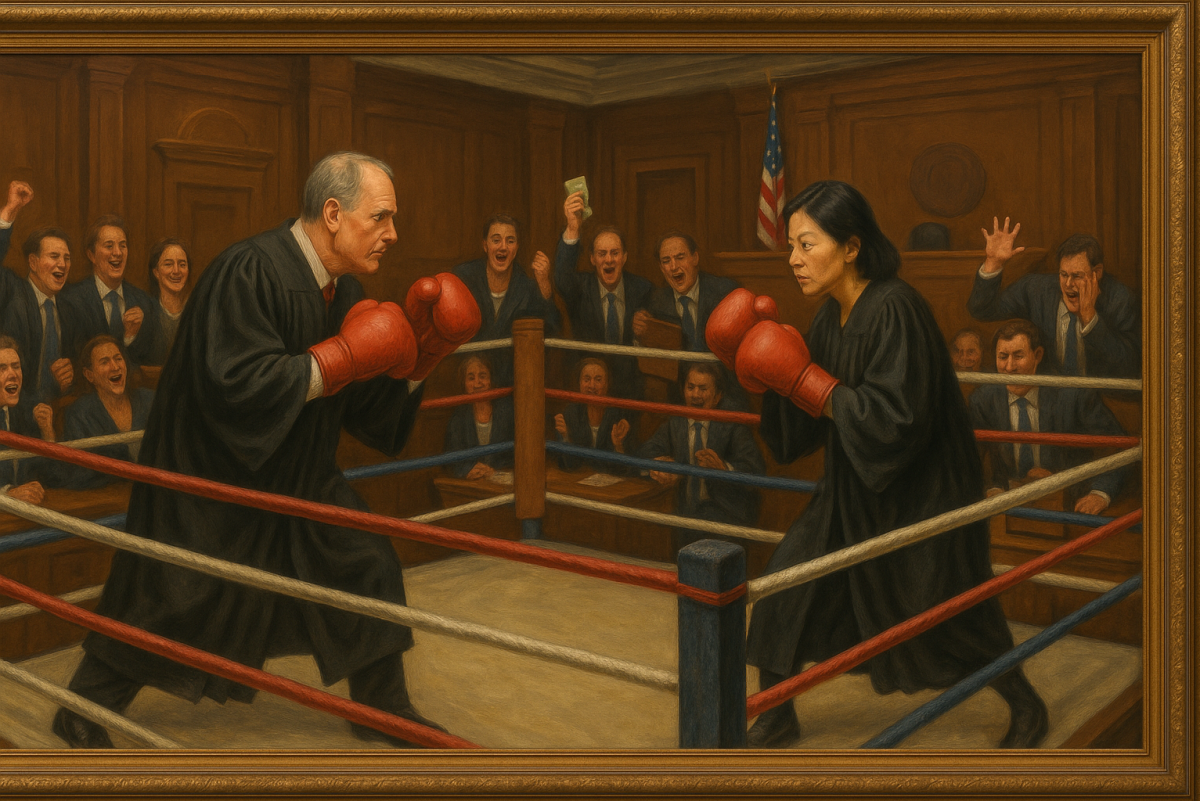
In the May 22 issue of The New Republic, Cass Sunstein has this review (“Virtue and Verdicts”) of Ronald Dworkin’s “Justice in Robes“. Sunstein sets the stage with this:
For over three decades, Ronald Dworkin has been the most influential and illuminating analyst of the view that judges can or should merely “follow the law.” In this collection of recent essays, Dworkin explores the relationship between law and morality, elaborating his previous arguments and replying to a number of prominent objections. Dworkin agrees that judges generally must be faithful to existing legal materials, but he insists that they are not merely “following” something. The law is often unclear. Dworkin contends that when resolving real disputes, judges must select the principle that puts previous decisions in their most attractive light. For this reason, the task of interpretation requires judges to think seriously about what morality requires, and they might well end up moving the law in dramatic and novel directions.
After a helpful summary of the book’s claims and context, Sunstein — drawing on his own defense of “minimalism” — writes:
[E]ven if we reject originalism, it does not follow that judges should adopt and impose large-scale moral principles of their own (and call what they are doing “fidelity”!). Suppose that we insist that when judges strike down legislation because of their own moral judgments, they might well err. In American history, it is easy to find examples. . . .
. . . Puzzlingly, Dworkin does not come to terms with the risk of judicial error in the moral domain. . . .
Dworkin’s . . . claim is that the Supreme Court should adopt an approach that calls on the justices to make large-scale judgments about the meaning of our highest ideals. I think that the Court should, most of the time, refuse to assume such a role. It should refuse to do so because fallible judges ought to avoid engaging, in particular cases, with the most fundamental problems in morality and politics. No theory of interpretation can avoid moral and political controversy, but it is possible to adopt, on moral and political grounds, a theory of interpretation that asks judges to decline to deploy their own moral and political judgments as weapons against the democratic process.
Posted by Rick Garnett on May 23, 2006 at 09:58 AM