
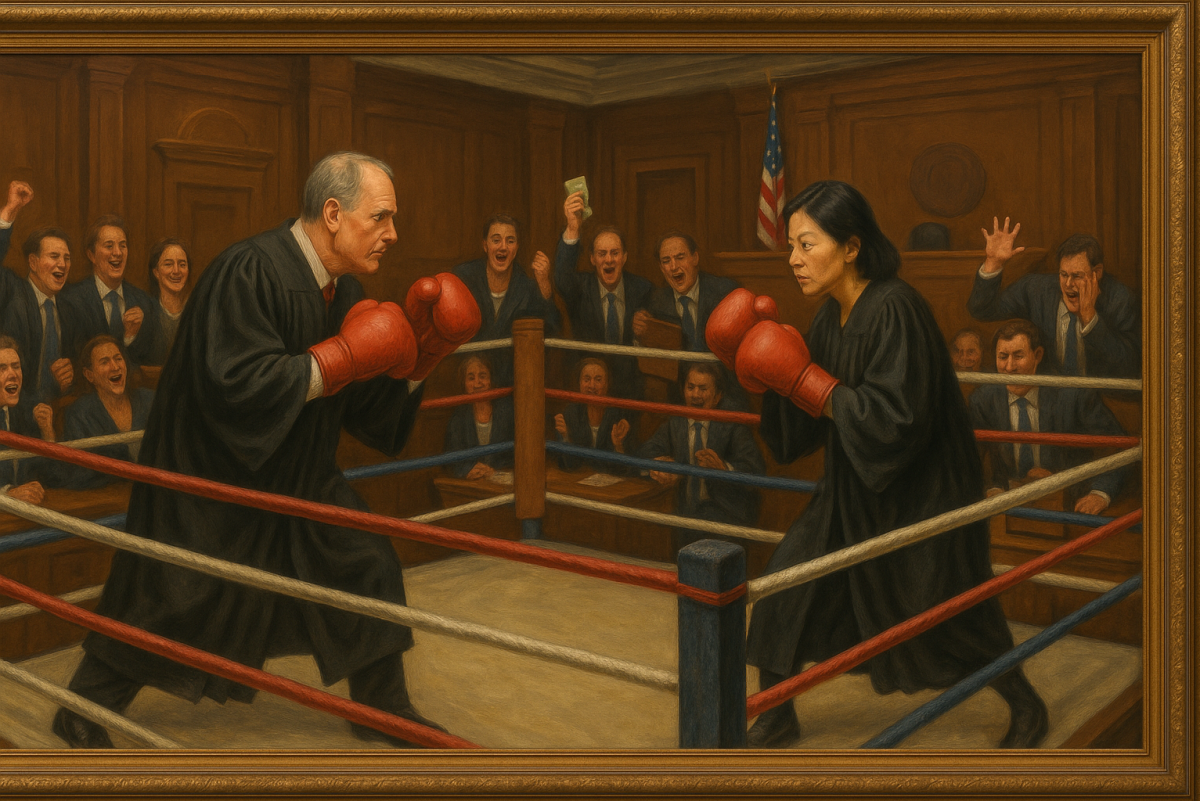
Chief Justice Taney, in Chambers vs. Circuit Justice Taney
I’m in the midst of a paper for the Temple Law Review‘s March 2007 symposium on presidential power that is largely about Chief Justice Taney’s famous/infamous opinion
Listed below are links to weblogs that reference Chief Justice Taney, in Chambers vs. Circuit Justice Taney:
Comments
Reasons that the case is one by the Supreme Court, with Chief Justice Taney, sitting as the sole justice:
1) The application for relief was addressed and delivered to CJ Taney of the Supreme Court in Washington, not at a Circuit Court in Baltimore. 2) The writ was issued by CJ Taney of the Supreme Court.
3) Justice Taney directed that the writ be returned in the Baltimore court for a very specific reason – he had no authority to order a member of the military out of their military jurisdiction, otherwise the case would have been heard in Washington and there would never have been any doubt that it was not a CC decision.
4) As noted above, Circuit Judge Giles had issued a writ in which the military failed to respond. The CC impotent, CJ Taney sat as a higher court.
5) Judge Giles was available, yet CJ Taney refused him participation in the proceeding due to the refusal of the military to obey orders of the CC.
6) Taney himself notes in the decision that the case is by CJ Taney of the SC, at chambers – ‘Before the Chief Justice of the Supreme Court of the United States, at Chambers’.
7) The case is delivered and signed by Taney as CJ of the SC – ‘Chief Justice of the Supreme Court of the United States’.
8) Per the Judiciary act of 1789, solitary justices were authorized to hear appeals for habeus corpus. The law did not (and still does not) require an en banc decision by the full court.
9) Fearing his own arrest by Lincoln, Taney directed the proceedings to be filed in Baltimore – if the case had been heard as a Circuit Court case, then the case would have been filed by Spicer in CC automatically, there would not have been any need to direct the filing.
(Evidence for Taney’s fear of arrest came from Taney himself, from Mayor Brown of Baltimore, from former SC Justice Benjamin R. Curtis, and federal Marshal Ward H. Laman. Taney’s arrest would not have been unique: on 25 May 1862, Judge Carmichael was beaten and dragged bleeding from the bench by the military. On 28 June 1862, Appeals Court Judge Bartol was arrested and confined in Fort McHenry – both men were later released.)
Posted by: 4CJ | Apr 16, 2007 10:21:48 AM
I just found your interesting commentary.
The Baltimore Sun reported the following in its May 29, 1861, issue:
“Chief Justice Taney, upon taking his seat on the bench, said that he desired to state that his associate, Judge Giles, of the Circuit Court, was present with him yesterday by his invitation, because he desired to avail himself of his counsel and advice in so important a case. The writ of habeas corpus was ordered by him as Chief Justice of the Supreme Court of the United States, consequently Judge Giles could not act with him in the case.”
In Ex Parte Merryman Taney mentions that the writ was issued by him as Chief Justice. When the writ was disobeyed, it seems to me the response (Ex Parte Merryman) would have also been by the Chief Justice, not by the District Court.
Keep in mind that on May 4, 1861, the same Judge Giles of the Maryland District Court had issued a writ of habeas corpus in the case of an underage soldier, John George Mullen. Major Morris of Fort McHenry disobeyed this earlier writ. This earlier writ is mentioned in the book by Mayor George William Brown of Baltimore, “Baltimore and the Nineteenth of April, 1861.”
The army had thus rendered the District Court impotent in the case of the earlier writ. Why wouldn’t the army just continue to refuse to obey any writs of the District Court when it suited them? Would they dare to do the same to the Supreme Court?
Posted by: Tex | Apr 6, 2007 10:22:11 AM
Tim — I’m not sure where we disagree on Bollman. There was a lower court decision denying the writ, and even though there was no direct appellate jurisdiction, the Court sustained the use of habeas as a means of (ostensibly) reviewing the decision below in order to (really) review the detention itself. As you say, it was “(aggressively) imaginative reasoning,” but I’m not sure where we are reading it differently. In contrast, in Merryman, there was nothing except the purely executive decision to detain Merryman that preceded Taney’s issuance of the writ… So, unless Ed Hartnett is right, the answer to the mystery may be compelled — perhaps Taney could _not_ have issued an original writ as Chief Justice in chambers.
Posted by: Steve Vladeck | Dec 5, 2006 2:55:25 PM
I dispute that account of Bollman. While there clearly was a petition to a lower court floating around, I don’t believe that exact petition was before the Supreme Ct. Since (per Marbury), the Constitution forbid additions to original jurisdiction, the Bollman petition was treated as appellate. This is some (agressively) imaginative reasoning, but it is still the law. See Yerger and Felker v Turpin (upholding certain AEDPA restrictions on Supreme Ct. review, while still reviewing the petition)
Posted by: Tim S | Dec 5, 2006 2:32:16 PM
This might be an obvious question, but has anyone bothered to go to the Archives Regional Branch in Philadelphia and check the order in the casefile? I’m sure it would at least help clear up the formalities.
Posted by: Zvi Rosen | Dec 5, 2006 11:13:17 AM
Steve,
I very much enjoyed your two pieces while in law school on a similar subject, and in fact used them at some length for my thesis (at you undergrad institution in fact). One thought that I dont remember seeing in them (its been two years) that might be relevant now, is that arguably Lincoln did have the write to suspend habeas even outside of the areas under martial law because Congress had adjourned sine die. Under parliamentary law, in essense, Congress had dissolved as a law making body, and thereby its poweres devolved on the nation as a whole. In suspending habeas, Lincoln was not violating the seperation of powers, as the legislative branch had (theoretically) ceased to exist. As Napolean and Jackson said — the tools belong to the man who can use them.
It is a very interesting point you make about Taney. I had also never bene able to nail that down, but hadnt thought that it could matter.
Posted by: Portia | Dec 5, 2006 2:37:06 AM