
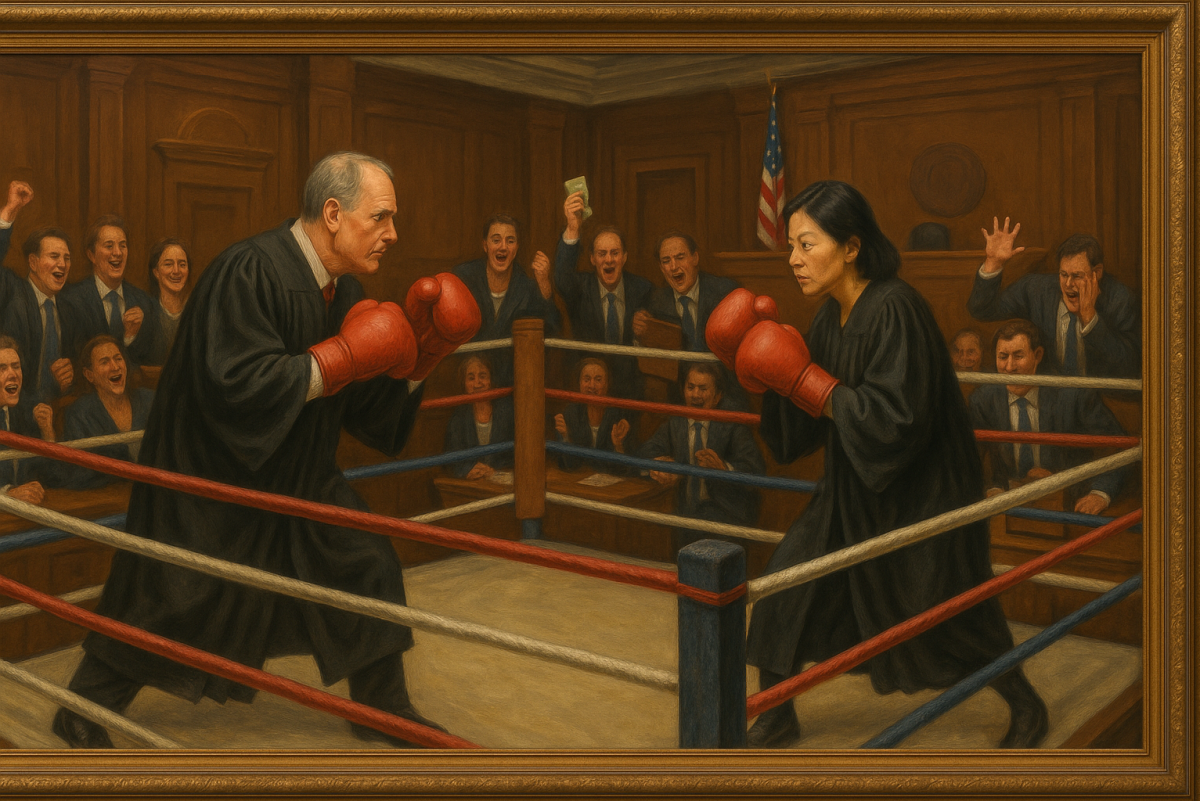
Ilya Somin seems to think so. Watch him tie himself in knots trying to figure out whether the 13th Amendment’s prohibition on involuntary servitude renders mandatory jury service unconstitutional. It is amusing and not altogether silly; at least he comes to the right conclusion that the Constitution doesn’t prohibit mandatory jury service. Of course, it does raise the question of whether my proposal for mandatory service on deliberative civic juries would be unconstitutional under the 13th Amendment. I hadn’t considered that possibility before. I’m not convinced at all that such a constitutional interpretation is sensible — but at least Ilya reminds me that I need an argument to explain why that is so. I suppose any old originalist, textualist, structural, prudential, or ethical argument will do.
Posted by Ethan Leib on September 26, 2007 at 03:09 PM
Comments
I find the idea that the 13A prohibition on involuntary servitude magically excludes or exempts jury duty to be laughable. Applying the principles of strict construction, it is eviden that the framers did not intend to exclude any services that could or might be owed “to the general welfare of the public”, indeed there is no positive expression anywhere in the Constitution that such a public indenture exists at all, in any form.
If the funds of the public treasury be not sufficient to provide through non-coercive means, a suitable pool of jurors, then taxes can always be raised, subject to the limitations of the laws, can they not? That is a power actually granted to the government, whereas the power to compel the services of others is not.
We can not look to nebulous theories, all of which are unsubstantiated, that imagine some heretofore undiscovered “public duty”.
Simply put, there is no such thing.
Posted by: JSebastian | Aug 21, 2020 7:35:43 PM
I was summoned to serve as a juror while self-employed, also. But the six weeks’ advance notice allowed me plenty of time to make the workload and schedule adjustments necessary to mitigate the effects of the anticipated interruption. I informed my regular clients right away, and they were very understanding and accommodating. Of course, every sole proprietorship is different. In many states, if the demands of jury duty are onerous — e.g., it would irreparably harm one’s business — a prospective juror can and does get released because of hardship. I agree jury pay is ridiculously low; and hardly anyone would argue it is just compensation. I do weigh that, however, against my desire to do unto the jury system what I would have it do unto me were I a criminal defendant or civil litigant. As for compelling bystanders to serve, Delaware isn’t the only state that grants sheriffs this power. But I believe it’s limited to the extremely rare case of an insufficient jury pool. The bottom line is we don’t have to keep the present system if we don’t want to. There are ways to reform, abolish or, if all else fails, effectively undermine it. Until we the people are generally convinced there’s a better method for rendering fair and impartial verdicts, I’ll continue to support the system we have now.
I apologize for my most untimely comment. Found this post in my search to discover whether anyone else is exploring the civic-jury concept.
Posted by: Libsareb Raindead | Sep 28, 2014 5:07:05 AM
My reply is more personal, based on recent events.
“I guess Ilya would much prefer this important civil liberty stripped from everyone to avoid the odd minor inconvenience of sitting for half a day on a jury”
It is a “minor” inconvenience when you are someone’s employee, and you lose nothing financially. There is nothing “minor” about being self-employed and having to shut your business down and losing out on hundreds or thousands of dollars of revenue because some smug civil servant, with the audacity to tell you that you have to serve or give up your right to vote and driving privileges, is on a power trip.
In Delaware, after calling it an ‘opportunity to serve’, the rules state that “jurors must be paid a reasonable fee for each day they serve”. Then the law goes on to state that the ‘fee’ is $20 per day, payable only from the second day, and threatens a citizen’s freedom and property for failure to comply with the command for servitude. It also gives the sheriff the right to drag people in off the street in case of an extreme shortage. How is this not involuntary servitude, or a ‘taking’ by the government? How is this the value of an individual’s lost income and time to benefit the state without just compensation not a direct tax?
There is also wording to the effect that the absence of the enumeration of certain rights does not preclude them, nor do the states have the right to legislate away the rights inherent in the Constitution.
If, as some people think, jury service is an obligation that comes with being a citizen, and there is nothing in the Constitution to that effect, why is it only people who drive and/or vote who get summoned? What about the rest of the citizenry? Some people don’t drive. Some people choose not to vote. Some are homeless, and not all of those have disqualifying conditions- many choose not to work. Yet the suggestion to seek jurors among the homeless yielded a ‘how dare you’ lecture from the same smug civil servant. So the conscription, supposedly the ‘duty’ of all citizens, is applied unequally.
In short, compulsory jury service is unconstitutional on so many levels, and unfortunately, the Supreme Court is not about to cut off the judicial branch’s nose to spite its face, so they will never, ever, rule accordingly.
Posted by: AB | Jan 31, 2008 10:21:05 PM
In Hurtado v. U.S., the Supreme Court held that individuals imprisoned as material witnesses awaiting trial were not owed just compensation under the Fifth Amendment for their sacrifices because they owed a public duty to appear (“The personal sacrifice involved is a part of the necessary contribution of the individual to the welfare of the public.”). In a one sentence footnote the Court discarded the plaintiffs’ 13th Amendment involuntary servitude argument: “There is likewise no substance to the petitioners’ argument that the $1-a-day payment is so low as to impose involuntary servitude prohibited by the Thirteenth Amendment.” … So Professor Leib, if you want to play it safe and avoid any constitutional infirmity for your mandatory jury service proposal I would suggest paying them a nominal amount (which would of course be an imperative if you wanted them to deliberate conscientiously). And if you are wondering how much $1.00 is worth now, factoring for inflation, it is the grand total of $3.46.
Posted by: Eli Mark | Oct 13, 2007 8:54:07 AM
I completely agree with you: Ilya’s post is nonsense. One can only worry about such developments. Once upon a time, there was no right to a trial by jury and, hence, people would be convicted with little knowledge of the charges nor the evidence. I guess Ilya would much prefer this important civil liberty stripped from everyone to avoid the odd minor inconvenience of sitting for half a day on a jury.
Posted by: Thom Brooks | Oct 1, 2007 6:58:48 AM