
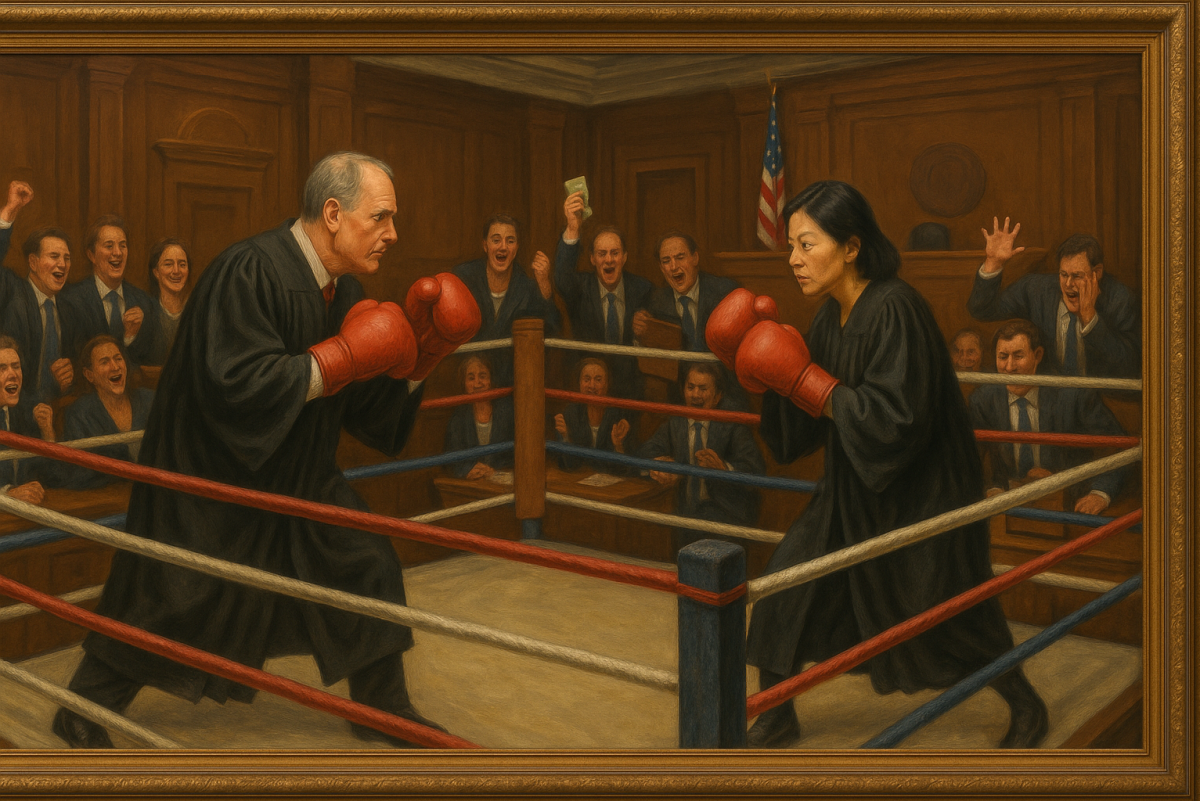
We spend a lot of time discussing different approaches to constitutional interpretation. For example, there has been a recent flurry of activity focused on Originalism, in particular as a consequence of Jack Balkin’s recent conversion to this method of interpreting the Constitution. Legal academics have also spent a lot time discussing approaches to statutory interpretation – or “legisprudence.” Using canons of construction, economic and public choice theory, or various approaches to purposive reading, we have explored a large range of issues vital to understanding the practice of interpreting statutes. By contrast, we spend much less time discussing ordinary approaches to linguistic or literary interpretation in the law, even though such practices can be just as important. For example, the subject of a prior post – the issue of a method of interpreting a video appended to a recent Supreme Court opinion – involved what I’m designating as ordinary textual interpretation. No statute needed interpreting, and constitutional theory was present only as a distant background noise. Straightforward textual interpretation of the meaning or story of the video was the whole game.
Likewise, in another Supreme Court case from last term, Morse v. Frederick, the outcome depended upon ordinary textual interpretation. The Court endeavored to resolve what “BONG HiTS 4 JESUS” meant, when displayed on a fourteen foot banner held by high school students on a public sidewalk across from their school when the 2002 Olympic torch procession passed. Joseph Frederick was suspended after refusing the Principal’s instruction to take it down. He sued, arguing that the Principal’s action violated his First Amendment rights. Writing for the majority, Chief Justice Roberts noted that the phrase was “cryptic.” Nonetheless the Court decided that the “cryptic” phrase reasonably could mean only two things – either a celebration of illegal drug use, or an imperative to engage in illegal drug use. Although neither interpretation seems particularly plausible, more to the point, where the Court had suggested in the prior case involving interpretation of a video that the text could speak for itself, in this case it employed an entirely different method, one that required the Court to speak for the text. My question is: ought we to pay more attention to the methods of “ordinary” interpretation employed by the Court?
The Court’s method in this case began with the two words “BONG HiTS.” The Court reasoned that these two words involved an “undeniable reference to illegal drugs.” The method then involved creating a propositional grammar and content for the reference. To do so, the Court had to speak for the text to derive either an imperative or a celebration. To derive an imperative the Court added an implied verb – “take” – in order to construe the phrase as “take bong hits.” To construct a celebration the Court adds either four or two additional words to create the phrases “bong hits are a good thing,” or “we take bong hits.” Regarding the celebratory interpretation, the Court was unable to discern a “meaningful distinction” between this celebration and “outright advocacy or promotion.”
What is most interesting about this interpretive exercise is that the Court added one, two and four words to create different propositional meanings for the reference “BONG HiTS,” but never considered the meaning or reference of “4 JESUS” at all – nor did the Court consider how inclusion of “4 JESUS” might contribute to any propositional meaning attributable to “BONG HiTS.” First, as a matter of interpretation, construing the meaning of this “cryptic” phrase, for which the Court acknowledges that “gibberish is surely a possible interpretation,” by ignoring half of the words in the phrase is significant, to say the least. Whatever “BONG HiTS” references (marijuana or tobacco, something else more akin to “GONG HiTS,” or nothing at all), the propositional meaning of the phrase cannot be accurately construed by ignoring “4 JESUS,” while substituting different words. In the world of statutory interpretation, this would be like ignoring the actual text of the statute and writing a new one instead – the height of judicial legislating. Second, because the Court finds an undeniable reference to illegal drugs construed as a “pro-drug message,” the Court ignores the speaker’s own expression of meaning – he claimed it was a form of spectacle designed to attract television attention. Although speaker’s intent is certainly not dispositive of meaning, it is certainly relevant. Third, the Court does none of the work associated with linguistic or literary analysis. Linguistically, the Court does not ask how the parts of the phrase fit together, consider the meaning of “4” as likely the preposition “for,” consider the reasons for use of capitalization (is it like shouting on email?), or consider whether the purported proposition is meaningless or nonsense (“Twas brillig, and the slithy toves”), etc. Regarding methods of literary analysis, the Court does not consider how the context might influence the meaning, what the history of the circulation and use of the phrase might be (Frederick claims that he saw the phrase on a sticker on a snowboard), whether it imbeds any cultural references or expresses group identity, whether it participates in any traditions of spectacle, or how it might function as political commentary. These are among the kinds of questions any serious literary rendering of the text might consider while speaking with the text – and all have plausible answers that having nothing to do with “unfurling a pro-drug banner.”
In speaking for the text in such a partial manner, the majority is vulnerable to Justice Stevens’ claim in dissent that they engaged in a “ham-handed” approach. More than this, however, I wonder if the partial exercise in textual exegesis is really beside the point. By interpreting the banner as it did, the Court was able to impart its vision of the proper scope of school authority, unchecked by First Amendment constraints in the face of rebellious and recalcitrant students. Like, for instance, interpreting a nativity scene as not having sufficient religious meaning in an establishment clause setting, such exercises in ordinary interpretation can be the means by which the Court is able to animate and articulate its vision of some domain of constitutional relations (I sketch an argument about the role of vision in more detail here). Interpreting “BONG HiTS 4 JESUS” as the Court does may be an opportunity for it to articulate a limit on the use of the First Amendment to constrain the disciplinary authority of school officials. That is, it may be a vehicle for further doctrinal erosion of Tinker. Even if so, however, ought we to consider methods of ordinary textual interpretation as potentially having similar importance for judicial constraint and legitimacy as methods of constitutional interpretation purport to have? Shouldn’t we be just as concerned about the literary capacities of judges and justices (as James Boyd White has argued for years)? It is tempting to engage Justice Thomas’s originalist understanding of the First Amendment articulated in concurrence in this case because arguments over method in constitutional argument are compelling and important. It is perhaps at least as important, however, to engage the Court’s methods of ordinary interpretation.
Posted by Tommy Crocker on November 13, 2007 at 09:56 PM