
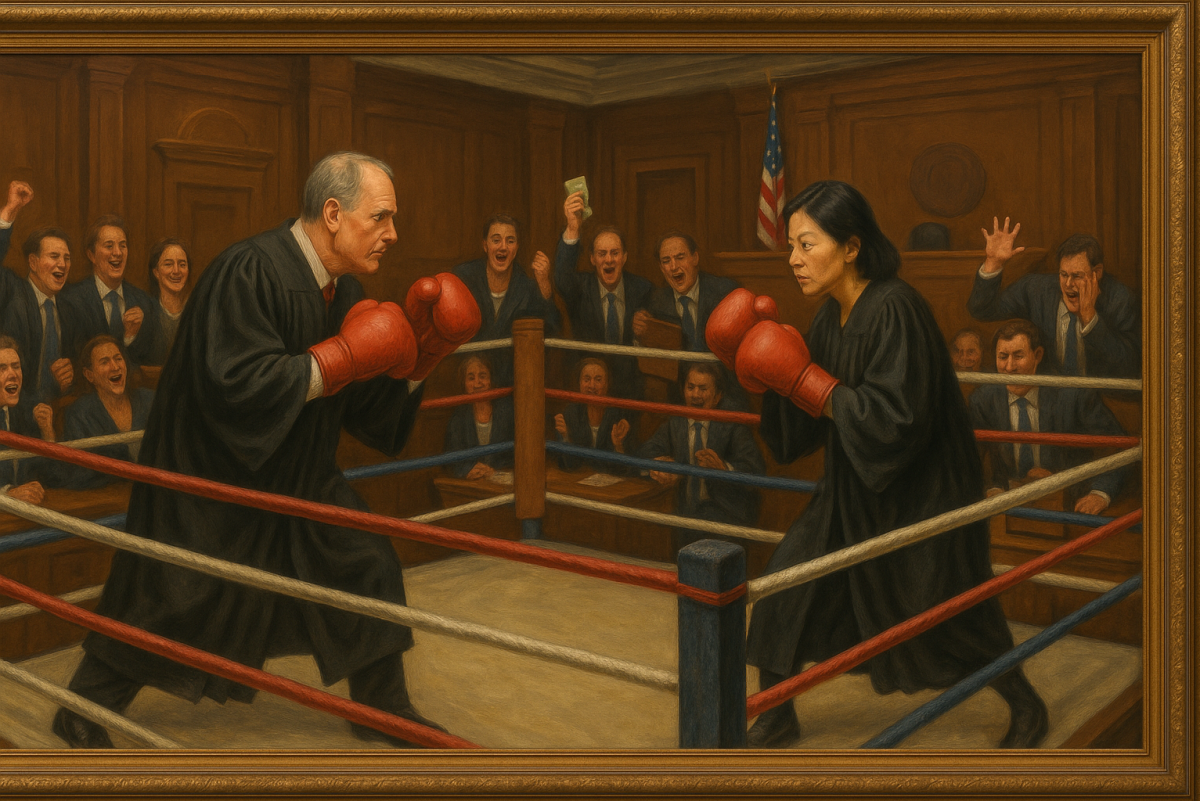
Law schools and litigation: what a combo. Yesterday, Geoff posted about profs suing students. Today, the question is: could a law school sue the ABA and win?
Here’s the background. Via Orin, I found my way to USD Prawf Gail Heriot’s sparky op-ed in the WSJ yesterday about how the ABA pressures schools like George Mason on diversity objectives. After reading it, I came across a post suggesting that GMU should sue the ABA under Section 1981. Since we have some civil rights experts in the audience, I was wondering: could this dog hunt?
After the jump is Hans Bader‘s argument. Please weigh in on the matter in the comments.
The American Bar Association is continually threatening to pull the accreditation of George Mason University Law School for failing to adopt illegal racial quotas in admissions. That’s what San Diego law professor (and member of the U.S. Commission on Civil Rights) Gail Heriot notes in the Wall Street Journal. The ABA first forced GMU — one of the few law schools without a marked liberal bias — to use what the ABA itself refers to as “preferential affirmative action admissions program” to radically increase its minority percentage from 6.5 percent to 19 percent. But the ABA still wasn’t happy with the results, which were insufficiently extreme for the ABA’s quota-mongers (never mind that the qualified applicant pool for a law school of GMU’s caliber is lower than 19 percent minority, as is the percentage of non-white lawyers even in heavily-minority states like California, so it’s not as if having 19 percent minorities is a sign of discrimination. Indeed, the ABA conceded that GMU has long had a “very active effort to recruit minorities,” even before adopting racial preferences in admissions). So now the ABA is demanding what are in essence racial quotas.
The ABA’s actions violate 42 U.S.C. 1981 and the Supreme Court’s ruling in Gratz v. Bollinger (2003), which held in footnote 23 that racial quotas violate 42 U.S.C. 1981 (which bans both private and public discrimination) as well as the Fourteenth Amendment (which bans only governmental discrimination). Moreover, the ABA and its accreditors are liable for pressuring GMU to engage in racial discrimination under 42 U.S.C. 1981, which allows not only employers and other institutions to be held liable for racial discrimination, but also individual discriminators. And GMU and its president and law school dean, who were personally summoned to appear before the ABA in order for them to be pressured to maximize GMU’s racial quotas, have standing to sue over those quota mandates under Lutheran Church-Missouri Synod v. FCC, 141 F.3d 344 (D.C. Cir. 1998), which held that the Lutheran Church had standing to sue the FCC to keep the FCC from pressuring it to take race into account in hiring employees for its religious radio stations in order to satisfy a ”diversity” mandate.
Anyone with relevant knowledge think Bader’s claims stand a chance of success? My sense is that they wouldn’t, putting aside the bombast and rhetoric about quotas, but I’d like to hear more.
Posted by Administrators on April 30, 2008 at 05:07 PM
Comments
I don’t believe the exact same analytical framework carries over from Lutheran Church to the instant case. An institution can bring an action under 42 USC 1981, as they did in Lutheran Church, even where they are merely being pressured to adopt certain racial guidelines. Yes, GMU would have standing to bring an action against the ABA. But I think the claim would be analyzed differently, under the Michigan cases. The holding in Gratz and Grutter was, essentially, recognized that public universities could legitimately attempt to increase diversity of the student body by considering race as a “plus factor”, but could not adopt a rigid point-based admissions system which, in effect, created quotas. With the court now having a different makeup, it’s quite possible that they would move away from this stark division between allowing a general push for diversity in educational settings but striking down racial quotas.
Unless and until GMU actually adopts a quota system as a result of the ABA’s threats, I can’t see this case moving forward. Then again, I freely admit that Hans knows this stuff better than I do. And I’d better get back to studying for my antitrust final.
Posted by: Jonathan Pollard | May 1, 2008 1:36:50 PM
I agree with my fellow student. Also,when school are forced to accept minority students in bulk, the general attitude is that the minority law students are less worthy of being at the school as white students. This is not only entirely untrue, but it is also a disservice to many minority student who would have been admitted on the merits of their application alone.
Posted by: 3L gmu | May 1, 2008 11:23:25 AM
GMU doesn’t need to show the ABA demanded “hard quotas” to have standing under Lutheran Church-Missouri Synod v. FCC, 141 F.3d 344 (D.C. Cir. 1998), which invalidated racial preferences that were not quotas (but rather merely incentives to use race — radio stations were subject to added scrutiny and paperwork if they did not meet non-binding diversity “goals”), and held that an institution had standing to raise such a challenge, even though its applicants and employees — not it — would be the direct victim of discrimination.
Nor would students, who could seek injunctive relief if their admissions chances were affected by the racial preferences, even without showing that they would have been admitted absent the racial preference (as the Supreme Court’s Gratz and Northeastern Florida Contractors decisions indicate).
You don’t need state action to sue under the race-discrimination-in-contracts law, 42 U.S.C. 1981, which covers not just state discrimination, but also purely private discrimination, including discrimination by private schools (as the Supreme Court held in Runyon v. McCrary (1976), in allowing a private school to be sued under Section 1981).
Moreover, if the ABA’s pressure succeeds in forcing GMU to agree to adopt a quota, then I wonder if there would not then be an element of state action (since the ABA is pressuring a state actor — a public law school — to discriminate) under Addickes v. S.H. Kress Co. and other Supreme Court cases allowing conspiracy claims and aiding-or-abetting claims to be brought against private actors under Section 1983 (as opposed to Section 1981) for violations of the 14th Amendment, which does require state action. (Tying federal funding to such discriminatory accreditation requirements also may supply an element of state action, cf. Truax v. Raich (1916) (requiring private employer to fire employee based on alienage violated equal protection); Norwood v. Harrison (funding discriminatory private school violated equal protection); Peterson v. Greenville (prosecutions enforcing private segregation violated equal protection clause); Merritt v. Mackey (federal official’s pressuring private employer to fire private employee without due process violated constitution). If that is true, then perhaps the ABA could be sued by applicants along with GMU under Section 1983, not just Section 1981. But that would be a more complicated and difficult undertaking than just suing under Section 1981.
Posted by: Hans Bader | May 1, 2008 11:22:24 AM
I am a minority student at GMU Law and am appalled by the ABA’s threats. The school – from administrators and professors to fellow students – are incredibly welcoming to all races and creeds. The ABA needs to reconsider its approach to ‘diversity.’ It cannot be measured by simple reference to quotas. Admitting under-qualified minorities will only serve to drag the school’s rank and reputation below it’s merited position. Merit drives admission and other academic decisions. If we are to embrace equality, we must accept the force of objective determinants and forget the mediocrity of fixed quotas.
I am respected because I merit my position. I wouldn’t want to be here to be a simple token statistic.
Posted by: GMU 3L | May 1, 2008 1:29:47 AM
The ABA can certainly encourage schools to increase their efforts to recruit more diverse student bodies. The ABA can even undertake some basic statistical analysis, arriving at what it believes would be a more representative % of minority students in a given law school’s student body. The ABA cannot, however, sanction a school for failing to meet a hard quota. Hard quotas are obviously disfavored under the Michigan affirmative action cases, but general efforts to enhance diversity remain perfectly valid.
Yes, GMU may have standing under Lutheran Church. But unless the ABA explicitly tells GMU to reach X quota or else face the prospect of sanction, I see no real case under 42 USC 1982. Unless the ABA makes such an explicit threat, it can simply argue that it’s true case is not one of quotas, but rather, of a need for increased diversity in law schools. Though it may seem like splitting hairs, the former (demanding hard quotas) is disfavored, while the later (demanding greater emphasis on recruiting a diverse student body) is perfectly legal.
Posted by: Jonathan Pollard | Apr 30, 2008 11:18:45 PM
Under the Brentwood decision, the ABA might be considered a state-actor under the wonderfully nebulous “nexus” test.
Posted by: anon. | Apr 30, 2008 9:40:00 PM
The ace in the hole – SCOTUS will have a GMU grad as a law clerk next term – (Justice Thomas – William Consovoy – Class of 01)
Posted by: anon | Apr 30, 2008 9:19:58 PM
No state action?
Posted by: Jackson | Apr 30, 2008 7:23:50 PM
There is in fact lots of litigation under “common law” due process claims (PDP and SDP)regarding the accreditation process. See e.g. Thomas M. Cooley Law School v. ABA, 459 F3d 705 (6th Cir. 2006); Ambrose v. New England Assoc. of Schools and Colleges, Inc., 252 F.3d 488 (1st cir. 2001). I would be surprised if one could not shoehorn these arguments into that approach – at least to survive a R12 motion; of course, you would not be recovering your attys. fees!
Posted by: Martin Rooney | Apr 30, 2008 5:54:52 PM