
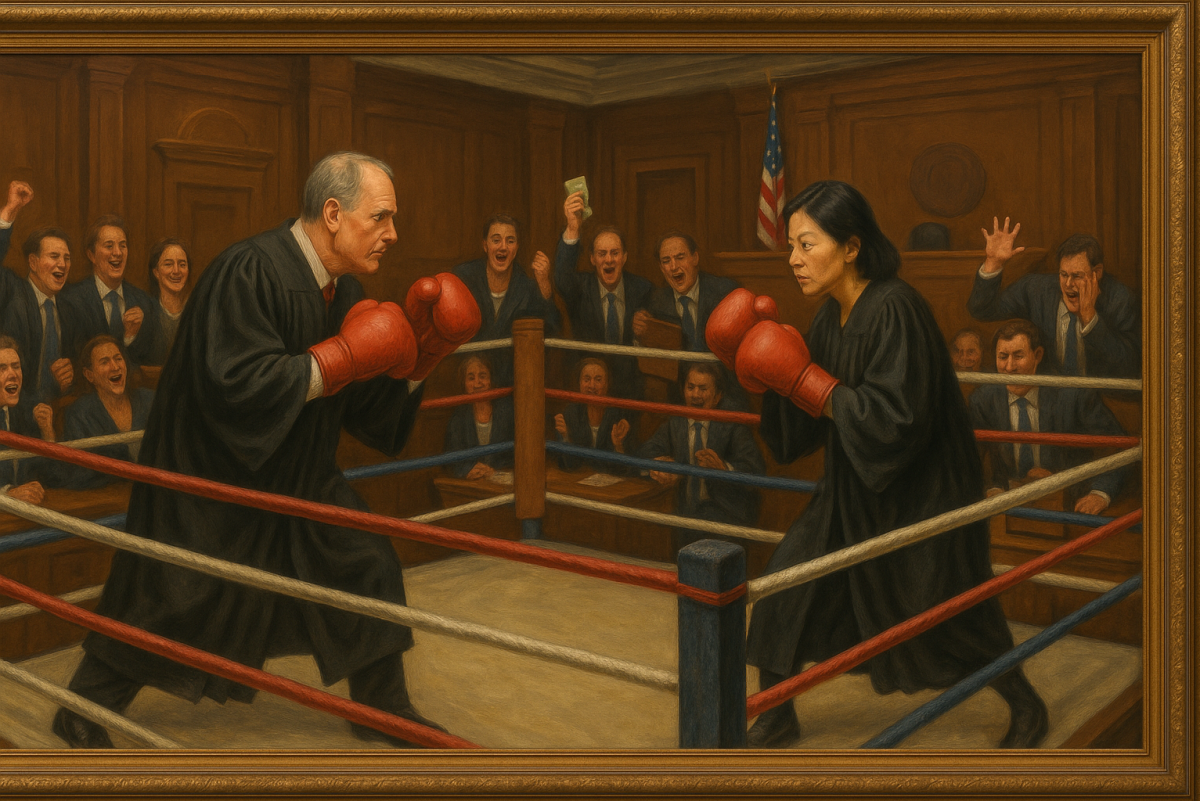
A couple hours ago our committee finished its last interview at the meat market meet market AALS Faculty Recruitment Conference. This is my second year as a tenure-track professor, and my first appointments committee experience. Comparing this experience to the one I went through just a couple short years ago, I learned the following:
1. Apparently it’s pretty rare for such new faculty to be on an appointments committee. Perhaps we’re progressive that way, or just gluttons for punishment, but two of our group are in their second year. At the same time, I relish the input I am having on the process.
2. The interviewing process is simply exhausting. Just as I always thought it was more tiring to take a deposition than to be deposed, I think it is more difficult to interview rather than be interviewed. (I except candidates that have 20+ interviews from these comments). We were on for a full half hour, every half hour, all day. No breaks except a lunch made short by being perpetually behind. I envied the candidates that got to stretch their legs on the run between towers – not the stress, and the rushing from room to room, but the ability to move for a second.
3. As a candidate I thought it was challenging to be on for every interview – not knowing which scholarship might be discussed. But at least it was my scholarship and I was familiar with it. This weekend we engaged 28 candidates on their scholarship, often wholly unfamiliar to at least some (and sometimes all) of us. It was like 28 mini-workshops where you can’t sit back and listen to other peoples’ great questions.
4. I can’t over-emphasize how impressed I was with all of the candidates. Everyone we interviewed had something really great to bring to the table. Of course, some did better than others, but I am really pleased with the work we did to select a slate of folks to meet. I also really personally liked some of the candidates aside from what they might contribute as scholars and teachers, including many I know we won’t have room to call back. I have been told that for many candidates one callback for every three interviews, and even one callback for every five interviews, is a good result. I understand that now. We surely will not be able to bring every highly qualified and engaging candidate back to campus, and it really stinks. And it may have little or nothing to do with a candidate’s quality or likelihood of success. If our full faculty had infinite time, patience, and money I would want to introduce most of our candidates to them. Did I mention the part where I personally liked many we just can’t accommodate? Ugh. *
5. That said, I don’t want to give potential candidates too rosy a picture. There were candidates who just weren’t ready to go on the market for a variety of reasons. There are things you can (and should) do to get ready for the academic teaching market. Prawfs and other sites have many tips on this, including a compilation I keep at my own web site. I have also read others say that being on this side of the table clears up a lot of mysteries in appointments, and it’s true. Things that didn’t make sense to me when I was a candidate make perfect sense in the dynamics of appointments committee decisions.
This has been a great experience, but one that is both exhilarating and exhausting. I hope we make the right choices as a committee – it’s a lot of responsibility that we took very seriously.
*Anyone reading this that interviewed with our committee – please don’t read anything into this about how you did. Our committee made no decisions today, is not meeting until we are back at school (did I mention the part about how exhausted we all are?), and my own personal thoughts are only one vote in any event. That said, if you don’t get a callback, also don’t read anything into it about how you did. Did I mention that there were people we really liked that we won’t be able to call back?
Posted by Michael Risch on November 8, 2008 at 08:15 PM
Comments
For purposes of sharing and consolidating information, it would be helpful if candidates/appointments committee members could post the names of schools extending call-back interviews here: http://prawfsblawg.blogs.com/prawfsblawg/2008/10/a-law-school-hi/comments/page/5/#comments
Posted by: anon | Nov 10, 2008 12:57:56 PM
Actually, a number of top 20 law schools have already extended invitations. My school made several offers to vist campus over the weekend. We aren’t going to go much deeper down our list, but if you are uncertain and very interested in us ask before accepting another offer.
Posted by: anotherlawprof | Nov 10, 2008 11:21:42 AM
I have an offer and deadline from school A and told all of the schools I interviewed with about it. They all told me I would know whether they were advancing me in their first round by Monday or Tuesday of this week. I received one invite from a school that I do not prefer to school A and have yet to hear from anyone else (except from one school assuring me I am alomost certain to get an invite). I told them pretty clearly that if I don’t receieve an invite I intend to accept school A’s offer.
Posted by: anon | Nov 10, 2008 9:51:27 AM
i’m a law prof at a top 20 school, and we almost never invite anyone back at the conference itself. the faculty members present at the aals certainly discussed the candidates and even tentatively ranked them, but we won’t make any decisions until we go back and meet with our whole committe toward the end of next week.
as for the question regarding whether our decisions are actually made in advance of the conference: the 30 minute interview is a significant data point, but it is not the only one or sometimes even the most important. there were a few candidates whose scholarship so impressed us that the interview standard was likely to be ‘don’t screw this up and we’ll call you back.’ conversely, there were a few candidates who we thought were weaker going in, but who had some sparkle that made us want to see them in action, or perhaps had teaching interests that were ideal and so we figured we’d give them a shot even though other aspects of the candidacy seemed less promising. those candidates would have to do a bang-up interview in order for them to survive to the next stage. in the middle is, well, in the middle. in short, the interviews truly do matter, often quite a lot, but it’s true that there may be at least an informal ranking that precedes the interview and influences later decision for call backs.
Posted by: lawprof | Nov 10, 2008 2:43:12 AM
As someone who was on the other side of the table from the professors . . .
1) I was amazed by how pleasant and engaged the interview teams were, on the whole. Much different (read: better) than the representatives of law firms were during on-campus interviews lo those many years ago.
2) About half of the interview teams included someone who had read one or more of my articles, usually one. There was a positive correlation between the “reputation” of the school and the likelihood that someone had familiarized him- or herself with something I had produced. Where someone had read what I had written, it led to more-challenging questions and, on balance, better interviews.
3) I had slightly more than a dozen interviews. I received a callback offer on Saturday (one); radio silence so far other than that.
4) The most awkward moments during the interviews did not involve questions I was asked. They occurred once the interview teams asked me to ask them questions. The elephant in the room with many schools is whether their budget situation will allow them to fulfill their initial hiring plans. I’m not sure whether I found a subtle yet effective way to broach that topic.
All in all, thanks to the vast majority of professors who managed to stay remarkably engaged and civil throughout what I am sure was an arduous process.
Posted by: anonymous | Nov 9, 2008 8:57:18 PM
To the anon prawf above: have you already called your “top candidates” or are you waiting to call them tomorrow?
Posted by: anon | Nov 9, 2008 8:48:40 PM
My school made a decision to invite through about a dozen of the candidates for campus interviews on Saturday. Most other schools I talked with made decisions on their top candidates at the conference, although a few may get around to it next week.
Posted by: anon | Nov 9, 2008 8:21:29 PM
Orin, I agree for the most part. I would say that there were several candidates we all agreed were good, but that our personal rankings are based on factors that are different for each committee member.
Which segues to Laura’s question. I suspect that different schools do it differently, but we did not have pre-determined slots. I’m certain that each member had favorites that we were rooting for, but you can learn a lot more than you might think in half an hour, and it is quite possible for a committee to make a quick decision on callbacks based on a good interview.
That said, at the margins it again becomes difficult to clearly differentiate candidates for callbacks. The debates are not usually about the first slots on the callback list, but the last ones. Those choices can depend on a lot of dynamics – committee members, school needs, guesses about the full faculty would vote, and of course the candidate. As noted in the post, if I had my druthers, I would invite 10 candidates back for the faculty to meet, but we are too busy to make that happen – so, the committee has to make some tough choices.
As Garry Marshall says in Soapdish: “This is the toughest decision I’ve ever had to make…but I get paid 1.2 million dollars to make these kind of decisions…” Of course, we have to do it for free.
Posted by: Michael Risch | Nov 9, 2008 11:58:52 AM
My husband just went through AALS for the first time and he commented that he didn’t understand how the various hiring committees could learn much about a candidate in such short interviews. We both wonder if the committees know before the conference who they are going to callback (i.e. a predicted first-string) and that the conference is just to make sure that the candidates that the committee likes can walk and chew gum at the same time. Case in point–my husband got one call back just hours after his interview with that school.
Do you think that’s an accurate description of what happens, or does a lot more truly hang on the candidate’s performance at during the interview?
Posted by: Laura | Nov 9, 2008 11:28:27 AM
MF,
I can’t speak for Michael, but when I was on the appointments committee at my school, I was struck by how different members of the committee were influenced by considerations other than scholarship. A candidate would come in who was obviously an engaging and prolific scholar, and who I thought was a star, and other members of the committee would think the candidate was a complete dud. So I think different committee members are just looking for different things.
Posted by: Orin Kerr | Nov 9, 2008 11:08:59 AM
MF –
There’s not much I can explain – they are little things (which may be different about each candidate) that affect the way we perceive a candidate that the candidate has no idea is being projected. Body language, scholarship choices, interviewing styles, etc. I suspect that they are different for different people and schools. The primary point of the comment was that candidates may leave an interview thinking things went perfectly, while the interviewers may have formed different impressions. I’m pretty certain that if I went on the market again the same would still be true for me, despite my experience. It’s all about perspective and the candidate never has the perspective of the particular interviewing school.
Posted by: Michael RIsch | Nov 9, 2008 7:08:35 AM
“I have also read others say that being on this side of the table clears up a lot of mysteries in appointments, and it’s true. Things that didn’t make sense to me when I was a candidate make perfect sense in the dynamics of appointments committee decisions.”
Can you explain more about this?
Posted by: MF | Nov 8, 2008 11:04:39 PM
anon – two good posts on your question: http://prawfsblawg.blogs.com/prawfsblawg/2005/11/meatmarket_stuf.html http://leiterlawschool.typepad.com/leiter/2007/11/how-long-after-.html
Posted by: Michael Risch | Nov 8, 2008 10:16:39 PM
So what’s the timeline for the callback decisions for most schools? I ran into a candidate who told me that she received a callback Saturday from a school she interviewed with Friday. Is that common?
Posted by: anon | Nov 8, 2008 9:45:00 PM