
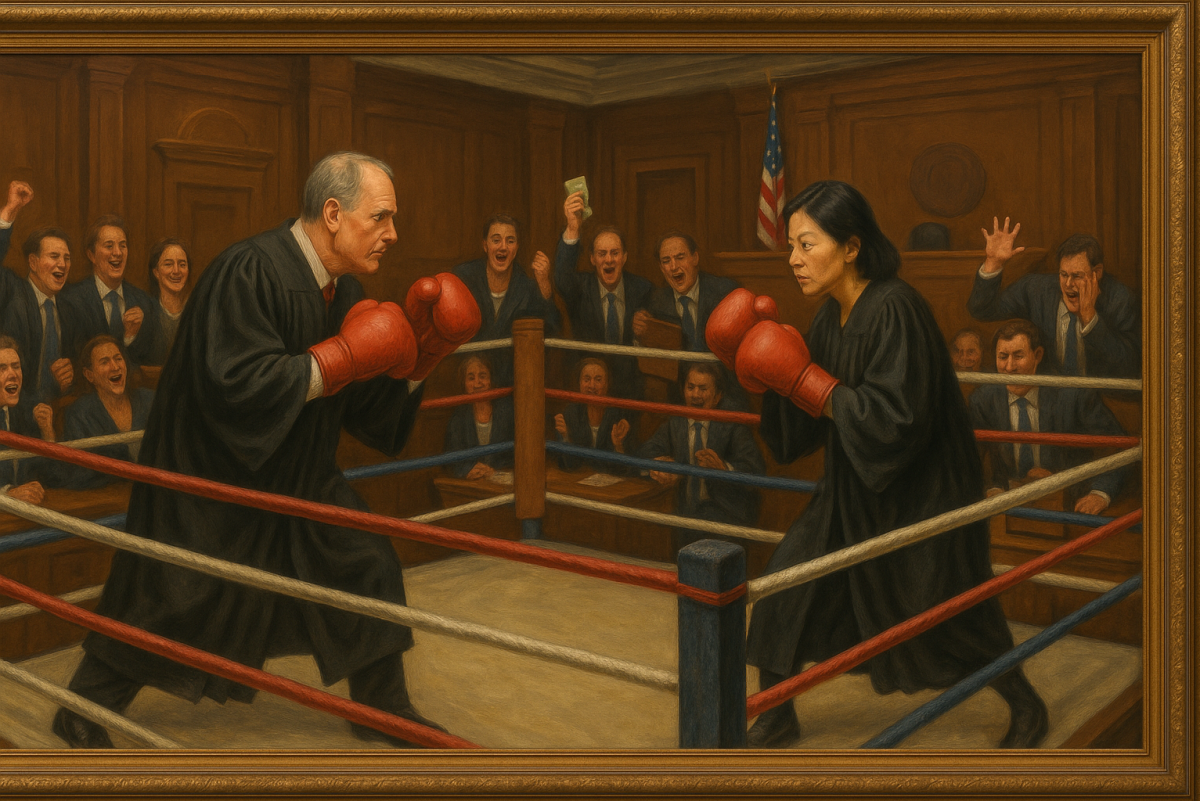
Last weekend, the Stonewall Legal Alliance at FIU College of Law hosted a day of panels on Florida’s Amendment 2, a ballot initiative amending the state constitution to define marriage as a union of one man and one woman and prohibiting creation of substantially equivalent unions. At the heart of the event was a debate between my friend and colleague Professor Jose Gabilondo (Stonewall’s faculty adviser) and Marge and Shirley Phelps of the Westboro Baptist Church–an anti-(inter alia) gay rights group best known for picketing at the funerals of fallen soldiers.
The invitation was met with anger and criticism from all sides. Some on the left argued the invitation gave Westboro legitimacy in the public debate that it did not deserve. Jose has told me that he received letters of protest from a number of groups, including the Anti-Defamation League and the Southern Poverty Law Center, as well as letters from individuals directly critical of him. Requests were made to both the COL and University administrations to intervene and rescind the invitation. And some campus student groups were urged by administrators not to attend the event so as to avoid being confronted by insulting words and ideas. Some on the right complained that inviting Westboro to present the pro-Amendment 2 position was stacking the rhetorical deck in the anti-amendment side’s favor, because the opponent is incapable of presenting the “true” intellectual arguments against same-sex marriage and can do nothing other than turn the event into a circus that will horrify observers into opposing the ballot proposal and make Prof. Gabilondo’s anti-amendment arguments look better.
Jose discusses the controversy here, including a strong defense of uniquely open intellectual exchange in a university setting, including the presence of non-“mainstream” speakers and views. (And, to the extent it matters, Stonewall invited a number of local and national amendment supporters, all of which declined the invitation.
The common theme, left and right, is that Westboro is not (and should not be treated as) part of the legitimate public debate or public discourse on these issues. The Phelps are not capable of engaging in an intellectual or academic debate, because their views are too out-of-the-mainstream, and thus should not be included. They are a hate-spewing, bigoted circus show that either (from the left) does not deserve to be legitimized and treated as having something useful to say or that (from the right) should not be allowed to make the case for the conservative, anti-same-sex-marriage side because they cannot make it well and will have the effect of making those who agree with their conclusions, but for legitimate, non-bigoted reasons, look like bigots. Westboro is not part of the “mainstream” of public views and thus should be excluded from the discussion. Not to say that they cannot speak in their own fora (although multi-million-dollar civil judgments will curb that); only to say that they should not be invited into the fold of “polite” public fora, such as at a university event.
Jose’s post offers a strong defense of expanding the range of speakers and ideas to be included in the debate, a position I share. It is not clear how one defines “mainstream,” a politically loaded term. And even the most reprehensible views (or most reprehensible manner of expressing some views) should be given the opportunity to be exposed to the light of day, if only to be ridiculed and defeated appropriately.
This incident brings to mind two somewhat similar controversies. The first occurred when I was in college in the late ’80s. Northwestern had a tenured engineering professor whose hobby was Holocaust denial and who had written a book on it. Around the same time, a Holocaust denial group published several editorial advertisements in The Daily Northwestern, pitching its views and seeking to debate (or at least sit down for a beer with) Peter Hayes, an NU history professor and leading Holocaust scholar. This was in the relatively early days of both the Holocaust as a subject of scholarship and pedagogy in the U.S. and of Holocaust denial as an open subject, at least in the U.S. And Hayes explained to me that he (and others in the discipline) refused to engage on the subject with deniers (either the engineer or the head of that group), whose views were deemed intellectually unserious and unworthy of engagement.
The second is ongoing. Last week, FIU’s College Republicans hosted a two-day display by a group called the “Genocide Awareness Project,” an anti-abortion group that compares legalized abortion to, among other things, the Holocaust, slavery, apartheid, and the Cambodian Killing Fields, and features graphic photographs of terminated fetuses. FIU’s decision to allow the group to set-up has been met with protests and criticism from faculty and student organizations, in part based on the view that the Genocide Awareness Project is an extremist, out-of-the-mainstream group that has no place on campus. Stay tuned on this one; I expect it to become a topic of discussion on campus, about which I likely will write more.
I am not sure of the answers here (although I know what my normative preference is). Is there some difference between what views and ideas are acceptable in political debate (broadly defined) and what is acceptable in academic or university debate–and if so, should the university be more inclusive of non-mainstream ideas? I throw this out for consideration.
Posted by Howard Wasserman on November 3, 2008 at 06:43 AM
Comments
While I strongly support the inclusion of non-conventional viewpoints in academic discussion, in this instance I think it is important to be clear about the nature of the group in question. The Westboro Baptist Church is an independent organization and is not affiliated with any Baptist conventions or associations. In fact, it is a 71-member group helmed by Fred Phelps and primarily known for its hallmark slogan “God Hates Fags.” Group members regularly appear at gay rights events, where they (literally) scream about how much God hates gay people. (http://www.godhatesfags.com/). Phelps and his followers believe that God also hates America because America fails to adequately punish gay people. They believe that homosexuality should be a capital offense. When the group appears in public its members tote signs that include messages such as “Fags die/God laughs” and “Thank God for AIDS.”
Not only does it seem safe to categorize Phelps’ group as quite outside the mainstream (if that concept has any meaning whatsoever), but it also seems safe to conclude that a group that is organized primarily around the notion that God hates gay people will have little to contribute to an intellectual exchange about the Florida ballot initiative. Further, having seen the Phelps group in action a number of times, it seems likely to me (and to the Anti-Defamation League, which has described WBC as publicity-hungry ) that the group will approach the debate less as an opportunity to participate in a meaningful dialogue and more as a conduit for its God-hates-gay-people message. It is regrettable that the group has found a platform that bears the imprimatur of intellectual legitimacy.
Posted by: Anon | Nov 3, 2008 3:07:06 PM
I don’t think it is necessarily beyond the bounds of an academic discussion to invite a group such as the Westboro Baptist Church to a debate. However, I would take issue with it in this particular case, as it seems the WBC was the sole representative of the ‘anti gay marriage’ side in this debate. I understand the limitations of a student group’s ability to bring speakers of its choice to campus, and it seems they did make an effort to bring other speakers. However, settling on a group so far out of the mainstream (however one defines that term) ends up cheapening the debate, even if that was not the intended effect.
Posted by: D | Nov 3, 2008 12:16:27 PM