
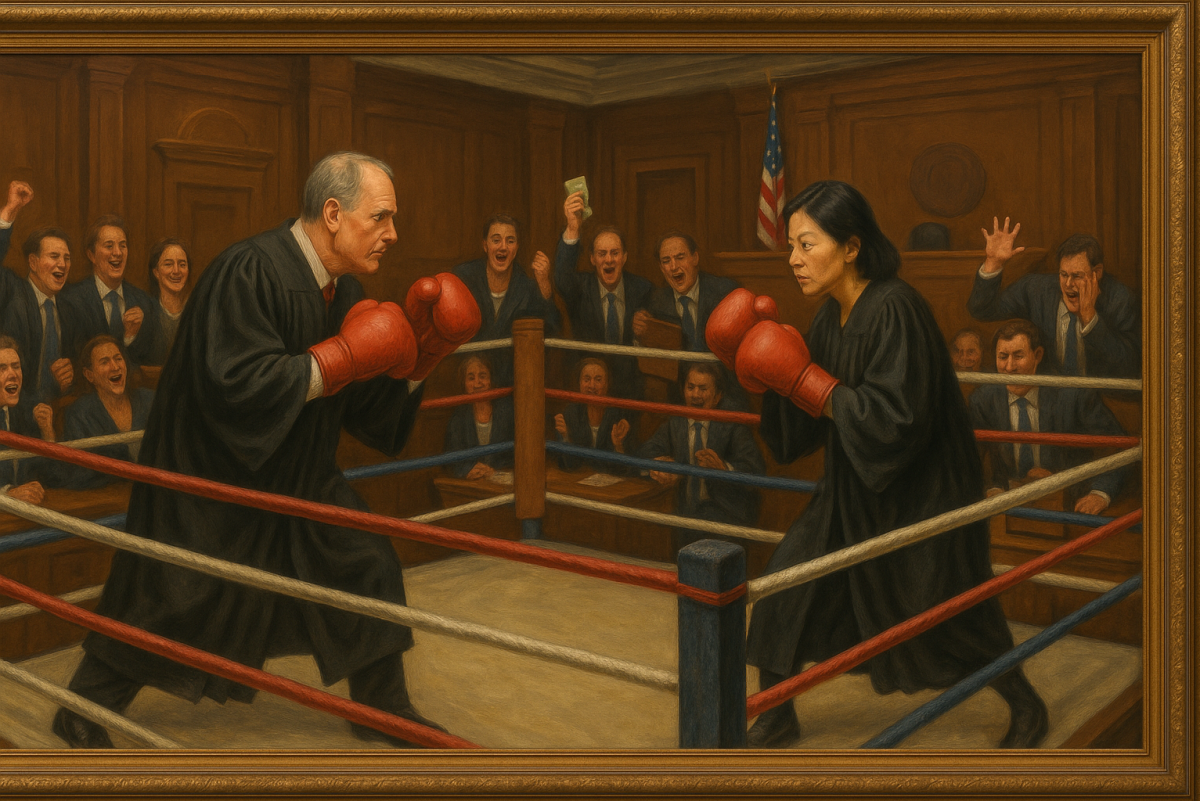
A couple years back in this very space, guest prawfsblawgger Liz Glazer invoked Bob Slydell’s immortal line from Office Space (“Just what would you say … you do here?”) to frame a discussion of the challenges of explaining to non-lawprofs … well, just what it is we do here. In this post, I want to pose a narrower question that crops up whenever I try (often with little success) to explain the content of my job to those outside the academy.
Often when I am in the process of attempting to explain the character of lawprof-ing, my interlocutor will reply, “Oh, you’re a lawyer” (or ask, “So you’re a lawyer?” or some such). I’m often unclear what to say in response to this. My guess is that most lawprofs would simply answer “yes”, and I can see the intuitive appeal of this reaction. After all, we all have law degrees and we train future lawyers, certainly we must be lawyers ourselves, right? But for some reason, I don’t find the answer to this question to be quite so straightforward. I understand the inquiry to be one about the content of my work (this may be wrong for reasons I detail below), and nothing about what I do looks anything like the applied practice (as opposed to the academic study) of law.
All this has prompted me to think more about what it means to be a lawyer. I propose a typology of possible approaches to this issue, and my sense of where I (though not necessarily others) fit, below the fold.
Here are a few different ways we might understand what it means to be a lawyer. First: simple formalism. Pick your bright line: if you’ve earned a J.D., or passed a bar, or are a member of a bar, then you’re a lawyer—it’s a status that you earn at some point, and that stays with you throughout your life, regardless of what you end up doing professionally. If you don’t meet the criterion, you’re not a lawyer, period. The appeal of this approach is that it’s nice and clear, like all formalism. The downside is that it has over- and under-inclusivity issues. If the definition is “passing the bar at some point in your life”, then the Duncan Kennedys of the world don’t count as lawyers (though one might say this is right). Moreover, if you pass the bar at 27, but leave law behind altogether for decades, does it still make sense to say you’re a lawyer at 60?
Second: practical functionalism. This is just the opposite of the formalist approach above. The idea is that if you practice law, you’re a lawyer. As I suggested above, this is how I usually understand what it means to be a lawyer. There are lots of people with J.D.s and even bar memberships whose daily work looks nothing like the practice of law, and who wouldn’t know how to advise or represent a client if their life depended on it. It’s hard for me to see how such folks (which may include a lot of law profs, possibly myself) can meaningfully be called lawyers, even if they have a diploma from an accredited law school sitting in a box somewhere. It’s worth noting that this approach doesn’t have an overinclusivity problem, because the ABA’s unauthorized practice guidelines preclude those without some kind of credentials from practicing law.
Third, and finally: lawyerly ethos. This approach suggests that being a lawyer is a set of behavioral norms rather than a formal or functional question. That is, if you act in a certain way—and in particular, if you frequently deploy what we think of as distinctively legalist reasoning—you’re a lawyer. The skill set we call “thinking like a lawyer” and that most of us attempt to inculcate in our students—critically examining assumptions, reliance on careful interpretation of language, and a willingness to engage in reasoned argument—is often what laypeople seem (in my experience, at least) to most strongly associate with being a lawyer. This approach, of course, has serious under- and over-inclusivity issues as well. I’m sure we can all think of lots of folks who have lawyer-esque approaches to reasoning even though they’ve never been formally trained in law school.
So given this typology, are lawprofs lawyers? The reason I find this inquiry interesting is not that I think there’s a right or wrong way to define “lawyer”, or a correct or incorrect way to categorize lawprofs pursuant to the above typology, but rather that it has forced me to think about what it means to be a lawyer. There are, of course, plausible arguments in both directions. I typically adopt a narrower (functionalist) view of what it means to be a lawyer, and as a result I typically say I’m not one. Most lawprofs I meet tend to prefer broader definitions that capture lawprofs in the definition of “lawyer” (although some lawprofs still practice, which makes them lawyers by any measure). So one’s answer to this question may say more about one’s own preferred professional self-conception than it does about what the right understanding of the term “lawyer” is. Interested to hear what others think.
Posted by Dave_Fagundes on July 7, 2009 at 01:58 PM
Comments
In most countries, the criterion is bar membership. Passing the bar is quite difficult in most European countries, including the UK. It usually involves several exams and extended apprenticeships, taking more than a year at least. As a result, the only people who go through that process are people who want to practice law before the courts, and they are lawyers. In my country, the Netherlands, lawyers represent about 10% of all people with law degrees.
A much larger group will give legal advice, or have some job that requires legal knowledge, without ever appearing in court. That includes law professors, of course. For such people I tend to use the word jurist. Jurist is the Dutch and French word for non-lawyer law people, and I find that with a bit of imagination it can pass for an English word as well.
If, by any chance, you don’t like the word jurist, why not simply describe yourself as a legal scholar? That concept seems clear enough.
Posted by: Martinned | Jul 8, 2009 11:41:23 AM
How about this wrinkle? Back in school, I seem to recall learning that this marked the difference between a lawyer and an attorney. A lawyer simply has a law degree; an attorney is a member of the bar and is “practicing law” (as David Krinsky defines it). So on this, most law professors are lawyers, but most are not attorneys.
Of course, I also could quote a senior colleague, during a faculty meeting to discuss a By-Law change that potentially raised constitutional concerns: “I’m not a lawyer, I’m a teacher.”
Posted by: Howard Wasserman | Jul 8, 2009 6:55:42 AM
I don’t think the appropriate formalist criterion is “passing the bar at some point in your life.” I think it’s “being a member of the bar.” That is, if you’re not entitled to practice law somewhere, you’re not a lawyer.
This is only overinclusive if “to practice law” and “to be a lawyer” are synonymous. I don’t think they are. If you’ve gone to the trouble and expense of keeping your license up, even though you’re not practicing law, you’re a lawyer. If you haven’t, or you never had a law license, you’re not. The only corner cases that occur to me offhand are people whose law licenses have some sort of inactive status, or perhaps some people with foreign legal credentials, but I’d argue that these could go either way depending on the factual details.
Most lawprofs are lawyers; fewer of them also practice law. If you’re asked whether you’re a lawyer, why not just respond, “I am, but I’m not practicing”?
Posted by: David Krinsky | Jul 7, 2009 8:58:33 PM
I usually answer that I am “not actively engaged in the practice of law in Mississippi,” which is how I get my discount each August.
Posted by: Chris | Jul 7, 2009 5:44:58 PM
I sometimes point out to my students, for laughs, that I don’t actually need to be admitted to the bar to teach them law. (I am, but I didn’t need to be.) My intuitive sense is that the term “lawyer” tracks the bar’s definition, which is someone who is actually practicing law, and therefore needs to be admitted in the jurisdiction where they’re practicing.
Posted by: Bruce Boyden | Jul 7, 2009 5:00:51 PM
Dave,
In direct answer to your question, I think lawprofs are lawyers, although many try to act is if they aren’t. I think Judge Harry Edwards had it right 15 years ago when he wrote about the growing disjunction between law school and law practice. Judge Edwards pointed out that some law professors, particularly those focusing on the “law and X” and “critical studies” areas, are really hostile toward practice and, I think, see the JD has just another reminder that they’re not professors in one of the humanities. I suppose you could call it Ph.D. envy.
Posted by: Gil T. Azell | Jul 7, 2009 3:20:44 PM