
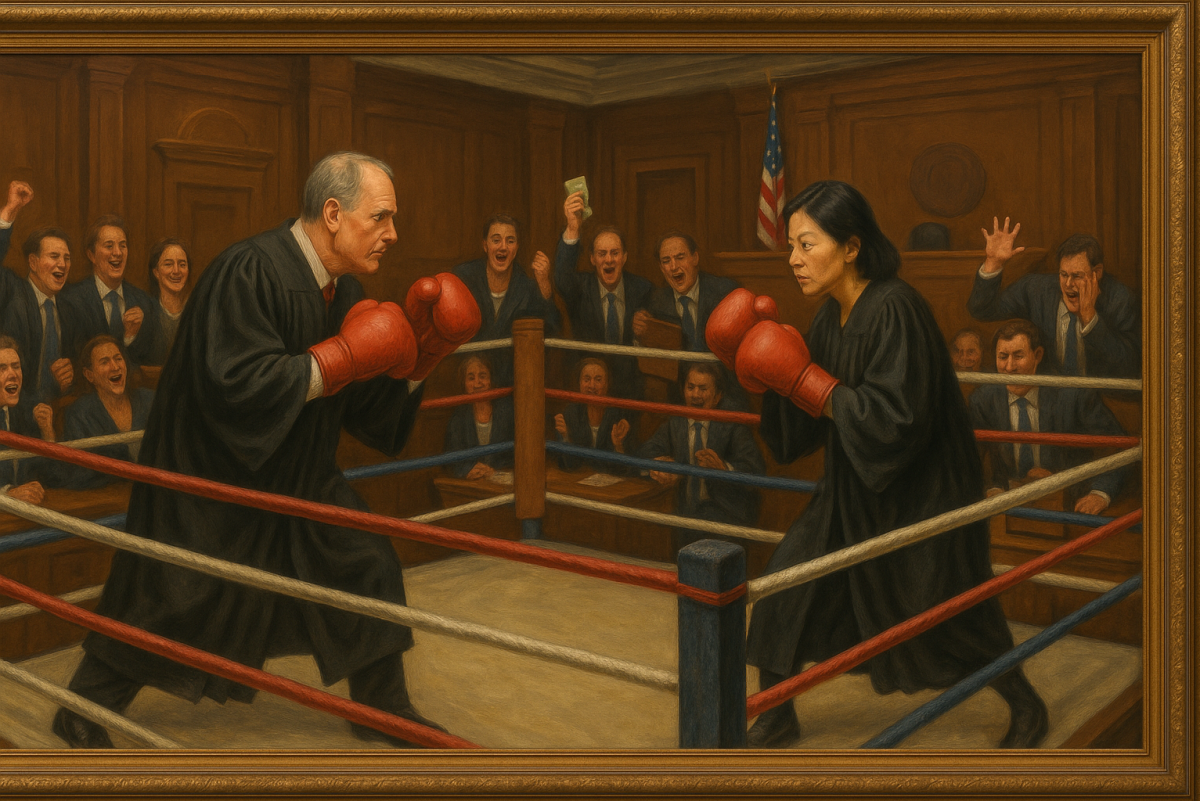
As a lover of federalism, I can only hope that the Daily News has the opportunity to run such a headline. My readers (both of them) will recall that the Daily News published its immortal headline, “Ford to City: Drop Dead” in October of 1975, after Ford refused to bailout New York City from its crushing debt, forcing Gotham to confront the reality of its fiscal crisis and re-negotiate its contracts with its unions. Since La Guardia cultivated his special relationship with FDR, the City had counted on federal assistance to cover its tab with bondholders. This ultimate faith in federal aid led the hapless Mayor Beame to use short-term notes to cover gaping holes in the City’s budget in the early ‘70s. When Ford made it clear that he would not be the City’s sugar daddy, the remorseless logic of Felix Rohatyn (essentially speaking for the City’s bondholders as head of the Municipal Assistance Corporation) forced Victor Gotbaum of District Council 37 to accept a significant trim on the city workers’ benefit. (For a short account, see pp 47-48 of Jerry Markham’s history of public finance). The alternative was default, state takeover of the city, loss of access to bond markets for decades – in short, the Detroit-ification of the Big Apple.
It will not surprise any of my readers (both of them) that I think that Ford’s refusal to sustain NYC’s spending addiction led to the re-birth of New York City in the 1980s. By requiring the city to rely more heavily on its own tax base, New York’s fiscal crisis ultimately improved the accountability and efficiency of city government. Voters who do not have to pay for their municipal services ultimately ignore corruption and waste: Like the oil that fuels the corruption and inefficiency of petrocracies like Nigeria, the federal funding of NYC from La Guardia to Beame led to a lax political culture of union contracts with unaffordable escalation of benefits and no performance measures. By contrast, voters who foot the bill for their services demand value for their money: Citizens tend to be much more unforgiving of a high crime rate, garbage collectors’ strikes, police who stage slowdowns, etc, when these dysfunctions are accompanied by high taxes.
The burning question for fiscal federalists (asked, for instance, by Megan McArdle in this week’s Atlantic Monthly) is whether the feds will be able to resist the temptation to bail out profligate governors like Schwarzenegger. The long-term costs of federal bailouts are immense: As Jonathan Rodden notes in his study of federal-state fiscal relations in the United States, Brazil, and Germany, such bailouts destroy the credibility of federal commitments to force subnational governments to live within their means. The fiscal independence of subnational democracy depends on such commitments: Otherwise, subnational politicians face a tragedy of the fiscal commons, as they race to pillage the federal fisc, knowing that their own austerity will not save their own voters from bailing out the profligacy of neighboring states. Of course, no one expects the feds to provide zero bailout money. (Ford actually ended up asking for a couple billion to keep NYC afloat). But, if one wants subnational governments to remain fiscally viable centers of independent democracy, then states’ taxpayers and employees should both be forced to bear the lion’s share.
Remember: The motto of every serious fiscal federalist is, “No Representation Without Taxation.”
Posted by Rick Hills on April 8, 2010 at 08:55 AM
Comments
I agree. On a related (I think) tangent, Rick, do you have any views on the health care bill’s massive shift of costs to states after the 3-year (I think) startup? As I understand it, the feds pick up the tab from 2014-17 for all, then much, then none, of the Medicaid expansion. That seems to me the opposite problem, if it actually happens as scheduled: the bill was able to achieve its CBO score and look responsible by dumping projected costs on states.
Any future outcome seems messy. If it happens as planned, the states are in deep trouble. If the states beg for help, they have a better case than in the NYC or California example, because they’ll just be asking for the feds to make good on their own mandates, not to fix state-chosen mistakes. But if that happens instead, then it turns out the bill was sold on a bait and switch, by just temporarily parking the cost on states to get through.
Posted by: federalist guy | Apr 8, 2010 11:12:04 AM