
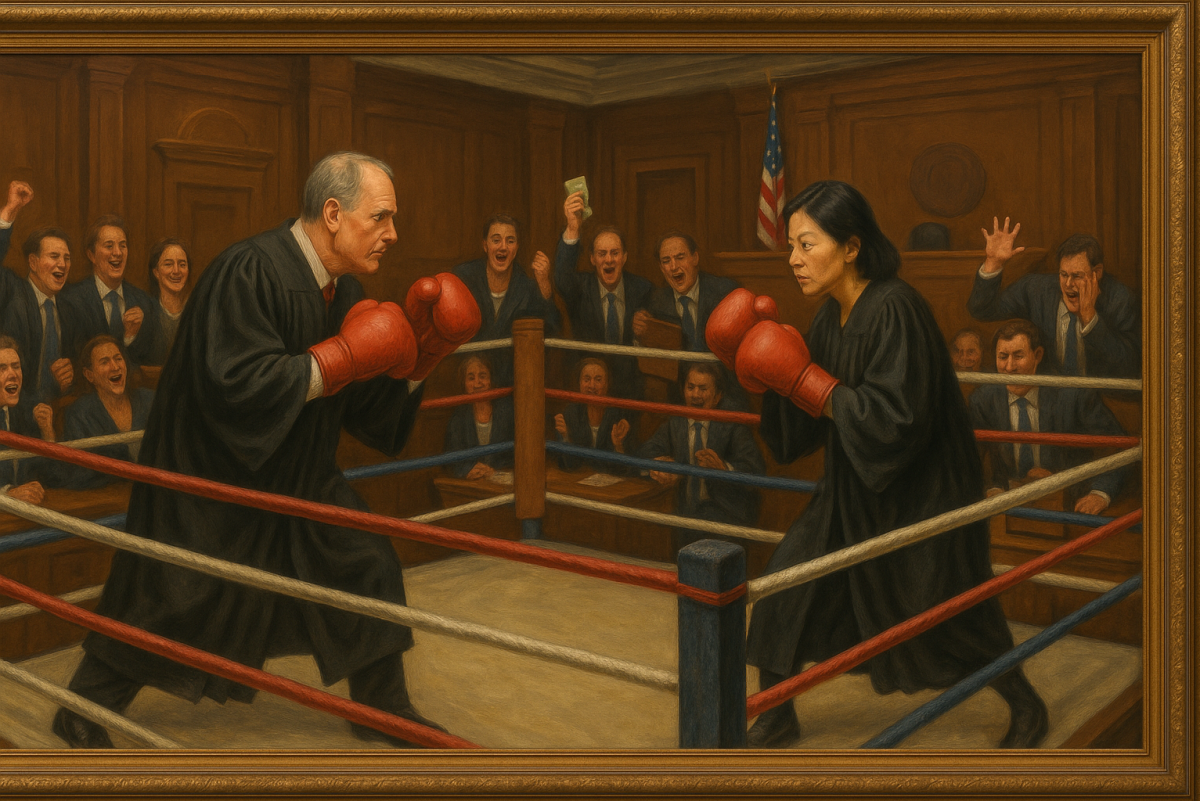
Justice Scalia is known for his witty, and sometimes sharp, language in his opinions. Adam Winkler recently commented here, “Pot, meet kettle,” when Justice Scalia reportedly decried the lack of respect in the world. I have thought that Justice Scalia’s opinions, for all their brilliance, don’t always model the ideal in civil tone, especially to young lawyers and law students who still are finding their professional voice. Today, however, I was really struck with something Justice Scalia included in his concurring opinion in McDonald v. City of Chicago. After the break, tell me whether I’ve overreacted to or misunderstood Justice Scalia’s comment.
Justice Scalia’s concurring opinion in McDonald consumes one paragraph explaining why he joins the majority’s opinion. Justice Scalia spends the next 14+ pages responding to Justice Stevens’ dissent. On pages 13 and 14, Justice Scalia addresses Justice Stevens’ “usual rejoinder of ‘Living Constitution’ advocates to the criticism that it empowers judges to eliminate or expand what the people have prescribed: The traditional, historically focused method, [Stevens] says, reposes discretion in judges as well.” (p. 13) Justice Scalia acknowledges that historical analysis can require “nuanced judgments.” (p. 14) But then Justice Scalia drops footnote 9: “That is not to say that every historical question on which there is room for debate is indeterminate, or that every question on which historians disagree is equally balanced … For example, the historical analysis of the principal dissent in Heller is as valid as the Court’s only in a two-dimensional world that conflates length and depth.” Justice Scalia, of course, wrote the Court’s opinion in Heller, and Justice Stevens the principal dissent. This editorial strikes me as quite disrespectful, to my ear characterizing Justice Stevens’ Heller dissent as the work of a hack, or a bad term paper. I’m no historian of any kind, but I don’t think I need to be to know that this comment is unfair, and certainly does not advance Justice Scalia’s substantive points in his McDonald opinion. Perhaps Justice Scalia meant only to be witty and not mean-spirited. Perhaps Justice Scalia knows Justice Stevens well-enough to know that Justice Stevens would not be offended, or might even chuckle. But for a Supreme Court opinion read by those of us without this inside knowledge, the comment reads as rude, not just to Justice Stevens, but also to anyone who may agree with Justice Stevens’ analysis in Heller. Have I misread or overreacted to Justice Scalia’s quip? Interestingly, Mark Tushnet at Balkinization today examines Justice Ginsburg’s sharp tone in Christian Legal Society, and notes, “It’s almost as if these parts of the opinion had been written by Justice Scalia.” Perhaps I am overvaluing the importance of civility to persuasive advocacy and analysis, at least in some contexts?
Posted by Brooks Holland on June 28, 2010 at 06:09 PM
Comments
That line did jump out at me during my quick reading of Justice Scalia’s dissent, but I didn’t see it as unusually disrespectful. And in light of the criticisms that the dueling opinions in Heller show how hard it is for courts to do history, it seemed necessary for Justice Scalia to make a claim like that. (It is common for those who disagree with a decision to point to the existence of a dissent as proof that the issue is one on which reasonable minds can disagree, and it is almost as common for those who support the majority to argue that the dissent’s disagreement is not “reasonable” in the relevant sense.)
But I do think that these kinds of “civility” assessments are inescapably subjective.
Posted by: WPB | Jun 29, 2010 12:23:28 PM
WPB: Your good question is why I asked whether I had misunderstood or overreacted—as I work on how to teach the value of civility in advocacy, and the difference between vigorous and disrespectful advocacy, I want to explore when I’m being subjective myself. Scalia’s footnote in McDonald seemed personal to me because it went beyond challenging Stevens’ *legal position and authorities* during robust debate. Scalia’s footnote seemed more openly and directly to mock the quality of Stevens’ *work*, and through a comparison that appeared to lack much by way of humility from Scalia. Saying someone’s work product could be good only if measured by page count, to my mind, comments on the author as much or more than the merits of the debate. But maybe I am over-reading it. Or, even if Scalia meant it to be personal, perhaps I should not view it as a big deal in the give-and-take of robust debate?
Posted by: Brooks | Jun 29, 2010 11:59:42 AM
Maybe I am missing something, but I do not understand what is unusually “personal” about Justice Scalia’s length/depth rejoinder. It does target Justice Stevens’s argument (although interestingly, NOT by name), but that seems only natural in a back and forth argument– and no different from all of the other “back-and-forth” and “robust debate” in the two opinions.
Could you elaborate on what makes this particular remark seem different to you? Or is this one of those things on which it is impossible to elaborate?
Posted by: WPB | Jun 29, 2010 9:43:06 AM
Adam: You are right that there is no shortage of back-and-forth in Scalia and Stevens’ robust debate about constitutional interpretation. Scalia’s footnote just read to me as disappointingly personal in a way the rest of Scalia and Stevens’ opinions did not. Perhaps read in the context of Scalia and Stevens’ full debate, Scalia’s footnote does not sound so out of tune. But if Scalia and Stevens are mocking each other in kind, I still wonder about the helpfulness of Justices addressing each other in this manner. Thanks!
Posted by: Brooks | Jun 28, 2010 11:59:16 PM
I don’t think you’re misreading the tone at all. Between Scalia’s concurrence and Stevens’s dissent, there a debate about constitutional interpretation, but not about the merits. Stevens attacks the method originalists use:
JUSTICE SCALIA’s method invites not only bad history, but also bad constitutional law. . . . [I]t makes little sense to give history dispositive weight in every case. . . . Not only can historical views be less than completely clear or informative, but they can also be wrong. . . . The fact that we have a written Constitution does not consign this Nation to a static legal existence. Although we should always “pa[y] a decent regard to the opinions of former times,” it “is not the glory of the people of America” to have “suffered a blind veneration for antiquity.” The Federalist No. 14, p. 99, 104 (C.Rossiter ed. 1961) (J. Madison). It is not the role of federal judges to be amateur historians. And it is not fidelity to the Constitution to ignore its use of deliberately capacious language, in an effort to transform foundational legal commitments into narrow rules of decision.
With Stevens kind of mocking a building block of originalism — the ability to accurately divine founding intent — Scalia hits back: “For example, the historical analysis of the principal dissent in Heller is as valid as the Court’s only in a two-dimensional world that conflates length and depth.” Maybe Scalia took Stevens’s “amateur historian” barb personally.
Posted by: Adam Richardson | Jun 28, 2010 10:56:28 PM