
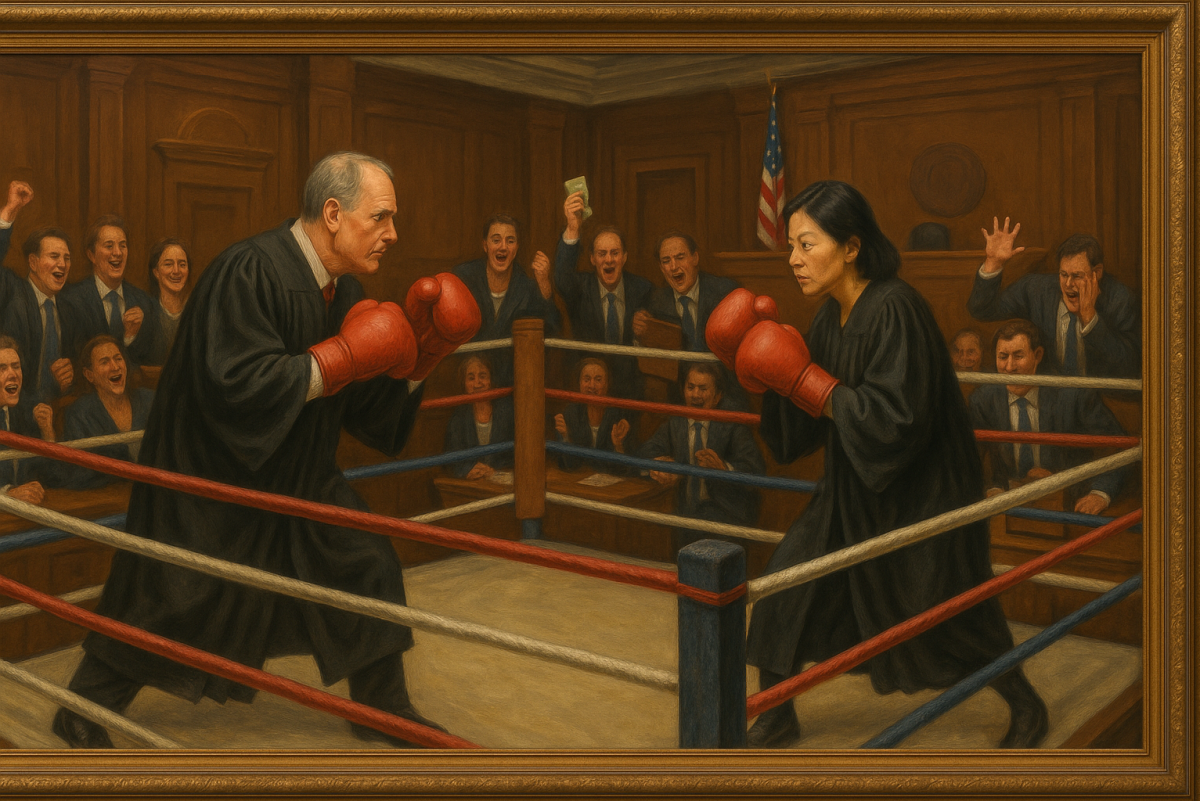
This subject is already getting a bit old, but before it completely disappears I wanted to note, and then ask about, John Boehner’s post-election statement in an interview that “we will not compromise.” Of course, this is partially political theater – in this case, throwing down the gauntlet to the Obama Administration that the Republican House majority will oppose him on major policy initiatives. And it’s completely appropriate for a party leader to make it clear that he opposes the agenda of the other party. But I’m curious if people think there is something new to this anti-compromise rhetoric. Isn’t compromise what’s supposed to happen when you govern?
In fairness, the full statement is that “we will not compromise on our principles.” And he did say that he would work to find “common ground.” So the statement is not as sharp as it appears at first glance. Still, when the reporter pressed on this point he insisted that “compromise” had a bad connotation among the American people — that it signaled a sell-out of people’s preferences, as he believes them to have been expressed in the midterm elections.
I’m speculating here, but I would guess he’s aiming his words at Tea Party types who feel unrepresented by politicians. But regardless of his motive, the questions remain. Is this rhetoric new? If it is new, is it a problem? One can always say, “it’s just rhetoric,” but the problem with that is, rhetoric matters. Congressmen Boehner obviously chose “finding common ground” over “compromising” (even if he described the other option as compromising principles). So he must think the difference matters to the American people, or at least the slice he’s trying to connect with. If it does matter, then I again pose the questions: is this anti-compromise rhetoric new (or at least atypical), and, if so, is there something troubling about treating compromise as a dirty word by linking it to selling out?
The more I think about it, the more I do think there’s a significant difference. “Compromise” implies giving something up, in exchange for getting something. “Common ground” means finding the golden spot where everyone gets something they want but nobody gives anything up. If this is true, then is it troubling that the incoming Speaker of the House is telling the country that his party is not going to give anything up?
I don’t think this is hair-splitting. Do others?
Posted by Bill Araiza on December 22, 2010 at 05:21 PM
Comments
How is this any different from President Obama’s “I won” quote from January 2009?
Posted by: anymouse | Dec 23, 2010 1:36:45 PM
This is the bane of John Bo(eh)ner.
Posted by: Shag from Brookline | Dec 23, 2010 6:36:30 AM
I think this type of distinction between “compromise” and “common ground” is extremely common and has been for a long time. Think of advocacy groups. For example, pro-choice groups often take very strong non-compromise stands (in rhetoric and in action). For example, a proposal to increase access to first trimester abortions while simultaneously restricting late term abortions would be a non-starter for many pro-choice advocates, regardless of the relative strength of the two provisions or any sort of cost-benefit analysis.
One reason for rejecting these compromises is that they help to legitimize concerns of the other side that are viewed as misguided or plain wrong. Another reason might be that such a bright line position helps to guard against slippery slopes and the co-opting of the group’s leadership.
On the other hand, pro-choice groups very frequently attempt (often unsuccessfully) to promote “common ground” type proposals, for example, efforts aimed at indirectly reducing abortions by reducing unwanted pregnancies.
For another example, look at the NRA. The NRA has been very active for years in promoting gun safety programs. These are a form of “common ground” policy in the sense that they attempt to serve one goal of many anti-gun groups (reducing gun-related accidental deaths and injuries) without compromising the NRA’s own commitments.
From time to time, the NRA has also been involved in promoting/crafting legislative compromises that aimed to protect gun ownership rights in some respects while simultaneously imposing restrictions. Unlike the safety programs, these efforts have been extremely controversial and divisive among the NRA’s membership, and have led to widespread accusations that the leadership had “sold out”.
Posted by: Anon ’08 Grad | Dec 22, 2010 6:20:55 PM
I think you could conceptualize the distinction as follows:
Imagine a Venn diagram where the first circle represents the set of policies consistent with Party 1’s ideological commitments and the second circle represents Party 2’s acceptable policies. A is the non-overlapping area of the first circle, B is the non-overlapping area of the second circle, and C is the area of overlap.
A policy proposal that combines elements of from A & B could be characterized as a “compromise of principles” — trading-off something desirable (A) for something undesirable (B).
On the other hand, if a policy proposal can be found that falls within C, then this would be “common ground”.
It’s easy to think of reasons why you might legitimately reject an A + B compromise (and, of course, it’s also easy to think of reasons why you might sometimes accept such a compromise). I can even see the argument that an across the board position against such compromises might make sense under some circumstances.
On the other hand, it’s more difficult to imagine the rejection of a genuine type-C common ground policy for any reason other than spite or pure partisan advantage.
Posted by: Anon ’08 Grad | Dec 22, 2010 5:48:56 PM
I would say that “extremism in the defense of liberty is no vice, and moderation in the pursuit of justice is no virtue” is pretty close in spirit. So this is not new.
Posted by: TJ | Dec 22, 2010 5:47:30 PM
Boehner and McConnell both have made clear that “common ground” means the things we believe in and the things we want to do. In other words, if you want to join us to do what we want to do, we will be glad to have you on board.
Posted by: Howard Wasserman | Dec 22, 2010 5:25:59 PM