
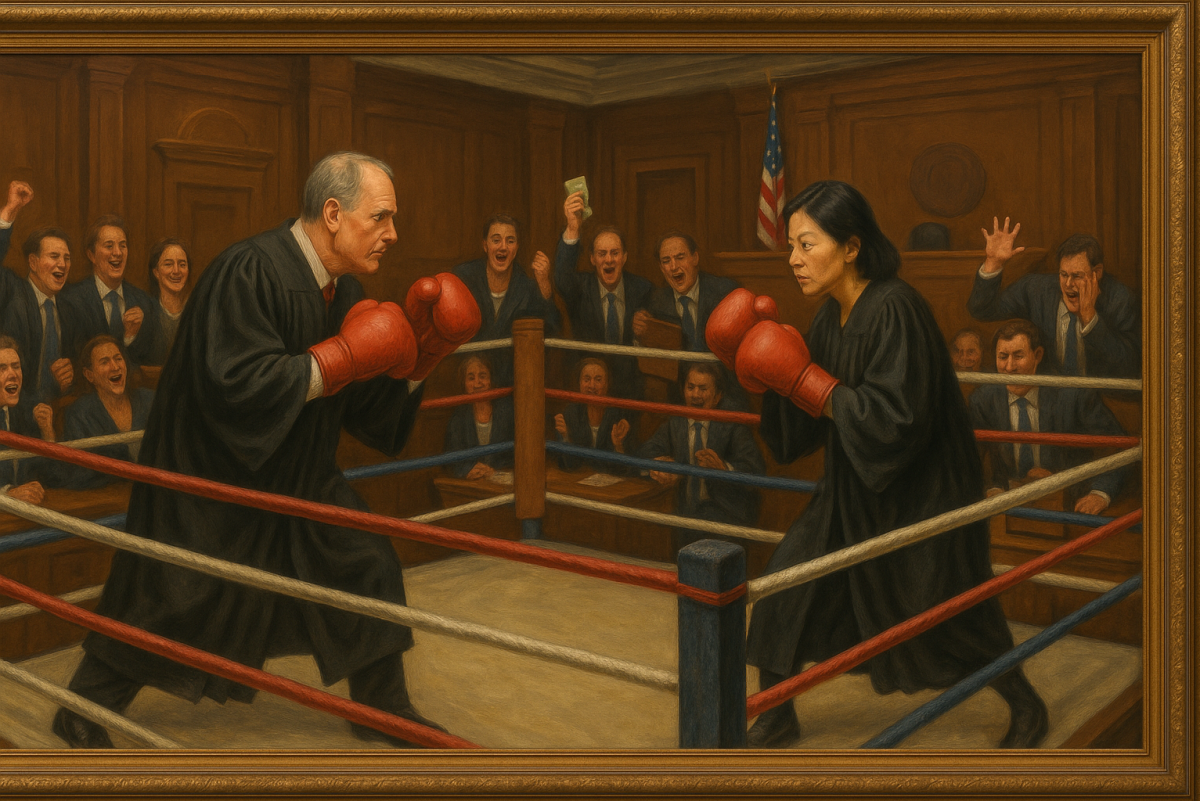
Alexander Bickel coined the term “counter-majoritarian difficulty” to describe the legitimacy problem faced by courts when they strike down popularly enacted statutes. While it is definitely a problem, I am not sure that it is very often necessarily a problem of counter-majoritarianism, though sometimes it is. More often, the debate is simply the level of generality at which we define the majority’s preferences.
Take flag burning. If you ask the majority of people whether flag burning should be banned, the answer would be “yes.” If you ask whether the majority of people whether we should ban “expressive speech” — entirely putting aside whether the First Amendment forbids this — the answer would be “no.” But as long as we concede that flag burning is an instance of “expressive speech,” then these preferences conflict (and for those who don’t agree that flag burning is expressive speech, imagine some other distasteful activity — e.g. KKK marches — that fits the bill). Unlike Bruce Ackerman’s conceptualization of the problem as an intertemporal conflict between different majorities, often it is a conflict within the same majority, where the preferences are measured at different levels of abstraction. A court that strikes down a flag burning ban is contradicting today’s majority preference for the ban, but effectuating the same majority’s more general preference for protecting expressive speech.
Thus conceptualized, the problem is not limited to constitutional law but is well known in voting theory. Its most common manifestation in real life is probably the public’s preferences on government spending. In the abstract, the public prefers reductions in spending in order to lower taxes and lower deficits. At the same time, majorities of the public also love individual spending programs. These two preferences conflict. Hence our deficit problems.
Posted by Tun-Jen Chiang on December 20, 2010 at 09:00 AM
Comments
TJ writes:
To take your hypo and modify it only slightly, a legislative enactment that says: “(1) all ice cream is hereby banned, and (2) everyone shall consume 1 pint of ice cream made of 10% toxic waste” would, in fact, be considered self-contradictory.Yes, of course. It is impossible to satisfy both rules at the same time.
And my point is that legislatures and the public sometimes have this type of self-contradictory preference, where they really do mean “all” ice cream.I agree that they sometimes do that, but I understood your post to be making a quite different argument.
Perhaps I misunderstood your initial post, and if so, I apologize. But I thought you were talking about alleged contradictions inferred by the different levels of popularity of legal rules when expressed at different levels of generality. That is, you weren’t talking about two rules that are actually impossible to satisfy at the same time. Rather, you were noting that if you describe legal rules at different levels of generality, the popularity of the described legal rule changes depending on what level of generality the rule is expressed. My argument was that this is true but does not actually reflect a contradiction.
Anyway, perhaps this was all based on a misunderstanding. If so, my apologies.
Posted by: Orin Kerr | Dec 22, 2010 2:52:33 AM
Orin,
On your distinct of the contract hypo–that contracts do not express majority preference (though my point is that at a higher level of generality, there is a majority preference to enforce contracts except for well-recognized grounds like illegality)–it would seem that you cannot answer my point about courts invalidating executive action because it is contrary to statute.
On your more abstract points, the ice cream example does not work because the contradiction in the preferences of actual individuals can be resolved by what economists call revealed preference. Ultimately, the actions of individuals reconcile the different levels of generality.
The “revealed preference” move does not work on the level of legislative enactments because legislatures cannot act. They can only issue directives that always exist as abstractions. To take your hypo and modify it only slightly, a legislative enactment that says: “(1) all ice cream is hereby banned, and (2) everyone shall consume 1 pint of ice cream made of 10% toxic waste” would, in fact, be considered self-contradictory. And my point is that legislatures and the public sometimes have this type of self-contradictory preference, where they really do mean “all” ice cream.
I read you to say that legislatures and the public never have this type of self-contradictory preference. When the public or the legislature says it likes freedom to practice religion but dislikes freedom to practice Islam, that to you implies that the statement must be using the word “like” “freedom” “practice” or “religion” in some special sense, to exclude freedom to practice Islam. That, to me, is not a good way to understand what the public is saying.
[TJC edit: to be clear, I concede that sometimes there are implied definitions to the words which prevent self contradiction and other absurd results. The “no vehicles in the park” example is the classic example of implied definition to avoid absurd results. But my point is that you cannot reasonably carry this to reconcile every apparently contradictory preference expressed at different levels of abstraction.]
Posted by: TJ | Dec 22, 2010 12:24:52 AM
Oops, that last line should be “it is NOT implicated . . . “
Posted by: Orin Kerr | Dec 21, 2010 11:43:17 PM
TJ,
I think you are confusing words with concepts. To show why, let me state an example of two preferences that I have: 1) I like ice cream. 2) I dislike ice cream that is made of 10% raw sewage.
Is my preference contradictory? I believe you would say it is: On one hand I have said I like ice cream, and on the other hand I have said I don’t like a particular type of ice cream. Thus, in your view, I have stated a contradiction between the general and the particular.
But there is no genuine contradiction. The reason is that expressions of preference imply a limitation of typical circumstances. When I say I like ice cream, I really mean that I usually like ice cream of the kind usually offered in the typical circumstances it is made available to me. It doesn’t mean that there aren’t some kinds of ice cream I don’t like, or that there aren’t some things that you can call “ice cream” that I dislike, or that I want an ice cream if I am locked out of my house in the middle of winter with no jacket on. It simply means that usually, in typical circumstances, when I am offered ice cream, it in fact something I want.
Now let’s imagine you force me to eat ice cream that is 10% raw sewage and that I object to it. Are you making me do something I don’t want to do? I believe you would say it is unclear: In your view there is no way to know whether my true preference is the general (liking ice cream) or the specific (disliking sewage-flavored ice cream), so there is no way to know if making me eat ice cream with raw sewage is really making me do something I don’t want to do. But it seems to me that my preferences are really quite clear: I said I don’t like ice cream made with 10% raw sewage, and your making me eat that ice cream is making me do something I don’t want to do.
As for your example of courts enforcing AIG contracts, it is not something that is normally understood as a problem of the countermajoritarian difficulty because the countermajoritarian difficulty is the difficulty of justifying the invalidation of statutes that presumably express majority preference. By definition, it is implicated by contract enforcement where there is no statute or constitutional issue.
Posted by: Orin Kerr | Dec 21, 2010 11:41:45 PM
Oh, and to answer your specific question about Citizens United, I think there is a perfectly good argument that it is not counter-majoritarian. Critics will say it is counter-majoritarian because it invalidates a popular statute. Supporters will say that it simply enforces the popular First Amendment. The question shifts to whether it really did enforce the First Amendment, and whether the First Amendment really is popular.
I think this is a better conception because, in your principle, it seems that every time a court strikes down an executive action for being inconsistent with a more abstract statute, the court faces a “counter-majoritarian difficulty.” After all, the executive is elected and reflects the popular will.
Posted by: TJ | Dec 21, 2010 6:37:02 PM
Orin,
I think we have pinpointed our disagreement. The problem with your formulation is that every legislative enactment is potentially a complex body of doctrine with hundreds or thousands of applications, because every legislative enactment is abstract to some degree. There is no difference between legislation and the constitution in this regard. But rarely would we say that legislative interpretation has a counter-majoritarian difficulty.
A court that interprets the First Amendment to allow murder is acting “counter-majoritarian” in the same way that it would if it interpreted a statute to so allow: because the interpretation would be so plainly wrong. When judges are clearly follow their own preferences, usurping the legislative function, and use a statutory hook only as pretext, that is counter-majoritarian. But that is the same whether the pretext is constitutional or statutory. The only difference is how hard it is to correct the usurpation. So I am not saying there is never a counter-majoritarian difficulty. What I am saying that the belief that every invalidation of a statute is counter-majoritarian is incorrect, if we believe that constitutional provisions themselves are majoritarian enactments–and would be enacted even by today’s majority.
The point is that the public and legislatures often hold contradictory preferences at different levels of generality because they doesn’t think through the consequences, and public policy often functions at the level of abstract slogans, though abstract at different degrees. You seem to deny that the majority can ever hold contradictory preferences, because in your view its preference for a more specific directive would by definition prove that its preference for the more general directive is qualified. But I don’t think that this is a good way to conceive of majority preference. By that principle, courts that enforce contracts to pay bonuses to AIG executives are acting “counter-majoritarian” since the public did not desire those specific contracts be enforced, even if we generally like enforcing contracts.
If you believe that is counter-majoritarian, then at least it shows that the counter-majoritarian difficulty is not limited to judicial review under the constitution. But more fundamentally I find that way of conceiving majority preference to be strange. Because it means the public likes that we enforce contracts, except when it doesn’t. I prefer to think of it not as a counter-majoritarian problem at all so much as one where the majority often has conflicting preferences, which are impossible to resolve coherently.
Posted by: TJ | Dec 21, 2010 6:15:49 PM
TJ,
I disagree. The First Amendment is not a single “thing.” It is a complex body of doctrine with hundreds (if not thousands) of different applications. Some applications of the First Amendment are popular, other applications are deeply unpopular, and many of the details likely depend on how the question is phrased. As a result, I don’t think you can just take as a given that “the First Amendment enjoys strong majority support” and take that to mean that the public understands First Amendment doctrine in all of its hundreds or thousands of applications and has pronounced that it approves of those applications in the aggregate.
Take the Citizens United case. Whether you agree or disagree with it, I don’t think you can say there was no countermajoritarian difficulty in striking down the campaign finance restrictions on the ground that Citizens United was a First Amendment case and the First Amendment enjoys strong majority support. Or to make the hypothetical more dramatic, let’s say the Supreme Court in the future says that there is a First Amendment right to murder people to express how much you hate them. I don’t think you can say that there would be no countermajoritarian difficulty with striking down murder laws on the ground that the First Amendment is popular.
Posted by: Orin Kerr | Dec 21, 2010 4:30:34 PM
Orin,
You are right that I am describing my doubt as to when the difficulty even exists. The problem with your formulation that the legislation is the proper level of generality is that I could just as easily say that the First Amendment (or whatever constitutional provision) defines the level of generality. After all, the First Amendment surely still has majority support even today.
In other words, imagine a single statute with two provisions:
1. Freedom of speech and expression shall be protected. 2. Subject to section 1, it shall be unlawful to burn the United States flag.
If this was a single statute and by your definition it defines the proper level of generality, then we get nowhere on resolving the internal conflict. You could either construe section 1 narrowly and say that freedom of expression does not encompass flag burning, or say that section 2 is utterly meaningless because of the “subject to” clause. And, in one way, you could understand every statute coming out of Congress as implicitly having the hypothetical section 1, since the First Amendment enjoys strong majority support even today.
[TJC edit: I should make clear that the point is that, no matter which interpretation a court chooses, it is not a counter-majoritarian difficulty. Both are plausible interpretations; neither is fully faithful to the statute because the majority will reflected within is internally contradictory. And we see these types of inherently contradictory enactments such as with the Arizona immigration statute that attempts to simultaneously allow police to question people who might be illegal immigrants based on “circumstances” while prohibiting questioning based on ethnic profiling. I bet you could find majorities to support both of those propositions, too.]
Posted by: TJ | Dec 21, 2010 4:04:12 PM
Oh, and I should add that I am not suggesting this point actually explains how to deal with the counter-majoritarian difficulty. Rather, I read the post to be about when such a difficulty even exists.
Posted by: Orin Kerr | Dec 21, 2010 3:38:54 PM
TJ,
If the issue is the counter-majoritarian difficulty in overturning legislation, then we have a ready-made level of generality: The level of generality used in the legislation itself. I take your point to be that we can always use levels of generality to pretend that there is no counter-majoritarian problem: We can just adjust the level of generality until we find some level of abstraction that has majority support. We can then announce — voila! — that *this* is the level of abstraction we want, and at that level, there is no counter majoritarian problem. But the legislative act will have adopted a level of generality, and it strikes me as no more than game-playing to raise the level of abstraction in order to hide the actual majority preferences.
Posted by: Orin Kerr | Dec 21, 2010 3:36:52 PM
Orin,
I’m not making a normative argument but instead an observation. I agree with you that there is a problem that a skilled legal or political advocate “can get whatever result you want” by picking and choosing among levels of abstraction. So the question is whether there is a principled way to always choose one level of abstraction. You say that the most specific level of abstraction is always the right one.
But I don’t think that is always the right answer, either, and at least it is not always the answer in reality. For example, if you ask whether a particularly disliked minority religion should get the charitable deduction, I dare say that you can marshal a majority of people against it. But that majority for the specific is trumped by the more abstract rule that all religions should get the tax deduction. And that holds largely even in societies that do not have a counter-majoritarian difficulty because they have weak judicial review, such as the U.K. Another way to think of this is to ask: if we discover a technical glitch that means the first amendment was never properly ratified, and so Congress proposed ratifying the first amendment today, knowing all the things that it will protect, do you think it could pass? Perhaps there will be one or two very specific carve outs such as for flag burning, but there won’t be many, and not only because of lack of legislative energy.
Posted by: TJ | Dec 21, 2010 10:44:30 AM
Isn’t majority opinion always most accurately measured by the least abstract description? The more abstract a description, the more the describer is doing normative work in classifying the specific that is hidden from the majority.
For example, if I ask people whether the federal government should give me $1 million for being a nice guy, people would say no. But if I can make the item more abstract, I can manipulate the category to hide what I’m actually describing. For example, I can say that at a very abstract level, the issue is whether the federal government should do a nice thing for a worthy person. If I can manipulate the categories that way, the public is much more likely to generate support than if I told them that it means giving me a million dollars for being a nice guy.
Your flag-burning example is another example. You’re hiding all the normative work when you decide to describe flag-burning under the general category of “expressive speech.” If you pick a different category, you can get whatever result you want. For example, instead of “expressive speech,” you could make the category “infliction of emotional pain on U.S. veterans.”
Posted by: Orin Kerr | Dec 21, 2010 1:29:30 AM