
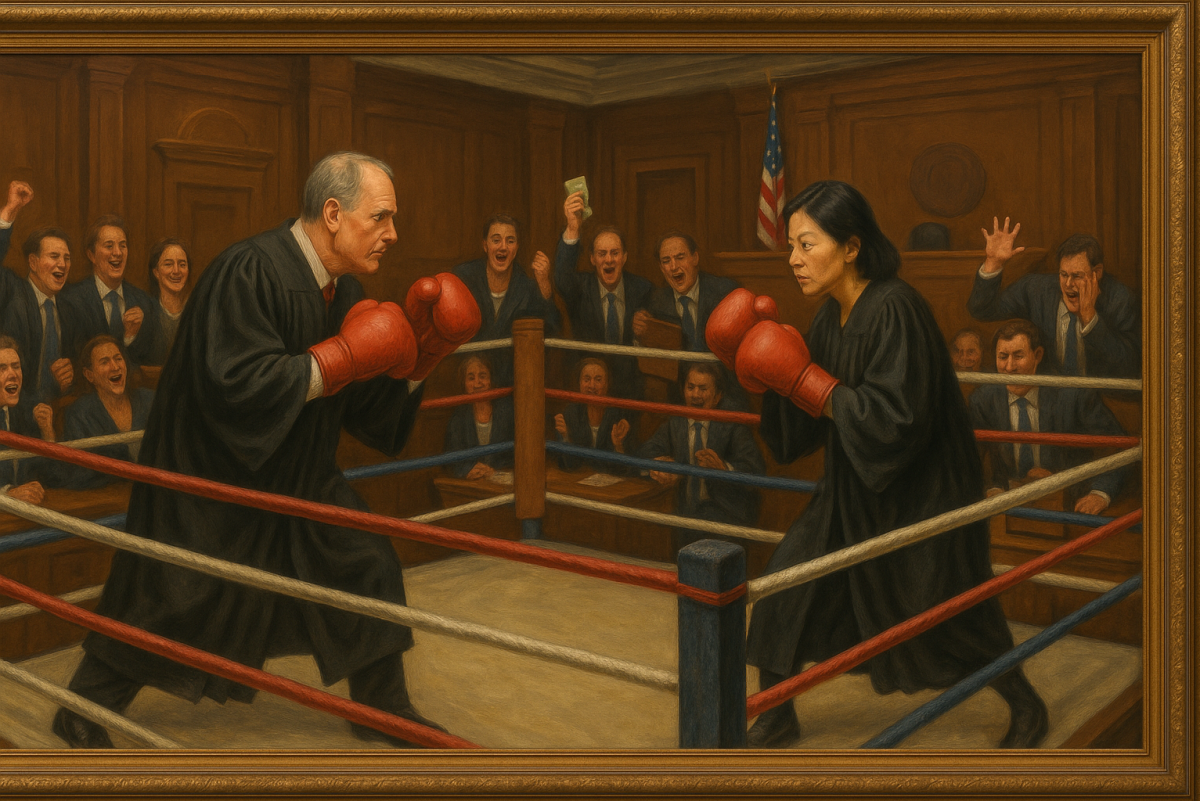
Lyrissa’s post on tenure denial elicited some interesting comments. MS wrote: “there is a good argument that tenure denials should be higher in law school than in other departments because of the absence of PhDs or any other indicator of a successful academic career.” Brian wrote: “I would have thought the problem in the legal academy is far too few tenure denials, including (esp.) at the very top law schools, whose faculties (esp. Yale’s) are notorious for the tenure mistakes who could not be appointed anywhere else,” and noted that “the law teaching market has a very high rate of false negatives at the entry-level,” so that “it would be surprising if it didn’t have at least as high a rate of false positives.” And an anonymous commenter wrote, in a similar vein, “It seems the rate of false positives/negatives is a direct result of the way law schools hire, rather than tenure, their faculty.”
I thought it might be worth adding another note on why there might be false negatives in hiring, especially at the very top law schools, and why that trend might be diminishing. All three comments seem linked to me. The very top law schools once had a habit of hiring on the basis of what they saw as sheer intelligence, measured by a small number of factors, particularly a top performance at an elite law school and a Supreme Court clerkship. A lot of that hiring happened off-market — indeed, pre-market. That is a high-risk, high-gain type of hiring decision. Having been a law school superstar is an imperfect proxy for qualities that might distinguish an academic in the long term: a commitment to teaching and scholarship, an actual research agenda and the ability to get it down on paper, and so on. Don’t get me wrong: some of my best friends are former Supreme Court clerks, and of course some of those hires worked out splendidly, especially when legal scholarship was more doctrinally oriented and thus demonstrating the quality to be an outstanding young lawyer and clerking on the Court was a good indicator that someone could churn out high-quality doctrinal pieces. But it also brings in people who are not necessarily committed to being legal scholars in the long run, or to doing something more than straight doctrinal work.
But now hiring, certainly at non-elite schools and also at the elite schools, relies on a larger set of proxies and predictors that are closer to MS’s vision of Ph.D’s in other disciplines: fellowships, VAPs, extensive pre-market publication records, and so on. More people entering the market at every level have already demonstrated a willingness to give up other opportunities to work in the academy, have already worked extensively in the academy, and have a track record of scholarship that consists of more than just glorified case comments. The proxies are getting more reliable. There is still a degree of shallow credentialism out there, such that we can still expect false positives (and false negatives: to the extent that elite schools still look for a narrow range of elite credentials along the lines of a Supreme Court clerkship, they may ignore others who don’t meet all those schools’ credential requirements, but who end up writing their way up the food chain). But on the whole I should think that the shift in proxies that even elite law schools look at in the hiring process is becoming more rational, and the quality and reliability of hiring decisions should go up. (This is leaving aside the fact that the elite law schools are relying more on lateral than entry-level hiring these days.)
That doesn’t mean I think tenure decisions should be easy or automatic. I don’t. But I do agree with “anonymous” that hiring and tenure are different things, and in theory a low rate of tenure denials might say less than a better system for hiring does. (In theory, anyway. In practice, it’s still the case that legal academics lack a strong standard for evaluating work, and in any event often don’t like to say no to their friends.)
Posted by Paul Horwitz on July 6, 2011 at 07:20 AM
Comments
I feel like mentioning this every time someone talks about fellowships and VAPs being the new magna-at-Harvard-and-impressive-clerkship as far as hiring credentials go: how does one get hired as a VAP? As far as I can tell from entry-level hiring reports, VAPs are people who … graduated magna at Harvard and got an impressive clerkship.
Posted by: Jason W. | Jul 7, 2011 11:36:29 PM
Perhaps there is some confusion about what’s at issue that explains the differing perceptions. I am aware of several cases where someone is about to come up for tenure, it looks like the vote will be negative, and so they are advised not to ‘formally’ come up, and look elsewhere: that’s a de facto, if not a de jure, tenure denial in my view. I understood Professor Zimmer’s scenario to be of people who are on the tenure-track, but after 2-3 years aren’t doing so well, so are advised to move on. Are we all talking about the same phenomenon here?
Posted by: Brian | Jul 7, 2011 6:59:05 PM
Brian writes: “In 18 years, I have seen almost no cases of people being “guided off the faculty” prior to the tenure decision. That leads me to be skeptical that this is very common, but perhaps others can weigh in with their own anecdotes.”
Wow, I’ve been in academia for less than a decade and I can think of several examples (all from within the last 5-6 years) just off the top of my head. I don’t want to name names (esp. because I’m writing anonymously) but I’m really surprised that Brian knows of almost no such cases. On my own faculty alone, I can think of 2 people since my time here who were “guided off the faculty” and 2 others who came in after being “guided off the faculty” elsewhere. And recent examples from other schools also readily come to mind.
Posted by: top30prawf | Jul 7, 2011 1:06:58 PM
In 18 years, I have seen almost no cases of people being “guided off the faculty” prior to the tenure decision. That leads me to be skeptical that this is very common, but perhaps others can weigh in with their own anecdotes. I’m not sure I understand Professor Zimmer’s final lines: “Holding out for the tenure denial rate in other parts of the university is not shown to be justified. Indeed, the craziness and counterproductivity of many of those departments suggests that the warmer and fuzzier law school environment is superior.” What was the showing that it is “not justified”? What is their putative “craziness and counterproductivity” referring to?
Posted by: Brian | Jul 7, 2011 12:23:43 PM
In the bad “good ole days,” hiring was done generally on the basis of an expectation of a little future scholarship. Do that, then settle in for a lifetime of tenure doing what you wanted, including scholarship.
These days hiring has changed in two important ways: 1. Published scholarship upfront is necessary to even get an interview (absent the exceptionally “credentialled” candidate picked as an inside job). So, there is simply much more evidence in the record to draw the inference of future productivity.
2. The culture of law schools has changed in three ways: First, more schools have more scholarly-oriented cultures; some have changed so much that even oldtimers are coming back to scholarship to stay in the game. Second, many more schools are trying to be much more nuturing and helpful to new hires wending their way toward tenure. At my first teaching job, I was “put up” (in more ways than one) for tenure and promotion without my knowledge. I doubt that could happen anywhere these days. Third, more schools make early interventions with review after a couple of years. A judgment is made at that point whether or not the person will make it through the tenure hoop. If not, then the person is guided off the faculty. All this reduces the pool of risky candidates at tenure time.
So, high tenure rates should not be surprising. I don’t think it is a sign of law schools wimping out. Holding out for the tenure denial rate in other parts of the university is not shown to be justified. Indeed, the craziness and counterproductivity of many of those departments suggests that the warmer and fuzzier law school environment is superior
Posted by: Mike Zimmer | Jul 7, 2011 12:10:40 PM
Annie sez: “As to false negatives, changing the event you are looking for (a track record of publishing, or an advanced degree, or a Supreme Court clerkship) is quite different than changing the error rate while holding the inquiry constant, and it isn’t at all clear to me that the inquiry has been constant over time.”
I read it, and think: Marry me.
But in all seriousness, this is why doctrinal scholars shouldn’t try and talk about quantitative methods – and vice-versa. Also why an outstanding candidate would be one who can use both quantitative and qualitative methods (ahem…).
Fun question: how many currently tenured faculty could have been hired in today’s market with the credentials they had? And let’s suppose that even after a full career and having been granted tenure, they still aren’t as impressive on whatever metrics you want to use as your entry-level candidates. Should we be forcing them to retire?
Posted by: Matthew Reid Krell | Jul 6, 2011 7:56:41 PM
This is not truly a post about tenure denial, but about entry hiring; I don’t think anyone here has explained the relationship they perceive between false negatives in hiring and false positives in tenuring. As to false negatives, changing the event you are looking for (a track record of publishing, or an advanced degree, or a Supreme Court clerkship) is quite different than changing the error rate while holding the inquiry constant, and it isn’t at all clear to me that the inquiry has been constant over time.
The post also concludes that “in theory a low rate of tenure denials might say less than a better system for hiring does.” I don’t know what that means. But if it means that the field of law should be forgiven its high rate of tenuring because its method of hiring has gradually come to resemble that for fields with relatively *low* rates of tenuring, what with advanced degrees and fellowships and the like, I think the argument is backwards; the case for exceptionalism is now even weaker.
Finally, as to the hiring of Ph.D. recipients, I think any candid appraisal of this trend has to ask whether law schools are hiring the cream of the crop or rather paying relatively more for relatively less successful students — who are willing (because of high pay and tenure prospects) or forced (because of the lack of alternatives) to settle for a professional school that is a bit afield from their disciplinary home. This will affect whether law schools are making a smart move by searching for advanced degrees.
Posted by: Annie | Jul 6, 2011 4:57:19 PM
Very interesting comments. Thanks, all. A few short responses:
1)Orin, I agree that the size and quality of the market has changed. I agree that the other proxies are imperfect as well, but I think their importance is that they at least demonstrate a fair degree of willingness to commit to a scholarly life, if only because they usually involve a fair amount of time investment (in fellowships, writing, etc.) that is not easily recouped outside the academy. The small size of the clerk hiring market is important; of course I agree that they still do well, although I would imagine a larger number of them now also meet some of the other proxy requirements I mentioned above. To the extent that they come on the market with “just” the clerkship in their favor, my point is not that they will be bad scholars, of course; just that they strike me in that case as being a high-“risk” high-gain option.
2) MS, I agree that a two-year fellowship shows less commitment than a six-year doctoral program; I’m just saying that these kinds of proxies, like a doctorate if not as well, at least involve a more substantial record and more substantial evidence of a commitment to teaching and scholarship than simply entering the market with a degree, a clerkship, and a single note. As for tenure denials, while I tend intuitively to agree that the hiring market might be more imperfect for law than for other disciplines (although I might feel otherwise if I had more experience with them), I can’t tell you whether the quality of the candidates for law school teaching jobs is more or less high or varied when compared with the entry level market for other fields, at least once one considers the top 200-300 candidates. How many tenure denials we should be handing out surely has at least something to do with the quality of the people we’re hiring, and I’m not qualified to compare the quality of entries into the law teaching market as against other disciplines.
3) Mike, by “shallow credentialism” I simply meant reliance on a very narrow range of factors (specifically, top law school and impressive clerkship, with or without a writing record), each of which are very imperfect indicators of future performance as an academic. I’m not sure whether or where we disagree, because I’m not sure whether you’re saying today’s hires are good because they mostly went to elite law schools, or whether you think they went to a diverse range of law schools, or whether you think they’re good because in addition to their law schools they’ve done a number of other things, like fellowships and publishing. And although a Ph.D is no perfect predictor of future performance, I would think it’s better than having no writing record at all, or only a student note, or only a student note plus one other piece, and so on.
4) Anon, again I’m not sure whether and how I agree or disagree with Mike because I’m a little uncertain of what he’s saying. But while I agree with you that law schools continue to place a heavy emphasis on where one went to law school, I would also say that candidates who have other credentials, including writing records and fellowships, in addition to a fancy law degree have a greater chance of success in the market, and that these factors are relatively new in the law teaching market.
Posted by: Paul Horwitz | Jul 6, 2011 4:24:03 PM
I’m not sure I think that Supreme Court clerks do as well as they used to, though that could be because more of them are on the market now than were in the past. Anyway, it’s an empirical question. But I do think Orin is right that the whole process is more competitive. Whether that means that the other proxies are doing well or not is another question….
Posted by: David Zaring | Jul 6, 2011 4:24:00 PM
I agree with Mike. Even setting aside PhDs, hiring occurs within a very small subset of schools. The academe keeps touting scholarship, but it’s hard to say credentials–mostly where you went to school–don’t trump almost everything else as an (initial) gatekeeping mechanism.
Posted by: anon | Jul 6, 2011 1:24:08 PM
I agree with Mike. Even setting aside PhDs, hiring occurs within a very small subset of schools. The academe keeps touting scholarship, but it’s hard to say credentials–mostly where you went to school–doesn’t trump almost everything else as an (initial) gatekeeping mechanism.
Posted by: anon | Jul 6, 2011 1:23:43 PM
Looking at the statistics of where new hires went to law school, it is hard to say we have only “shallow credentialism.”
There seems to be an assumption that PhDs are more likely to be long term committed scholars than our present complement of law profs, who mostly don’t have a PhD. Why not a study to check that out? Most PhDs end up writing one hypernarrow dissertation that is no longer of interest to anyone once it is approved after a harrowing process over many years. How does that predict future productivity? The debate over PhD v JD was won by the PhD proponents at Northwestern at one point but now it appears that is at least up for grabs.
Posted by: Mike Zimmer | Jul 6, 2011 12:22:24 PM
While I am not aware of any empirical research on the matter, VAPs seem to be relatively weak predictors. I think at most they show that someone can produce an article or two when given the time, but they do not provide any real indication of the likelihood of a sustained writing career, which is, after all, what a school should seek. (Two articles do not a career make.) PhDs might be better on this score and that might explain why they have become more plentiful, though it might be interesting to have some data on how PhDs fare on law faculties. In any event, it seems that by its nature, hiring in law school is likely to be more imperfect than other disciplines, which again suggests that tenure denials should be higher than other disciplines (after 6-7 yrs we should have a sense of whether someone is likely to produce meaningful scholarship certainly a better sense than at the hiring stage), rather than the virtually automatic system that continues at most schools.
Posted by: MS | Jul 6, 2011 10:45:12 AM
Interesting post, Paul, although I’m not sure I agree. First, there aren’t many former Supreme Court clerks on the market (maybe 10 a year) and they still do really well on the whole. Second, I think it’s still somewhat unclear how good the other proxies are that you mention. Third, the teaching market as a whole has become so much more competitive, and scholarly standards so much higher, that I think it’s hard to make comparisons across time. So you may be right, but I’m not sure.
Posted by: Orin Kerr | Jul 6, 2011 9:16:17 AM