
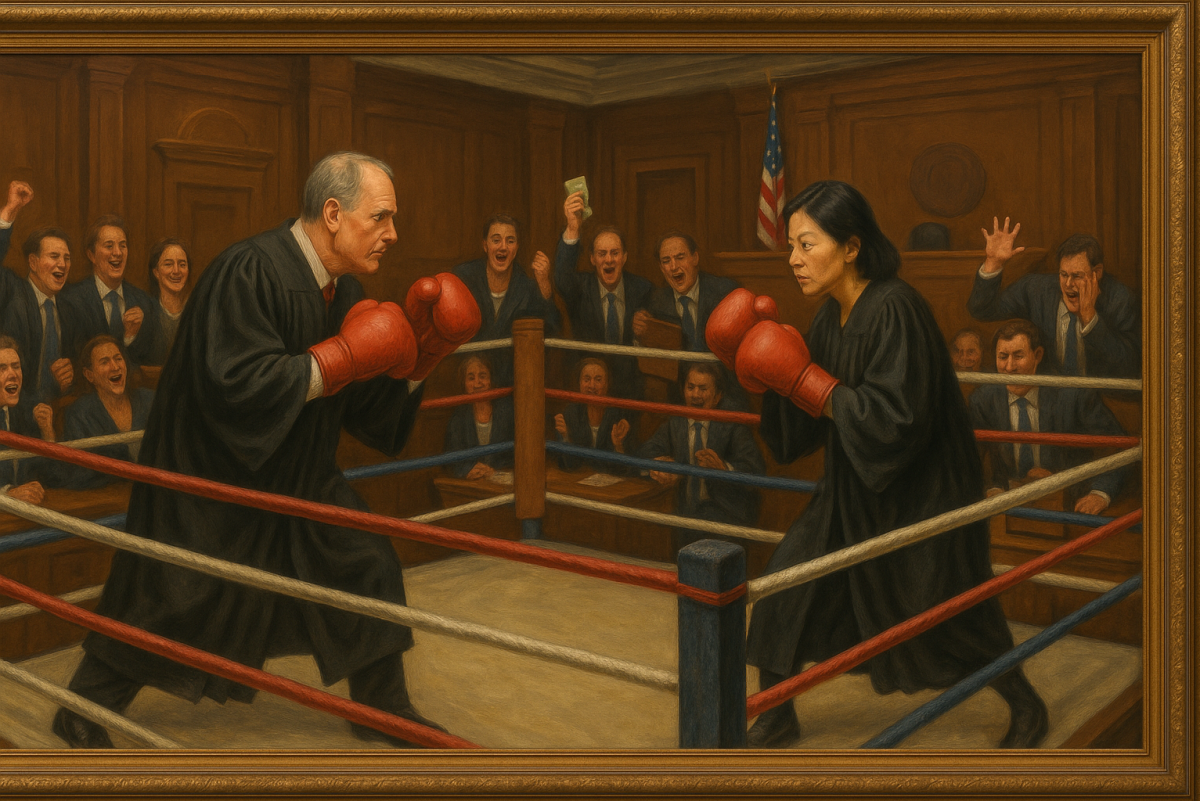
Kent Greenfield (Boston College) had this op-ed in Thursday’s Washington Post. Yesterday’s Occupy the Courts ralliy has as its major target Citizens United (the rally was timed to the decision’s second anniversary, which is today) and the idea that corporations possess First Amendment liberties. The group is pushing a constitutional amendment, which is garnering smatterings of support, providing that that corporations are not people, money is not speech, and constitutional rights are only for people.
Greenfield does a good job undermining the first and third of these goals:
The Constitution protects the rights of various groups and institutions — whether Planned Parenthood, Bob Jones University or the AFL-CIO — though they are not “natural persons.” Humans gather themselves in groups, for public and private ends, and sometimes it makes constitutional sense to protect the group as distinct from its constituent humans.
The question in any given case is whether protecting the association, group or, yes, corporation serves to protect the rights of actual people. Read fairly, Citizens United merely says that banning certain kinds of corporate expenditures infringes the constitutional interests of human beings. The court may have gotten the answer wrong, but it asked the right question.
This is exactly right and is entirely missed in the knee-jerk progressive/liberal reaction to Citizens United. It reflects de Tocqueville’s view of associations as important and beneficial means to enhance individual power for all sorts of purposes–business, political, and personal. If only natural persons enjoy constitutional liberties and GM cannot speak, then neither can The Times or ACLU.
On a separate note, are all social and political protests (at least from liberals) now going to be titled “Occupy ____”, just as every political scandal is “—Gate”? I sure hope not.
Posted by Howard Wasserman on January 21, 2012 at 09:05 AM
Comments
meh. You’re conflating two distinct points, imo. Freedom of speech and freedom of the press. I think it’s clear that trying to suppress the expenditure of funds used to support the press (they did have actual printing presses that needed to be built and purchased at the time of the First Amendment) is unconstitutional. But it’s less clear that trying to suppress the expenditure of funds used to amplify one’s speech is unconstitutional.
Posted by: AnonCandidate | Jan 24, 2012 11:50:18 AM
But if The Times or CNN cannot expend money on speech, it can’t pay those reporters’ salaries, can’t provide them the financial and other support to do their research and reporting, can’t provide them a means of distributing their speech, etc. A Times reporter without Times financial support is a blogger–he has lots of freedom to speak, but no means of broad distribution and no ability or incentive to do it full-time.
Posted by: Howard Wasserman | Jan 22, 2012 10:17:18 PM
“A freedom of the press that protected only “natural persons” would allow the Pentagon to, say, order the New York Times and CNN to cease reporting civilian deaths in Afghanistan.”
This can’t be right, though, can it? Anything published by the New York Times and CNN is ultimately some sort of action or speech by the natural persons who work there. If the “New York Times” and “CNN” themselves don’t have constitutional protections as separate entities, that wouldn’t mean that all of the natural persons working there suddenly lose their personal constitutional rights to speech, etc. Indeed, they’d probably have more rights (if anything) if considered in their roles as natural person as opposed to their roles as corporate employees.
Posted by: Stuart Buck | Jan 22, 2012 9:59:32 PM