
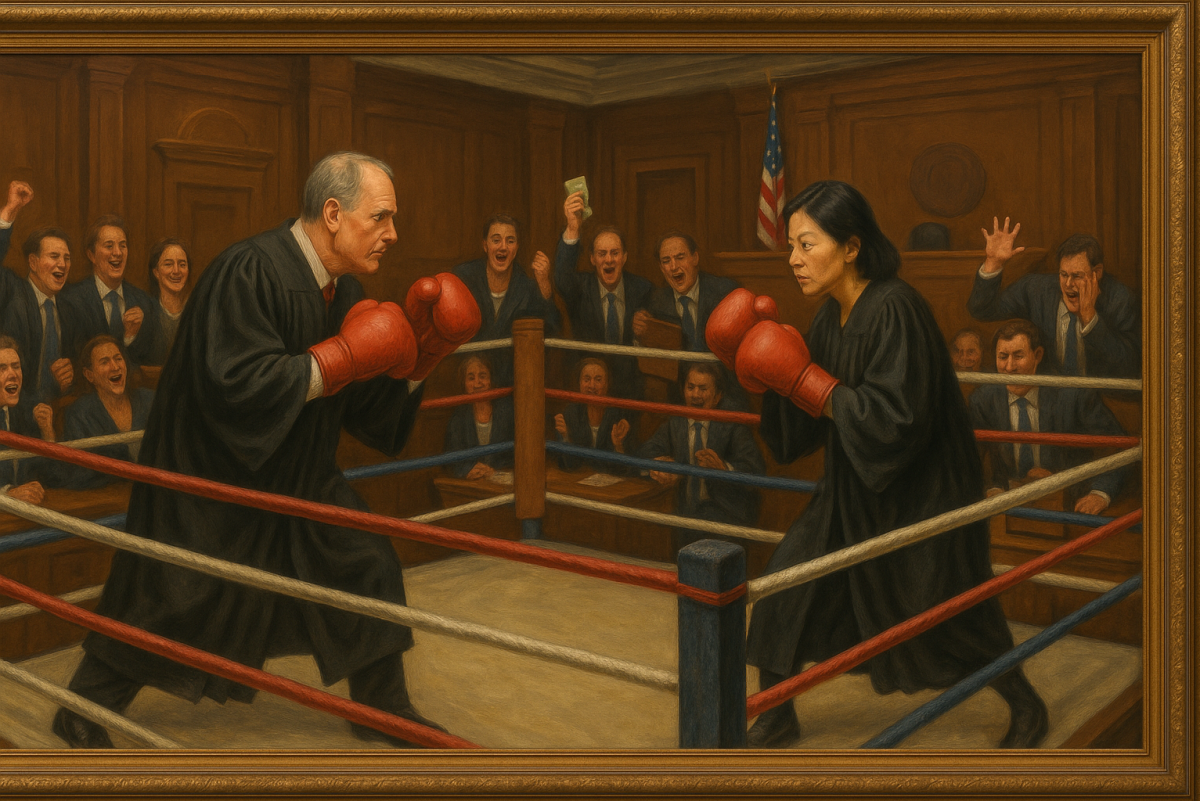
Although all eyes on the Court will be focused on First American Financial Corp. v. Edwards, it’s worth remembering that a potentially important First Amendment case, United States v. Alvarez, will also be decided today. That’s the Stolen Valor Act case, dealing with a federal statute that criminalized a knowingly false statement that one has won military honors. It was subsequently amended, I believe, to require the falsehood to involve obtaining something of value, but that was not part of the original statute. I’ve written some about this case in a larger context here.
The case is important because it revisits the classic statement in Gertz v. Robert Welch Inc. that “there is no constitutional value in false statements of fact.” The strongest aspect of the government’s case is that the statute, although it may still not have been narrow enough without a requirement of some material gain, focused narrowly on a specific knowing false statement of fact — not an inadvertent statement and not a statement of opinion. Counsel for Alvarez was pressed hard in oral argument to answer what the First Amendment value is in what Chief Justice Roberts called “a lie, a pure lie.”
On the other hand, the Court’s recent decisions in Stevens and Brown suggest that the Court is leery of engaging in case-by-case balancing to determine whether a particular speech act is of low or no value. Instead, they have asked for proof that some category of speech — crush videos, violent videogames, etc. — is of low value not just as a logical matter, but as a matter of longstanding historical practice. So the outcome in this case will depend in part on how loyally the Court hews to those recent precedents. It will also, it seems to me, depend on the level of generality at which it treats the conduct criminalized by the Stolen Valor Act. If the act is treated narrowly, it is less likely to give rise to slippery slope concerns but also harder to identify as a speech act that has long been treated as falling into the category of low- or no-value speech. if it is treated more broadly as a “pure lie,” it may be easier to argue that there is a long practice of regulating such lies. On the other hand, at oral argument the Solicitor General was pressed on the question whether, if the principle is read that broadly, it would not allow a host of other laws criminalizing false statements in other contexts. And the Court recognized that in most of the cases in which it had treated particular false statements as regulable, they were closely associated with longstanding and well-delineated harms.
In reading about this case, I have been interested in the number of scholars who share the idea that false statements of fact as such have no constitutional value. It represents, in part, a move away from Mill and toward other theories of the First Amendment. It suggests that the old idea that even falsehoods have value by serving as a whetstone for the truth is out of vogue. Those arguments have changed my outlook on this case somewhat. But I still hope that the statute is overturned. (See my article above for a full discussion.) My concern is both that there is, or may be, some constitutional value in false statements of fact, and that even if there isn’t, allowing the government (state or federal) to begin narrowly identifying “worthless” false statements of fact as subject to criminalization would open the gates too wide to government regulation of speech. But I appreciate, more than I initially did, the arguments against this position. We’ll know soon enough which way the Court goes. I’m not sure whether I expect it to address squarely the statement in Gertz, or whether most of the decision will be about applying Stevens and Brown, but it will be interesting either way.
I gather that besides First American Financial and Alvarez, some other decisions will be handed down today.
Posted by Paul Horwitz on June 28, 2012 at 08:13 AM