
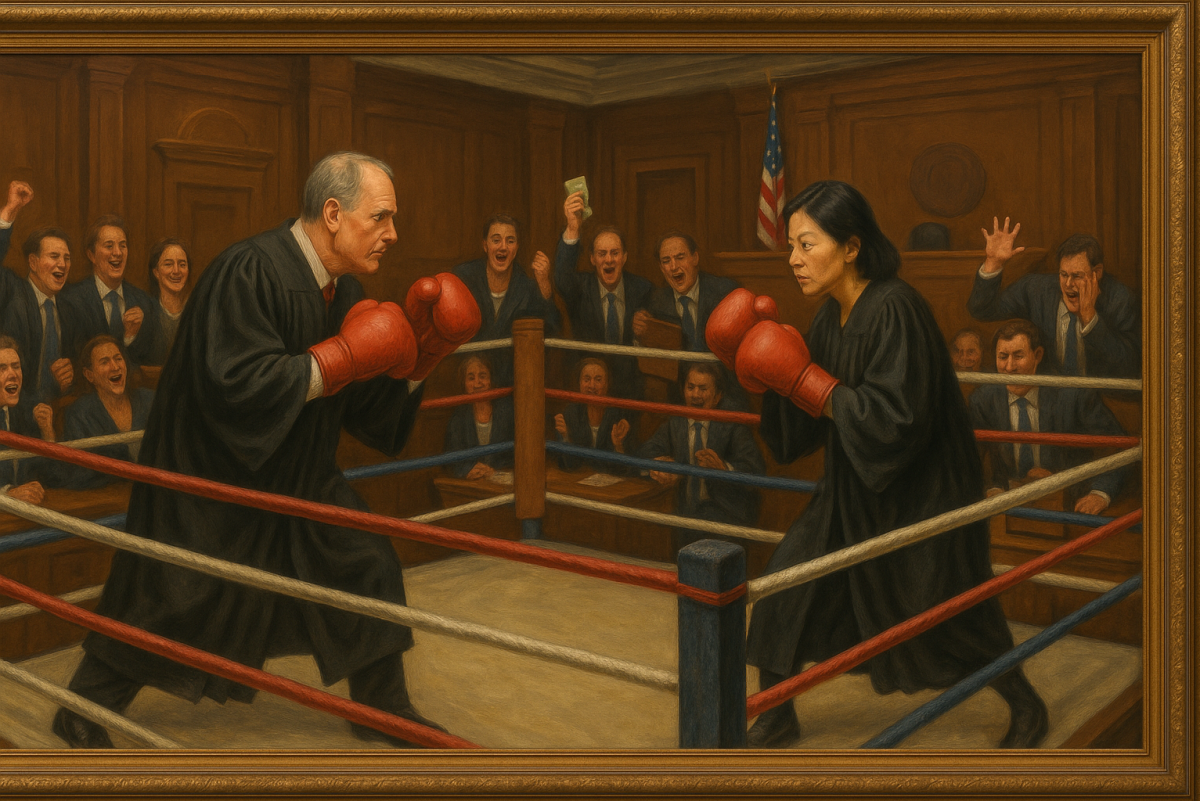
When the Solicitor General files briefs in the Supreme Court, the briefs always bear the names of other lawyers from the Department of Justice. In special cases, however, officials from other agencies sometimes sign on, too. For instance, in cases bearing on commerce, national security or foreign affairs, the SG’s briefs might respectively bear the names of officials from the Commerce Department, the Department of Defense or the State Department. The point of this unusual gesture, it seems, is to show the Court that other relevant agencies have been consulted for their expert views and are standing by the Department of Justice in what must be an important case.
But what if a case seems to involve issues pertinent to agencies besides the DOJ, and yet those other agencies don’t appear on the SG’s brief? Does that surprising absence mean that officials from the other agency disagree with the position of the Solicitor General? Has there perhaps been an intense debate within the executive branch—an exchange of views wherein a purportedly expert agency has dissented from the litigation position ultimately taken by the United States? These kinds of thoughts can lead jurists to discount or even discredit the position that the Solicitor General has taken. The practice of including extra agency names on the SG’s briefs is thus a two-edged sword–and one that seems to have been cutting the SG increasingly frequently in recent years.
Justices sometimes pick up on the fact that SG briefs are missing names and then bring up the point during oral argument. As Will Baude notes over at SCOTUSblog, this just occurred in Armstrong v. Exceptional Child Center, which raises a very important and complicated issue implicating the role of the Department of Health and Human Services. The United States filed a brief, but its cover reveals only the names of DOJ officials—nobody from HHS.
This didn’t escape the notice of Justice Kagan—herself a former Solicitor General. As someone unusually familiar with the workings of the executive branch, Justice Kagan was well-positioned to probe the matter. Here is a portion of her line of questioning directed at the SG’s Office:
MR. KNEEDLER: […] If you’re income qualified or you get hospital services, you can sue about that.
JUSTICE KAGAN: Judging from the – the names on the brief, I take it that HHS does not agree with that statement.
…
JUSTICE KAGAN: Judging from the names on your brief […] or the absence of names on your brief, I take it that HHS does not agree with that statement.
Mr. Kneedler, the uber-veteran SG attorney at the podium, didn’t take up Justice Kagan’s inquiry, perhaps because he preferred to let the question go without a direct answer.
If deliberate evasion is indeed what happened, you can hardly blame Mr. Kneedler. Judicial inquiry into behind-the-scenes thinking in the executive is at the very least embarrassing, possibly corrosive of candid deliberation, and—in an extreme instance—a separation-of-powers problem.
For an example of an extreme case, consider the blurb below from Alison Frankel’s coverage of Judge Posner’s truly remarkable series of orders last year in Motorola v. AU Optronics:
On May 1, the 7th Circuit panel judges sent a letter to the U.S. State and Commerce departments — which hadn’t specifically signed the Justice Department amicus brief — inviting them to file their own brief to address “the potential effects on foreign relations resulting from the issues presented by this case.”
Solicitor General Donald Verrilli responded with a polite-but-firm letter to the 7th Circuit on May 19. He had personally authorized the amicus brief urging reconsideration of the panel’s decision “on behalf of the United States after appropriate consultation with interested components of the federal government,” Verrilli wrote. “It reflects the views of the United States on the matters expressed therein. Neither the United States nor any of its departments plans to file an additional brief at this stage of the appeal.”
That was not a good enough answer for the 7th Circuit panel. On May 22, Posner and the other judges issued a quite stunning order directing the solicitor general to name the government officials he consulted before sending the May 19 letter, to describe the nature of those consultations and to explain exactly what he meant when he said that Justice’s amicus brief reflects “the views of the United States.”
Happily, the Seventh Circuit eventually backed down.
All this raises the question of whether it’s actually worth having the practice of occasionally including non-DOJ officials on SG briefs. From the Solicitor General’s perspective, the punch of added names in one case has to be weighed against the deflationary effect of having names missing in others.
Viewed more abstractly, giving other agencies the option to sign SG briefs effectively gives those other agencies a bit of authority over how the US represents itself in the Supreme Court. An agency that has the opportunity to sign onto an SG brief has in effect obtained a significant bargaining chip. Much like a Justice at the Court, the extra agency might demand changes to the brief as a condition of its “join.” This might be good insofar as the expert agency actually has expertise that should influence the SG’s filings. Needless to say, however, the SG’s office is unlikely to be pleased with this non-trivial diffusion power within the executive branch, not least because it weakens the SG’s office itself.
There’s also the serious possibility that judges might erroneously infer something from the fact that certain names are absent from briefs. After all, officials sometimes stay off briefs for reasons unrelated to inter-agency intrigue. For example, either the OSG or the other agency itself might not think that the other agency has a significant institiutional interest in the case, even where an outsider might assume otherwise. In those cases, the dog that didn’t bark isn’t a clue but an irrelevance. Yet the SG might have difficulty assuaging even erroneous concerns of this kind, particularly since they are usually aired (if at all) during oral argument.
My sense is that the Solicitor General has gotten more questions about missing names in recent years, possibly because three of the last four Justices to be confirmed served in the SG’s office. If there is such a pattern, the SG might have to rethink or re-articulate its policy on extra agency names–even though that policy change would likely come with an institutional cost of its own.
Posted by Richard M. Re on January 22, 2015 at 11:39 AM
Comments
Milwaukee Brewery Workers Pension v. Schlitz, 513 US 414, 442 (1995) (rejecting an SG interpretation of ERISA that was not supported by the Pension Benefit Guaranty Corp.)
Posted by: T. M. Deneen | Jan 30, 2015 2:11:03 PM
Apologies for the distraction and thanks to other commenters for enlightening me.
Posted by: stan | Jan 25, 2015 5:08:50 PM
I really enjoy the discussion here, as well as the great post, Richard. (All your posts are really terrific.) As some of the comments expressed above note, I think the analysis has interesting implications for the kind of deference the court has given agency interpretations in amicus briefs, like those in Williamson, Geier, and Auer, itself.
Two off-the-cuff thoughts, even though this is not totally in my area of expertise: (1) Given the Supreme Court’s statements in the past about how and when to defer to solicitor general representations of an agency, I agree with Steve that a substantive disagreement in interpreting federal law would seem to matter in some cases. Cf. Williamson v. Mazda, 131 S.Ct. 1131, 1139 (2011) (observing there is “no reason to suspect that the Solicitor General’s representation of DOT’s views reflects anything other than `the agency’s fair and considered judgment on the matter.'” Geier v. American Honda Motor, 529 U.S. 861, 884 (2001) (quoting Auer v. Robbins, 519 U.S. 452 (1994)).
(2) Given that there seems to be a range independent and executive-type agencies, see Richard L. Revesz, Deconstructing Independent Agencies (And Executive Agencies), 97 Cornell L. R. (2013), I wonder how “independent” or “executive” the agency has to be — and what factors should be considered in judging that independence — before such separation of powers concerns become really important.
Posted by: Adam Zimmerman | Jan 24, 2015 5:10:24 PM
Richard — Again, I agree 100%. I think the really interesting question is what “best practices” are, not just from the perspective of OSG, but also from the perspective of the Justices trying to divine what to make of cases in which an agency’s absence is noticeable. Not all cases are equal, of course, but I do just want to reiterate the critical distinction in my view between OSG taking a different position from another non-independent Executive Branch agency over the interpretation of federal law (in which I’d be inclined to defer to OSG), and OSG making claims about how that agency operates / its ability to enforce the underlying federal law (in which the agency’s refusal to endorse the OSG position is, to me, a substantively significant disagreement in which I’d be more inclined to side with the agency).
The harder question then becomes whether it’s useful for that agency’s views to be provided to the Court–and, if so, whether briefs of former agency officials speaking to historical practice is the most practicable way of providing those views…
Posted by: Steve Vladeck | Jan 24, 2015 12:52:45 PM
Two other quick thoughts:
1. As Steve’s comment indicates, missing signatures can be especially noticeable if an agency has previously signed onto filings in that very case. That is a pretty strong signal that the case is thought to implicate the agency and, as a result, that the agency’s “join” has been requested. So the sudden absence of an agency that previously signed probably signifies internal executive branch dissent. Here is a link to (another) Alison Frankel piece discussing this point in connection with the State Department, the ATS, and Kiobel: http://blogs.reuters.com/alison-frankel/2012/06/15/kiobel-brief-shows-statedoj-split-over-human-rights-litigation/.
2. Some of the other comments, particularly Will’s and Anne’s, highlights that much of my post’s reasoning is limited to so-called “executive” agencies and excludes some of the independent agencies with their own litigating authority. When an agency can file its own brief, then Congress has created the diffusion of executive authority and multiplied the voices before the Court. By contrast, the practice of having or not having signatories on briefs–so far as I know–is exclusively a function of internal executive practice and tradition. That makes it easier to overlook but also in many ways more remarkable, given its increasing salience and contingency.
Posted by: Richard | Jan 24, 2015 12:19:02 PM
I’m biased, since I filed the brief on behalf of “former HHS officials” in Armstrong that, I suspect, provoked this exchange. But in this case, at least, there are a few extra details that are worth flagging:
1) When this exact issue was first before the Court in Douglas three years ago, the Court issued a CVSG at the cert. stage. And when the SG recommended a denial of certiorari, that brief _did_ include HHS signatories.
2) When the Court nevertheless granted cert. in Douglas, the SG took the position that private enforcement of the equal access provision would affirmatively interfere with and hinder the Secretary of HHS’s enforcement discretion–a factual claim about a different agency that does not answer to DOJ. And not only did HHS not sign the SG’s brief on the merits; the New York Times publicly reported on the internal deliberations that led to this schism.
3) In Armstrong, the government has once again filed an amicus brief taking a position about the relationship between private enforcement and administrative enforcement by HHS. That’s why we filed a similar brief, again on behalf of former HHS officials, to advance a specific claim about the agency’s historical view and current capacity to meaningfully enforce the relevant statutory provision by itself.
Without taking sides in the broader discussion about what we should/shouldn’t infer from agency absence from SG briefs, this strikes me as a special case–one in which HHS’s absence is not just unclear, but due to a fundamental disagreement between DOJ and HHS over what HHS itself thinks and does.
Posted by: Steve Vladeck | Jan 24, 2015 10:19:29 AM
There are a few agencies — FCC and NRC — with completely independent litigating authority from the DOJ when cases reach the Supreme Court; others have more limited authority (the FTC has it when the SG refuses to back up their position). Independent regulatory commissions generally have more authority in the lower courts. Neal Devins has some nice work on this from the 1990s — including information on a showdown between the Postal Service and the Executive Branch in the DC Circuit (an interesting take on removal issues, for those who teach Administrative Law). More recently, Dodd Frank gave the new CFPB authority in the lower courts, with a mandate to consult the DOJ, and the ability to ask DOJ for authority in the Supreme Court. There are some interesting divisions: the Export Import Bank controls its litigation abroad but DOJ takes charge in federal courts.
Posted by: Anne Joseph O’Connell | Jan 23, 2015 7:44:04 PM
It’s worth noting that several years after Schering-Plough (the case that stan highlights), the FTC and the DOJ filed a joint petition for cert on the same topic.
Here: http://www.scotusblog.com/case-files/cases/federal-trade-commission-v-watson-pharmaceuticals-inc/
Posted by: TNN | Jan 23, 2015 6:03:36 PM
I don’t think that’s the SG’s fault: http://www.gwlr.org/wp-content/uploads/2012/08/77-4-Karr.pdf
Posted by: William Baude | Jan 23, 2015 4:23:18 PM
The DOJ and others would be better situated to criticize judicial inquiry into their deliberations if the United States always spoke with one voice in litigation.
In this case (briefs linked in post), the FTC petitioned for cert. The Supreme Court CVSG’ed. And the SG recommended denying cert. http://patentlyo.com/jobs/2006/05/ftc_v_schering_.html
I think I recall that FTC and DOJ may have filed separate amicus briefs in another case, but I can’t find it and may simply be misremembering. If the feds are willing to speak with multiple voices in litigation, then it seems to me to be fair for the courts to ask which voices it’s hearing at the moment.
Posted by: stan | Jan 23, 2015 3:24:04 PM
Relatedly, I observe that there are some big non-DOJ names on the government’s recently filed brief in King v. Burwell: http://d35brb9zkkbdsd.cloudfront.net/wp-content/uploads/2015/01/14-114-Respondents-Brief.pdf
Posted by: William Baude | Jan 23, 2015 11:31:53 AM
Thanks for this interesting post. I am really troubled by the idea that courts would infer (wildly speculate?) something about internal branch deliberations (which are relevant how, exactly??) by how closely an administrative custom on brief signing is followed.
The law is pretty clear. Under statute and longstanding practice, 28 U.S.C. 516-519, the DOJ speaks for the US in most litigation, particularly at the level of the Supreme Court. Although courts might have some minimal ability to interfere with a party’s choice of counsel (i.e. disqualify a crook), it strikes me as completely inappropriate to second guess a party’s choice of competent counsel (or draw conclusions from it). This is particularly true when we’re talking about the executive branch’s formulation of positions, which implicates constitutional concerns. Should the Court also take note that any individual line bureaucrats might also disagree with the DOJ’s position? (Looking behind the curtain is somewhat of a change for the Court; singular representation has been favored by the Supreme Court in the past, as the Court wrote in 1971 to oppose giving the FEC litigating authority: “It is the unanimous view of the Justices that it would be unwise to dilute the authority of the Solicitor General as to Supreme Court jurisdiction in cases arising within the Executive Branch and independent agencies.”)
Even assuming that brief signing reflects some internal disagreement (which still seems like a bit of a stretch to conclude–and a completely inappropriate thing for the courts to ask about), then what’s the relevance of that? If there’s a doubt about whether the SG has really thought through a position, the fact that an intrabranch conflict was raised and resolved reflects far MORE deliberation than if the DOJ signs onto a position put forth by an agency. The one area where I see it having POTENTIAL relevance is when a court is deciding whether to give a government brief formal deference (i.e. Chevron) in interpreting a statute. Some courts have given Chevron deference to amicus briefs filed by USG in earlier cases. This is a reasonable (though not beyond question) application of the “Step 0” inquiry of how deliberative the decision was. But when answering the question of whether the agency delegated the power to fill in the gap has spoken (since Chevron insists that interpretive power be delegated to a particular agency, which then must exercise that power), the participation of the delegee agency in the DOJ’s briefing would seem to be potentially quite important. Otherwise, I call foul on the whole inquiry.
Posted by: Joe Mead | Jan 23, 2015 8:09:56 AM
TNN: Thanks!
Bryan G.: I think you’ve linked to the piece that I already block quote in the middle of my post:)
Posted by: Richard | Jan 22, 2015 1:32:21 PM
Another interesting episode is when a Seventh Circuit panel led by Judge Posner ordered he Solicitor General’s office to disclose whom it consulted when it authorized a particular agency to file an amicus brief (with another potentially interested agency not signing on or filing its own amicus).
Posted by: Bryan G. | Jan 22, 2015 1:14:43 PM
Another notable example comes from the Federal Circuit in Myriad (the case eventually went before the Court, whose opinion closely hewed to the Solicitor General’s recommendation). Judge Bryson, noting the absence of the PTO/Commerce, even suggested that it might have been appropriate for the patent office to file a dissenting brief.
There’s a link to the audio of argument here: http://www.717madisonplace.com/?p=5380
Posted by: TNN | Jan 22, 2015 12:23:13 PM