
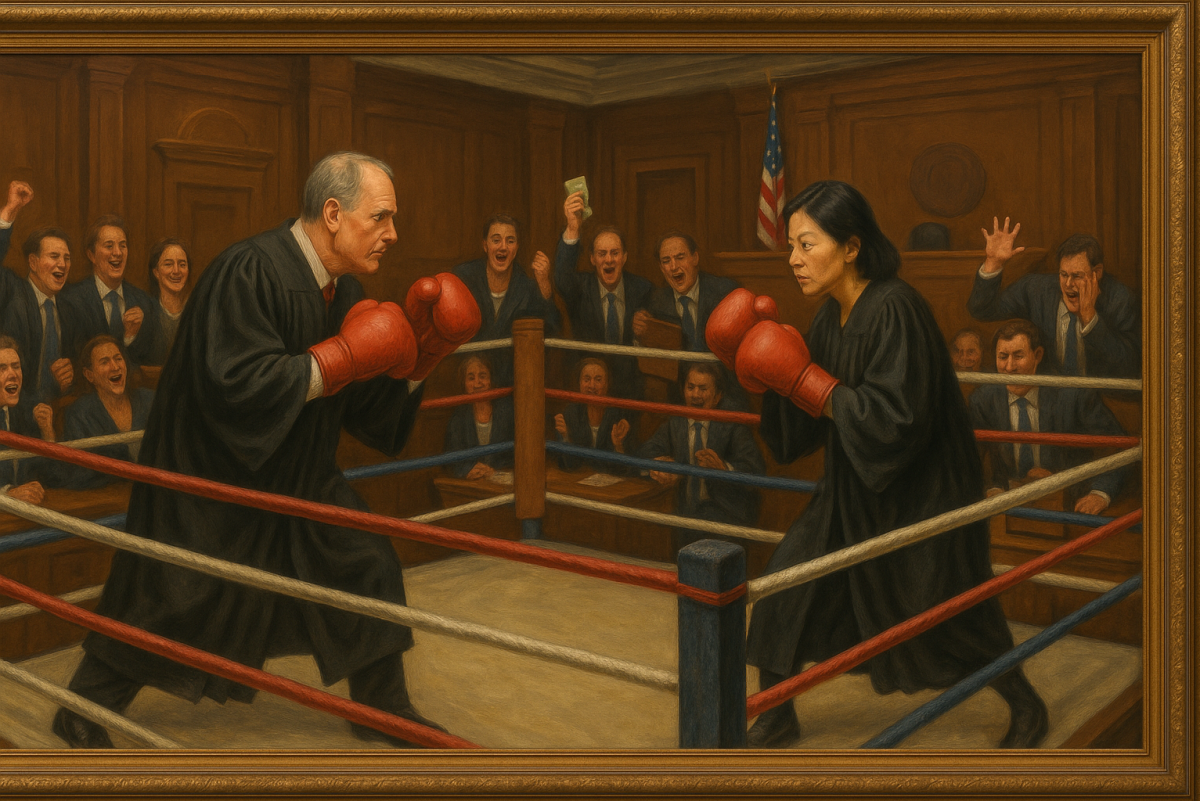
The odds-makers are generally in agreement that the deciding vote in Obergefell v. Hodges will be Justice Kennedy. While some have speculated that Chief Justice Roberts will find a way to join in a majority judgment (if not majority opinion) recognizing a Constitutional right to same-sex marriage, the more-prevalent view is that the liberal-conservative stalwarts on the Court will split 4-4 and that Kennedy will cast the decisive fifth vote one way or the other. If he sides with the proponents of same-sex marriage, the winners will have another Kennedy to thank, albeit posthumously, for that result: Senator Ted Kennedy. The narrative goes like this:
In 1987, Justice Lewis Powell retired, leaving President Ronald Reagan his third Supreme Court vacancy to fill. (The first occurred when Potter Stewart retired, and President Reagan appointed Sandra Day O’Connor. The second occurred when Chief Justice Warren Burger retired, and President Reagan elevated William Rehnquist to the Chief Justice seat and appointed Antonin Scalia to fill the vacancy.) Reagan nominated Judge Robert Bork of the D.C. Circuit, leading to the infamous confirmation hearing that ended with a Senate vote rejecting Bork, 58-42. Bork’s greatest and first nemesis in that nomination process was Senator Kennedy, who took to the Senate floor and urged that “Bork’s America is a land in which women would be forced into back-alley abortions, blacks would sit at segregated lunch counters, rogue police could break down citizens’ doors in midnight raids, schoolchildren could not be taught about evolution, writers and artists could be censored at the whim of the Government, and the doors of the Federal courts would be shut on the fingers of millions of citizens.” Notably absent from that floor speech was any notion of rights for gays and lesbians. Remember, this was 1987. Bowers v. Hardwick, the 1986 case that permitted states to criminalize sexual conduct between members of the same sex, was fresh law (and remained on the books until 2002, when Justice Kennedy wrote the decision in Lawrence v. Texas that overturned it). Kennedy’s speech galvanized the Senate, and the nation. Vice-President Joe Biden, then a senator and chair of the Judiciary Committee, had his own field day during the committee hearings. I was a fresh-faced first-year law student, and the protests on my law-school campus made indelible impressions on me. When Bork was ultimately defeated, we knew we had won. We didn’t quite know what we had won, but we knew we had won something. President Reagan next nominated Douglas Ginsburg to fill Powell’s spot, but Ginsburg withdrew after reports surfaced that he had used marijuana. (Remember, it was 1987.) So Reagan turned to Anthony Kennedy. And here we are today. Bork died in 2012. Had he won confirmation and remained on the Court until his death, President Obama would have been in office at the time of the vacancy. Given the likelihood that Obama would have appointed a justice favorably disposed to same-sex-marriage rights, some might say that blocking the Bork nomination had no ultimate impact on this issue. But it’s important to remember that Obergefell did not materialize out of thin air. It comes following years of development of legal protections for gay, lesbian, and bisexual people: (1) the Kennedy opinion in Romer v. Evans, which in 1995 struck down a state constitutional provision banning anti-discrimination laws protecting gays, lesbians, and bisexuals; (2) the 2002 Kennedy opinion in Lawrence; and (3) the 2013 Kennedy opinion in United States v. Windsor, overturning a portion of the Defense of Marriage Act. So some credit is due to Senator Kennedy, arguably responsible (at least in part) for the ultimate nomination of Justice Kennedy. And that Kennedy-Kennedy legacy may end up making a bigger mark on history when the Court announces the Obergefell decision at the end of June.
Posted by Andrew S. Pollis on May 7, 2015 at 12:20 PM
Comments
Sen. Kennedy was an important liberal voice in the promotion of various causes. So, I’ll give him something of a “due” here.
But, I think the Bork defeat was a combination of President at a weak point of his term, a questionable choice that tried to bite more than one can chew (made worse by the candidate’s decision to give it his all that only made things worse), the important of the swing vote & the Democrats regaining control of the Senate in 1986.
And, Douglas Ginsburg was itself something of a fluke. Overall, I think this is akin to focusing on one senator to show how the appointment of Fortas for Chief Justice faltered. Then, again, the senator doesn’t have the same name as the justice in question!
Posted by: Joe | May 8, 2015 10:25:03 AM