
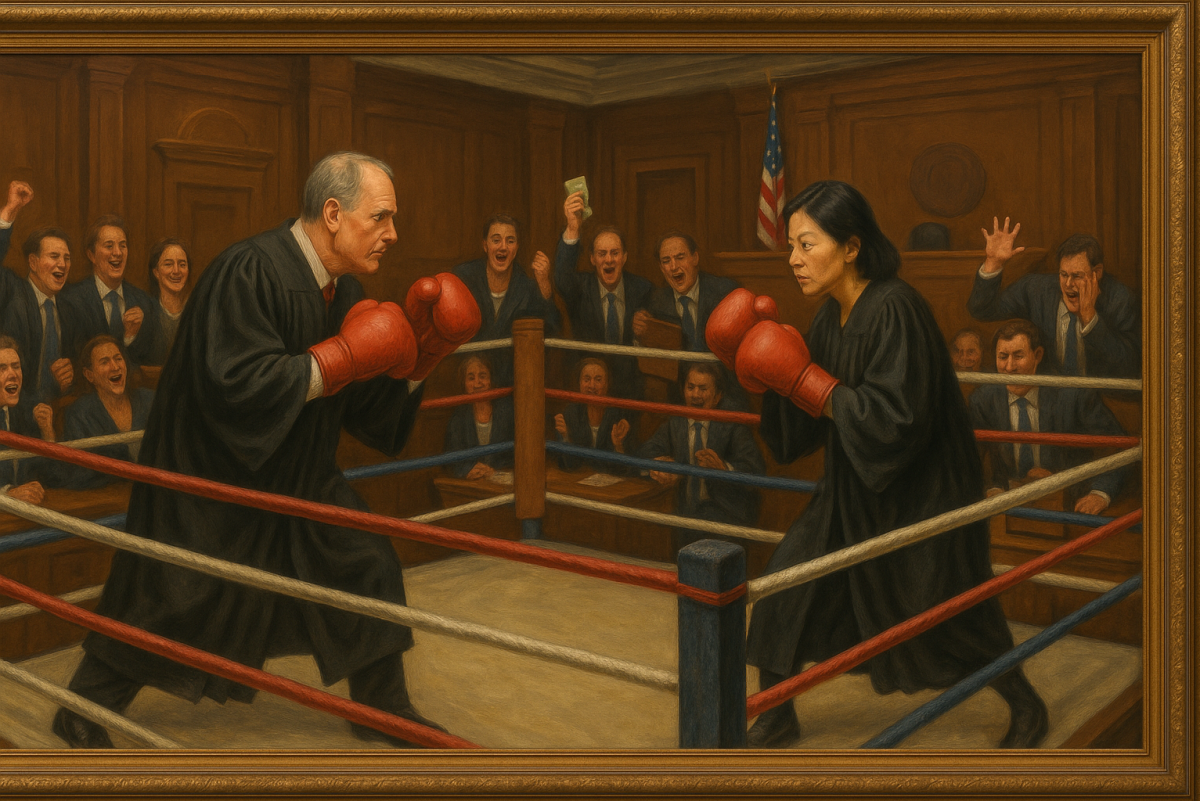
For those of you who love either land-use law arcana or NYU, yesterday brought good news. NYU finally prevailed before the New York Court of Appeals on the question of whether it could develop four parcels of land (two pocket parks, a playground, and a dog run) that had been previously used as public spaces but that had been formally mapped as parts of West Village streets by NYC. Opponents of NYU’s “2031 Plan” (an ambitious program of building extra classroom and housing space around Washington Square) argued that, because these four parcels had been used as parks by the public, they had been implicitly dedicated as parks under the “public trust” doctrine, a New York state law doctrine requiring state legislative approval for local governments can convert parkland to non-park uses.
The “public trust” doctrine, so understood, strikes me as a bizarre exception to the most basic principles of local government law, an exception that the state courts stumbled into by conflating local governments with private donors. As I suggest after the jump, it provides a nice illustration of how court-created doctrines, invented purely for policy purposes, outlive the reasons that give them birth. I might be mistaken, however, and I’d welcome any efforts to defend what strikes me as a mindless legal atavism.
Consider two ways in which the “public trust” doctrine violates core principles of local government law.
First, it is commonly assumed that local legislative power is normally inalienable. Ordinarily, one local legislature cannot tie the hands of its successors, so that one city council’s decision to create a park should be up for grabs by the next city council. But the “public trust” doctrine allows one city council to tie its successor’s hands by saddling it with parks that require the permission of Albany to be sold.
Consider, second, the principle of home rule. For decisions largely affecting the voters of New York City, the legislature elected by those voters should be responsible. But the “public trust” doctrine requires the City to go hat in hand to Albany where a bunch of Republicans from Cortland County or some other upstate venue get to decide the fate of a dog run in Washington Square, NYC.
This doctrinal oddity of “public trust” was conceived in the late 19th century century by analogizing local governments’ lands dedicated to public use (“streets, wharves, cemeteries, hospitals, court-houses, and other public buildings,” in the words of Meriwether v. Garrett, 102 U.S. 472, 513 (1880)) to the corpus of a charitable trust managed by the local government as trustee on behalf of the public. Just as a trustee cannot simply sell off the assets of the trust and use it for non-trust purposes, so too, the local government cannot dispose of public lands as it sees fit without express authorization from the state legislature.
The analogy, however, is hollow. Cities create and maintain assets like parks with money appropriated from past and current taxpayers. The past taxpayers have no more reason to bind the current ones with respect to parkland anymore than with, say, police squad cars or garbage trucks. Local governments are not “trustees” except in a very remotely metaphorical sense. They are instead elected bodies assigned to make tradeoffs between parks and other goods like (say) education. If they cannot be trusted to do so with parks, then why should they be trusted to do so with taxes, budgets, bonds, collective bargaining agreements, and a host of other matters involving public investment?
Behind this “public trust” analogy, I suspect, lay the fear of nineteenth century upstate Republicans that Tammany Hall Democrats would otherwise sell off city assets and use the assets for corrupt purposes. Today, however, using Albany to clean up the NYC City Council is like using a doormat to wash your dinner plates. As a full-time salaried body policed by a squeaky clean Conflict of Interest Board headed by Columbia’s own Richard Briffault, NYC’s council is pretty clean, while the state Assembly and Senate are part-time bodies with little ethical policing that are notoriously corrupt.
The public trust doctrine, in short, seems to me to be a pure legal atavism, a throw-back to an earlier period lacking any conceivable current justification but chugging along nonetheless and causing mischief as it chugs. (It is currently slowing down the re-development of Willets Point).
But maybe, biased as I am in favor of NYU’s project, I am missing some important justification for this doctrine and the special protection for parks that it provides?
Posted by Rick Hills on July 1, 2015 at 01:01 PM
Comments
A historical nit-pick. While there’s surely a case to be made that New York City government was more corrupt 120 years ago than today, I’d hesitate to assert that the legislature in Albany was any less corrupt. I recall strong suggestions otherwise from biographies of Theodore Roosevelt that I read some time ago. The legislators of the late 19th century may have been less concerned about the existence of corruption than who its beneficiaries were.
Posted by: Ben Ross | Jul 2, 2015 11:40:37 AM
David, you’re absolutely right that, even without the Public Trust doctrine, NYC could tie its successors’ hands — and a good thing, too, given hat such tying is necessary to make a credible commitment for stuff like borrowing money, Normally hand-tying of this sort is accompanied by procedural formalities that at least to purport to trigger more careful consideration of the commitments being made. I take the commitment to maintain Flushing Meadows in precisely its current shape was NOT accompanied by such safeguards, so I am not nuts about a doctrine that ties the hands of the park department when they want to lease a piece of the tennis court parking lot to a food vendor.
Paul D., you are absolutely right that NY’s “public trust” doctrine barring disinvestment in municipal property like parks and streets has very little to do with the classic doctrine protecting “natural” public goods like beaches and rivrs from private appropriation. I would not bash the latter — or, at least, if there are objections to the latter, they have nothing to do with one legislature’s tying another’s hands by bringing in a third legislature (the state) to veto the second’s decisions.
And, yes, NYU spared no expense on this one: For NYU, real estate is serious business.
Posted by: Rick Hills | Jul 1, 2015 6:23:28 PM
Boy, NYU must have been pretty concerned if it retained Seth Waxman!
What’s interesting to me is that “public trust” is, of course, a much broader doctrine that is often used by courts to restrain the state legislature from selling off or despoiling natural resources like ocean shores and navigable waterways. Joseph Sax famously pushed for applying it to environmental resources more generally. Here in Oregon, a group of high school students recently sought to expand the doctrine to have it cover the atmosphere, but a trial court balked. http://ourchildrenstrust.org/sites/default/files/15.05.11.OregonCircuitCtOpinion.pdf There was a recent decision in New York applying the “classic” public trust doctrine to waterways in the Adirondacks: http://decisions.courts.state.ny.us/ad3/Decisions/2015/518309.pdf.
Interestingly, in New Jersey, the courts have used public trust to prevent local governments along the Shore from acting parochially — namely, by making it hard for out-of-towners to use their beaches. See Matthews v. Bay Head.
So, Rick, I’m hesitant to bash the public trust doctrine more broadly without a more specific term for the sub-doctrine(?) you’re decrying — say, the “local government dedication” doctrine. Is this subdoctrine even linked conceptually to the “classic” public trust doctrine in New York, or is this another case of courts using one term for two different things?
Posted by: Paul D | Jul 1, 2015 2:23:21 PM
Completely agree. The stance of state legislators from the city on this (Glick, Squadron et al) was particularly silly, arguing that the input and great wisdom of legislators from Poughkeepsie and Plattsburgh was necessary before New York City made a decision without any conceivable effects negative effects on residents outside of its borders.
The doctrine after Glick, though, while still a little odd, is probably not particularly harmful. A city can make clear that new land used as parks is not, in fact, intended to remain that way permanently, and thus escape the public trust doctrine. Whether it does so is another question, I suppose. All governments have plenty of ways to tie the hands of their successors (e.g. bonds and bond covenants, or any of the tools discussed in the recent Levinson and Sachs piece)
Posted by: D.Schleicher | Jul 1, 2015 1:45:31 PM