
Implicit within the rallying cry “Black Lives Matter” is the word “too.” In the debate about the slogan, that sometimes gets lost. Some politicians and public figures seeking to be inclusive about the value of lives have responded “All lives matter” sometimes missing the implicit “too”. And perhaps the movement seeking to provoke has intentionally obscured the “too” in order to elicit a reaction that feels tone deaf when you understand the implicit “too” is there. For me, the rallying cry is much more powerful with the “too” explicit. The perception that we need reminding that those lives historically treated as having lesser value through the Constitution, slavery, and Jim Crow should matter too in our supposedly “post racial” world is a damning critique of where we are as a society. The Black Lives Matter movement is critical for keeping the light brightly shining on racial injustice as the news media and the public mind shifts its attention away from Ferguson, Staten Island, and North Charleston.
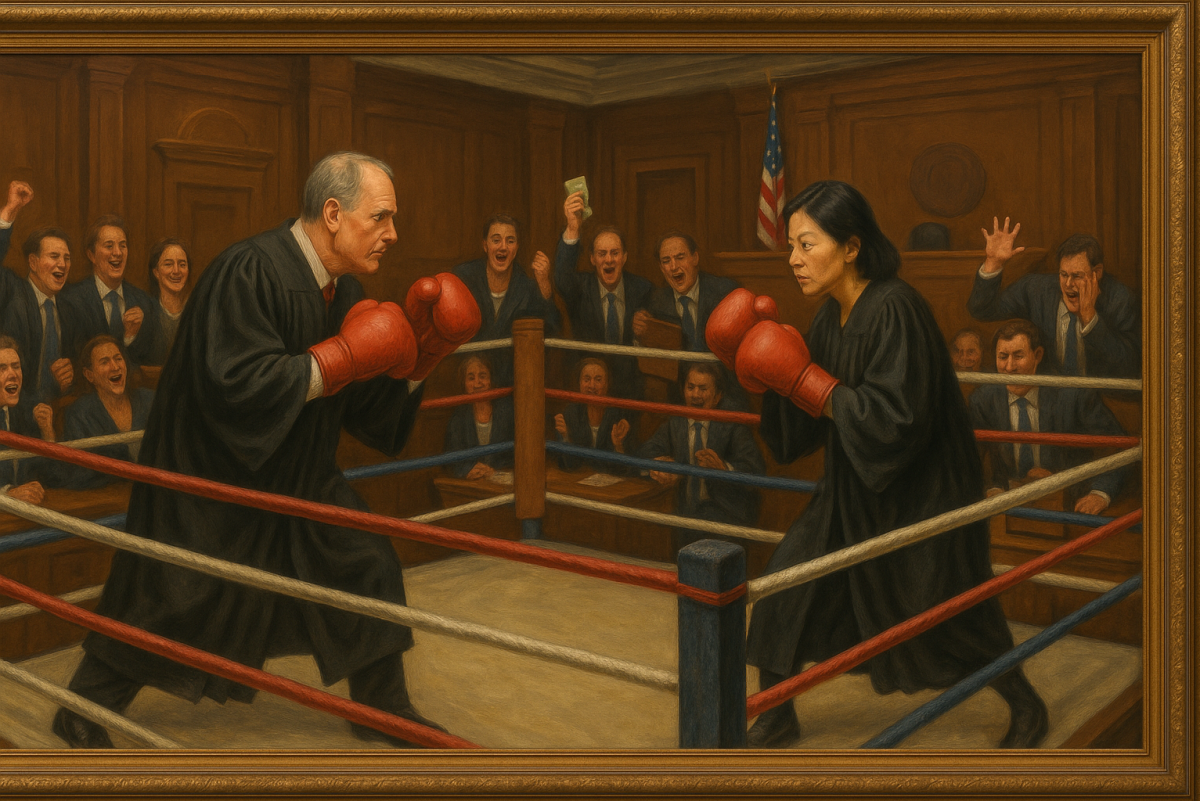
But I am also frustrated with the movement as it seems to have revived the unfortunate class versus race competition. Its almost as if some of the movement’s actors have forgotten the implicit “too” in their calls for the prioritization of race over other forms of inequality like class. And maybe that’s right given America’s original sin of racism and racial subordination. But for me, race and class are fundamentally intertwined. Michael Brown, Eric Garner, and Walter Scott obviously had in common the color of their skin, but they also were among the most economically vulnerable. Perhaps it is a coincidence that they shared this class characteristic, but I suspect it is not. I suspect that we have forgotten or perhaps never learned that poor lives matter too.
In the competition between race and class, it is hard for that message to come through. My first substantive blog post asked why class is so little examined in legal scholarship. I suspect that part of the answer lies in the pressure to prioritize race over class. Some scholars, particularly scholars of color, might be concerned that a focus on class will be perceived as a betrayal of the prioritization of race. Other scholars, particularly white scholars, might be concerned that a focus on class will be perceived as a devaluation of the importance of race. After all, nearly a majority of poor people in the United States are white and there are privileges that come with whiteness. We therefore seem to tip toe around issues of class (if we discuss them at all) for fear of being perceived as tone deaf about the racial injustices all around us.
But I just don’t think we will ever resolve racial injustices without bringing into focus the class injustices that are just beneath the surface. Our forgetting that poor lives matter too has contributed not only to the reckless police behavior that we see on the television screens, but also to decisions of some states not to expand Medicaid, to underfund public schools (particularly those that serve poor minority communities), to warehouse mostly poor black and Latino men in prison, to segregate the poor through decisions not to provide affordable housing in wealthier neighborhoods, to maintain substandard minimum wages. These are as much issues of class as they are of race. And while the latter policies do not result in the same instant and tragic death as a bullet from a gun, the slow death from economic, social, and political marginalization and subordination should not be ignored.
I am not only frustrated with the Black Lives Matter movement, but also with the current talk of “economic inequality.” This talk of economic inequality seems to mirror the occupy movement in that the message conveyed still seems blind to the fact that poor lives matter too. Our renewed focus on economic inequality seems different from that of the 1960s War on Poverty in that it leaves the very worst off, the poor, on the sidelines. Many of the issues advanced by Occupy Wall Street such as student loan debt forgiveness, quality jobs, bank reform, and protection from housing foreclosures are mostly issues that do not concern the 15% that live below the poverty line. These issues certainly matter, but they seem to matter more to a middle class (or the 99%) made vulnerable by the Great Recession. The fact is that many of the poor lack jobs, let alone quality jobs, student loan debt to forgive, or a house to foreclose.
While it might seem paradoxical for the poor to be marginalized from an agenda focused on economic inequality, the fact is that it simply reflects their broader marginalization in politics and their limited influence on social movement actors and elected officials. The black lives matter movement has been able to get the attention of presidential candidates and engaged them in conversations about racial justice because the movement is able to cross class lines. Members of the movement and their allies (actual and perceived) are not only members of the mostly poor communities of color afflicted by the tragedies, but also middle class, college educated, social justice activists who have taken on leadership roles. The poor seem to lack these cross-class coalitions and the political power necessary to get a seat at political table. The only hope right now is that whatever policy gains achieved by the Black Lives Matter movement will have a spillover effect on the poor (at least, the poor communities of color).
I think that until we recognize that its about more than race, until we recognize that poor lives matter too, until we find a way to empower the poor to protect themselves through social movements or through representation in politics, the crucial injustices that are an important source of the racial fault line will remain. Just my two cents about the world as I see it.
Posted by Bertrall Ross on August 25, 2015 at 12:35 PM
Comments
Thanks for the post, Bertrall. I take up a couple of your themes in two forthcoming articles. In particular, I address what you call the “competition between race and class” and the reasons “class is so little examined in legal scholarship.” The first piece is framed in terms of that competition, which I call a false choice. It is “The False Choice Between Race and Class and Other Affirmative Action Myths” 63 Buffalo Law Review (2015).
http://papers.ssrn.com/sol3/papers.cfm?abstract_id=2652923
Both of my new articles address poor and working class whites as critical race projects and not solely as class-focused projects. As a white scholar who has been shushed over the years when I have tried to talk about poverty and various aspects of socioeconomic disadvantage–including in relation to whites–I finally decided to write about the shushing and to theorize what drives it. Among other things, I talk about the deterrent to this scholarship that Bertrall identifies: the fear “that a focus on class will be perceived as a devaluation of the importance of race.” As I observe there, the response I have often gotten to efforts to talk about poor whites and my own “class migration” from a working class family suggests that I could not begin to be aware of the potency of my white privilege because, if I were, I would not dare mention class disadvantage. These are issues I take up in the second piece, “Who’s Afraid of White Class Migrants? On Denial, Discrediting, and Disdain (and Toward a Richer Conception of Diversity)”
http://papers.ssrn.com/sol3/papers.cfm?abstract_id=2652924
In both of these pieces I argue that–tempting as it is to relegate low-income, working class whites to another sphere (we would like to help unionize them, but we do not want “them” among “us”), we need them as students in elite higher education and we need them in the professoriate, in part because they can help us make progress on thorny issues of race-relations. Further, valuing them for these purposes and in these contexts does not mean we do not also value racial and ethnic minorities. In short, we don’t have to choose between race and class, and we need to do a better job of teasing out the complex intersections of race with class, including the intersection of white-skin privilege with class disadvantage.
Posted by: Lisa Pruitt | Sep 25, 2015 9:52:05 AM
Tactics aimed at whom, might be more to the point. To me, it seems like the only question is “what is the more effective way to put pressure on those in power, and thereby advance policy in the general direction we prefer” (where “we” roughly means “people who agree with people like me and Bertrall”).
I could be wrong—maybe the single-issue BLM focus isn’t working. But I think it is; we certainly seem to be having an extended conversation, particularly since the death of Mike Brown, and major players (politicians, journalists, etc.) seem to be feeling themselves obliged to answer these complaints in ways that they don’t seem to feel themselves obliged to answer extended complaints about more complex social issues and policy proposals…
Posted by: Paul Gowder | Aug 28, 2015 4:52:28 PM
Tactics for whom, Paul? There are a lot of different groups involved, as I understand it, in Bertrall’s critique, including the legal academy. Even limiting one’s focus to BLM, clearly BLM is not an “it,” but a decentralized group with various motives, goals, and views on tactics, as some of the behind-the-scenes issues with the Seattle protest shows. One assumes that some BLM organizers and members are thinking tactically, and others–perhaps especially some or many BLM “allies,” to use a standard locution, are less inclined to be aware of class issues, especially if they live within some largely affluent or class-homogeneous enclave. Without denying the existence of complicating facts, my experience of the tenure-track, research university sector of the academy suggests that it largely fits that bill and that other aspects of identity might be more salient to its residents than class.
Posted by: Paul Horwitz | Aug 28, 2015 12:00:37 PM
Bertrall,
I think everything in your post is right, but—but—how much of this is just a question of tactics? It’s easier to fight on single issues than many issues, it’s easier to fight on salient things like police murders than on a cluster of deep-rooted problems, and if the single big issue can contribute to the little issues as well, ought we maybe to focus on it?
“Black Lives Matter” makes for much better salience and persuasive power than “Students Whose Schools Are Crappy Because Racial And Economic Segregation Combine With Property Tax Funding Systems Matter…”
Posted by: Paul Gowder | Aug 28, 2015 11:14:28 AM
This is one of the few places I’ve read an article/post with a correct understanding that much of the current social turmoil is about class as well as race. Where I live, in Portland OR, I visited the Occupy Movement where it had settled camp in downtown Portland, and saw a clearly delineated, almost caste-like, separation, between the “noble, upwardly mobile” activists protesting things like housing foreclosures, and street people, who seemed to be tolerated like a species of lice who “clearly don’t understand how to be activists and are just leeching off of us”. Not only did I read that type of comment in social media, when I tried to talk to someone who was a doctor doing medical care there, I was brushed off rudely because it seemed that I was perceived as someone not of the activist class, but of the leech class– when in fact, I was neither, just an observer. One of the reasons class is not recognized as a true cause by activists who protest race is that protesting race conditions is a clear social marker that the activists have felt, since the 60s, has separated them, the “educated, enlightened” whites, from the “uneducated bigots”, who largely are imagined as white people who haven’t had the educational opportunities to advance financially. While I have heard this division referred to, I have never heard the person stigmatizing these types of people ever express any kind of sympathy for why someone might be both white and poor, while the reasons someone may be black and poor seem to be taken for granted. There is a lack of understanding that being poor, period, is difficult to escape, and that is this blanket condition that exacerbates race conditions. While poor whites may not face that kind of problem, they do face a general contempt different in nature that indicates, “You have no excuse to be poor if you are not a minority. ” This further obscures the fact that poverty is a gigantic problem that affects all sorts of segments of society. There is still a very not well hidden bigotry against poor people in general, as those who simply aren’t with it enough to be in the forefront of change, and have no excuse to be left behind economically, especially if they aren’t a minority. Put succinctly, white upper middle class protestors suffer from class bigotry almost as an essential element of their enlightened liberal attitudes towards race. They only noticed the war on the poor when it did start affecting their mortgages and their retirement packages– and this has seemed to only exacerbate their hostility towards those without houses, retirement funds, and energy efficient cars. There has been a noticeable difference in my opinion between this new activism and the activism I witnessed in the 90s by the same class of people– they seem to feel that now that the economy has worsened, one of the things they cannot “afford” is sympathy towards the truly poor. One way to point them towards an awareness, at least partially, is to note that most of the black victims of incarceration policies are ALSO poor. But all poor people are targeted, regardless of race. It’s just a fact. And it’s also the case that if you are poor, you are considered not qualified enough to speak about poverty because you haven’t escaped it– while of course, those who are still lucky enough to be middle class are considered much more qualified spokespersons. (That is why it is hard for poor people to network– the people who say they want to speak for the poor don’t really want poor people around. Just my experience.)
Posted by: Jill | Aug 27, 2015 2:33:58 PM
I’m on board, for what it’s worth, with most of what you write here. However, the circles I read and work in, and those I know and associate with who share my Leftist views, are now and have long been concerned with the facts of poverty, both in affluent countries and so-called “less-developed” countries around the globe. The concern for same is evidenced, for example, in groups like Academics Stand Against Poverty (ASAP) (‘an international association focused on helping researchers and teachers enhance their impact on poverty’), or the Democratic Socialists of America, or numerous groups and organizations in communities large and small involved in helping and agitating for the poor (like the Catholic Worker Movement). So too those of us who are fighting against dismantling of the Welfare State (be it liberal, corporatist, social democratic, what have you). Many of us on the Left believe, for instance, in the value of socio-economic and political policy proposals and programs proffered, say, by Erik Olin Wright in Envisioning Real Utopias (2010) or those found in Anthony B. Atkinson’s Inequality? What Can Be Done? (2015), many of which are designed to eliminate poverty. And anyone on the Left familiar with the “capabilities” approach to social justice topics (going back at least to the early 1980s) pioneered by Amartya Sen and extended or modified by Martha Nussbaum and others has kept the problem of poverty front and center among their many concerns. There is a fairly large body of literature clearly evidencing manifest concern with inequality AND (absolute and relative) poverty: See, for instance, many of Sen’s books (including co-authored works with Jean Drèze), as well as Nussbaum’s work on women and human development, and David A. Crocker’s The Ethics of Global Development: Agency, Capability and Deliberative Democracy. More might be said, but I’m surprised to learn there is a significant number of people “out there” who are truly concerned with inequality while at the same time marginalizing the horrible facts that surround the living of life in (absolute or relative) poverty. (I trust they’re the ones in support of Hilary Clinton over Bernie Sanders.)
Posted by: Patrick S. O’Donnell | Aug 25, 2015 6:01:16 PM