
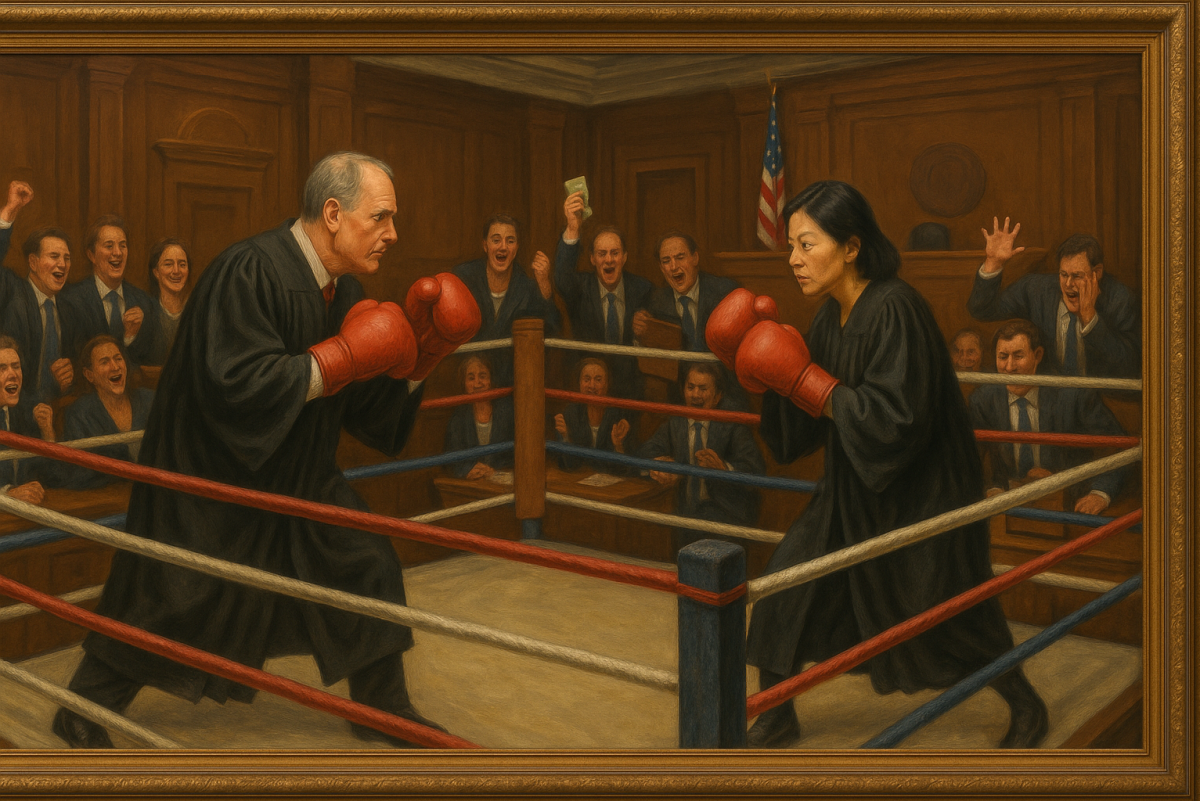
Kevin Walsh has coined the term to perfectly capture the precedent/judgment/departmentalism distinction I have been drawing and that Josh Blackman and I make: “Judicial Departmentalism.” (H/T: Rick, in a comment to my prior post). The idea is that SCOTUS precedent and vertical stare decisis control what happens within the judiciary.* But they do not control the actions of anyone outside the judiciary, particularly officials in the other branches of government, who remain free to act on their own constitutional understandings in terms of the legislation they propose, the way they enforce laws, etc. At bottom, Kevin argues, the American Principles Project is rejecting judicial supremacy in favor of judicial departmentalism.
* The APP statement acknowledges the supremacy of the Supreme Court over the federal judiciary, although does not mention state judiciaries. I default to James Pfander’s argument that a state court deciding a federal issue is a “Tribunal inferior to the Supreme Court,” thus part of the federal judiciary and bound by vertical stare decisis to the same extent as a federal district court.
Of course, judicial departmentalism inevitably morphs into judicial supremacy, because the actions of public officials contrary to binding SCOTUS precedent will eventually find their way into court, where vertical stare decision and judicial departmentalism will compel the court to issue a judgment compelling the officer to abide by the precedent. And the executive cannot act contrary to a judgment directed at him–stated differently, the specific judgment pulls the officer into the judicial department. Moreover, a number of rules that the judiciary applies functionally enforce, or at least incentivize, judiciary supremacy: 1) FRCP 11 requires lawyers and parties to bring cases that are supported by existing law or a nonfrivolous argument for overturning that law, meaning law as established by SCOTUS; 2) qualified immunity is lost and damages possible against a public official who disregards SCOTUS precedent; and 3) the knowledge that an official will certainly be enjoined by a court applying SCOTUS precedent may cause the official to fall in line. [Ed: I guess I should add state Rules of Professional Responsibility, although I know less about these; based on comments to my earlier post, it sounds as if they limit lawyers’ freedom to advise their government clients not to feel tied to judicial supremacy]
But the fact that we (likely, if not certainly) reach the same result at the end of the does not mean there are not multiple steps involved, that everyone is bound everywhere by what SCOTUS says about the Constitution, or that our system is, in fact, one of judicial supremacy.
Posted by Howard Wasserman on October 14, 2015 at 11:08 AM
Comments
The examples you give are where the Court says the popular branches can do something, but they decline to do so on their competing constitutional views. This is Andrew Jackson and the Bank. These categories are not in dispute, by anyone, including judicial supremacists.
But Kevin and I were both writing in the context of reactions to Obergefell, a situation in which the Court has said the popular branches cannot do something (ban or refuse to issue licenses to same-sex couples) and they try to continue to do what the Court says they cannot do. That is going to end up in court.
Posted by: Howard Wasserman | Oct 21, 2015 12:17:25 AM
I disagree with the OP’s premise that contrary understandings of the Constitution will necessarily be brought into line. Many cannot be.
E.g.: A Congressional majority is elected holding the view that the Commerce Clause does not authorize laws that rely on “indirect effects” (a la Wickard v. Filburn). Said majority proceeds to repeal or limit every law on the books, so that such laws apply only where there are direct effects on interstate commerce. Can the Court command Congress to adopt its view of the Constitution? No.
E.g.: A President is elected holding the same view. The President directs prosecutors to decline to prosecute cases whose only federal jurisdictional hook is indirect effects on interstate commerce. Can the Court command the President to prosecute such cases? Maybe, but probably not (I don’t buy the argument that things like DACA violate the Take Care clause).
I realize these are “conservative” examples, but one could just as well use “liberal” ones (like a Congress that passes a guaranteed minimum income based on a view that the Constitution’s general-welfare clause compels it to do so). Bottom line, if the political branch’s underlying reasoning isn’t reviewable, the courts can’t stop that branch from reasoning on the basis of contrary views of the Constitution’s meaning.
Posted by: Paul Thomas | Oct 20, 2015 11:24:20 PM
Ok — my confusion may have been over the line of reasoning you’re using to arrive at your conclusion. (I’ve read many of your posts on this topic, but not all of them.) I thought you were proceeding from (a) court judgments don’t bind anyone not a party to them to (b) courts can’t sanction government officials for not following a precedent when they’re not subject to a judgment to (c) other governmental officials aren’t bound by judicial precedent. My point was just that there’s a gap between (b) and (c) — there’s a plausible theory of constitutional obligation on which it is a “violation of their oaths” for government officials to not “fall in line” with the Court, even if the courts can’t sanction that violation. My reason for teasing them apart is that (b) seems obviously correct, while (c) is debatable. But if that wasn’t the argument you meant to be making, I apologize.
Posted by: Andrew MacKie-Mason | Oct 18, 2015 6:30:58 PM
We probably are quibbling semantics. But that is not the definition of judicial supremacy I am using. My definition (which is what I read all the Kim Davis critics as using) of judicial supremacy is a notion that the President, Congress, and state officials are constitutionally obligated to abide by the Court’s interpretation of the Constitution and they act in violation of their oath and their constitutional obligations in not falling in line. The competing possibilities at the close of Andrew’s comment are not competing principles. The President can, indeed, legitimately act contrary to Supreme Court precedent. And, as a normative matter, for all sorts of structural reasons (not least of which because he will lose in court and be enjoined), he very often should act in accordance with SCOTUS precedent.
Posted by: Howard Wasserman | Oct 18, 2015 5:45:13 PM
Sure, there could be multiple reasons to do so. But one of those reasons could (and I think, plausibly would for many people) be a sense that the oath requires, at some point, acceptance of the Court’s interpretation of the law. This is really just quibbling over terminology, of course. But my sense is that the definition of judicial supremacy I read you to be using (the power of the judiciary to sanction other branches of government for not following a judicial precedent) isn’t the sense in which “judicial supremacy” is typically used. It seems to be much more of a normative claim (the President ought to act in accordance with Supreme Court precedent vs the President can legitimately disregard Supreme Court precedent that he or she disagrees with).
Posted by: Andrew MacKie-Mason | Oct 18, 2015 4:34:03 PM
But I wouldn’t call that judicial supremacy. There are a lot of reasons that the other branches, in their constitutional discretion, may go along with the judicial interpretation even if they don’t agree with it.
Posted by: Howard Wasserman | Oct 18, 2015 3:34:35 PM
I agree that there’s a version of judicial supremacy that isn’t an accurate characterization of our system: government officials can’t be subjected to judicially imposed sanctions for failing to obey a court precedent in the absence of a judgment that binds them. But it seems to me that there’s an important alternative that can be missed if we jump too quickly to “there is no judicial supremacy.” Suppose a president engaged in a long pattern of obstructionism against a controversial Court decision, but always complied with specific judgments against him or her. At a certain point, even members of Congress who disagreed with the Court’s interpretation of the Constitution might be persuaded to vote for impeachment on the grounds that the President is failing to faithfully execute the law as set out by the Court.
That form of judicial supremacy is definitely not uncontroversial, but it seems like at least a plausible alternative. That is to say, we can have judicial supremacy that’s enforced by non-judicial actors.
Posted by: Andrew MacKie-Mason | Oct 18, 2015 1:20:53 PM
“But the fact that we (likely, if not certainly) reach the same result at the end of the day, does not mean there are not multiple steps involved, that everyone is bound everywhere by what SCOTUS says about the Constitution, or that our system is, in fact, one of judicial supremacy.”
True, but if, at the end of the day, the spirit of the law, is not consistent with the letter of the law, it is only logical to assume there must be an error in substantive and/or procedural due process.
Posted by: Nancy | Oct 17, 2015 12:09:21 PM