
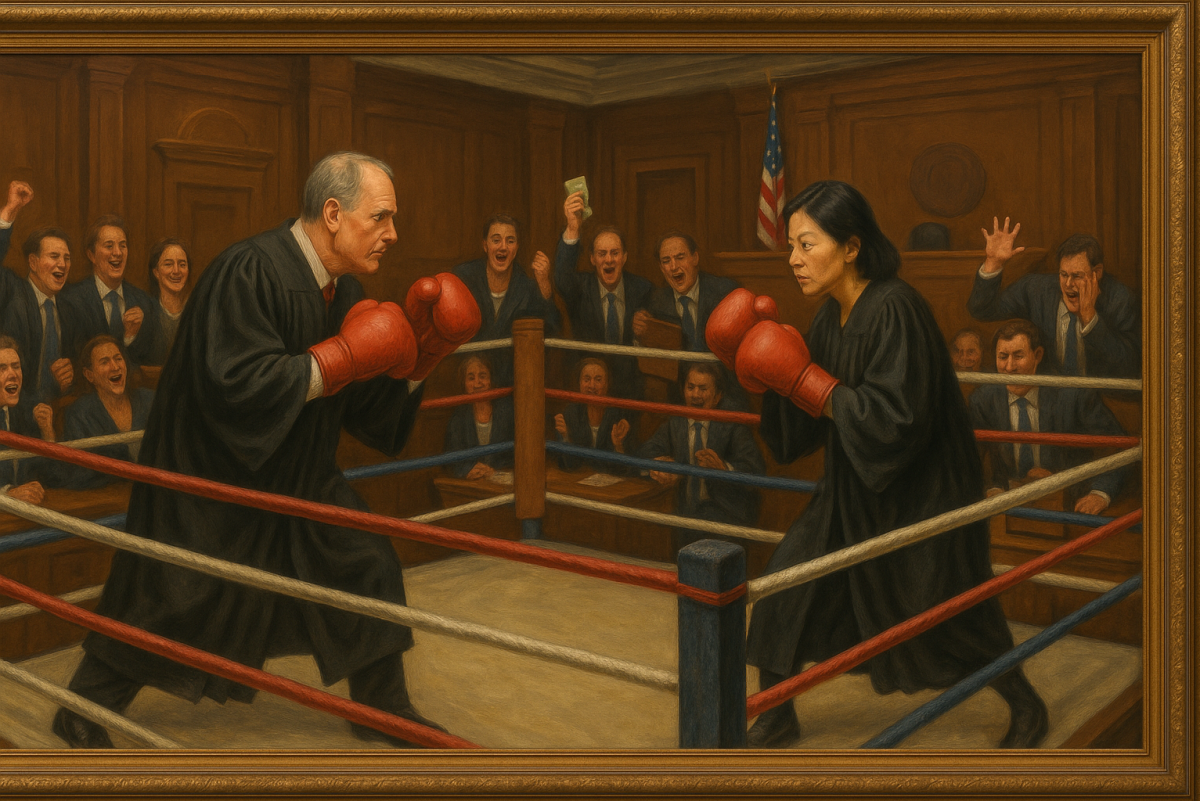
Suppose that a state law’s restrictions on private persons or its own officials and facilities apply only when those persons, officials, or facilities assist the federal government. Does such a law constitute “discrimination” against the feds that violates the Supremacy clause? If the answer is “always yes,” the state autonomy protected by Printz v. United States could become a dead letter. If the answer is “always no,” then the feds’ immunity from subnational governments’ attacks becomes a dead letter. Between these two answers is “a darkling plain/ Swept with confused alarms of struggle and flight,/Where ignorant armies clash by night.” It is a place I call Baseline Hell.
This infernal battlefield is nicely illustrated by the United States’ lawsuit against California alleging that new state laws violate the Supremacy Clause by imposing discriminatory burdens on facilities and people who help implement immigration law.
AB 103, for instance, requires the California AG to inspect “county, local, or private locked detention facilities in which noncitizens are being housed or detained for purposes of civil immigration proceedings in California” to determine the “conditions of [the detainees’] confinement,” the “due process provided” to the detainees, and “the circumstances around their apprehension and transfer to the facility.” AB 450 provides that an employer or its agent “shall not provide voluntary consent to an immigration enforcement agent to enter any nonpublic areas of a place of labor,” unless “the immigration enforcement agent provides a judicial warrant” or consent is “otherwise required by federal law.” The United States argues that these provisions violate the Supremacy clause because they “constitut[e] an obstacle to the United States’ enforcement of the immigration laws and discriminat[e] against federal immigration enforcement” (para 35 of Complaint).
Two legal principles bear on this complaint: The “state autonomy” principle of Printz and the “intergovernmental non-discrimination” principle of the Supremacy Clause. (This latter principle does not have really a “leading case,” given that the role of discrimination in McCulloch’s holding was murky. If one wanted a citation, I’d recommend Davis v. Michigan Dep’t of Treasury, about which more below). The feds may not force the California legislature to enact state laws to help implement federal immigration policy, nor may they force state or local officials to execute federal immigration laws. But California may not single out federal policy for “discriminatory” burdens.
Has California so discriminated by subjecting detention facilities and private employers to a special regulatory regime if and only if they help implement federal immigration law? Ilya Somin has a typically thoughtful post in which he acknowledges that “it is far from clear how the federal courts will rule.“ Eight legal commentators at Vox (including Ilya) offer similarly equivocal conclusions.
I think that that the conflict between the “state autonomy” and “don’t-discriminate-against-the-feds” principles nicely illustrates the uncertainty of baseline hell. Ilya’s defense of AB 103 shows how obscurity of the baseline defining “neutral” treatment of federal policy makes it impossible to reconcile these two doctrines based on existing precedents. According to Ilya, because ”California clearly has the right to inspect its own state and local government facilities at will,“ AB 103 is permissible. But Ilya’s reasoning, I think, assumes that the baseline of neutral treatment is that states can do anything they like with their own property, even if states’ regulation of their own facilities singles out federal interests for discriminatory treatment.
I do not think that this view of the baselines is correct. To see why, consider an easier case. Imagine that California enacted a law requiring state courthouses to impose much more time-consuming TSA-style security checks only on federal officers, requiring federal officers (but no one else) to take off their shoes and take their laptops out of their briefcases before walking through the metal detector to enter the state courthouse. I assume that creating such a special procedure only for the feds would violate the Supremacy clause even though the California legislature would certainly be free to impose such enhanced security on everyone in a non-discriminatory way. Because the discrimination would manifestly serve only the goal of harassing the feds and impeding the execution of federal law, it attacks federal supremacy just as surely as if California had forced the federal officers to pay a special “federal employee fee” whenever they entered state-owned buildings.
So what counts as impermissible “discrimination” against the feds? In some contexts, the SCOTUS has defined impermissible “discrimination” with extraordinary breadth. For instance,
Comments
OP: Is your approach consistent with the Arizona case which held that Arizona may not perform certain actions with its own resources which went against federal immigration policy?
Posted by: Biff | Mar 9, 2018 4:15:50 PM
Just two clarifications to my comment above :
The citation brought , is relating to : 7285.1 (b) in that AB450 .
And :
I wrote that there is no transgression of any law , should be instead :
Transgression or violation of any legal principle , or rather : inherent wrongful conduct ( to comply with such demand for search of fed agent ) .
Thanks
Posted by: El roam | Mar 9, 2018 8:01:10 AM
Interesting post , just should be noticed :
The respectable author of the post , has ignored people or persons that should obey those ” state autonomy laws ” . They are fined simply , due to violation of such laws , here I quote from the AB450 :
” An employer who violates subdivision (a) shall be subject to a civil penalty of two thousand dollars ($2,000) up to five thousand dollars ($5,000) for a first violation and five thousand dollars ($5,000) up to ten thousand dollars ($10,000) for each subsequent violation. ”
End of quotation :
So , it is a civil penalty , yet , for none transgression of any law . This is not an offense , to comply voluntarily ( apparently voluntarily but complicated ) with a demand of a fed agent , to search a place ( private ) . How a fine can be imposed on a person , for such compliance ? It is unconstitutional per se . For such person , is exercising normal and legal discretion . Voluntarily , he is demonstrating good and lawful conduct .
However , The respectable author of the post , is stating so :
” Any two principles can always be reconciled with each other simply by changing one of the principles ”
Well , typically principles are not changed , one is Balanced Vs the other . So both stay valid at the same time , and in light of given concrete case , one is given more priority over the other . But that , only for the purpose of handling certain concrete case .A person is intruding unlawfully the property of another person , both have valid constitutional rights :
One not to be detained and arrested generally speaking , the other to keep his property safe from intruders .Now , in light of particular situation like this mentioned , one principle is not changed at the back of other , but rather balance is changing . Since , theoretically ,as constitutional rights there is no priority to liberty over property right, but in light of given concrete case ( and that was an extreme illustration for the pure methodology , typically , much more tuned and fine balance can be and should be illustrated , that is why there are courts , courts need to handle balance of such , in every given case ) .
Thanks
Posted by: El roam | Mar 9, 2018 7:13:56 AM
Oops!
Posted by: Rick Hills | Mar 9, 2018 12:15:44 AM
While I regularly experience baseline (and other forms of) hell here in the Sunshine State of Florida, this particular baseline hell is coming from the Golden State of California.
Posted by: Howard Wasserman | Mar 8, 2018 11:56:27 PM