
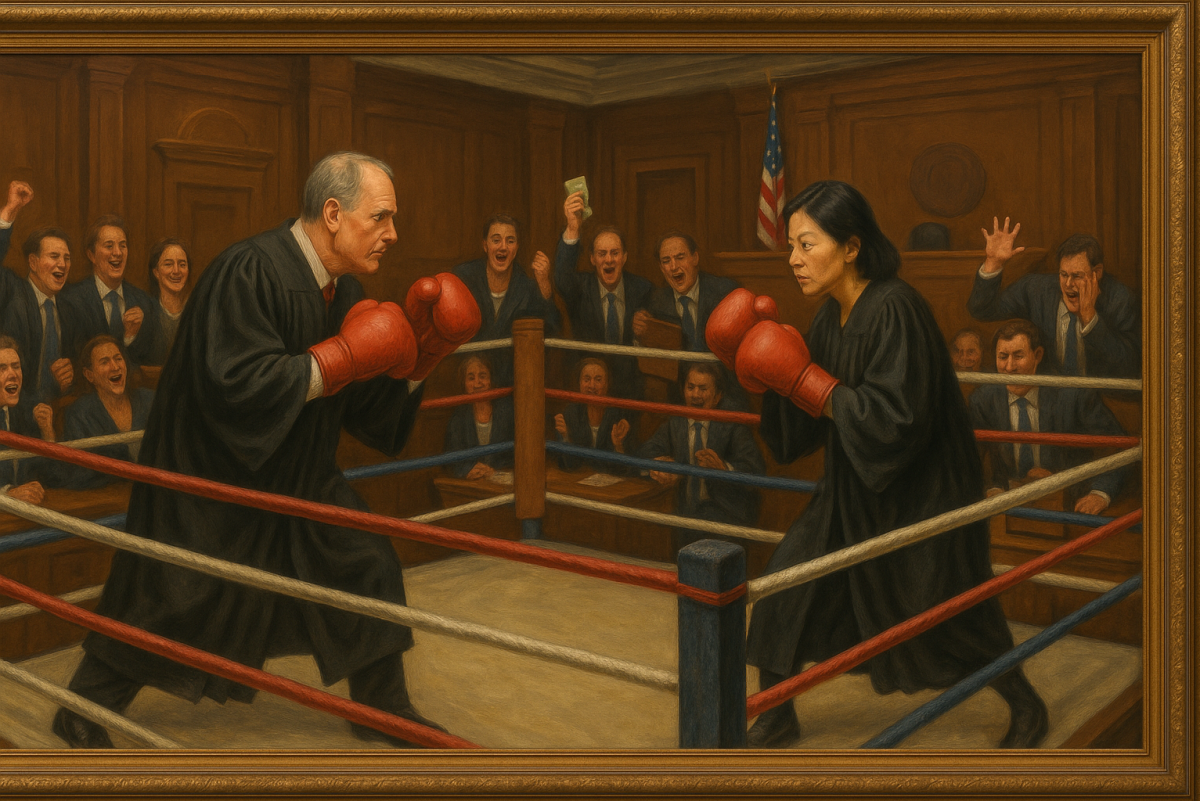
Justice Gorusch, joined by Justice Thomas, concurred in the judgment
Comments
‘it would appear that a state could establish an official church and no one would have standing to challenge that as long as individuals are not forced to participate in that church or otherwise disadvantaged for their non-participation in the religion.”
Not trying to defend Gorsuch but I don’t get your point. Under your own example I don’t see how a religion is established in any sense greater than National Turkey Day or National Day to Honor Fidget Spinners. Congress does that thing all the time and no one gets hot and bothered about it.
Posted by: James | Jun 21, 2019 9:49:57 AM
Wonder whether Gorsuch would allow a rival church to sue over the establishment of a church. A business who is illegally disadvantaged in the market can have standing to sue (under for example anti-trust laws) and Roman-Catholic church would seem to have an excellent similar claim to injury if the SBC was proclaimed the established church.
Posted by: Jr | Jun 21, 2019 8:31:40 AM
There is a world of difference between saying that establishment of the Church of Alabama is permissible, and that anyone has standing to challenge it.
Posted by: Salem Al-Damluji | Jun 21, 2019 3:44:59 AM
Important. But the source of the mess is bit different it seems. And it is very simple:
How to reconcile, symbolic religious historical values with current or actual injuries or grievance. One can’t expect simply to root out or dismantle such monuments, while the historical and religious value is huge, and the act itself, would be by itself per se, be considered as not neutral one. Here I quote from the ruling:
Finally, as World War I monuments have endured through the years and become a familiar part of the physical and cultural landscape, requiring their removal would not be viewed by many as a neutral act. And an alteration like the one entertained by the Fourth Circuit—amputating the arms of the Cross, see 874 F. 3d, at 202,n. 7—would be seen by many as profoundly disrespectful.One member of the majority below viewed this objection as inconsistent with the claim that the Bladensburg Cross serves secular purposes, see 891 F. 3d, at 121 (Wynn, J.,concurring in denial of en banc), but this argument misunderstands the complexity of monuments. A monument may express many purposes and convey many different messages, both secular and religious. Cf. Van Orden, 545 U. S., at 690 (plurality opinion) (describing simultaneous religious and secular meaning of the Ten Commandments display). Thus, a campaign to obliterate items with religious associations may evidence hostility to religion even if those religious associations are no longer in the forefront.For example, few would say that the State of California is attempting to convey a religious message by retaining the names given to many of the State’s cities by their original Spanish settlers—San Diego, Los Angeles, Santa Barbara, San Jose, San Francisco, etc. But it would be something else entirely if the State undertook to change all those names. Much the same is true about monuments to soldiers who sacrificed their lives for this country more than a century ago.
End of quotation:
So, it seems that in order to reconcile, what is by nature so hard to do, the judges, have turned to the standing issue as scapegoat simply. This is by the way, a Universal issue all over the world. Take for example, the ” Brit milah ” ceremony in Judaism. The law forbids any physical harm of course, surly to helpless baby, surly with no consent. Yet, it is a religious ritual. What to do ? Would one challenge it in court ? Surly it is per se against the law. No doubt. But, it is historically deeply rooted.So, one should deal with it, differently.For it won’t do good to public trust.
Thanks
Posted by: El roam | Jun 20, 2019 6:34:29 PM