
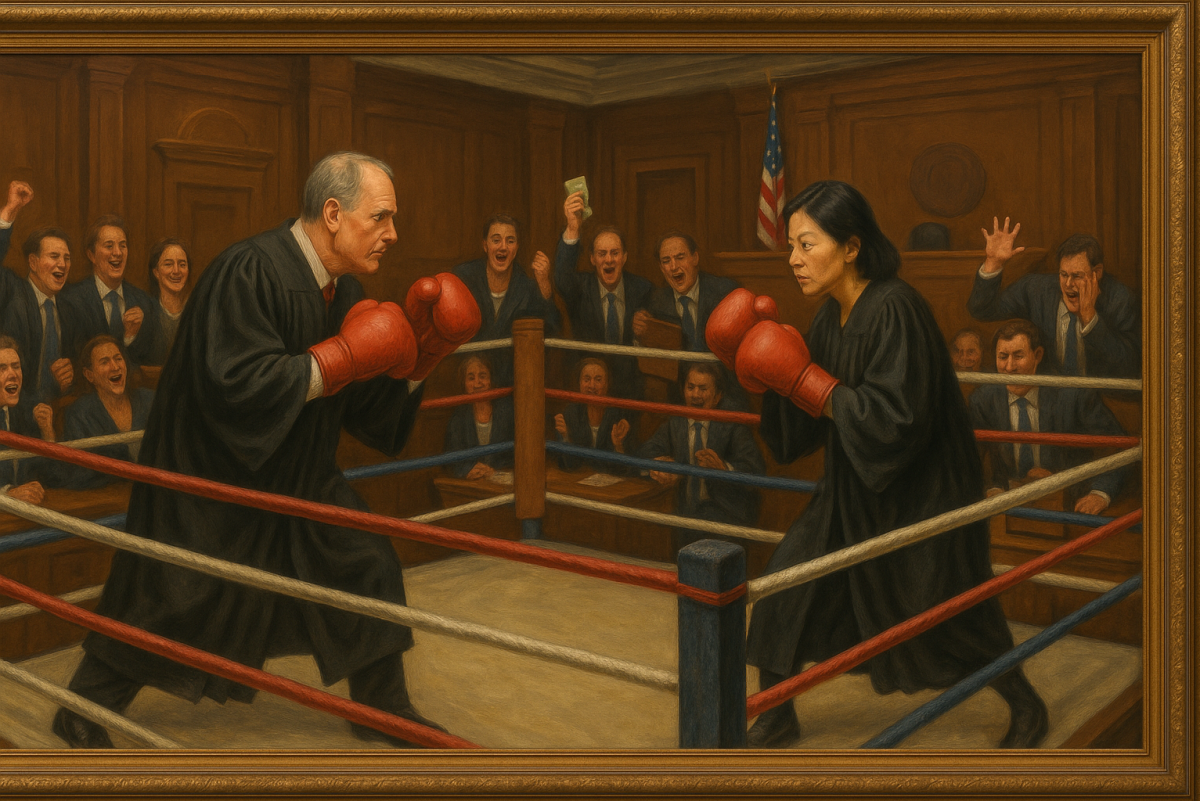
Some thoughts after listening to arguments
Comments
Very interesting post, Howard.
Posted by: Orin Kerr | Nov 17, 2019 11:41:39 PM
“Here is a different, interesting procedural question: Suppose the law-firm plaintiff just pleaded that the rejection letter contained racially motivated language. Could the defendant on a 12(b)(6) present the letter to give full context to what the plaintiff was told and still have it be treated as a 12(b)(6) (rather than converted to summary judgment)? The letter is not part of the four corners of the complaint. But the complaint references the letter, so the letter itself provides context.”
I agree with you about the oddity of Chemerinsky’s argument, though he seems to think that there’s some precedent that supports it (and that also boxed him into having to concede having to ultimately prove but-for). On your interesting procedural question, I think the rule (at least in the Second Circuit, where I won a case under this rule) is that documents that are incorporated by reference in a complaint, even if not attached, or documents that are integral to a complaint’s allegations, may be considered on a motion for judgment on the pleadings if the plaintiff doesn’t dispute that the defendant is supplying the real documents. It’s perhaps more appropriate to make a 12(c) motion on the pleadings, including an answer with the documents attached, than to attach the documents to a 12(b)(6) motion to dismiss.
On the hotel hypothetical, I think Chemerinsky’s view is that even if you pleaded the hotel manager’s claim that there were no rooms, it’s of course possible that the manager was lying and so the case can’t be dismissed on his say-so (whereas, if the plaintiff pleads she didn’t attend law school or implicitly admits it by not denying the firm’s assertion she didn’t, that’s the end of that case). If at trial there turn out to be no rooms, he might admit defeat, though Breyer got him to half-retract his concession and say there could be but-for on a Summers v. Tice theory. I am not sure your distinction of Summers is correct; perhaps Summers could extend to a tort case where, e.g., a hunter negligently shoots his companion at just the same moment that a wildcat he was trying to shoot instead fatally bites him. I don’t know why that case should come out differently.
Posted by: Asher | Nov 17, 2019 10:19:56 PM
Very interesting. The point is that we tend indeed, to separate facts from mental state. It is not really so. One can’t separate them necessarily. It is a matter of degree typically. So, Breyer and Gorsuch are right as mentioned in that post.One can claim facts, and anyway, unless explicitly, head-on admitted by defendant, it would always be on the plaintiff to prove the mental state. But, pretty complicated, for the time being.
Anyway, this is not really the issue here. The issue is not sole reason. But rather, effective reason. If the effective reason, was discrimination ( for not contracting) then, they are entitled for remedy sought. Because the statute dictates: ” make and enforce contracts”. This is not theoretical right. It bears outcome. Tangible outcome and ability and results. So,this was the intent of the Congress ( granting rights to slaves after the civil war). This is the purpose of the law.
All one needs to do: is to prove, that effectively, discrimination barred him from contracting. If there are other additional reasons, it doesn’t matter. But proving discrimination, and as effective reason, among others or not.
Thanks
Posted by: El roam | Nov 17, 2019 5:29:37 PM