
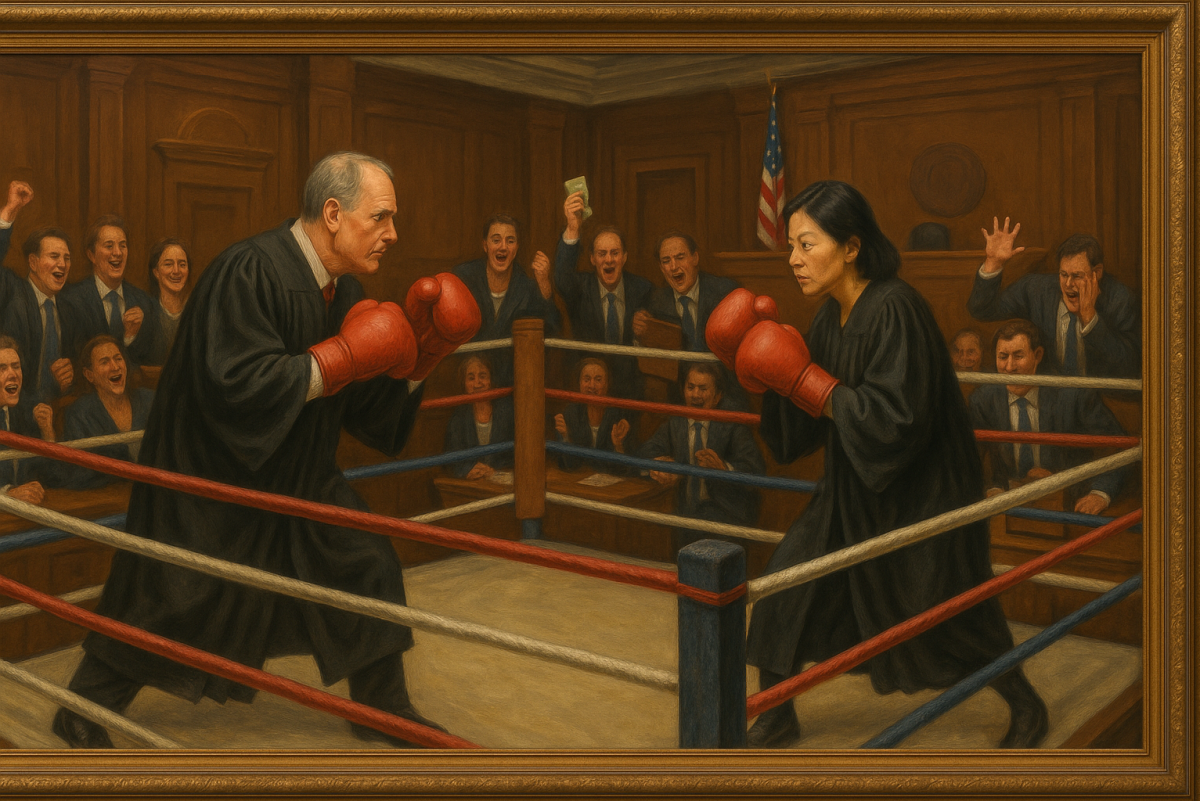
If you’re reading this, you’re probably trying to think about something ordinary during our extraordinarily trying times. In that spirit, I’d like to explore the question that’s the title of this post, using the Supreme Court’s recent ruling
Comments
Really interesting thoughts and draft paper Richard. Your view describes the ways judges use the doctrine in a unique and (I think) descriptively accurate way. I had just a couple quick reactions.
First, you point to precedent’s epistemic value as a shortcut to acceptable, or more likely accurate, legal answers. I agree. But isn’t that a reason that following precedent should be mandatory, absent special justifications to deviate? It seems that judges can only mine the value of past decisions if they approach them with humility, admitting that those decisions are probably correct and should be followed unless there is some strong practical justification to change course (a position I take in this forthcoming article: https://papers.ssrn.com/sol3/papers.cfm?abstract_id=3520664). If following precedent is purely permissive, I doubt any judge will obtain much of that value from prior reasoning.
On your point that precedent may act as a shield, I think that’s a very interesting idea often found in judicial rhetoric. It’s akin to a judge jutting out their chin and claiming to bravely decide in ways contrary to their policy preferences, thereby proving their neutral decision maker bona fides. But I wonder if, more broadly, that kind of attitude actually encourages deciding everything based upon first principles, even if it might tear down more precedent and upend modern practices in the majority of cases.
Looking forward to seeing the draft in print sometime soon!
Posted by: Mike Gentithes | Mar 26, 2020 7:52:00 AM
My sense is that stare decisis arguments get almost* no purchase in the legal academy because pursuing theory absent constraints is a big part of the legal academic self-identity. It seems more academic to remove constraints and go back to first principles. Stare decisis arguments are all about existing constraints, though. They’re the opposite of the value structure of academia, especially elite academia, so they are fashionably dismissed.
*The “almost” caveat is that stare decisis can become tactically desirable if you favor preexisting law to what a court may change the law to be. I hear a decent amount of that today, especially in the academic world: Some take umbrage at the courts not respecting stare decisis when their objection is not so much to whether stare decisis is respected but which decisions the courts have chosen not to respect.
Posted by: Orin Kerr | Mar 24, 2020 5:15:12 PM
Richard: I like these ideas. And I think they support what I wrote yesterday–everyone should have joined the majority opinion, save a few additional personal points of disagreement or jurisprudential preferences defeated.
Posted by: Howard Wasserman | Mar 24, 2020 1:03:04 PM
Does no one remember the Southern Appeal blog from 10-15 years ago?
https://www.yalejreg.com/nc/fifth-circuit-review-reviewed-judge-smith-listens-to-strict-scrutiny/
Posted by: stan | Mar 24, 2020 11:47:20 AM
Interesting. But, there is no particular problem here ( in terms of precedents or Stare Decisis, distinguished from the substantive issue of copyrights and state immunity):
A precedent meant rather for guiding, not for binding necessarily. It is binding, only when there is total similarity in factual and legal terms between both cases. But, the latter is pretty rare. It does create reliability , certainty and uniformity, but, as guiding principals, not in advance, totally binding. Similarity, is not automatically implied.
Even Justice Thomas, recognizes it in fact, here I quote him ( in the current case):
” Here , adherence to our precedent is warranted because petitioners have not demonstrated that our decision in “Florida Prepaid” is incorrect, much less demonstrably erroneous ”
But, what does it mean among others, incorrect or erroneous? Means that ( as in that case) that,it is correct for certain legal and factual configurations, yet, incorrect, for another new one, despite, prima facie similarity. And indeed, more quoting him (and contradicting himself in fact, and, by the way) here:
” In my view, we should opine on ” only the case before us in light of the record before us ”
So, on one hand relying on precedent, on the other, exercising ad hoc attitude. But, combined as explained , that is the right thing.
It is reasonable, to presume, that Stare Decisis should be more rigid, because simply of the significant implication it has. Yet, special arguments or reasoning, may overrule it.
Nothing here, is abnormal. On the contrary, guiding principles and jurisprudence, combined with ad hoc case by case careful observation, are doing it . That’s it.
Thanks
Posted by: El roam | Mar 24, 2020 10:10:56 AM