
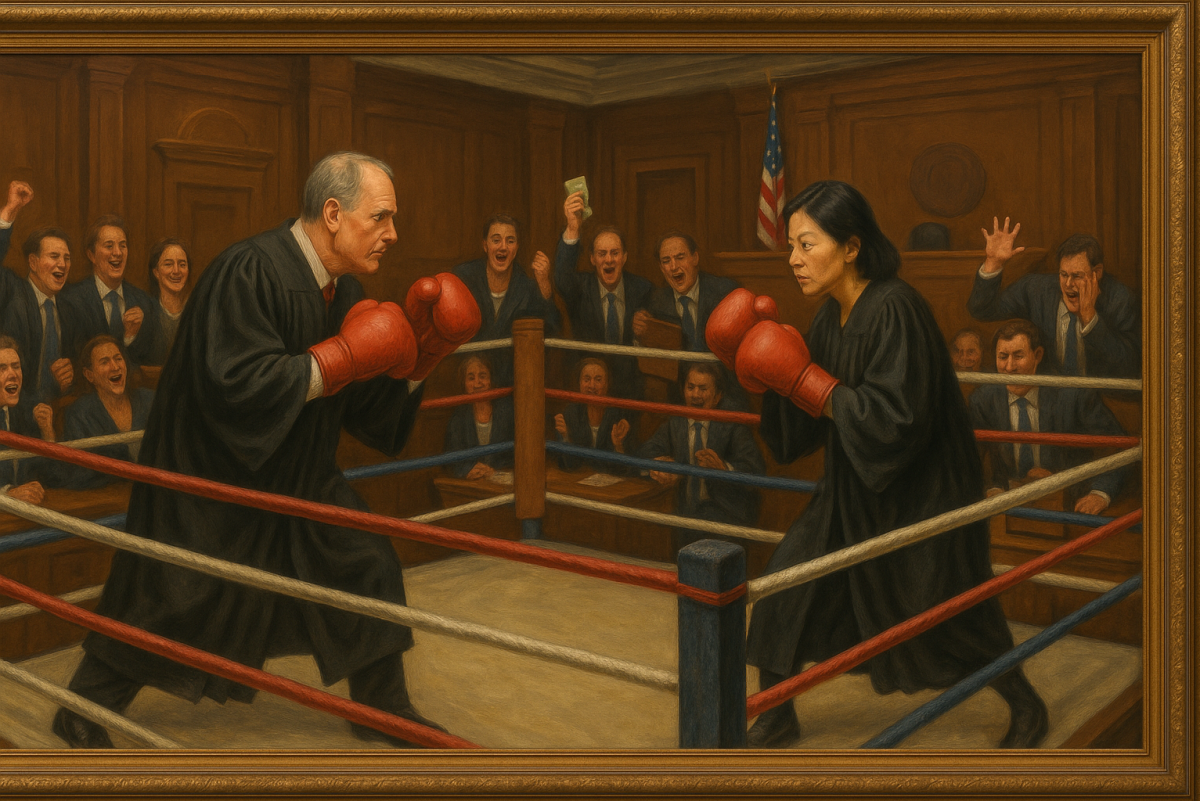
A recent “Social Q’s” column in the New York Times addresses the following law-related etiquette question:
A Hard-Earned Title Worth Demanding
I am a retired judge. Like many judicial retirees, I work as a private arbitrator, occasionally on panels of three. I am working on a panel now with a retired judge from another state. On conference calls, he refers to himself as Judge Smith and to me as Miss Jones — even after he’s heard the lawyers call me Judge Jones. Should I let this go, or take it up with him and the agency that books our cases?
Signed,
JUDGE
To me, it seems just as premature to let this go as it does to report the man to the agency that hires you both. You are peers and have nothing to fear from him. Speak up! Tell him you want to be called Judge Jones — the same honorific you use for him. If he doesn’t, then report him. There is probably some degree of sexism baked into his current behavior, but you won’t know how much until you point out his error directly.
The answer, from novelist Philip Galanes, who has been writing the column since 2008, makes pragmatic sense, but it misses a key point. Neither of the arbitrators should be calling themselves “judge.” Judicial titles apply to the office, not the person, and should not be used for private purposes.
ABA Formal Ethics Opinion 95-391 makes this clear:
A former judge who returns to the practice of law may not continue to use the titles “Judge” or “The Honorable.”
Nor should he encourage others to refer to him as “Judge X” or “Your Honor” in the courtroom or otherwise in connection with legal proceedings. [Gendered language in 1995 original.]
This is especially so in arbitrations, where it is important to preserve the distinction between private dispute resolution and actual legal proceedings.
Yes, I know it is common, but it is still wrong.
Comments are open and will be monitored for relevance and civility.
Posted by Steve Lubet on July 30, 2023 at 12:59 PM
Comments
This arose in a discussion about the presidency.
A person was confused when someone in the early 19th Century referenced George Washington as “General Washington.”
The expert noted that George Washington thought there was only one “president” — the one in office — and this was after he left office.
This seems to reference a comment involving military titles.
The practice of applying them to people who retired while not doing so for various other offices appears long-lasting. Notably, military titles regularly were honorary in nature.
===
The explanation of the OP appears reasonable.
Posted by: Joe | Jul 31, 2023 11:37:40 PM
I genially/respectfully disagree with Professor Lubet’s take (and the ABA’s take) on the use of “Judge” referring to retired judges during arbitral proceedings.
(1) It’s inconsistent with protocol practice — that is, formal State Department-type protocol. There are several centuries of tradition that one refers to a former government official by the highest office he/she/they held — thus, referring to Colin Powell as “Mr Secretary” up to his death (even though he preferred “Chairman,” a post he considered a greater achievement).
For some of us, that’s a barrier. During 1L moot court, a local-community lawyer politely and mildly criticized an inexperienced student for referring to a panelist as “Ma’am”… without knowing, or apparently caring, that the student had just come back from the first Gulf War and remained a USN reservist, and was showing EXACTLY the kind of respect to seniors expected of commissioned officers. This caused me to stumble slightly because I was the old guy, up next, and reflexively started to refer to the critizing lawyer as “Sir” (I did catch myself before making the “mistake”).
(2) Bluntly, the ABA is WRONG when it singles judges out as being exceptions to that practice — especially in an arbitration where the parties have specifically selected the panel, and at minimum their lawyers (and the parties themselves, if the lawyers have properly consulted with their clients) know darned well that these are not sitting, active judges. There’s less chance of confusion here than arises from a lawyer saying he specializes in DUI defense… oops, that’s an ethics violation too, isn’t it? (The organized bar is also wrong when it singles out the word “specialist”/”specialized” as problematic.) Further, there’s substantially less chance of confusion than when a judge later refers to a former government official by the courtesy title of “Senator” during a family-law proceeding, too…
The better practice would parallel the twofold manner in which the military handles things. First, one does not even claim that courtesy title without retiring — or dying! — at that grade. And for those few enlisted grades/positions that retain a courtesy title, it’s the same. Second, and most important, ONE ALWAYS SPECIFICALLY REFERS TO THE RETIRED STATUS. The “correct” signature block would look like this:
H Norman Schwarzkopf, Gen (Ret)
Notice, too, that it gets the name out FIRST and the title out SECOND. It’s certainly not the fault of the subject if lazy newscasters can’t do the same… and it certainly doesn’t deceive anyone. In the stated instance, I seriously doubt that the arbitrators were in robes with gavels — not even on a Zoom call, let alone a telephone conference in slacks and a polo shirt!
As to the specific item: It’s wrong for Judge X to NOT refer to his/her/their colleague of equivalent status as “Judge.” Leaving aside any ego, or conscious/unconscious discrimination, _in the context of an arbitration_ everyone needs to be civil — to maintain protocol — in an appropriate manner. And it matters here in reminding everyone, all the time, about the probable/potential blind spots of the arbitrators, too; I have a healthy disrespect for the prejudices of former jurists when one side of a dispute is pro se or only dubiously “in arbitration” (I’ll leave it there, as this overlong piece has already gone far enough from the initial inquiry).
Posted by: C.E. Petit | Jul 31, 2023 2:37:52 PM
You could also call him Mr. Smith. It might get the point across.
Posted by: Ellen Wertheimer | Jul 31, 2023 9:11:13 AM
The ABA Opinion is no more binding than the Social Q opinion. The ABA Model Rules are binding no where, and many states (perhaps even a majority) would permit a former judge to be referred to as judge when presiding over an arbitratIon.
Posted by: Clarification | Jul 30, 2023 2:43:40 PM