One of the interesting aspects of the Trump regime, which is also effectively a look inside Donald Trump’s head, is the way in which things that are utterly trivial and things that are indisputably important are so intimately connected. There is no doubt that Trump cares about, inter alia, detention & deportation, tariffs, and Israel, and it’s understandable that fans, critics, and general spectators tend to focus on those issues in attempting to understand and evaluate the regime, whether positively or negatively. But this, I think, is not an accurate mental map, and therefore not an accurate way to understand the regime. It is less accurate to think of Trump’s brain as a checklist, presented in some kind of order of importance, and more as a gigantic patent desk, with thoughts and desires shoved willy-nilly into every cubbyhole in no particular order of importance. Windmills sit next to unwritten or undisclosed international trade “deals” and Pete Rose‘s unquiet ghost occupies the cubicle next to the unclean souls of the corrupt politicians he pardons, and one is not much more important than the other. Any lexical ordering is performed according to affective criteria–what is he exercised about at this very moment?–not rational ones. Of course this is a terrible way to be an executive. As I have suggested and intend to keep repeating, the key small-c constitutional question of the moment is not what powers a “unitary executive” has but what basic criteria of responsibility, honor, and duty ought, according to that vision of the executive branch, to guide him. At a minimum, asking what a good “unitary executive” is requires asking what basic qualities we want from a sound executive of any sort. To not ask such questions–or to carefully refrain from asking them out loud–is to disclaim any kind of serious moral or intellectual interest in the “unitary executive,” or the presidency more generally.
But Trump’s broken neural circuitry and lack of impulse control are useful in one sense. They make it much easier to spot throughlines in the thoughts and deeds of the regime–not that they are exactly subtly concealed–if one recognizes that when they occur, the Pete Rose moments are just as important to Trump as the use-of-military-force moments, and thus looks for themes and patterns across lofty and lowly events alike, rejecting the apologist’s dismissal of some example as trivial. They are not trivial to Trump! And they should not be treated that way by us either. We should pay just as much attention to the Pete Rose-type idiocies and intrusions as he does. (I would add, also by way of repeated themes, that given the nature and structure of his executive staffing, one could say that these trivia are just as important to his enablers as they are to him. I don’t think that’s quite right; rather, I would imagine that someone like Russell Vought is happy to have Trump expend his energies literally tilting at windmills, because it frees him up to do the job of serving as chief acting president. Nevertheless, as long as Trump’s wishes are facilitated, the distinction is not great.)
One such throughline–again, not one that takes a genius to spot, as should be clear from the fact that I’m writing the post–has been evident since January, in numerous actions of varying levels of gravity or triviality. That throughline is this: For Trump, and thus for his regime, one of the greatest offenses that institutions and individuals–for the most part American citizens, equal in sovereignty and dignity to anyone in the executive branch–can commit is temerity. To insult, ignore, reject, or argue back against the regime is to insult Donald Trump himself, to insult Donald Trump is to insult America, and it must be met with a show of force.
Of course I can’t speak to the sincerity of such a view on the part of regime officials who respond in this manner, although whether they are sincere or merely playacting is legally and morally irrelevant. Nor, to be sure, is this offense treated with uniform sensitivity or met with uniformly ridiculous and abusive responses. Among other things, that would not be consistent with Trump’s own inconsistency and erratic attention span. Nor would it comport with the inevitable basic calculations on the part of lower officials about who can get away with disagreeing with the regime and when. The regime is not consistently abusive, or indeed consistently anything, save perhaps for consistent dishonesty. Nor does it have the resources to do so. But its tendency to meet temerity–a basic and essential quality in any vigorous democracy–with abusiveness is frequently, remarkably, distressingly true. When Trump complains about someone not saying “thank you,” it’s not playacting; he actually means it, and very much in a “Thank you, sir, may I have another” sense. And when someone insults or rejects the views of the regime publicly, the offense is much the same. It is as if, not content with reviving the Alien and Sedition Acts, the regime is, in fits and starts, creating a federal offense, sometimes civil and sometimes criminal, of lese-majeste–or even just plain impertinence.
As I said, the examples are numerous. Take some just from the past month or two:
- Firing BLS commissioner Erika McEntarfer.
- Targeting former Cybersecurity and Infrastructure Security Agency Director Chris Krebs for investigation, for having had the temerity to point out, pursuant to the performance of his office, that the claims of a stolen election in 2020 were a lie. (That lie is now official government policy. Orwell, thou shouldst be living at this hour.)
- Punishing the AP for refusing to go along with the Newspeak name for the Gulf of Mexico.
- Threatening the New York Times and CNN for refusing to call the Iran bombing an unqualified success and thereby, in the words of Trump’s lawyer, “undermin[ing] the credibility and integrity of President Trump.”
- Threatening, repeatedly, to revoke the citizenship of his enemies. (That he would do this could have been predicted the second Marco Rubio went after the first student visa holder. There were reasonable arguments for some of these moves and I wrote a long time ago, by current standards, that universities should have imposed discipline against student protesters for more disruptive actions in 2023 and 2024–carefully observing institutional due process–without regard for what that discipline would mean for their visa status. But apologists who offered confident assurances that this was only about visa holders, and only extremist visa holders at that, should have been fully aware that permanent residents and citizens would be threatened too, and not just for those reasons. Whatever Rubio may believe, Trump draws no principled distinctions between, say, a violent anti-semite with a visa and a citizen who calls him a jackass, and would not stop with the former if he felt aggrieved by the latter. Giving weapons to morons is always a bad idea.)
- Virtually everything that Paul Ingrassia, Brendan Carr, and Ed Martin have done since January. One might as well call them Assistant Secretaries for Lese-Majeste Enforcement, although Carr also effectively serves in the role of White House Counsel for Facilitating Personal Lawsuits Against Media Companies.
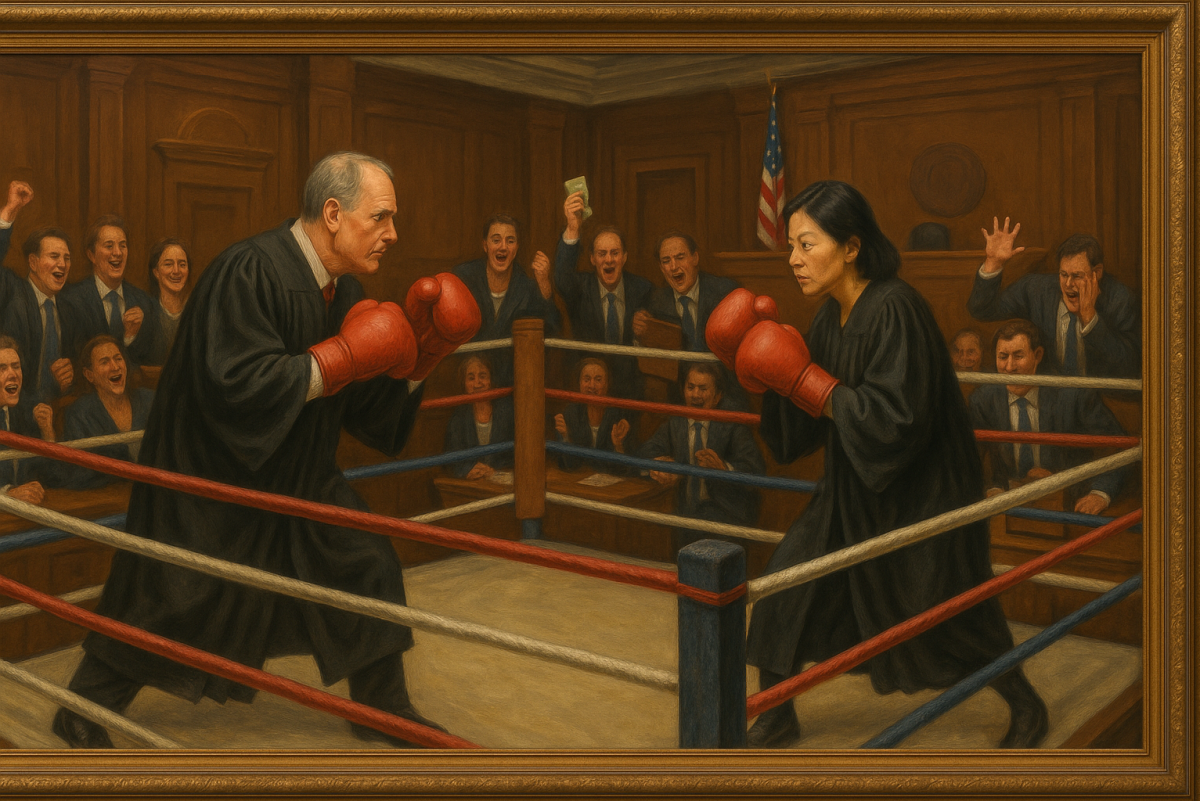
- Virtually everything involving Judge Boasberg. This could be seen as part of a war on the federal judiciary, but that leaves out the personal element. Boasberg’s original sin was simply having the temerity not to believe and go along with everything the regime was doing, and thus to risk embarrassing or inconveniencing it with respect to a high-profile policy. As with the threat to the Times, the underlying grievance is that he “undermined the credibility and integrity” of Donald Trump himself.
- A good deal of its actual conduct in its war on the universities, leaving aside the merits of either the administration’s claims or the universities’. As with Boasberg, its actions against Harvard have consistently been supercharged by an apparent sense of insult and amazement at Harvard’s cheek–at the fact that it did not simply bend the knee immediately or shut up and negotiate quietly. Most of what the White House has done to Harvard has been simple retaliation–including retaliation for the university claiming that the government was engaging in retaliation. (Viz., “Ms. Mailman, [the lawyer assisting acting Attorney General Stephen Miller], pointed out that Brown, unlike Harvard, did not sue the administration.”)
Some of these actions can be likened to the actions previous administrations have taken, although as always there is a point at which differences of degree–of extent, of brazenness, and of how vicious and viciously dishonest the regime’s propaganda apparatus is–become differences in kind. (We should, of course, take the fact that other governments have done some of these things as a lesson. One salutary element of living through this regime–possibly the only one–is that it gives us food for thought about what easily abused elements of executive power should be cut back on significantly. Not simply reformed, and certainly not retooled so they can only be abused in one direction. It is not an answer to current abuses of government speech doctrine to come up with proposals that government speech should be subject to vague equality-based limits, or an answer to current funding disputes to argue that government should only aggressively impose funding conditions when it’s for the right causes, liberal or conservative. We should be thinking in advance about a much more chastened federal government regardless of who occupies the office.) Others are far more unusual if not outright unprecedented.
Given the diversity of cases and approaches, it’s understandable that some of these are viewed as discrete activities: as a war on the federal judiciary, say, or a war on universities. But the broader throughline in all these cases is about temerity and lese-majeste. The emerging rules are pretty clear: 1) Don’t insult Donald Trump personally. 2) Don’t make Trump look bad, including by not simply going along with his claims and his wishes. 3) Don’t stand on your rights, and certainly not in public. 4) Don’t embarrass the government or its officials. 5) Or else.
Posted by Paul Horwitz on August 6, 2025 at 01:22 PM