
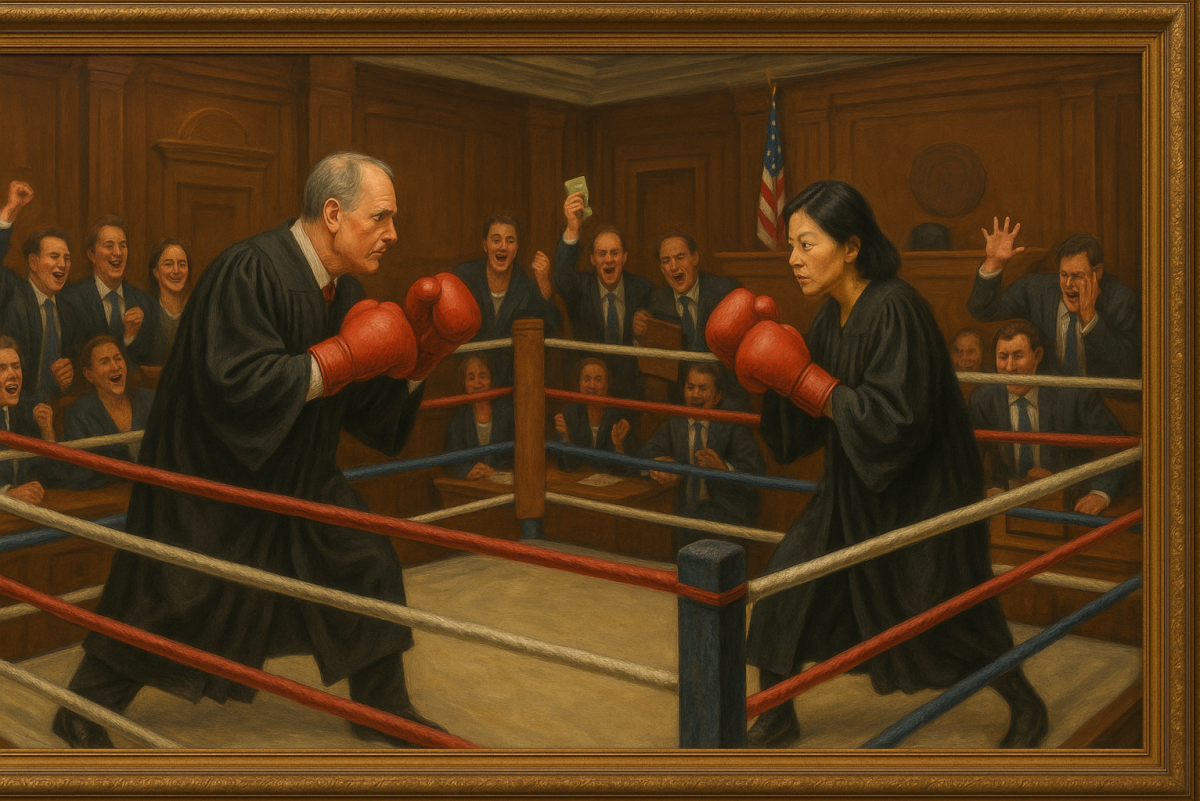
Here’s another, slightly different way to view Judge Southwick’s dissent in Rodriguez v. Vergara (inter alia, “extolling the constitutional rights of illegal aliens,” but holding that plaintiffs had not made out a Due Process claim to a bond hearing when detained by immigration authorities pending removal proceedings, while acknowledging the possibility of due process concerns–yea, even for “illegal aliens”–in the event of indefinite or bad-faith detention).
Judge Southwick, one will suppose for present purposes, wants to see the appointment as his successor of one of his law clerks, for which he needs the agreement of the President and the Senate. He knows that presidents can withdraw judicial nominations. He knows that President Trump–or, to give him the John Fordian moniker he will wear through history, The Man Who Killed the Kennedy Center–withdrew eight judicial nominations in his first term. He knows that under the slow-car-wreck version of presidential administration that characterizes the current regime–unsurprisingly, since guardrails help mitigate car wrecks and Trump thinks guardrails are a form of treason–Trump has been positively dotty about withdrawing nominations. He knows–all nominally conservative intellectuals, professionals, and grifters know it, hence the painstaking silence and focus (to take an example from the third category) on other things–that Trump’s word is worthless and that the fit of pique is one of his dominant modes of executive decision-making. So writing a dissent that would displease the people–not to put too fine a point on it, the “elites”–who run the executive branch can hardly be said to be a prudent move if he would like to see his protege ultimately ascend to the bench.
Judge Southwick’s dissent might be right or it might be wrong. But under the circumstances, the evidence does seem strongly to suggest that Judge Southwick acted out of a sense of duty–or, to quote a colleague of his, a “duty to follow the law in every case[,] regardless of whether [the] decision is popular or divisive.” To paraphrase Justice Alito, the evidence suggests that Southwick was willing to make a decision on a controversial matter despite the knowledge that he might be strongly disliked by the very elites who could yank or capsize his protege’s nomination.
It strikes me that there really ought to be a phrase or label to describe the judicial virtue of steadfastly following one’s sense of judicial duty despite the possible personal and political consequences.