
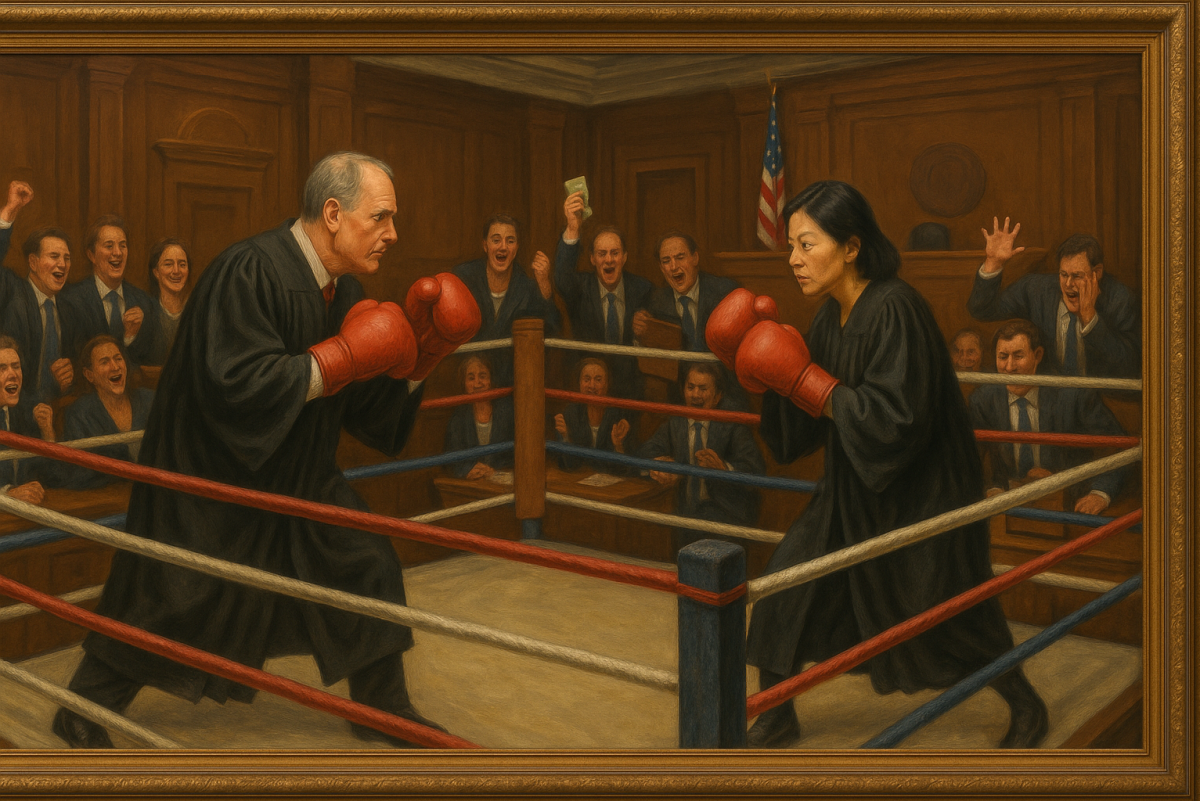
Watson v. RNC held that federal statutes establishing “election day” do not preempt or preclude state laws (in more than half the states) allowing for receipt of absentee ballots up to five days after federally established election day if post-marked (and thus “cast”) by election day.
According to the majority, an election is the expression of the voters’ choice. Each voter “chooses” when she fills out and submits her ballot. The electorate as a whole chooses when voting by all those eligible is complete–when all complete and submit their ballots. The majority rejected the argument (as a matter of text and historical practice) that the electoral choice is made only when we learn who “won,” which requires receipt of the ballots
Although I did not have Watson in mind in this post, it hints at a similar idea. The “game” ends when the voters complete and submit their ballots, the content of which is out of public view. We learn the winner in a distinct action–looking at and counting votes–after the game has ended.
Update: A quick comment on the voter-fraud concerns in Alito’s disssent: when late-arriving ballots change the outcome, it creates the appearance (if not reality) of fraud and thus casts doubt on the outcome and causes loss of confidence in the system. Two problems.
First, it ignores that the winner comes at the end of the counting, not based on the count at any one randomly chosen moment in the counting–just as the winner is the team leading at the end of basketball game, not at the end of randomly selected tsegments of the game. So Alito still plays into this narrative in which a complete counting “changes” the winner.
Second, Alito’s hypo allows those who are ignorant of the rules of the game they are watching to find fraud and to lose faith in the outcome because of that ignorance; that, in turn, allows for rejection of rules these people (and Alito) do not like.
If the viewer does not the rules of the game, then things may look improper (“wait, how is that really tall man allowed to just reach up and slam the ball through the hoop?”) and thus the outcome based on his repeatedly slamming the ball through the hoop is “flawed” and not worthy of confidence. If everyone knows the rules (slam dunks are permissible), then the outcome is consistent with the rules (it is not “fraudulent”). One my believe different rules should apply and that dunks should not be allowed. But not because they call the outcome into question, since everyone knows dunks are permitted.
Similarly, counting late-arriving votes creates the “appearance” that something is amiss only if the person does not know the rule that late-arriving votes are allowed and will be counted. If those watching the counting know the rules (late-arriving votes count), then the rule does not cause loss of confidence in the outcome, at least by those acting in good faith. One may not like the rule and think such ballots should not be allowed. But not because they call the outcome into question, since everyone knows such votes count.
The second point is the source of the real mischief through some circular reasoning. It incentivizes people (Alito in the opinion, Trump and Republicans more broadly) to hide the ball on what the rules are and to keep people ignorant. That, in turn, allows them to question the outcome for those ignorant of the rules, creating the loss of confidence in the system, which they use to justify voting restrictions.