
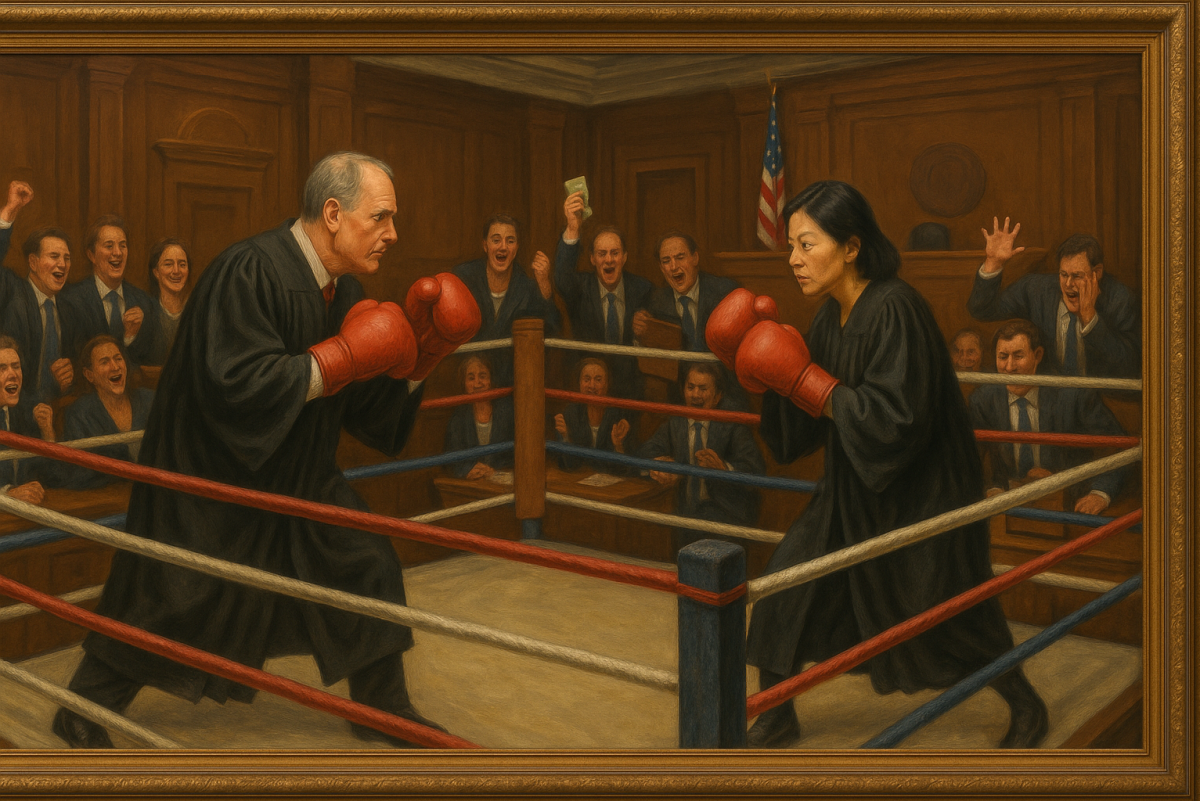
Rodger Citron has an article over at Slate discussing the seemingly fashionable attacks on the judiciary. He takes a historical approach and looks at two other cases in history when politicians and the public attacked the Court: when Roosevelt threatened the Court with packing to push throught he New Deal, and when the public pounced on the Brown v. Board decision. Citron concludes from the fact that the Court persevered in both instances, the Court will once again come out on top.
It strikes me that in all three cases (Roosevelt, Brown, and today), the Court is attacked for refusing to bend to public pressure and political will. Surely that is what we want from the Court, for otherwise it would simply be a rubber-stamp for the elected branches.
At the same time, we really should worry about an Imperial Court. There is no reason to believe that the Court gets it right more often than it gets it wrong, or more often than Congress.
Let’s ask the question this way: which demonstrated and created more “progress”: the Civil Rights Act of 1964 (which took years of grass-roots mobilization and coalition-building, as well as the death of a president), or Roe v. Wade? As I’ve already expressed in my previous posts about same-sex marriage, I think that the Civil Rights model leads to better and longer-lasting results, even if it requires compromises and sacrifice of some principles.
Thoughts?
Posted by Hillel Levin on April 18, 2005 at 01:01 AM
Comments
The lawyer should not become a justice. The conflict of interest results in rent-seeking, no matter the ideology, right or left.
SC decisions would be more respected if it contained only random selections from the Northern Virginia jury pool. The quality of the decisions would also increase. The jury pool members would read the plain, high school language of the Constitution, and obey it. There would be no attempt at mind reading of dead people for their intent, which, for some reason, always coincides with the biases of the Justices. They would not believe they are brighter than the elected Congress nor the President.
Example: They would have let stand a slave state Supreme Court decision, that once a slave has entered free territory, that slave is free and has citizenship standing. Thus, there would have been no Civil War.
Posted by: SupremacyClaus | Apr 18, 2005 8:38:05 AM