
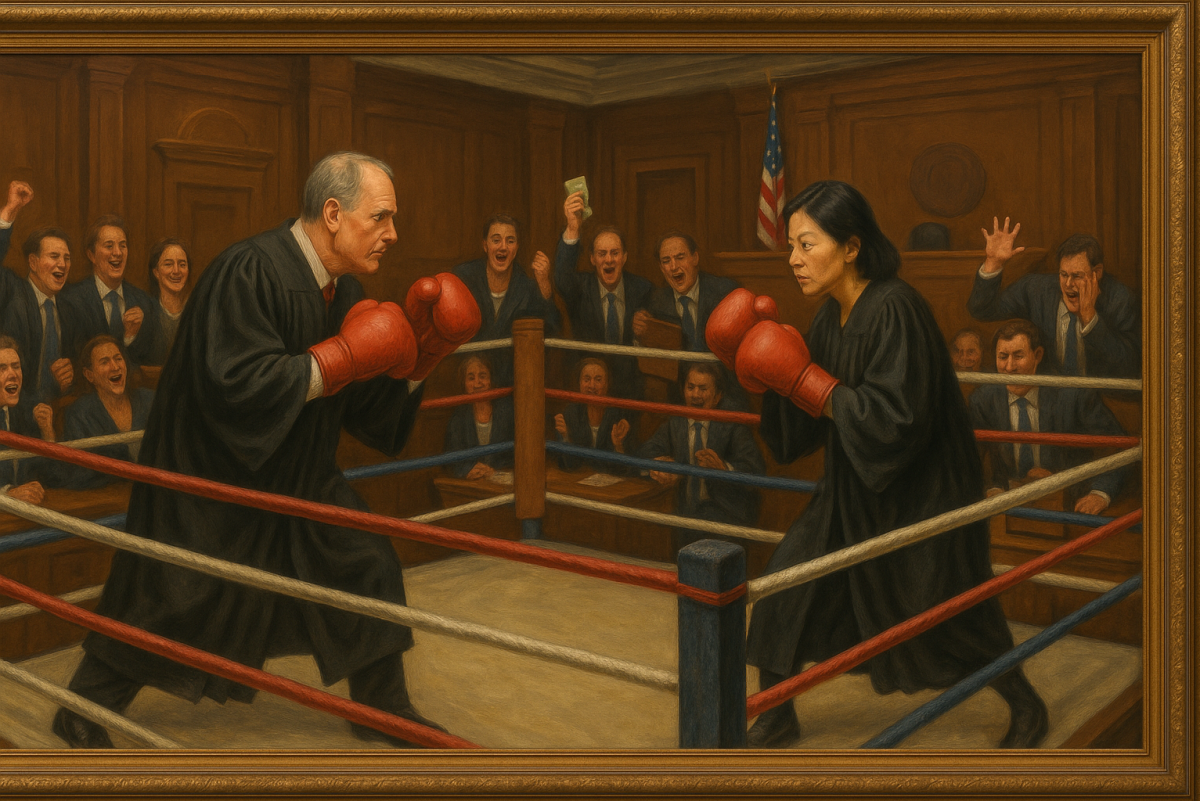
Dan’s comments on the Garrow/Blackmun kerfuffle are interesting and eloquent. I have separate comments posted on the blog already, having to do more with the question of clerk’s sometimes unduly loving views of their judges. A couple of responses to Dan’s observations:
1) I think Dan is right that there is lots of back-and-forth between clerks and judges. I’m not sure I see an abdication by Blackmun here — or at least a significant one that falls outside the increasingly corporate character of judicial chambers. (Or is that chamberses?)
2) I am interested in the question of whether intemperate language was more excusable because the stakes were high. First, would one accept as an argument in defense of a bad judicial opinion, “Well, we were pretty lawless here, but the stakes were high?” I’m not sure I would. It may be true as a practical matter, and I don’t mind the infusion of more than a dollop of Posnerian pragmatism into a judicial opinion, which presumably involves taking the stakes into account. But Posnerian pragmatism also assumes that formalism may have pragmatic virtues to the extent it restrains result-orientation in high-stakes case, and avoids the error costs inherent in attempting to predict future consequences, as well as the error costs involved in imposing an imperfect rule, good for one case, that may distort future cases. Now all of this is far from intemperate language in a memo. But here we get to the idea of clerk self-dramatization discussed in my separate post. Were the stakes high? Yes, if you put it in terms of “the fate of constitutionally protected abortion rights.” Less so, if you consider that it was one in a series of cases (albeit a central one), capable of revisiting by future Courts (but not while these clerks were serving — hence the clerk’s tendency to overdramatize one’s own Term and insufficiently acknowledge that the Court is a continuing body), and of course that abortion rights are capable of legislative protection as well. Still less so if you consider that some of the intemperate language came after it was clear the core abortion rights would be upheld. And the stakes are still lower when you consider that it was a memo, not an opinion or a vote.
The point also seems to resonate with me because it raises a point that has been noted by other critics of the Court’s docket — that it has, at times, been filled with the dramatic, “high stakes” material and less so with the quotidian problems on which lower courts sometimes cry out for judgment, and which in the aggregate affect millions of lives. Is the tendency to get heated about the high stakes cases also a tendency to be muted, or dismissive, about “low stakes” cases? And are “dog cases,” like tax or Indian law decisions, so considered by the subjects of the cases? Would we be equally sanguine if a clerk were to quip in a memo, “This case involves a minor question of tax liability. The stakes were relatively low, so I flipped a coin.” Judge Kozinski wrote recently that the tendency to give short shrift to such cases can be thought of as a hidden ethical dilemma for judges. This is moving somewhat far afield, but I guess the point is that part of the ideal of equal justice under law is that we give the high- and low-stake cases equal respect. Far afield, as I say. But I did find some of the language intemperate, and don’t think the high stakes excuse the writers. More to the point, none of the intemperate language actually moves the analysis forward, and I should think that the higher the stakes, the more the times call for careful, thoughtful analysis. We may all be legal realists now, but I sometimes wonder, as I read histories of the Court based on the public record, whether the Clerk selection process in some way favors clerk applicants who are too politically committed. This is an empirical question that I raise but cannot answer.
3) Finally, there is a difference in any event between getting heated up, but still staying well within the judicial role, and recommending that the Court act fairly explicitly as a political institution. Maybe it’s a sausage-factory thing — I think the fact that all the Justices signed Cooper v. Aaron makes a strong statement, but maybe I wouldn’t have liked to watch the process of gathering the signatures — but I am disquietened by the suggestion by Prof. Karlan, in a memo dealing with Bowers, that the Justice ensure that the opinion’s release be handed down for maximum press effect. And I am doubly concerned by the suggestion in the McUsic and Dangel memos that the Justice time events according to the election cycle. I wonder whether it is possible to think such statements justifiable, a reasonable part of voting strategy particularly given the high stakes, without rethinking the level of rhetorical fire aimed at Bush v. Gore.
4) I said “finally.” My mistake. Posner (clearly, a personal favorite of mine) once lampooned the Court’s statement in the Casey case that, as he put, “American’s ‘very belief in themselves’ as ‘people who aspire to live according to the rule of law’ is ‘not readily separable from their understanding of the Court.'” And here we have the Dangel memo saying that “[t]he people of American need someone to tell them the truth. And, as the author of Roe, I think you’re the only person who can do it.” Really? Not one other? Not a candidate for President, in the very election that was ongoing at the time? Only a septuagenarian Minnesotan with a necessarily isolated lifestyle? This is surely too grand a view of the role of the Court.
Posted by Paul Horwitz on April 20, 2005 at 06:33 AM
Comments
This is a fair point. I am humbled by the damned instant marketplace of ideas nature of the blogosphere, and not for the last time, I’m sure. I think I’d add that there is no doubt that the Court takes more statutory cases, etc., than it does, say, free speech cases. What I don’t know is whether the proportion of cert.-worthy constitutional cases it takes is higher, compared to the proportion of statutory, etc., and cert.-worthy cases it takes up. Certainly a long-standing complaint has been that many business cases, in particular, that raise important federal questions and occasion circuit splits have been left to founder in the lower courts. But I generally accept your point.
Posted by: Paul Horwitz | Apr 21, 2005 3:10:31 PM
I suppose in this meager comment space, I should limit my comments to one small piece of your post.
Here’s my reaction to your docket selection point: the sexy cases are the exception, not the rule. Take a look at the 80 cases decided each year. You can count the ones that are not “dogs” on your fingers, usually on a single hand.
Now I’m certainly aware of the incredibly shrinking docket–and acknowledge that the Court could be taking even more dogs. But it is worth noting that the Court probably turns down more sexy cases than it accepts.
Posted by: Ethan Leib | Apr 20, 2005 10:04:31 AM