
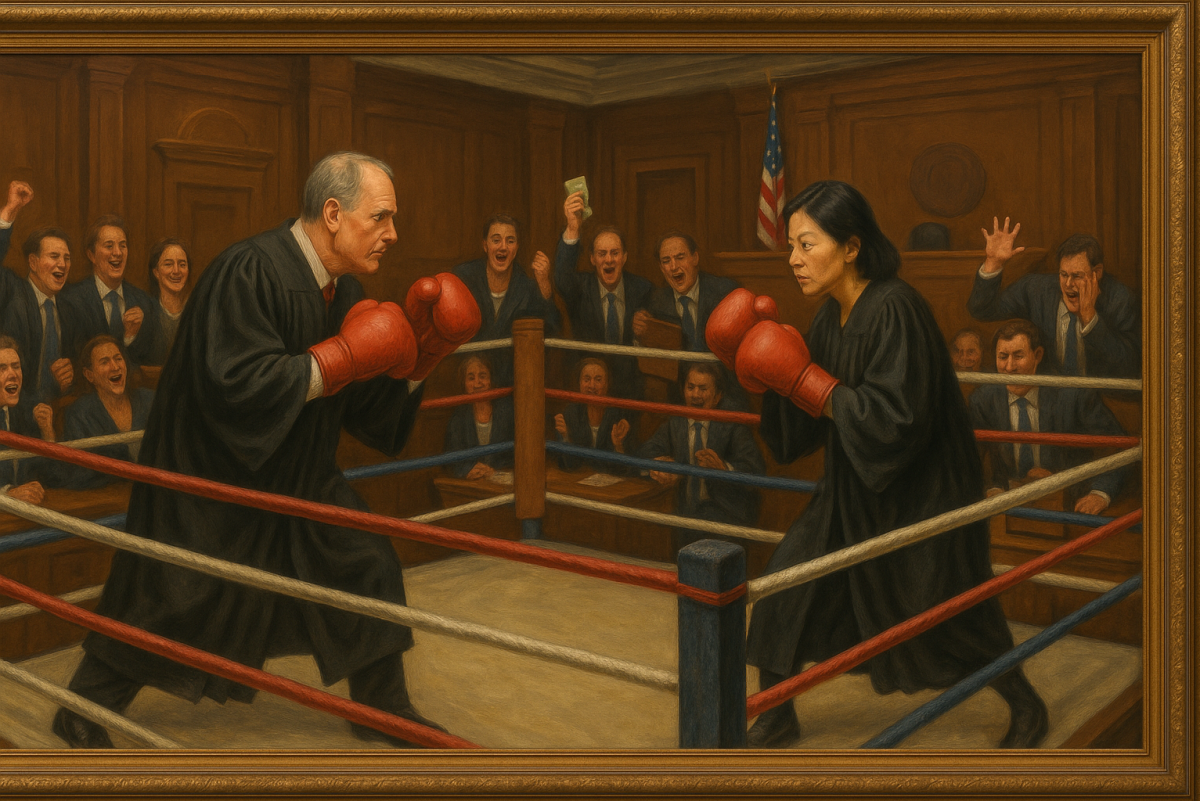
A few weeks back, AA1 and I tried to dissect Jim Lindgren’s attack on our Gerontocracy by poking holes in the substance of his proposal. But I failed at the time to deflate some of his rhetoric. He wrote:
The current Court is nothing less than a gerontocracy—like the leadership cadre of the Chinese Communist Party.
Preying on some Americans’ sense that the Chinese live in a completely repressive and autocratic society, Lindgren hopes to use the CCP as codeword for political evil.
As some of our readers know, I have an interest in how the CCP is doing its business these days (and have written on my recent exposure to the CCP here). In the service of educating people about the CCP’s interesting experiments in real (deliberative) democracy, I offer this article from Time/Asia. Let’s not jump to conclusions too quickly about that one-party authoritarian regime.
Posted by Ethan Leib on April 20, 2005 at 04:54 PM
Comments
Joel: You agree with lawyers’ being sued for malpractice, as testified to by experts in their specialties. Does that include acts of malpractice that injured adverse third parties, and not just clients? I do not mean heirs, that are not really third parties, but crypto third party beneficiaries. I mean the adversary in court. Is there a duty of professional care to such an individual? (Warning. This upends the furniture, and will get you personal destruction from the enforcers of the cult interest. You will be highly popular with everyone else, including smart, competent lawyers who have nothing to fear from such a proposal.)
I have not questioning the sincerity of the Justices, just the results of their thinking. If someone sets off a Civil War, they should at least lose their job.
As a taxpayer, I am willing to buy the judge insurance for negligent behavior, set out by peer experts in expert testimony. If a man sits on death row for 20 years, who was innocent, paying him is not a problem (estimate is 20% of death row inmates, but not reliably so). Who would resent that?
If I were a judge, I would want the inconvenience of torts, and not the lethality of self help as the only recourse for my errors. I would admit to being human, not King George the III, and to grant compensation to the victim injured by my unintentional error. If a lawyer sues a judge for retaliation, without merit, that would be costly error to an extreme and in many ways.
We can wring out any possibility of frivolousness and extend these techniques to all tort defendants. Certificates of merit, changes in the rules of evidence and civil procedure would protect the judge and all other defendants.
The 75% failure rate of tort lawsuits relative to the 1% failure of criminal prosecutions, with their far greater burdens and obstacles, is itself a massive tort to be remedied by tort action. The standard of professional practice is set by criminal prosecution, well prepared, on a small budget, and being correct 99% of the time. Any lower figure is a deviation from standards.
Posted by: David Behar | Apr 26, 2005 3:52:44 PM
1) & 2) we have our agreement. Congress has been abdicating any heavy lifting in the legislative arena and there are bad lawyers and judges out there. 3) I have some disagreement with. The specific concept of mens rea is traced to the british common law specific & general intent crimes, but that is even derived from the differeing levels of culpability found in Roman law. It was a different offense if you dropped a vase on a nobles foot than if you stomped on it. Also, the jury of your peers idea goes back much further then Medieval Catholicism. As to the question of whether there is an Establishment Clause violation, is there an endorsement of religion in our laws? I do not see the codification of murder as an endorsement of religion. 4) Here, I have to disagree in several significant fashions. Lawyers being sued for malpractice makes sense and, in fact, malpractice insurance is a significant portion of a lawyer’s outlay. I cannot, however, support the idea of a judge being sued for judicial work. In a common law system, the judge has the duty to make the decisions about what the law does in the case before him or her. One of the major complaints of the medical community is the proliferation of lawsuits against doctors and the fact that just about every doctor out there will be sued and must settle cases several times throughout their careers. I belive that importing that sort of liability on judges would reduce the already strained judiciary and drive good lawyers out of working for it. When the government is paying the salary of the judge, do you really expect the judge to carry insurance? Many State level judges are elected and that serves as a check against gross incompetance, usually. The idea of forcing a life-time appointed judge out of the bench runs against the job security of the federal bench, though. It is that security that frees the judge to make the legal call and not the political call. I believe that you would see a much less independent judiciary in the situation you would descibe and I believe it would only increase the litigious nature of society. On a philosophical note, I don’t believe any Justice of the Supreme COurt would intentionally misread the Constitution. I believe that each and every one of them believes in the interpretation profferred and that they each believe they are correct. I don’t believe there is one and only one answer to most cases that reach the USSC. Frankly, if it was clear cut and easy it would not get there. IMHO.
Posted by: Joel | Apr 26, 2005 10:36:14 AM
Claus, thank you for responding. I enjoy debate and dissent. I don’t expect nor want everyone to agree with me.
“The law is in utter failure, in every subject. Its core doctrines are from 1200 AD. Nothing from that era meets current standards of practice.”
It seems to me that you have a decided disagreement with the way in which the entire judiciary is structured. Both as a dual State/Federal system as well as the USSCs decisions that are often unpopular at the time. I’ll point out that the core ideas of our jurisprudence goes back much further than that. Roman law heavily influences our jurisprudence, especially when applying a federal analysis.
Your distinct dislike of lawyers and of the legal system seems to imply that you would prefer no lawyers. Now, I am curious as to whether that is a valid perception considering where you are posting this. Why is crime not evenly distributed? Because we are human. Do you really think lawyers are herding crime into areas? Or that this is truly a lawyer welfare state?
On one last note, I completely disagree with you on the nature of the USSC and on Congress’s failure to “rein it in.” The USSC is punted the tough decisions that the Congress does not want to make for political reasons. They make political choices and make political moves irrespective of whether they really think it is a legal option leaving the COurt to sort it out. The counter-point to the fact that the Courts keep having to step into the mess is that if Congress would pass more laws that do not require the courts to step then the courts wouldn’t step in. Separation of powers and checks and balances all work together. Beyond that, the very nature of the federal structure of the US government downplays States outside of their boundaries. For good reason. If you want to talk about the death of State’s rights, look at when the Senate became directly elected.
Posted by: Joel | Apr 25, 2005 10:51:24 AM
(correction: someone who actually practices criminal law [you can tell I don’t by my repeated misspelling of blakely]: wasn’t booker expressly non-retroactive?)
Posted by: Paul Gowder | Apr 24, 2005 6:27:51 PM
Claus:
1. Blakley isn’t causing any prisoners to be released. Many of the circuits are affirming pre-blakley sentences, some courts are just resentencing. I defy you to find 5 prisoners across the country that have been released because of Blakley. And I think Scalia’s reading of the sixth amendment is the only sensible one. It says you get a jury trial. The logical implication is that the jury gets to decide what happened. Having someone OTHER than the jury decide what happened is contrary to the plain language of the 6th amendment.
2. You can’t just assert that the law is an utter failure or that it all dates from the dark ages, and then say “courttv taught me so.” What is it about the law that’s failed? Apart, that is, from these imaginary prisoners of yours that are being released?
(Why on earth am I tilting at this windmill? Do I have nothing better to do??)
Posted by: Paul Gowder | Apr 24, 2005 6:24:25 PM
Claus: Blakley was certainly interpretation! The sixth amendment says you get a jury, and the Court interpreted it to mean you get a jury on every issue that goes into sentencing, not just guilt. (Basically.) That’s perfectly interpretive.
Also, what makes you think you would have a right to go in and disrupt Dan’s class? There’s a difference between fair dissent and complete takeover.
And frankly, Claus, if you MADE these menacing arguments you think you have, instead of just implying that you have them (“ooh, what if I brought out these big scary arguments I have!”), perhaps someone could answer them.
Posted by: Paul Gowder | Apr 23, 2005 11:42:09 PM
I kinda like SupremacyClaus. (Perhaps it’s just the attack on Coase in the “most important…” comments. Any attack on Coase gains points with me.) So (s)he is a little intemperate. Call it gonzo.
Posted by: Paul Gowder | Apr 21, 2005 12:15:15 PM
SupremacyClaus has been warned by us now, but thanks for the input Joel. Well-warranted.
Posted by: Dan Markel | Apr 21, 2005 10:44:20 AM
You know, you could show a little bit of respect to people who so suffer from Alzheimer’s. You have made it quite clear that you dislike the federal structure of separation of powers with your posts, but you don’t need to be blatantly insulting. This blawg is functioning on the theory that the people who post have a higher than average IQ.
Posted by: Joel | Apr 21, 2005 10:18:08 AM