
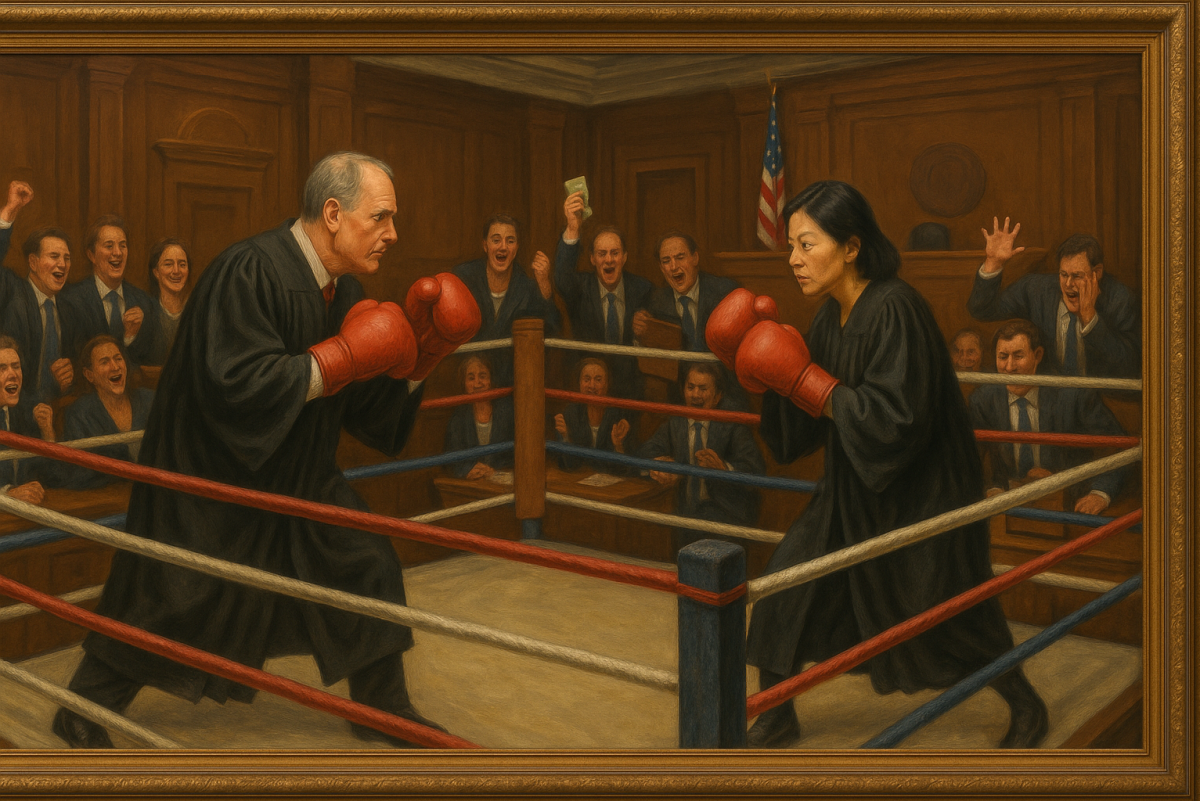
Trevor’s proposal that we ask Judge Alito to prepare some thoughts on a case drawn from the banks of Supreme Court precedents is an interesting one. Perhaps he is right that it would provide for a more fair and interesting discussion at the confimation hearing. This is an interesting question, but I wonder how it would cash out for him — or, more importantly, for a Senator choosing whether to vote.
The first thing I’d note (as Trevor correctly notes himself) is that interpretive methods may vary depending on the case selected for the exercise. Do you anticipate using as your test case a statutory case, or a constitutional case? And if the latter, do you anticipate using a case involving a constitutional question rich in existing doctrinal material, in which case it is likely that the interpretive method of any judge, whether conservative or liberal, would converge on commonplace doctrinal manipulation; or one in which there are few clear answers and only thin gruel in the caselaw, in which case the distinctions in method between those who are originalist in orientation and those who use a variety of tools, including policy analysis, would be more evident? And would this truly be about discerning the Justice’s method, or about (God forbid) trying to figure out whether he has a “heart” — i.e., would you make sure the case had no “poor Joshuas” roaming around pitifully in the facts?
Assume that you pick a constitutional case. Assume also that you scour the case of sympathetic facts that might distort your attempt to get a clean read on the nominee’s methodology, and that the case is not so grounded in caselaw that the nominee’s methodology drops out of the equation. Then you might get an interesting answer. But what would be the result? A Senator who simply thinks originalism is an illegitimate method of constitutional interpretation can find out whether a nominee is an originalist simply by asking, and the converse of course is true as well. But it is unlikely your nominee would hew that closely to a single method; as we all so often do, he or she would dish out a stew of interpretive approaches — that holy liturgy of “text, history, structure, tradition [and precedent].” How would a Senator vote then? How should the Senator vote? Even if the Senator objects to originalism, don’t most of us admit that it is at least potentially within the “mainstream” of currently accepted constitutional interpretive approaches?
And how much would we ultimately learn? If Judge Posner is right to say in his recent Foreword that “[t]here is no legal outcome that a really skillful legal analysis cannot cover with a professional varnish” — that a decent Justice with a decent clerk “can defend whatever position he adopts with sufficient skill and force to keep the critics at bay” — then what will we have gained by the exercise? (I think Posner is right, by the way. And he’s right, too, for the most part, to say that “it is rarely possible to say with a straight face of a Supreme Court constitutional decision that it was decided correctly or incorrectly.”) And if Posner is right to say this about actual cases, then surely a nominee drafting answers as to a case in which there are no actual adjudicative stakes can take all the more care to split the difference in his method and outcome and blunt the force of any criticisms. I think much the same observations could be made about a statutory test case, if you went that way. Of course the exercise, if it taught us little about the nominee’s methodology, might teach us something about his or her legal skills. But I don’t think this is much at issue for Alito, or for the lion’s share of contemporary nominees, so I’m not sure your exercise would shed much additional light on this question.
One answer to the question whether the effort is worth it is the one you provide, Trevor — that it would provide the fodder for a more “useful and fair” and “concrete” discussion. Maybe so. Certainly it would provide the grounds for criticism of those Senators who did not offer a useful and fair look at the nominee’s work product. But I think you give too little credit to the extent to which the Senators will in any case be driven by prior political commitments, and I think it is these commitments that would drive much of the praise or criticism of the nominee’s discussion of the test case. Indeed, I think that even for those Senators who fail to seriously consider the nominee’s answers “fairly” and “concretely,” and so open themselves up to potential criticism, they will have little incentive to change their tune. After all, we must remember the polarized and heated political views of their audiences, the most attentive of whom are also likely to be the most polarized and the least receptive to new data. And, of course, any Senator who thinks he or she isn’t getting enough yield out of criticizing (or praising) the nominee’s answer to the test case can always switch to other aspects of the public record to excoriate (or laud) him.
None of which is to pour too much cold water on your proposal. I agree that it would be nice to get more light than heat out of the confirmation hearings, and that often we don’t (although didn’t we get plenty out of the Roberts hearings?). But I’m not sure your proposal would ultimately shed all that much additional light. The problem with confirmation hearings is that Senators are more interested in outcomes than methods, and motivated more by politics than jurisprudence — if that is a problem; it may be a spectacle, but it’s not entirely clear to me that it’s a problem. Even if it is a problem, I’m not sure your question is the solution. I’m not sure there is a solution — and if there is one, I tend to think it will be found in nominees saying less rather than more.
Posted by Paul Horwitz on December 13, 2005 at 03:15 PM
Comments
Paul, I think you and I are indeed quite close in our views here. I certainly agree that my proposal isn’t a panacea. At best, it would provide only a marginal improvement in the hearings. We may differ on the magnitude of that improvement, but at the end of the day that’s a pretty small disagreement.
Anyway, I fear this is all highly academic, in the “opposite of reality” sense of the word. I’ve seen no indication that any member of the Judiciary Committee is planning to adopt anything like the approach I favor. Too bad.
Posted by: Trevor Morrison | Dec 14, 2005 4:49:32 PM
Trevor, thanks for the comments. I think there’s less air between us than one might suppose. I don’t think yours is a bad idea — it seems to me a perfectly good idea. I am perhaps just less certain that it would yield net informational benefits of a substantial size; and as for benefits in terms of making the confirmation hearings more serious and less heated or purely political, my view is that your proposal would help some but not a lot, given that the test-case idea would form one, but only one, line of questioning. I think a nominee would offer more than bland reasoning or platitudes; I’m just suggesting that the nominee would have recourse to more than one methodology in framing his answers, and so would only let in so much light on this question. Even as to the Posner quote, while we disagree, I recall that I did qualify my agreement with the particular quote you give above. Ultimately, I agree that we ought to care about a nominee’s style of legal reasoning; I just think that even under your approach, which would give a full and fair opportunity to examine that reasoning, we might learn little more than that the nominee is skilled at employing the existing and settled tools of standard judicial work. But that doesn’t mean we shouldn’t try it! It just means that it’s not a panacea. As I’ve suggested, I think the real work of calming the waters of confirmation hearings might turn on whether nominees are willing to simply and bluntly say less rather than more, or conversely to be utterly open and not merely platitudinous, while accepting the Senators’ votes either way (and thus also burdening them with the political costs of their votes).
Posted by: Paul Horwitz | Dec 14, 2005 2:49:11 PM
A slightly off-topic footnote. Many of the same people who oppose Alito also oppose (and perhaps even more strongly) Janice Rogers Brown, the African-American libertarian California Supreme Court justice nominated to the Federal Bench. This suggests that the issue is not about ideas (the nominee’s or anyone else’s) but about partisan politics. When I ask someone why he opposes Alito, he says it’s because he is too conservative, “not a libertarian like you, Fernando, but a right-wing enemy of freedom.” But it turns out that libertarian nominees, proven champions of freedom, are also unwelcome. Any thoughts on this?
Posted by: Fernando Teson | Dec 14, 2005 2:04:17 PM
Thanks, Paul, for these very interesting thoughts. You raise many interesting points. Here I’ll respond to just two.
First, you note that many (perhaps all) members of the Judiciary Committee will inevitably decide how to treat the nominee on the basis of their prior political commitments. That being so, there may be little to be gained from my proposal because, even if it were adopted, it wouldn’t be deployed in the spirit I have in mind. You might be right. (I’m inclined to think at least some members of the Committee might have a somewhat more complicated decisionmaking process, but that’s just my hunch, and I could certainly be wrong.) If so, then there may indeed be relatively little reason to adopt my proposal. But that’s why I premised my proposal on the assumption that at least some members of the Committee really do want to learn more about the nominee’s “judicial philosophy” (I don’t much like that rather abstract and slippery term, but there it is). If members of the Committee have that goal, I guess I continue to think my proposal might be worth pursuing. If they don’t, as you’ve plausibly suggested, then my proposal certainly won’t get them to change their priorities. Indeed, probably *no* set of potential questions for the hearings can reliably convince senators to change what they want out of the hearings.
Second, you suggest elsewhere in your post that even if a senator does want to learn more about the specifics of the nominee’s approach to certain issues, it’s unlikely that the nominee will offer anything other than rather bland, waterfront-covering statements like the importance of considering “text, history, structure” in constitutional interpretation. Here I tend to think it depends on the case. Discussions about at least some cases, I think, could provide much more specific and useful information. Suppose a senator has reason to be particularly interested in the Supreme Court’s administrative law jurisprudence. Why not ask Judge Alito about a case like Mead? Had he been on that Court, what factors would he have wanted to take into account when deciding what kinds of agency actions should be entitled to judicial deference? Which arguments in the case seemed to him most, and least, consistent with the best theoretical account of the Chevron doctrine? A colloquy along these lines is unlikely to get front-page coverage in the NYT, but it could well provide real insight into Alito’s thoughts about an incredibly important area of law.
Ultimately, I think my position here may simply reflect my view that the style and substance of legal reasoning, as distinct from legal outcomes, really does matter. To be clear, I think Judge Posner is spectacularly wrong to suggest that “there is no legal outcome that a really skillful legal analysis cannot cover with a professional varnish.” Complicated areas of law may rarely dictate a single correct answer, but that is not to say that there are no clearly incorrect answers. But let’s set that issue aside for a moment. To the extent the law *is* open-ended, the question then becomes how well any particular outcome can be justified. Addressing that question entails examining a judge’s reasoning. So we should want to know about a Supreme Court nominee’s style of legal reasoning. I think asking him to talk about how he would have reasoned his way through certain past cases could be a useful way to get at such things.
Posted by: Trevor Morrison | Dec 13, 2005 11:45:04 PM