
If it’s June, this must be PrawfsBlawg. Here I am again for the third summer in a row, gazing out at the lake,  working on my work, and, this year, missing the LSA annual meeting for the first time since I took up law
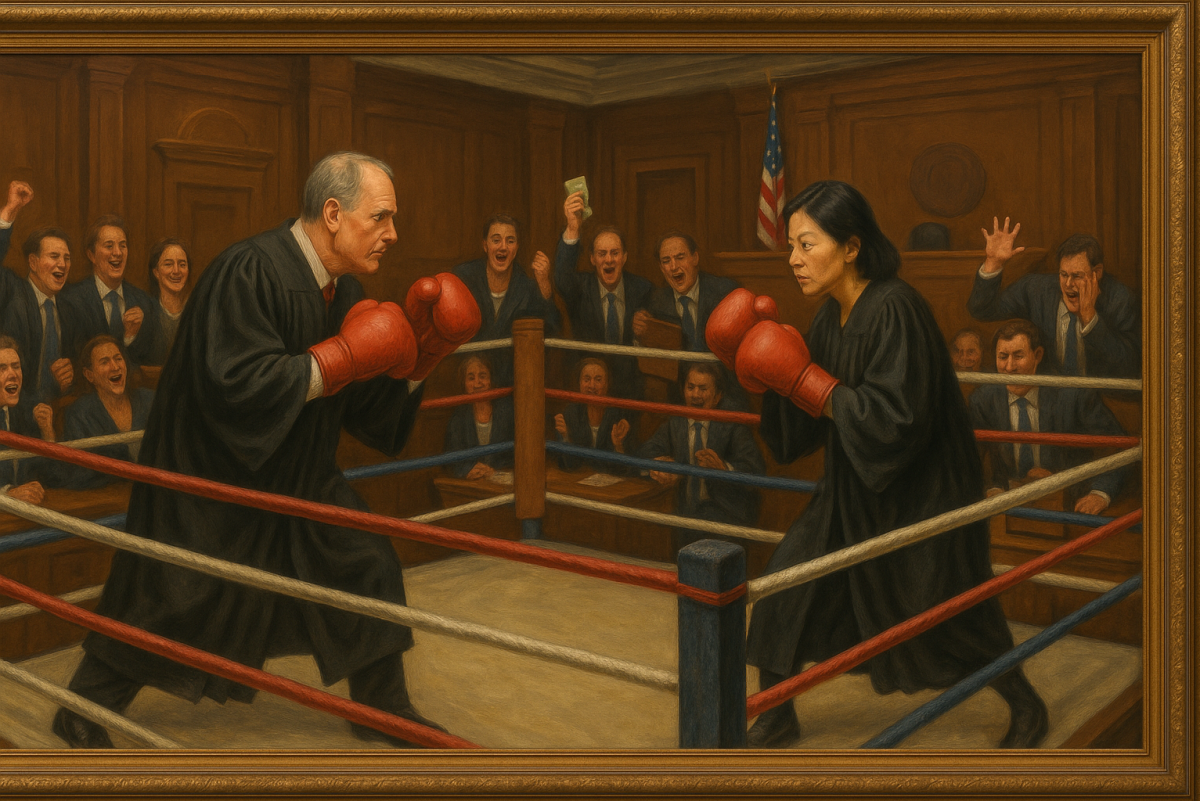
 professoring. Also, a year later I’m still trying to figure out if I really look like Owen Fiss. On one hand, he is taller, far more accomplished, and makes more than I do, but he also has a comb-over thing going, I think.
I thoroughly enjoyed the Rick Hills-Brian Leiter debate. If you aren’t one of the seven people who read it over at Legal Profession Blog (a Member of the Law Professor Blogs Network), feel free to make your way over there to find my contribution (and praise of Paul Horwitz’s post). While you are over there, give some props to Mike Frisch, whose stories about lawyers behaving badly are now picked up regularly by the online versions of the ABA Journal and the Wall Street Journal. And welcome our newest co-editor, Bill Henderson, perhaps the leading scholar currently working in empirical study of the legal profession.
Oh, why I like theory. More to come on this over the next few weeks. For now, take some insight from Brian Greene, the Columbia physics professor and popular science writer, in today’s New York Times Sunday Opinion section. His point is about the inspirational aspects of science, a teleological view if there ever was one, in which you can not only marvel at the spectacle of a sky full of stars but also “recognize that those stars are the result of exceedingly ordered conditions 13.7 billion years ago at the moment of the Big Bang.” Personally, I’m agnostic on the teleology but, if forced to take sides, I much prefer it to purposeless post-modernism.
But there’s a point here to be made about theory (even philosophy) and the law, and it goes something like this. Greene isn’t looking to have science inspire scientists; he’s looking to have it inspire middle-school and high school students, thinking adults, and in one instance, as he describes, a lonely soldier in Iraq. What’s the problem? Says Greene, “in teaching our students, we continually fail to activate rich opportunities for revealing the breathtaking vistas opened up by science, and instead focus on the need to gain competency with science’s underlying technical details.” Even if you take the point of the methodological naturalists, are skeptical of the existence of non-natural or transcendental truths or imperatives (in law, morality, or  otherwise), and believe that moral discussion needs to emulate the methods of the natural
  sciences, what’s problematic in inspiring students of physics and biology is a fortiori problematic in inspiring law students. Again, quoting Greene, “we rob science education of life when we focus solely on results and seek to train students to solve problems and recite facts without a commensurate emphasis on transporting them out beyond the stars.” Or to take slight issue with Rick Hills (more to come on this later), in the context of legal education, we ought not give up on coming to terms with the distinction between the “is” and the “ought.”
Well, that’s enough for today. While you are contemplating the mysteries of the universe, you might also want to consider whether Larry Ribstein (left) is the nom de plume of the actor James Rebhorn (right), at least when Mr. Rebhorn is doing work in unincorporated business entities and not playing slimy defense lawyer, Charles Garnett, on Law & Order, or the wimpy Secretary of Defense who joined Judd Hirsch’s minyan in Independence Day.
Posted by Jeff Lipshaw on June 1, 2008 at 02:05 PM