
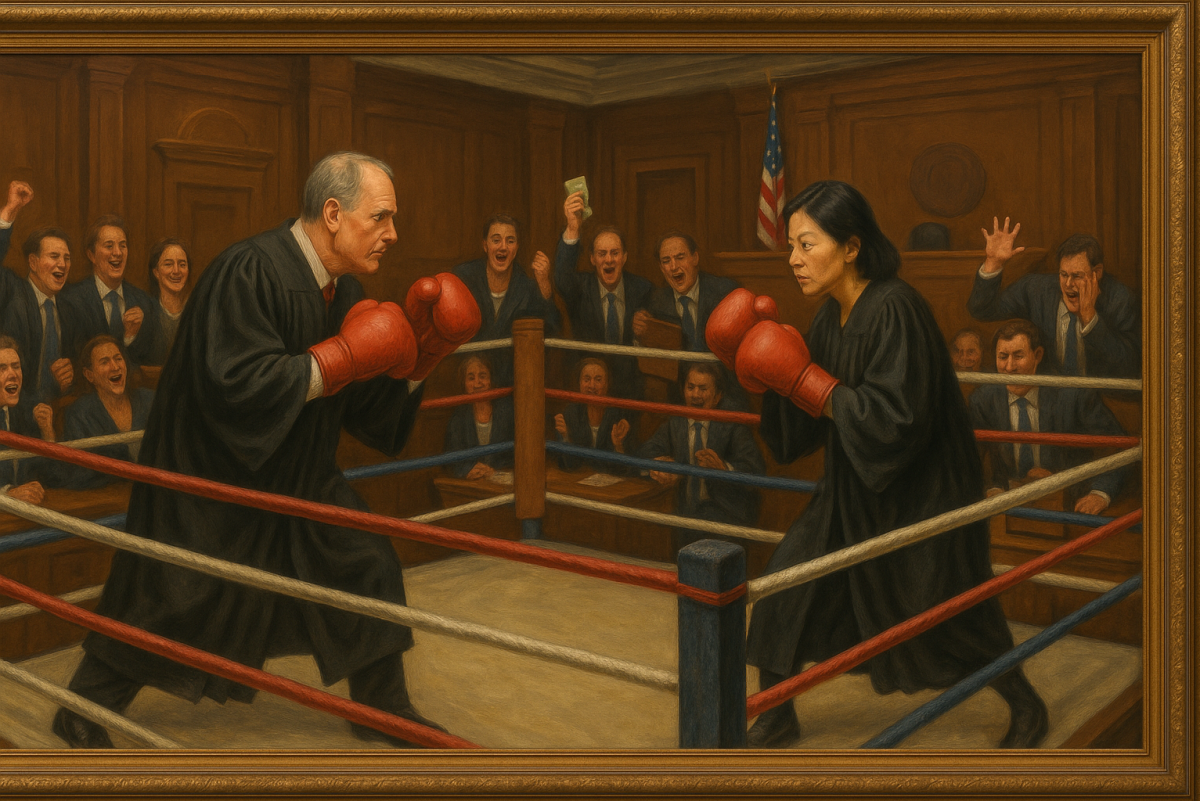
Looking for something to do this weekend? I have just the thing for you. Here is a short draft review, which should hopefully be destined for a popular practice journal, of two great new books: Richard Posner’s How Judges Think, and H. Jefferson Powell’s forthcoming Constitutional Conscience: The Moral Dimension of Judicial Decision. Both are splendid, and I hope the review is a nice introduction. I hope fans of virtue jurisprudence will find it particularly interesting, but it should be of general interest to students of and kibitzers in constitutional law and people who are interested in the judge’s craft — that is to say, everyone who reads this blog. Here’s the abstract:
This is a short review of two new books on judging — Constitutional Conscience: The Moral Dimension of Judicial Decision, by H. Jefferson Powell, and How Judges Think, by Richard A. Posner. Although both books examine the same topic, and both focus largely on judicial decision making by Supreme Court Justices in the area of constitutional law, their approaches diverge significantly. Powell takes a page from virtue ethics in offering an expansive and ruminative vision of the ethical virtues and vices that characterize the judge in a constitutional case. Posner brings his economist’s toolkit, supplemented by a variety of disciplinary adjuncts and a bracing dose of pragmatism, to many of the same questions. Their goals are somewhat different, and their conclusions, despite some common ties, present a striking contrast. These books may be read as complementary and not just competitive accounts. Nevertheless, I suggest that Posner’s account is far more descriptively accurate, although Powell leads us, commendably, to think about the ways in which we might reconsider and revive the kinds of constitutional virtues that are at the heart of his romantic account.
And here’s a brief snippet comparing the two authors:
Powell would drape the figure of Lady Justice in new and glorious robes, albeit robes of ancient design. Given his druthers, Posner would criticize the cut of Justice’s robes, scoff that they aren’t warm enough to have any useful function, and digress to note that the taboo against nudity is itself a historically contingent and only locally applicable social norm. (Seriously. Doubters may consult the index entries on “nudity” in Posner’s Sex and Reason.)
Enjoy. May I add self-servingly that I would love to expand this short review into a full-on treatment for a law review, and I invite law review editors who might be interested to let me know.
Posted by Paul Horwitz on May 9, 2008 at 03:32 PM