
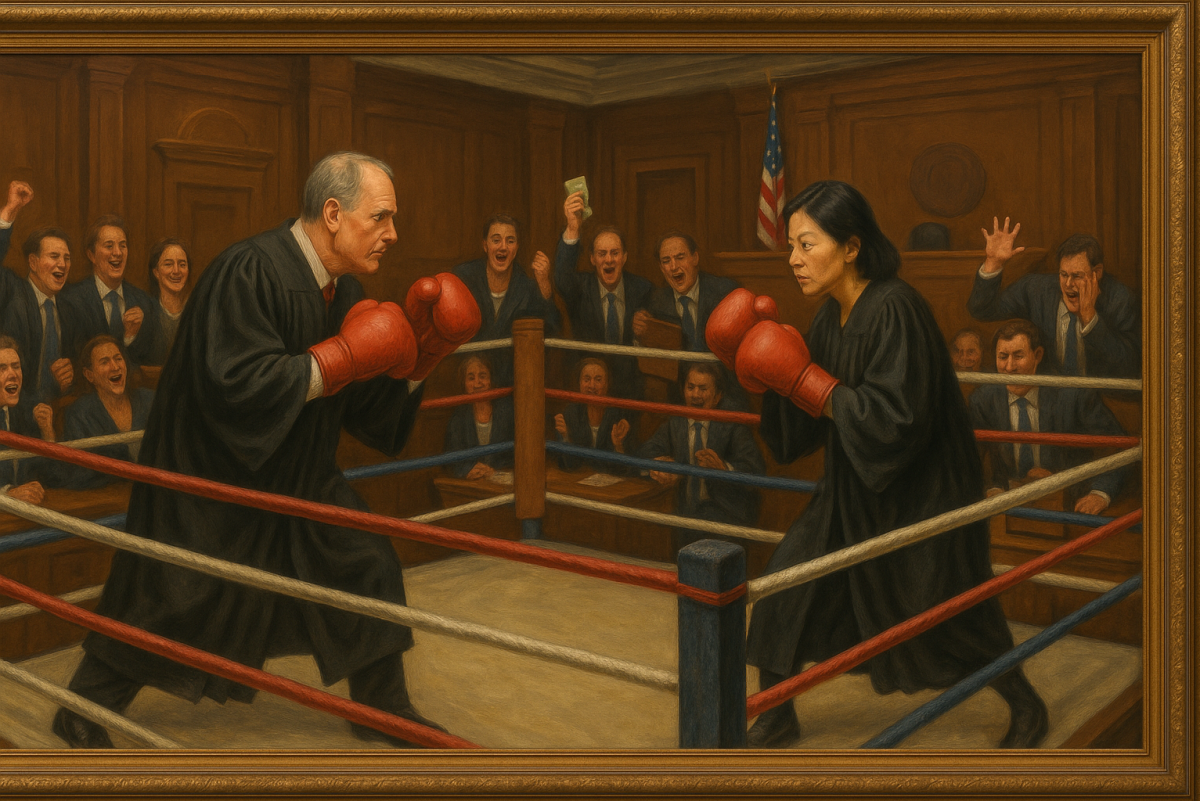
With Senator Barack Obama leading in the polls and general economic conditions favoring the Democrats, speculation has turned to what type of relationship a President Obama might have with the conservative Roberts Court. In what is quickly becoming a common comparison, both George Washington University Law Professor Jonathan Turley and Washington Post columnist E.J. Dionne analogize to Franklin Roosevelt’s New Deal battles with the Hughes Court. “Both the Hughes and Roberts courts ruled during periods of economic difficulties and political shifts in power,” Hurley adds. “Both courts had four conservatives who maintained a united voting bloc on most major issues. . . . With a country in economic crisis and a world in upheaval, Obama,” like FDR, “would face a court with a near majority of ideologically hostile justices.” Dionne concurs: “The spate of 5 to 4 conservative decisions during the Supreme Court term just ended should stand as a warning that we may soon revisit the fights of 70 years ago.”
Is this analogy to the Hughes Court apt? I must confess to finding it a bit strained. True, a President Obama would, like FDR, inherit a dire economic situation. And like FDR, Obama would likely have relatively strong support in Congress for his policy agenda. (Come November, Democrats are expected to solidify their majorities in both the House and the Senate.) And as in the 1930s the Court would be the one branch of the federal government controlled by the opposition party.
So why do I find this analogy unpersuasive?
The most obvious reason is that unlike FDR Obama’s is not proposing a constitutional revolution. The power of the Hughes Court analogy lies in the specter of a grave constitutional conflict between the branches. The New Deal was premised on a fundamental reordering of the constitutional structure, centralizing authority over the economy in Washington contrary to decades of settled – if controversial – precedent. FDR’s conflicts with the Hughes Court resulted from the passage of successive pieces of major legislation that ran afoul of Lochner era decisions.
Obama’s agenda has been criticized for being a bit too ambiguous and flexible, but it hardly breaks new constitutional ground. No significant piece of Obama’s health care or economic recovery policies is at odds with longstanding constitutional precedent.
Of course, there will be conflicts between President Obama and the Court — just as George W. Bush has had and a President McCain will have. One area where there might be conflict is executive power. Although a progressive, Obama may pursue a broad vision of executive power once he becomes the executive empowered by that broad vision. But presumably it won’t be the conservatives on the Court who will fight against broad assertions of executive power. If there is a conflict with the Court, it will be with the same moderate majorities that conflicted with President Bush.
There is, however, one area where a significant constitutional battle might arise: the environment. Obama apparently intends to push forward an aggressive agenda to protect the environment and fight global warming, and the Roberts Court has all but declared war on federal environmental laws. In 2006, the Roberts Court watered down the Clean Water Act’s protections and left many seasonal streams and small rivers, especially in the west, open to development. And recall that Chief Justice Roberts is one of the very few federal judges to hold that the Endangered Species Act was unconstitutional as applied to purely instate species. Yet, because most environmental laws are clearly regulations of interstate commerce, even an aggressive Court is unlikely to challenge the heart of Obama’s agenda.
Posted by Adam Winkler on July 6, 2008 at 11:48 AM
Comments
Executive power might disputes, if they arise, might be the best test of the justice’s principles. Will Scalia/Thomas/Roberts/Alito, normally solicitous of executive power, continue to be so when executive power is being wielded by a president of a different party or towards political ends with which they might disagree?
Posted by: Howard Wasserman | Jul 7, 2008 8:01:14 AM
Hmmm…difficult to know whether this post is correct or not, seeing as it’s becoming more and more difficult to know exactly what Obama’s constitutional vision is.
The main problem with the post is that it doesn’t make clear whether FDR *when he ran for the first time* in 1932 (I think) made it clear that he was proposing, as you put it, “a constitutional revolution” that would run headlong into the ethos of the conservative Hughes court. That’s the valid timeframe of comparison at this early stage, since we really have no idea — before Obama has even been elected to a single term, let alone elected to 4 terms, as was FDR — how radical Obama’s constitutional vision may or may not be.
Posted by: anonymous | Jul 7, 2008 7:55:58 AM
“True, a President Obama would, like FDR, inherit a dire economic situation. “
Uhhhh….I don’t think an economy with a 10 trillion dollar GDP and 5.5% unemployment is anything even remotely like the Great Depression.
Posted by: andy | Jul 6, 2008 1:09:38 PM