
The SCOTUS has lately been going long on the idea that post-enactment political precedents can settle constitutional controversies. Their latest investment in this principle is Trump v. Cook’s idea that the independence of the Federal Reserve Board from presidential removal is established by the precedents of the First and Second Bank of the United States. As Cook puts it,
“[The founders] knew from experience (and Hamilton reminded them) of the calamities that could arise from even the ‘suspicion’ of political manipulation of monetary policy.… So when they established the First Bank of the United States, they guaranteed its independence from Presidential control. Their successors did the same for the Second Bank.
According to Cook, the “tradition” established by the First and Second Banks shows that “the Federal Reserve maintains the ‘balance struck by the founding generation’ under ‘modern circumstances.’ We thus look to history not as an end in itself, but (as we often do) to give ‘essential content to undefined provisions in the frame of our government.’”
Cook’s invocation of the two Banks of the United States nicely illustrates two related points. First, the decision shows how courts adopt amnesia to create political precedents. The Cook Court simply omitted any mention that the constitutionality of two Banks’ charters was ultimately rejected by a broad consensus of 18th and 19th century politicians. Second, Cook is a reminder that we need but lack an account of how widely accepted or durable political decisions must be to count as either political precedents or “liquidations” that resolve constitutional ambiguities.
1. Cook’s Amnesia: Ignoring the nation’s ultimate rejection of BUS’s constitutionality
Consider, first, how SCOTUS simply ignored the fact that, in the end, Congress rejected BUS’s constitutionality, deciding in the 1830s that it was constitutionally impermissible to delegate monetary policy to private corporations. Hamilton’s report in favor of the BUS did not represent “the balance struck by the founding generation.” It was instead a bitterly contested Federalist Party document. Hamilton’s contested idea was that Congress could ensure a monetary policy independent of democratic politics by delegating such policy to a private corporation. Jefferson’s and Madison’s Democratic Republicans fiercely resisted that idea, arguing that Congress lacked the power to turn monetary policy over to private corporations precisely because a private board was unaccountable to the people. In 1811, the Democratic-Republicans prevailed by refusing to renew the Bank’s charter. After Madison relented in 1816 and signed the Second BUS into existence, Jackson and Van Buren launched a new opposition to Clay’s Whigs by attacking the Second BUS using the same constitutional theory, ultimately creating the Independent Treasury System in 1841 to ensure what “hard-money Jacksonians” called “constitutional currency” (i.e., government-minted gold coin rather than privately issued bank notes). (For condensed summaries of this history, see my articles here, here and here. Or you can read the classic histories by Bray Hammond, Peter Temin, and John McFaul, among others).
Cook briefly alludes to Jackson’s constitutional objections to Hamilton’s principle of private delegations, but the opinion then utterly ignores the fact that Jackson ultimately prevailed by overturning BUS on constitutional grounds. How could Cook so thoroughly misrepresent the historical record by treating Hamilton’s report as “the balance struck by the founding generation” rather than a partisan Federalist (and later Whig) position that was soundly rejected by the nation?
I suggest that such judicial amnesia is essential for making temporary political victories look like the consensus of We the People. This was Madison’s famous 1831 justification for “liquidating” constitutional disagreements with political precedents: Such precedents were supposed to represent, in Madison’s words, “the uniform sanction of successive Legislative bodies, through a period of years and under the varied ascendancy of parties.”
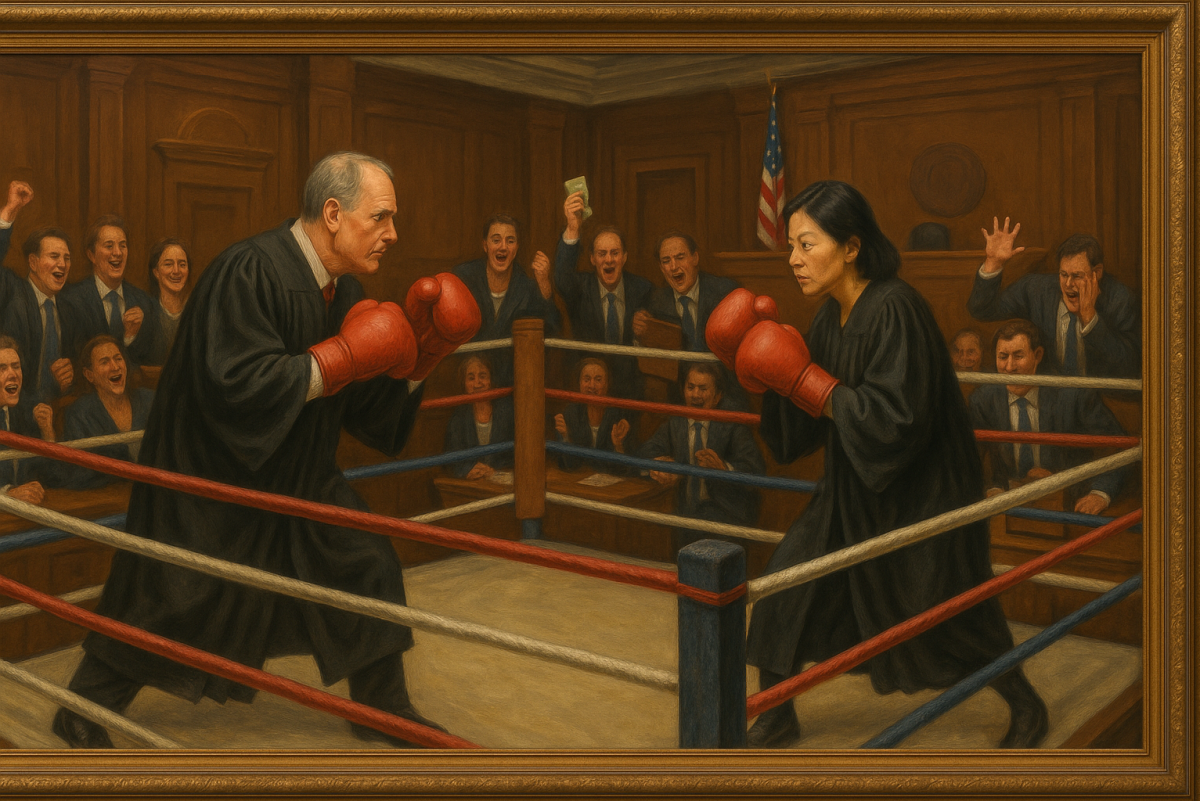
The problem is that very few political settlements have this character of lasting national consensus – especially in the early republic. As I wrote back in 2019, “[g]oing back to the 18th century for apolitical, legalistic settlements of big issues is like going to a saloon in 19th century Deadwood to curl up with a nice cup of tea for a quiet read. The 1780s and 1790s were a constitutional barroom brawl.” Maybe one side managed to out-slug their enemies in 1791 long enough for a big huzzah to toast their constitutional principles– but their opponents managed to burst back through those swinging doors after 1801, bum-rush their enemies out, and establish a new precedent with a new round of intoxicating constitutional theories.
The ITS governed United States from 1841 until 1913 – seventy-two years to the two BUS’s cumulative forty-five years from 1791 to 1811 and 1816 to 1841. Why should the first settlement get stare decisis as some sort of generational “balance” while the second settlement gets forgotten entirely? SCOTUS solves the problem of distinguishing the Fed from the FTC by concocting a generational consensus – the “balance struck by the founders” – through sheer historical amnesia. Happy as I am that SCOTUS preserved the independence of the Fed, I do not think that Cook has much of a theory as to when and how politics yields constitutional principles – beyond the sort of judicial amnesia that can attract five votes.
2. Is the BUS precedent for the Fed’s Independence even though Congress overruled it?
That SCOTUS might not have a fully worked-out theory of political precedents is hardly shocking. It is the job of law professors, not courts, to spin theories to make sense of judicial decisions. Aditya Bamzai was published the leading scholarship on the analogy between the Fed and the BUS, and it is no surprise that his characteristically careful and insightful work shows no signs of historical forgetfulness. In 2019 and 2024 articles (the last co-authored with Aaron Neilson), Aditya accurately lays out the Federalist/Whig consensus that the BUS exercised no “sovereign” functions and therefore need not be controlled by the President. Indeed, he provides an especially thoughtful analysis of antebellum treatise writers’ efforts to make sense of the BUS’ peculiar mix of public and private functions.
Even Aditya’s fine scholarship, however, brushes aside historical disagreement by IMHO unjustifiably marginalizing opposition to the Federalist/Whig consensus. In Aditya’s words, “[w]hile President Jackson viewed the grant of currency-making authority to the Bank to be an impermissible delegation of congressional authority to a private entity, the mainstream view understood currency creation as a function that could be undertaken outside of presidential supervision” (page 898, 2024).
Characterizing Jackson as outside “the mainstream view” takes a bit of Whiggish nerve. After all, Jackson not only won his war against the BUS but also overturned the old Federalist/Whig consensus about the appropriateness of delegating monetary policy to private corporations. In its place, Jackson created a new consensus: Even “non-sovereign” or “proprietary” functions of the federal government could not be delegated to private corporations. That new consensus was so powerful that it eventually pressured Jackson himself to give up on “pet banks” – state-chartered banks that served as depositories for federal revenue – instead eventually advocating for the Independent Treasury System under which the U.S. Treasury was obliged to hold its own money as hard currency in federal buildings.
Like all truly lasting constitutional positions, Jackson’s non-delegation doctrine was rooted in an external shock having nothing much to do with constitutional theory but rousing the entire nation with its severity. That shock was the Panic of 1837, which “hard-money” Democrats blamed on private banks’ over-issuing notes for the purchase of western land and then suspending specie payment on those notes, thereby precipitating a financial crisis. Jackson railed against the “base perfidy and treachery” of the depository banks in violating the terms of their depository agreements by their specie suspensions, thereby confirming William Gouge’s theory that bankers inevitably provoked financial panics. Egged on by hard-money radicals like William Leggett who hated even state-chartered banks as vehemently as any DSA radical today hates Jamie Dimon, Democrats adopted “Separation of Bank and State” as their slogan. This was a constitutional slogan, driven by the idea that giving private corporations power over currency violated the Coining Money Clause of as well as the Necessary and Proper Clause Article I, section 8. Behind these (weak) textual arguments was the passionate belief that the money supply had to be controlled by democratically accountable officials, not private bankers.
Unlike Cook, Aditya does not ignore this history. Instead, he relegates it to the status of a dissenting position without the binding force of “the mainstream view.”
But that is a weird take. Those dissenters ultimately won the war! Aditya quotes a bunch of Federalist and Whigs –Alexander Hamilton, James Kent, and ultra-Whigs like Rhode Island supreme court justice Samuel Ames – to establish the idea the BUS’s power were sufficiently “non-sovereign” that they need not be controlled by the President. By 1841, however, all of these writers were historical has-beens, relegated to the dustbin of history by a wave of Jacksonian indignation at what the Jacksonians regarded as banking abuse. The ITS permanently ended all federal deposits of revenue into the vaults of private banks on the ground that such federal use of private power was unconstitutional. Neither the Whigs nor the Republicans even attempted to revive any version of the BUS. Nelson Aldrich’s 1912 effort to revive a version of the BUS with his private “reserve association” owned and controlled by banking corporations was dead on arrival in Congress, denounced as a give-away to bankers by Democrats inspired by Bryan’s attack on bankers’ controlling the money supply, an attack that was incorporated into the Democratic Platform of 1896.
How, then, were Hamilton’s and Kent’s theory of the bank as “non-sovereign” activities that elected officials need not tightly control “the mainstream view”?
4. The real holding of the BUS precedents: The private non-delegation doctrine
If you buy my account of the ITS’s constitutional significance laid out above, then you will agree that the BUS precedents do not really stand for the idea that private corporations can be given “non-sovereign” functions. But then what do these precedents actually stand for?
As Richard Primus and I argued here, the BUS precedents are the origins of the idea that the federal government may not delegate significant powers – even non-sovereign powers – to private corporations. This private non-delegation doctrine is most familiar from Schechter Poultry’s denunciation of the NIRA’s delegation of code-making power to private trade associations. The private non-delegation doctrine enjoys a vibrant life in state courts’ interpretations of their own state constitutions, and the SCOTUS has given it a hat tip in Department of Transportation v. Association of American Railroads.
The rise of the private non-delegation doctrine in the 1840s was part of a much larger movement against governmental reliance on private corporations to carry out important functions, regardless of whether or not those functions were characterized as “sovereign.” Such reliance was common in the 19th and early 19th centuries, constituting what Joseph Wallis has described as “taxless finance.” The idea behind such finance is that governments could build infrastructure (toll roads, bridges, canals, railroads, etc.) and create a paper currency (privately issued bank notes that would act as a circulating medium) without ever raising taxes. The key move was to confer monopolies on private transportation and banking corporations that would in return provide the desired benefits – a freely circulating currency of paper banknotes, bridges, canals, etc. – in return for private control over public resources like a toll-road route, bridge, or deposits of federal revenues. The Jacksonians rebelled against this idea as a betrayal of democratic accountability.
Burned by the 1837 Panic, numerous states amended their state constitutions to aid anti-aid provisions in the 1840s, forbidding gifts or grants to private corporations. The ITS was just one such rebellion against conferring financial power on private corporations, of a piece with the Taney Court’s Charles River Bridge Case denying to a private bridge company the right contained in its charter to operate a bridge to the exclusion of competing bridge companies. According to the post-1837 orthodoxy, such private entities could not exercise power over public goods, even if that power might plausibly be characterized as “non-sovereign” because it was “proprietary” – involving the spending or lending of money – because even “non-sovereign” powers could result in corruption and abuse of the public trust.
Aditya, in sum, creates a constitutional precedent from a temporarily successful position that ultimately was overruled by later events. Moreover, the overruling stands for a position exactly opposite to the position for which Aditya and Cook cite the BUS examples: In fact, the downfall of the BUS stands for the proposition that Congress may not ensure independence of monetary policy from politics by delegating such policy to a private corporation.
In so invoking precedent, however, Aditya does no worse than James Madison, who also claimed in an 1831 letter that the constitutionality of the BUS had the “uniform sanction of successive Legislative bodies, through a period of years and under the varied ascendancy of parties.” That statement was true enough in 1816, but, by 1831, anyone could see that the political precedent was about to be overturned – as it was a year later with Jackson’s Bank Veto Message.
Aditya might reasonably reply that the Federalists won the crucial first round in 1791, in the First Congress. It is conventional wisdom, after all, that the views of the First Congress carry special weight because so many of its members were involved in the ratification of the Constitution. Moreover, a precedent can be binding even when lots of people dissent. In the political case of Madison v. the First BUS, Madison lost. Why, then, should this early interpretation not bind SCOTUS today as an authoritative reading of the Constitution? A 5-4 SCOTUS precedent, after all, binds lower courts just as surely as a 9-0 precedent.
This response, however, may confuse precedent with constitutional liquidation. Precedents come and go. Ceteris paribus there are good reasons sounding in reliance and civil peace to stick with them. They are not immune, however, from being overruled: Just ask the Dobbs majority.
Constitutional liquidation is a much more binding enterprise in which some set of interpreters who can plausibly claim to speak for “We the People” provide an authoritative reading of an ambiguous phrase that should not be lightly overturned—or maybe not overturned at all. The First Congress, bitterly divided as it was between Federalists and Democratic-Republicans, was not sitting in any constitutive capacity capable of liquidating any disputed question. It could hardly claim to speak for a unified People. Maybe it established a precedent of sorts – but the sort of liquidating precedent described by Madison when he referred to the “uniform sanction of successive Legislative bodies, through a period of years and under the varied ascendancy of parties.” Whatever precedent it established was swept away by Jackson and Van Buren as thoroughly as Dobbs swept aside Casey and Roe.
Why, then, does this long-discredited and -overruled ancien regime of private corporations’ providing taxless finance for the federal government, a product of a bygone era of deference to the wealthy and well-educated beloved by Federalist elites, give any aid to the Fed today? That regime was soundly rejected in 1841 after decades of fierce objections to the Hamiltonian principle that independence from politics could be secured through delegations to private corporations. No politician today would ever try Hamilton’s archaic stunt of handing over monetary policy to a single private corporation under the control of private bankers. Nelson Aldrich was the last person to try in 1912, and he was laughed out of Congress. One might as well resurrect tax-farming to replace the IRS. As Nick Parillo argued in his landmark book, Against the Profit Motive, we just do not rely on private agents any more for such significant governmental functions regardless of whether such functions can be denoted “non-sovereign” according to some hyper-technical notion of “sovereignty.”
4. When can one liquidating tradition overrule another earlier liquidating tradition?
This brings me to one final question: How can one tell when a political precedent really is binding and when it has been overruled? Will Baude wrote an outstanding essay on liquidation that grapples with this question. As I noted back in 2018,
[Baude’s] discussion of whether a liquidating settlement is permanent – -whether, in his words, liquidation can be liquidated … is balanced and subtle, and the best evidence of his fair-mindedness is that, in the end, Baude punts. He concludes that it is uncertain whether mere normative disagreement with a prior liquidating decision should be sufficient reason to overturn them but that nonetheless such decisions do seem to get overturned on such a basis.
That’s the problem with allegedly liquidating consensus: The very fact that a significant part of the public rejects it is proof that the precedent is not really liquidating. James Landis’ and Louis Jaffe’s Administrative State surely looked like it was the established “mainstream view” by, say, 1975. By 2026, that view was being led to the Slaughter by the Roberts Court and its theory of the unitary presidency.
Let’s say that such a theory was in fact adopted by the First Congress in the Decision of 1789, contrary to the evidence set forth by Jed Shugerman. Was not the liquidating decision of 1789 itself liquidated by the New Deal? Why did not the precedents that created the ICC, the Fed, the FTC, etc., sufficiently overrule the earlier precedents that resolved any ambiguities in Article II in favor of the President’s power to fire agency heads? Is the theory that the People have less power to overrule their political precedents than SCOTUS has to overrule its judicial ones, at least if the former are truly liquidating? That sounds a bit weird, no?
Baude to his credit does not answer this question, and I will not repeat here my musings from 2018 about it. This post is already far too long. Until that question is answered, however, the invocation of liquidating traditions to resolve constitutional controversies will sound contrived. Given the dissensus characterizing the traditions allowing both banks of the United States, one can understand why SCOTUS might prefer to lace its reliance on such precedents with a little face-saving amnesia.
