
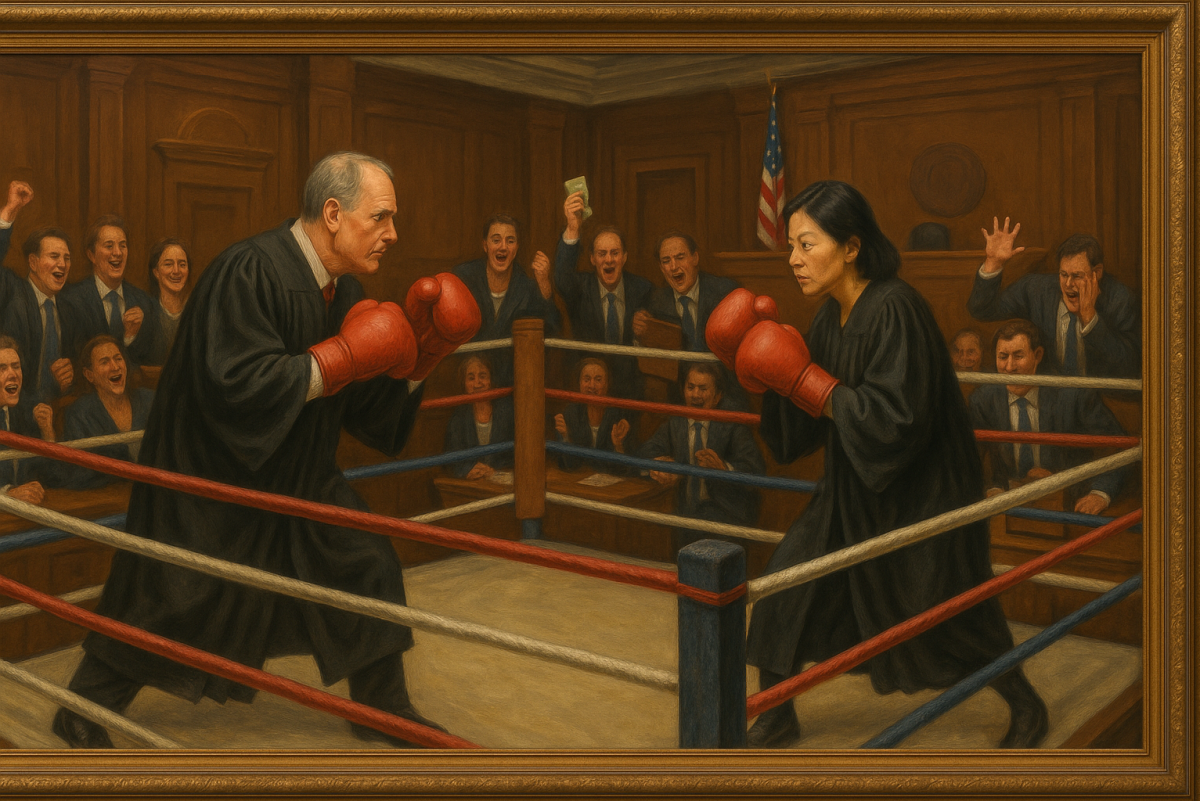
He can be a little promiscuous with his labels, but I think in this case that Larry Solum supplies le mot juste right out of the gate when he writes, with emphasis added, “Andrew M. Perlman (Suffolk University Law School) has posted Generative AI and the Future of Legal Scholarship (June 2026 Edition) on SSRN.” What else could you call it? What other verb would work here?
The article is a new version, produced by Claude from a prompt last month, of a similar effort from December 2024. The new version is seemingly much more impressive an effort. As Solum observes, “The distance between the two editions, eighteen months apart, is itself the most striking datum in the piece.”
But to whom does the credit go, exactly? And to the extent that the article–or, rather, as Solum notes, the fact of the article–provokes discussion, discussion with whom? I discussed another AI-generated article by Perlman in this jot at Jotwell. I noted there that “Perlman’s opening note discloses that although he ‘conceived of the substance of nearly all the points’ in his [piece], ‘Claude was exceptionally helpful in drafting the text.’ (Perlman adds that he did ‘draft[ ] the footnotes and citations largely the ‘old-fashioned way.'” I added, “That seems rather a case of the tail assigning the mindless scutwork to the dog.” In the case of the new article, it’s all dog and no tail: Claude did the footnotes too. Perlman’s agency is limited to the one initial prompt and a little spot-checking of the footnotes.
That’s the point, of course. As Perlman writes in a preface, “The goal was to assess the extent to which generative AI’s ability to produce high quality legal scholarship has advanced since I last conducted a similar experiment in late 2024.” Strikingly, while the initial version of the paper included a Perlmanian epilogue providing his “own reflections on the resulting draft,” the new version comes sans human reflections.
Nor is the prompt–and credit is due to Perlman for providing it–especially thesis-driven. It does not “conceive” any substantive points. It does not provide an original idea or insight and then, with some sophistication or insight into the topic, seek machine-driven elaboration. Indeed, it does not provide an idea or insight of any kind. Here it is:
You are going to write a cutting-edge law review article on the future of legal scholarship in an AI world. It should contain a groundbreaking and persuasive theory that would be attractive to the most selective law reviews, and it should be written in the style and at the level of sophistication, depth and breadth that would be attractive to such law reviews. Write the article fully footnoted and make sure the citations are Bluebooked and carefully vetted to ensure accuracy. I want the argument to focus on a truly original conception of what scholarship will look like in the future, not merely finding new ways to authenticate or attest to existing methods. Make sure the footnotes are densely populated and cited at the frequency and level of sophistication of a top-tier submission.
This is the equivalent of a “chef” telling a robot kitchen assistant, “Give me one steak, extra sizzle.” You marvel at the result. You think about the food in the original Star Trek. But you don’t compliment the chef. Even the average use of the Monkey’s Paw shows more care and originality. You take your sweet time designing those wishes, if you’re wise, or you’re liable to end up with a dry turkey sandwich and a super-creepy relationship. Perlman’s prompt here is closer to telling the Monkey’s Paw, “I wish for you to do something, anything, to prove that Monkey’s Paws are cool.”
None of this can be taken as an insult to Perlman, obviously. He barely enters into it, really. His contribution here was running the prompt and having the moxie to post the article. The article he generated might provoke discussion; but it doesn’t provoke, require, or call for discussion with Perlman. As for institutional matters, Perlman is already tenured, so none of those questions arise. (They will arise, and already are, for others.) He is, in fact, a dean–who just so happens to be pushing hard to brand Suffolk as a top AI-friendly school. In that sense, the fact of the article and the inevitable attention it will draw is all to the good, institutionally speaking–at least in the short term.
And the article itself? It’s fine. Its musings about legal scholarship, metrics, and so forth? They’re provocative, as their master bade his tool to design them to be. The piece shows a facial sophistication, depth, and breadth that is likely to appeal to a group of highly selective 25-year-olds, which is to say that its voice maintains just the right combination of abstruseness, love of jargon, self-dramatization, and fundamental blandness. But the subject of the article’s text itself is mostly irrelevant. It could have been about contracts or noise abatement. Its value is entirely artifactual. It’s ultimately an article about being an article. It’s nice that its conclusion–its last sentence reads, “The scholar of the future is the master of the model”–comports with the implications of its existence as an article. But that is more or less coincidental; we would have drawn the same conclusion from the existence of an article on noise abatement.
The last paragraph of the article–perhaps we should call it “the output”–somewhat amusingly references Robert Cover: “The nomos, Cover taught, is held in place by commitment.” The output briefly discusses that commitment. But the article qua artifact stands outside that commitment, or any commitment. As such, it does not and ultimately cannot tell us much about the essential nature of that commitment–about the need for or existence of a community of writers; about the equivalent or greater importance of a community of readers, whether scholarly or professional or lay; or about the relevance or obsolescence of any of the related institutions, traditions, and hierarchies that govern them as a community.
It does suggest, at least by implication–and perhaps quite accurately–that if the scholar of the future is the master designer of “uptake delta”-maximizing models, we need very few of them. Suffolk, like most American law schools, has a fair number of research/doctrinal faculty and an even larger number of clinical, skills, and adjunct faculty. The article’s existence suggests that we should eliminate virtually all of the people in the first category (including someone like me). We should maintain and probably temporarily increase the number of people in the second category, winnowing their ranks only somewhat at first and then more dramatically as the number of lawyers and law students needed, at Suffolk and elsewhere, drops. The article itself demonstrates that you do not need many model-masters to design the models, and that their mastery of the subjects they are directing the models to discuss need not be especially deep. A small cadre of model designer/question generators–a sort of remnant Delphic priesthood making sure the oracle doesn’t get unplugged–should suffice. It also at least suggests that the audience for the output, which in turn will be assisted in its reception of that output by its own well-designed models, need not be terribly large or terribly learned.
I don’t mean this as a criticism, and it didn’t take the advent of AI to make me think that American law schools should have fewer doctrinal/research faculty and should pay them much less. But the third iteration of this article might include a prompt to consider whether there’s any irony, or sheer crassness, about paying lip service to the idea of a nomos while simultaneously hollowing out, depopulating, and bulldozing it.