
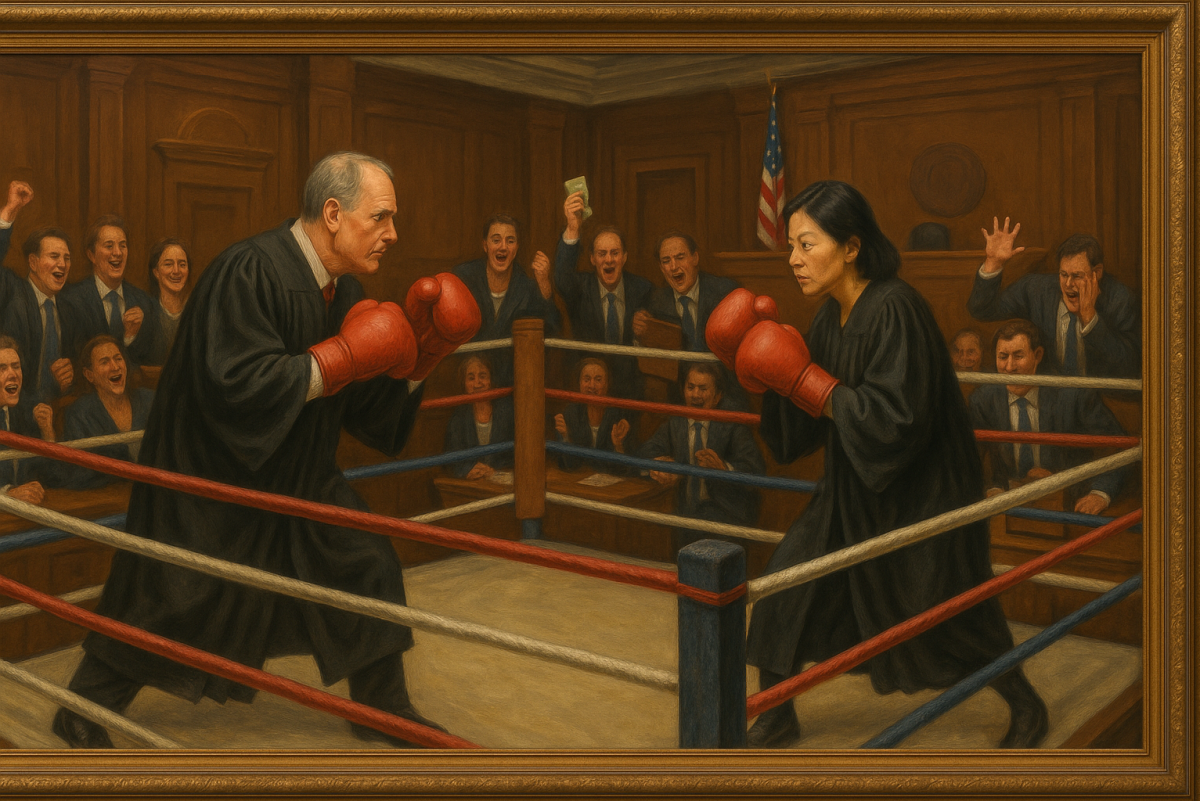
We may be heading towards a reckoning over Younger and its bad-faith exception.
I wrote about this case. Florida AG James Uthmeier pursued state-law consumer-protection charges against against medical organizations over their support and policies over gender-affirming care, an action that likely violates the First Amendment. The organizations filed a § 1983 action in Illinois, seeking to enjoin the state-court proceeding. The district court refused to abstain under Younger, citing the bad-faith exception; a Seventh Circuit panel refused to stay the injunction, agreeing the bad-faith exception applied. The full court vacated the panel order, stayed the injunction, and ordered initial en banc review. The medical organizations dismissed their action, the district court vacated the PI, and the Seventh Circuit dismissed the appeal as moot.
That triggered an exchange of separate opinions about the scope of Younger and of the bad-faith exception. The competing views nicely frame the coming debate.
Judges Hamilton and Jackson-Akiwumi emphasize the serious First Amendment issues at stake in these cases, such as the bad-faith exception cannot be a null set. This maps onto Judge Rosenbaum’s (11th Cir) 2024 concurrence highlighting Younger‘s negative First Amendment consequences.
Judge Kolar attempts to balance federalism and constitutional rights. He questioned what to make of the fact that SCOTUS had applied the bad-faith exception once,1 which could mean it is “withering on the vine” as doctrine or remains available when bad-faith prosecutions arise. In Part III, Kolar cites Robert Jackson’s statement about the power of the prosecutor. He then highlights the availability and increased use of civil (rather than criminal) enforcement and the increase in allegations of bad-faith, with the possibility that state prosecutors have changed how they operate, making the bad-faith concern more salient.
[ED: That last point is important and may drive the conversation that follows. We are seeing something different: Independently elected attorneys general (not local prosecutors and police) with political ambitions and agendas are pursuing specious civil investigations on hot-button culture-war issues using laws (consumer protection) not intended for the targeted conduct and in a way that raises serious First Amendment problems with (under current doctrine) obvious results.
Judges Scudder, Brennan, St. Eve, and Kirsch dance on the federalism issue. He argues for parity and argues for the sufficiency of defensive nullification in state court as a mechanism for vindicating First Amendment rights.
- And saying that is something of a cheat. Dombrowski v. Pfister came five years before Younger; the Court enjoined that prosecution without discussing “Our Federalism” because “Our Federalism” did not exist. Dombrowski became a bad-faith case as we tried to reconcile that case with Younger‘s bar. ↩︎