
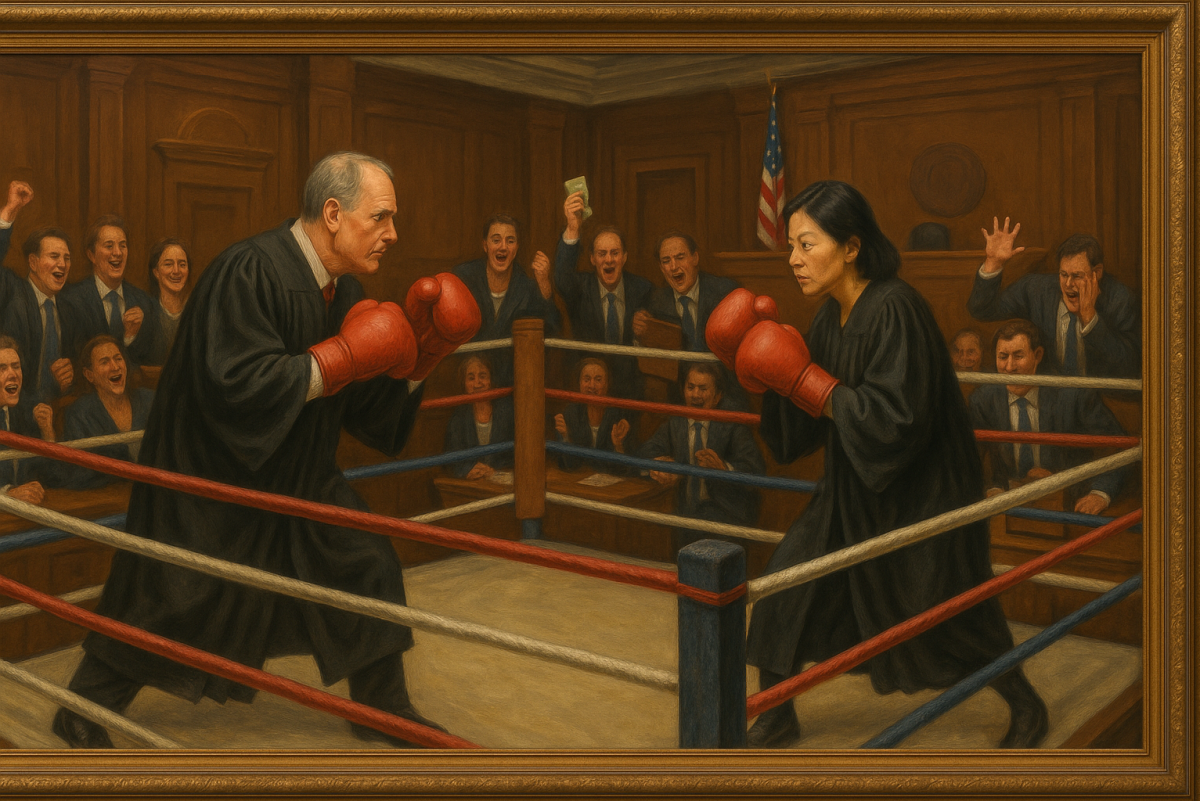
Greetings, sportsfans! While the Court gave us no merits opinions today, there is some interesting miscellany to report in connection with today’s Orders list. Well, not “interesting” like the NFL playoffs are interesting, or the ongoing Lindsay Lohan-Paris Hilton duel for the title of World’s Least Intelligent Non-Vegetable is interesting (at least in a morbid-curiosity sort of way). But hey, if you’re the kind of person who has subscribed to a Supreme Court newsletter, this may beat out the Golden Globes on TiVo for your attention this evening. Those of you who do not feel at least a little tingle when reading about CVSGs may want to move on to more heady fare.
First up, we have orders-related opinions from the Court’s opera-loving odd couple, Nino and Ruthie. And last but not least, we bring you another thrilling edition of Relist Watch, in which your humble sportscaster notes intriguing petitions languishing on the Court’s docket and speculates on what fate will befall them.
United States v. Omer, 05-1101
Justice Scalia concurred in the denial of cert in this case, which was being held for Resendiz-Ponce—the case that was supposed to determine whether a defective indictment could ever be harmless error. Of course, last week’s decision in Resendiz-Ponce did not answer this question, but instead held that the indictment (for attempted illegal re-entry) was not defective because the meaning of “attempt” is so well-known that the indictment need not specifically allege the overt-act and mental-state elements. The SG immediately pounced on that holding, filing a supplemental brief in Omer arguing that the fraud indictment in that case was not defective either, because everyone knows what fraud means, so why should the government have to go to the trouble of spelling out the elements of the crime in the indictment. Justice Scalia argues that the government’s filing vindicates his decision to dissent in Resendiz-Ponce from the Court’s new “some-crimes-are-self-defining jurisprudence.” He laments that that case gives the government “a license to avoid explicating the elements of a criminal offense,” thus opening “another frontier of law . . . full of opportunity and adventure for lawyers and judges.” This may set a new record for the shortest time elapsed between an opinion of the Court and Scalia’s “I told you so” opinion.
Haas v. Quest Recovery Services, Inc., 06-263
The Court GVR’d this ADA case to the 6th Circuit so that it could consider both the views of the United States as intervenor and the Court’s decision in United States v. Georgia (2006), which held that Title II of the ADA validly abrogates state sovereign immunity at least to the extent that a plaintiff alleges constitutional violations. The CA6 had held that the ADA did not abrogate Ohio’s immunity. Justice Ginsburg concurred in the GVR and penned a short advice column to the CA6, noting that the lower court’s opinion was just plain fishy in various respects. Her friendly advice on how to be a good appellate court: (1) Do not ignore controlling Supreme Court decisions (see U.S. v. Georgia); (2) dismissing claims based on judicial immunity is a no-no when the defendants are not judges; (3) do not make up your own heightened pleading standards that are not included in the Federal Rules of Civil Procedures; (4) do not reach out to strike down a federal statute when you hold that the plaintiffs didn’t state a claim under the statute anyway. Maybe Justice Ginsburg has a particular type of dyslexia that makes 6s appear to be 9s.
In other cert-related news:
· Justice Stevens concurred in the denial of cert in Josephs v. United States, 06-5590, to say that he thought the CA3’s holding was wrong, but probably harmless and therefore not worth correcting.
· The Court denied cert in Didden v. Village of Port Chester, 06-652, a takings case with egregious facts that seemed even to exceed the private-development takings the Court allowed in Kelo v. New London (2005). Today’s denial shows that the Court is none too eager to grasp the nettle of crafting judicial limits on Kelo takings.
RE-LIST WATCH: Here are a few particularly interesting cases that the Court has been sitting on for a while, along with my speculations on why. I’ve omitted cases that are clearly being held for a pending decision.
· Skoros v. New York City, 06-271 (relisted six times): This is the potentially important religious-symbols case from the 2d Circuit that I mentioned back in December. When, as here, a case has been relisted for over two months, it is either being held for another case or we are waiting on a significant dissent from denial. Holds frequently just “disappear” from the docket and aren’t affirmatively relisted; also, there’s no evident reason to hold, so it’s probably the latter.
· Lance v. Dennis, 06-641 (relisted twice): This is a direct appeal from a three-judge district court’s denial of a claim that Colorado violated the Constitution’s Elections Clause by permitting the state judiciary, instead of the state legislature, to draw Congressional districts. Because this is a direct appeal, the Supreme Court must rule on the merits. Ordinarily on direct appeals, the Court either summarily affirms without opinion, summarily affirms with opinion, or sets the case for full briefing and argument. When this case reached the Court in an earlier incarnation in 2004, cert was denied over three dissents (CJ Rehnquist, Scalia, Thomas). Similarly this time, I bet we will see a summary affirmance over multiple dissents. However, it’s conceivable that the relists simply mean the Court is still deciding whether it wants to hear full argument or not.
· Powerex Corp. v. Reliant Energy, 05-85/ Powerex Corp. v. California, 05-584 (relisted twice): Cert to the CA9, with the SG’s recommendation to grant. The issue is when a foreign company gets sovereign immunity as an arm of a foreign state. I’m not sure what the holdup is here, but the Court’s docket tells us that the parties recently filed supplemental briefs, so there may be some late-breaking developments that the Court is still processing.
We may see opinions tomorrow. Until next time, that’s today’s baseball. Aaron M. Streett is an associate in the Houston office of Baker Botts LLP, and a member of the firm’s Appellate and Supreme Court Practice. If you would like to subscribe to these updates, please send an e-mail to [email protected]
Posted by Administrators on January 16, 2007 at 06:48 PM