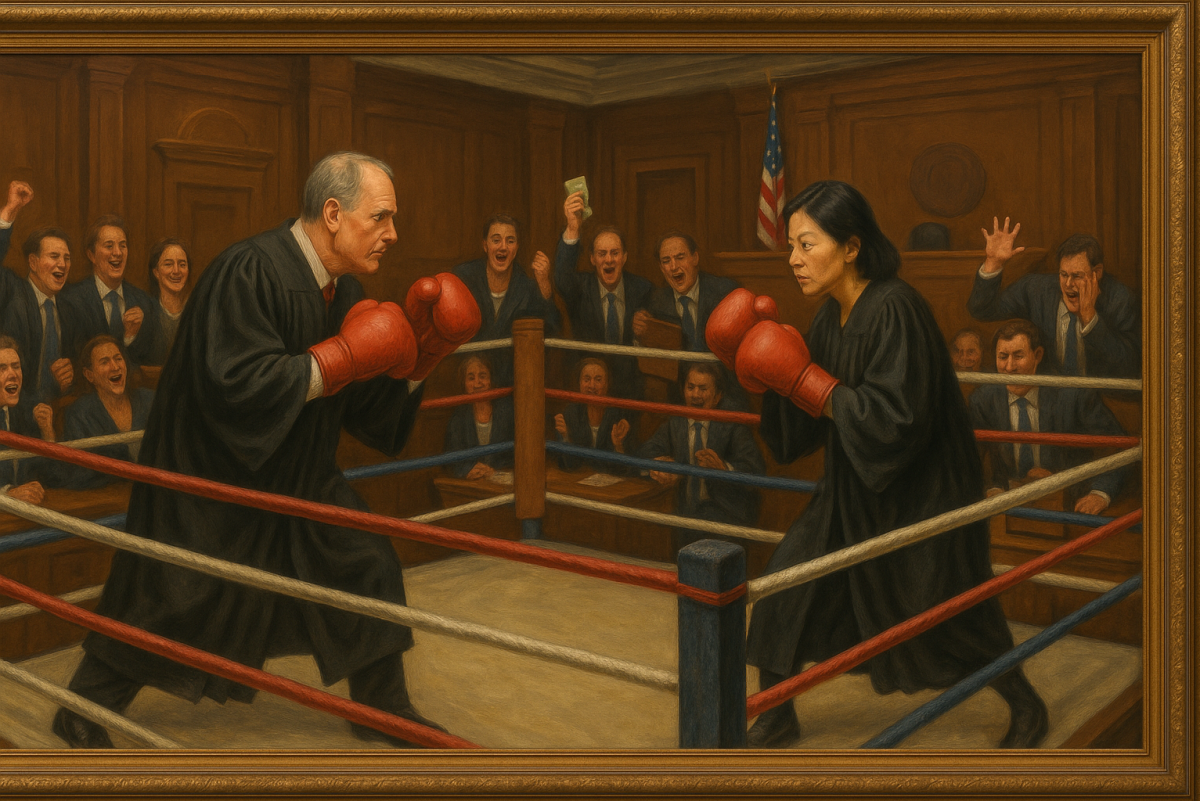
Scalia on civil procedure

Yesterday, Justices Scalia, Ginsburg, and Alito attended the annual end-of-argument reception at Georgetown Law Center’s Supreme Court Institute, which also included a tribute to Justice Ginsburg. (H/T: Thomas E. Baker). On his colleague (who used to teach Civ Pro), Scalia had this to say:

She can be tough. You don’t want to have a civil procedure matter” before Ginsburg “in which you are wrong.” With a smile, he then shrugged and said to the law school audience, “But who cares about civil procedure?”

Yes, that clearly is the case with the current Court.

Posted by Howard Wasserman on April 27, 2012 at 01:13 PM

Freedom of speech and the politics of the underlying speech

Guesting at CoOp, Erica Goldberg has a thoughtful post describing how “disheartened” she is by the confusion of protection of speech with the political views expressed. She relates her experience working at the Foundation for Individual Rights in Education (“FIRE”), a group often viewed as right-wing because many of the high-profile cases it has taken on has involved either speech by conservative groups or non-partisan speech that offends liberal sensibilities (e.g., a case involving misogynist chants as part of fraternity initiation). Erica concludes with a nice line about the ease with which the principle of free speech gets conflated with the speech at issue: “The day that I don’t have to disassociate myself from the speech that I am defending is the day that I can stop worrying so much about the state of free speech issues on campus.”

It’s a nice commentary and worth a read. I want to add some thoughts on the margins.

First,this is not a new phenomenon. The ACLU was labeled left-wing (if not outright “Commie” and “Un-American” for its, in retrospect, tepid support for communist speech). And the ACLU became the poster-child for America-hating liberals during the flag-burning debates. That the ACLU also represented the Skokie Nazis just got lost in the noise of politics. The ACLU was a bunch of liberals, end of story.

Erica illustrates the different perspective on Jack Balkin’s “ideological drift” argument that I have argued for in the past: It’s not that conservatives have discovered free speech as a principle, but that many liberal groups have abandoned it (or at least made its position less-absolute) in favor of other principles. The problem (from the perspective of many) with the ACLU is that it has taken on other issues besides free speech, notably equality for women and GLBT, decidedly liberal positions; this necessarily weakened its unwavering support for some speech that had the purpose or effect of denying equality to those groups. So perhaps Erica is correct that the ACLU would not apply its lower standard for harassment to liberal groups, but that is because such speech does not interfere with the organization’s other, non-speech positions.

Finally, my conclusion from Erica’s last sentence (quoted above) is that we’re never going to be able to stop worrying about the state of free speech on campus (or anywhere else for that matter). The free speech principle is inseparable from the content of the speech being protected. And not only in the political realm, but also in the legal realm. Consider how often courts, in the course of protecting especially heinous speech, find it necessary to include some disclaimer either disociating itself from the speech or taking a potshot at the speaker. For example, last year

Comments

That was a descriptive point: Most people (in politics, in the courts, and in the public at large) cannot or just do not separate the idea of protecting speech from the content of the speech being protected.

I’m not disagreeing with you on the ACLU point, although I guess wouldn’t use the word “nonpartisan”, at least not directly. It’s about different constitutional values (which incidentally, and unfortunately, have a political valence) more than an explicit idea of “we’re only going to protect liberal speech.”

Posted by: Howard Wasserman | Apr 27, 2012 1:31:21 PM

Hello,

Thanks so much for the link to my post, and I really appreciate your thoughts. Question: when you say that the free speech principle is inseparable from the content being protected, are you making an empirical claim or a normative claim?

With respect to the ACLU, I have tremendous respect for the organization, but I do feel like altering their formerly unflinching position on speech issues in deference to other causes with a decidedly more political bent does make them less nonpartisan. I take your point, however, and not everyone is going to decide that the free speech principle trumps all other values.

Posted by: Erica Goldberg | Apr 27, 2012 1:04:44 PM

Law and Grace and Bishop Jenky

My friends at Mirror of Justice have had a host of interesting posts lately on a variety of issues, many of them involving the recent statement on religious freedom of the USCCB, the question of “who is the Church,” and the recent homily by Bishop Jenky, in which the Bishop said, inter alia:

Hitler and Stalin, at their better moments, would just barely tolerate some churches remaining open, but would not tolerate any competition with the state in education, social services, and health care.

In clear violation of our First Amendment rights, Barack Obama – with his radical, pro abortion and extreme secularist agenda, now seems intent on following a similar path.

MoJ has posted a student comment (I emphasize “student”; I don’t want to be patronizing about it, but although I’m critical of the post I don’t want this to be an arena for nasty counter-comments) defending the homily. It reads, in part:

I do venture to suggest that perhaps Jenky’s words are true. . . . Serious Catholics ought to take Jenky’s suggestions seriously. Does our culture and political order affirm the transcendent dignity of the human person? Or is Jenky right to discern in recent governmental trends indications of a nascent “culture and praxis of totalitarianism”? The bishop by no means intends insensitivity towards victims of Stalin or Hitler’s abominable practices. If anything, by drawing such parallels he intends to generate a greater sensitivity towards the millions of innocent victims of abortion in America—that which has come to be known in some circles as the “American Holocaust.” . . . Notre Dame, as a Catholic university, should follow his example in standing up for religious freedom and against the insidious soft despotism of relativism that pervades mainstream culture. Perhaps if more members of the clergy and scholarly communities had issued “incendiary statements” like this one, some of the gravest atrocities of the past century might have been preempted by a bolder and more conscientious citizenry.

Against these statements, allow me to counterpose a different vision. It’s not my own. It comes from this month’s Virginia Law Review, which has published a speech by the late William Stuntz titled Law and Grace. Looking back on the connection between the culture war and the wars on drugs and crime, which he thinks claimed many unintended victims and did not improve matters any, he wonders whether “we might have fought a different kind of culture war, and a different kind of crime war–wars that were less warlike, with many fewer casualties.” Comparing other culture wars to the civil rights struggle, he writes:

[Martin Luther] King fought and bled and died for the right to have relationship with those who refused relationship with him. He did not seek to punish, though he had every excuse and every right to seek precisely that. He wanted his enemies’ embrace. It’s an utterly captivating vision. And it changed the culture. . . .

By and large, law can do three things: it can punish wrongdoing; it can relieve suffering; and it can promote and protect and, some-times, create relationship. The culture wars of the early and late twentieth century focused on the first of those three roles. King’s culture war focused on the second and third. King got it right, and my generation of American Protestants got it badly wrong. . . .

I believe King’s movement was America’s Good Culture War, one that was fought as such battles ought to be: aggressively and passionately and with deep commitment to principle, and yet also with love for those with whom the movement did battle. Call it the marriage of law and grace. Legal change helped produce social and cultural change—not by locking up evildoers, but by building the beginnings of an integrated national community. Abraham Lincoln, the historical leader whom King most resembles, would have understood. Lincoln fought a terribly bloody war—and yet, as hard as he fought, Lincoln could not bring himself to hate those he fought. They are our countrymen, he liked to say; we should approach them “[w]ith malice toward none; with charity for all”—famous words that define the spirit of the one who spoke them. That spirit, and King’s spirit, have been too little evident in the culture wars of the recent past.

Some might wish for an American future free of culture wars. I do not; I think these battles are worth fighting. But I do wish for good wars: the kind King fought—the kind in which we love our enemies, and fight for the chance to embrace them.

I appreciate that these are romantic words. I also appreciate that loving one’s adversaries doesn’t mean not opposing them. And I can appreciate just how demanding this sort of love is. (A good deal more demanding, in fact, than any of the demands Bishop Jenky makes on his flock in his homily; calling for “heroism,” or for contempt for “Hollywood” and “the media,” is easy, if not lazy.) For one who believes that abortion is murder, how can one not consider oneself to be in a war? (And why not, then, fight it as a genuine war?) For one who believes that certain fundamental rights are an absolute part of human dignity, how can one not resolutely and angrily oppose those who would deny the basic right to marry the worthy person whom one loves? (And why not, then, seek to circumscribe or vanquish the rights of those institutions that oppose it?) And I further note that Stuntz quite rightly said that some battles are worth fighting.

But I still think the best answer one might offer to the student commenter (and to those with similar views across a wide political spectrum) is the one Stuntz offers. You can’t build a world of just and loving relations with others unless you are willing to have and seek loving relationships. The capacity for that seems sadly lacking in our culture these days, in many places.

Posted by Paul Horwitz on April 26, 2012 at 10:27 PM

Comments

Right on. Well said.

Posted by: Jim | Apr 27, 2012 9:47:04 AM

When Should (Law) Faculties Speak Out Collectively?

At CoOp, Sarah Waldeck has an interesting post* asking “when—if ever—[ ]law faculties have a responsibility to take public positions on matters facing the electorate.” It’s occasioned by a vote of the William Mitchell faculty opposing a state constitutional initiative banning same-sex marriage. The resolution argues that: 1) the amendment is in conflict with the school’s antidiscrimination policy and could have a negative impact on the school’s ability to attract and retain members of its community; 2) the policy itself is discriminatory and wrong; and 3) limitations on state rights should not be constitutionally fixed.

The comments on Sarah’s post are very interesting.

A number of individuals there–mostly the sorts of questionable characters I tend to agree with on such issues–champion a position taken on such issues by Harry Kalven:

[A] good university, like Socrates, will be upsetting. The instrument of dissent and criticism is the individual faculty member of the individual student. The university is the home and sponsor of critics; it is not itself the critic. ….

[The university] cannot take collective action on the issues of the day without endangering the conditions for its existence and effectiveness. There is no mechanism by which it can reach a collective position without inhibiting that full freedom of dissent on which it thrives. It cannot insist that all of its members favor a given view of social policy; if it takes collective action, therefore, it does so at the price of censuring any minority who do not agree with the view adopted. In brief, it is a community which cannot resort to majority vote to reach positions on public issues. ….

From time to time instances will arise in which the society, or segments of it, threaten the very mission of the university and its values of free inquiry. In such a crisis, it becomes the obligation of the university as an institution to oppose such measures and actively to defend its interests and values. … These extraordinary instances apart, there emerges, as we see it, a heavy presumption against the university taking collective action or expressing opinions on the political and social issues of the day.

I am broadly sympathetic to those conclusions. I would put it in these terms. To the extent that a faculty, whether of a law school or a university in general, is going to take a public and collective position on any issues, it should do so only to the extent that it is speaking out of particular expertise and/or unique concerns. If I may offer up yet another in the series of quotes that will be held against me at my hypothetical judicial confirmation hearings, general questions of justice and morality are not among the issues on which university faculties as a collective body, including law faculties, have any special expertise. For such issues, civic and professional engagement should be on an individual basis.

If I may offer a couple of caveats and a personal example. It seems to me that if a university faculty believes that particular laws or public policies would interfere with its mission, that is an appropriate occasion for speaking out collectively; Kalven himself acknowledges this, although arguing for a presumption against doing so. That suggests to me, however, that the collective statement should be confined to those issues and reasons as to which it has particular expertise or concerns, as opposed to broader moral statements about the policy. This will of course generally deprive the statement of much of its emotional power, and of some of the personal satisfaction that some members of the institution might have taken in making a more sweeping statement (although a drier and more confined statement might also be more effective as a matter of persuasion). So be it.

Institutional pluralist that I am, I also acknowledge that some faculties, including but not limited to those of religiously affilliated schools, might craft a mission that takes broader positions on moral issues, and so might feel freer or more obliged to speak out on such issues. Although I don’t share such a vision of the university’s mission as a general rule, I can accept some variety on this point, provided that those faculties are willing to be judged for that mission and criticized for failing to live up to it–if, for instance, they continue gladly to receive funding from institutions they have collectively condemned.

Judged by that standard, and assuming that William Mitchell’s mission is reasonably conventional in its basic points, I think it was entitled to make its first argument, about the effect of such a law on the school itself. I think the Kalvenesque position offered above suggests it should have refrained from a collective statement about arguments two and three, which addressed general questions of justice and public policy. Your mileage, of course, may vary.

I had some personal experience with this lately. I have been a public critic of Alabama’s immigration law, the prior HB 56, currently undergoing revision. Last week, the University of Alabama’s Faculty Senate, of which I’m a member, voted for a resolution criticizing the prior bill and urging significant changes during the revision process. In addition to making particular statements about how the bill had affected the university itself, it added some moral condemnations of the bill, including the statement that the prior bill “diminish[ed] the human dignity of all it [ ] intended to impact.” I voted against the resolution. Granted that a faculty senate resolution and five dollars may get you a cup of coffee, but I don’t think university faculties as a body have any special insight into human dignity, and I think they should refrain from speaking collectively on such matters unless and until they do. If the resolution had limited itself to criticisms of the bill for its effect on the university community and/or on academic freedom, I would likely have voted for it.

* Here’s a link, with apologies for my wonky computer: http://www.concurringopinions.com/archives/2012/04/should-law-faculties-speak-up.html#comments

Posted by Paul Horwitz on April 26, 2012 at 02:40 PM

Comments

Hello all —

I’ve been arguing about this over at Co-Op so I won’t join here, except to ask you to consider a point I made there:

Stanford professor Yamato Ichihashi, his wife Kei, a dozen other Japanese-Americans then at Stanford, and many alumni were rounded up and placed in internment camps. Professor Ichihashi languished in the camps for 3 years; his spirit was broken by the experience and he never resumed his scholarly career. http://news.stanford.edu/pr/96/961115ichihashi.html

Should Stanford’s law faculty, as a faculty, have spoken out against the internment of Japanese-Americans? I don’t think it’s quite good enough to answer, as Professor Kalven might, that a university is a forum for debate but not a participant in it. First, a law faculty is not as university. Second, a law faculty can, as William Mitchell did, give dissent a voice by revealing the vote with regard to the adoption of a position. More importantly, a law faculty is a member of wider community with a unique role: a purported expertise in law. How can it be a contributing member of the community if it is silent with regard to issues that fundamentally affect law?

William Mitchell’s mission statement says “We serve the law. We teach it, study it, practice it, and work to make it just.” I think that we have both a participatory civic duty, and an institutional duty, to speak on those rare occasions when the community in which we sit faces grave questions on fundamental rights.

If you think it would have been inappropriate for Stanford’s law faculty to participate, as a faculty, in the civic discussion about whether the internment of citizens in its community based on their race was consistent with the theory of fundamental rights — regardless of whether it would have stated, as did the a majority of the Supreme Court, that it believed the internment lawful, or not — then in my opinion you have an overly restrictive view of the appropriate role of a law faculty in its community.

Best regards, Mark

Posted by: Mark A. Edwards | Apr 28, 2012 1:26:57 PM

Jeff,

You might want to consider Gandhian satyagraha campaigns, acts of collective disobedience, and similar social and political phenomena (e.g., some of what falls under the heading of ‘engaged Buddhism’). I don’t accept the idea that “a collective action isn’t rooted in consciousness/conscience in the same way as an individual one,” so long as it is understood that individuals in question are each motivated by moral judgments or conscience and then acting in concert. We can obviously distinguish the individual from collective cases and I can see how it is easier for an individual to more readily or “purely” translate the dictates of conscience into action, but I seen no compelling reason to deny the fact that groups of similarly motivated individuals acting in concert cannot do the same. A judgment, as a thought process, can precede a commitment for an individual and/or a group of individuals who come to act in a joint manner. Individuals make moral judgements, have a conscience, singular intentions, and so forth, but there coming to together to act need not significantly diminish, alter, or transmute such judgments, moral convicitons, or intentions, indeed, it may accord them a power and difference in the world they might otherwise have lacked. (I’ll leave it that for now.)

Posted by: Patrick S. O’Donnell | Apr 27, 2012 3:59:39 PM

Patrick, my noun ship is passing your adjective ship in the night. My distinction goes to judgment vs. doing. The former is a mental thing, an aspect of conscience (my footnote not included mentions Arendt’s linguistic equation of “conscience” and conscious”). Actions taken in respect of conscience are meaningful as such, but a collective action isn’t rooted in consciousness/conscience in the same way as an individual one. Another Patrick raised this same issue with me (this is all from the Venn Diagram article) and I addressed it this way in another footnote:

“In a discussion of this point, my colleague Pat Shin directed me to the “plural subject theory” developed by the philosopher Margaret Gilbert. See, e.g., MARGARET GILBERT, SOCIALITY AND RESPONSIBILITY: NEW ESSAYS IN PLURAL SUBJECT THEORY (Rowman & Littlefield 1999). Her central thesis is that a joint commitment is fundamentally different than an individual intention and ‘cannot be analyzed [solely as] . . . the sum or aggregate of the individual commitments’ or intentions. Id. at 3. I have not thought this through in detail, although I suspect it may be fruitful in considering contract theory. My initial reaction, however, is that a commitment, whether individual or joint, is a doing, even though it involves the minds of the committers; whereas, judgment is a thought process that precedes commitment, whether individual or joint.”

Posted by: Jeff Lipshaw | Apr 27, 2012 3:07:15 PM

Jeff,

I well understood that the collective bodies weren’t making moral judgments, but the aggregation of such judgments is a moral undertaking no less and that’s the point, is it not? What use is a moral judgment if it is confined to one’s mind? Few votes such as this are ever wholly unanimous, hence the role of principled dissent and individual conscience (which in no way means the individual dissenter is necessarily right: her judgment may be mistaken). We might speak of a “collective judgment” as a term of art, a manner of speaking, not intended literally but to communicate the aggregation of individual judgments. I too happen to believe moral judgment is an individual undertaking (going back to Socrates and through Godwin in the modern period), but what seems important in our case or similar cases revolves around the role of individual moral judgments in group situations. Because not everyone agrees on a moral judgment hardly means we should rest content to leave all such judgments without practical effect(s), in effect letting the moral judgments of an individual or less-than-majority of individuals trump the moral judgments of the majority. I’m not so interested in the case at hand but rather the role of moral judgments generally. Again, I would ask you to consider how or why the aggregation of moral judgments is more “political” than, say, an individual or group of individuals in disagreement with or dissent from a collective decision. Their disagreement and dissent is no less political, as is abstention or indifference. The consensequences of moral judgments are necessarily and unavoidably political, at least on my construal of what counts as “political.”

Posted by: Patrick S. O’Donnell | Apr 27, 2012 2:31:57 PM

Collective bodies might take moral actions, but they aren’t moral JUDGMENTS. They are political acts. A collective body has no mind or consciousness by which to make a judgment. (Understand that as a contract theorist I also cringe at the concept of the “meeting of the minds.”) The key thing here is that I’m not distinguishing it on the basis of the adjective “moral.”

And the point here is that the vote isn’t unanimous. Making it even more of a political act.

Posted by: Jeff Lipshaw | Apr 27, 2012 2:11:15 PM

errratum (last para.): (…myriad effects on us as individuals).

Posted by: Patrick S. O’Donnell | Apr 27, 2012 11:13:33 AM

Jeff,

Your account strikes me as assuming an arguable division between what counts as moral and what counts as political. If a collective body comes to identical or largely similar moral conclusions and expresses them with a united voice, what makes that collective decision somehow less moral than the one arrived at by the individuals alone before acting in concert? One may believe that a moral judgment, as a process, is an individual affair, but the moral decision or conclusion that is the end result of that process can be endorsed by others who likewise have engaged in the process for themselves. A collective decision to endorse the result of aggregating the individual moral decisions may be described as “political,” but it is no less moral for all that, indeed, if individual moral judgments are to have effects or significant consequences in the real world, if they inform us of our moral responsibilities, duties, and the like, then it may very well be possible if not likely that the collective decision that is the sum total of those moral judgments is more efficient, more effective, more practical when it comes to realizing the sundry duties or responsibilities individually arrived at but shared on a collective level. That a collective body acts on the some total of individual moral judgments does not somehow diminish the moral scope, nature, or salience of those individual judgments: “the political” in this instance is merely and virtuously coextensive with “the moral,” indeed, it may mean that our moral judgments can have real world consequences in a way that they may not if viewed in purely “individualistic” terms. Moral or ethical judgments bereft of any practical determinations or effects are solipsistic, otiose, meaningless.

There are other ways to talk about some of these topics, relying on such notions as “shared responsibility” (Larry May, among others) and “collective responsibility” (Robert E. Goodin, among others), and these are not in any way divorced from individual responsibility. And given the ubiquitous nature and power of organized and unorganized groups of various sizes in our world, our individual moral and political responsibilities are heightened and quickened both by virtue of our membership in such groups and because our actions are in the context of the moral and political consequences of the actions of these collective bodies (both those to which we belong to or associate with in one degree or another and those which have myriad effects on us in us as individuals).

Posted by: Patrick S. O’Donnell | Apr 27, 2012 11:08:25 AM

I think the question is an odd one if you unpeel it a little. It’s certainly not surprising that it gets posed this way, but “responsibility” imputes moral judgment, and I don’t think collective bodies make moral judgments. Each individual within the body may make a moral judgment, but the action of the body is a political one, no more, no less.

Indeed, I don’t think judgment can ever really be a collective matter. I wrote about it once (drawing on a similar circumstance) as follows:

“It is hard to resist the idea that judgment is not a collective undertaking; for example, in a faculty vote on a pressing issue or in the vote by which a law firm partnership admits new partners. The judgment occurs in the mind of the decider. Our faculty recently decided to take a vote expressing the sense of the faculty on an issue facing the university. The individual decision of the faculty member proposing the resolution was an act of conscience. Each individual decision to speak at the meeting, and even the decision to attend the meeting, was an act of conscience, as was each instance of casting a vote. The collective expression resulting from the vote, however, was a political act, not an act of conscience. Indeed, as Hannah Arendt suggested, conscience, in the sense of the ethical judgment one makes as in the faculty vote, is a mental activity closely linked to consciousness in the sense of inner awareness described above. Thinking, she observed, is the soundless dialogue we have with ourselves; it is like a wind that sweeps away ‘the implications of unexamined opinions and thereby destroys them’ and manifests itself in judgment. She further observed that judgment is ‘the faculty to judge particulars without subsuming them under those general rules which can be taught and learned until they grow into habits that can be replaced by other habits and rules.’ Whether the judgments are ethical, as opposed to merely practical, they occur in our minds, are privileged to us, and are beyond influence, authority, external truth-justifications, and power, regardless of whether we accede, knowingly or unconsciously, in the solitude of our own minds, to influence, authority, justifications, and power.”

Posted by: Jeff Lipshaw | Apr 27, 2012 7:50:40 AM

I concur with Prof. Horwitz. Part of this may be the tendency of lawyers and law professors to think they know it all and are experts in everything. We have seen this in the ABA’s tendency over the years to adopt resolutions in favor of one side or the other of highly contested issues of public policy. It’s not surprising that a law school faculty should fall victim to the same sense of hubris.

Posted by: Douglas Levene | Apr 27, 2012 1:51:54 AM

I recently voted against some resolution proposed in our University Academic Senate, where I agreed with the resolution on the merits, for the same reason. It’s good to know I’m not the only one making a stand for staying within institutional expertise. A quixotic stand, I suppose I should add, since I think there were like 3 votes against.

Posted by: Bruce Boyden | Apr 26, 2012 4:46:03 PM

Yes, these are all issues on which a law faculty could arguably speak collectively as well as individually. Thanks for your comment.

Posted by: Paul Horwitz | Apr 26, 2012 2:56:02 PM

Yes, I agree, the faculty should limit itself to speaking out collectively on only those issues for which it has specific expertise or involvement.

How about voting to get rid of tenure?

How about advocating abolishing the legal monopoly in all its ugly manifestations: LSAT, JDs, Bar Exams, state certification?

Posted by: Jimbino | Apr 26, 2012 2:53:27 PM

Underneath the Law Review Submission Process: Part IX Fall Submission Timing

For the next post on the law review submission process, (see intro, part I, part II on timing of submissions,part III interview, part IV interview, part V interview and part VI interview, Part VII expedites and Part VIII memes if you are interested) I am going to (unsatisfactorily) try to address some questions I’ve received on fall submission timing.

The timing of fall submissions remains a bit of a mystery to me as it is to many of you who have written me. It is hard to know when to submit, when journals begin to fill up, and whether there are as many offers made in the fall cycle. Unfortunately, I do not have answers to most of these questions. I will try to collect some information this upcoming year and post on it in the fall but it will be too late for many of you who are planning on submitting in the fall. So, this post is an attempt to put what little data I have out there in case it is of any help to those of you who plan to submit in the fall.

So, the chart below reflects the submissions received by BYU Law Review between August 1 and 23.

Unfortunately, the articles were put on hold at that point since offers were made and accepted and all of the spots filled by that time. I’m sure there were plenty of articles submitted after August 23 and BYU may be an outlier (and make decisions earlier than other law reviews) but for what it is worth, here are some graphs on the 2011 fall cycle.

Numberoffallsubmissoin

Numberofaugsubmission2

Submissionsbydayaugust

So, after seeing these numbers I naturally wondered how they compared with the February 2012 numbers that I revealed in an earlier post. I’ve done a few different comparisons below in three different periods of 23 days in February and August (1-23). Again, I wish I could do a full comparison for the entire period, but this is all I have. Frankly, I was surprised at how many articles were submitted in the fall. I had always thought that there were much fewer submissions in the Fall (and that may still be the case since March could be a much heavier month of submission than February) but still, there are a substantial number of articles submitted in the Fall. I would be interested to know if the number of articles submitted matches the number of offers given and whether people have better chances of receiving an offer (or an offer they like) in the fall or winter submision cycle.

Febvaugsubmissions

Febvaugsubmission2

Febvaugsubmissions3

So, that’s all on timing until the fall I’m afraid. Just a couple more posts in this series on best practices for law review editors . . .

Posted by Shima Baradaran Baughman on April 26, 2012 at 10:36 AM

Comments

Thanks Sam. I really appreciate the advice.

Posted by: Josh | Apr 26, 2012 3:57:38 PM

anon, I’ve never done this, but I hear that changing the title and the intro will help you a lot, at least at journals where your paper was dinged at the preliminary stage.

Posted by: re anon | Apr 26, 2012 2:39:28 PM

I am a semi-recent graduate who struck out in the Spring submissions cycle. Is it even worth trying again with the same paper (making some revisions of course) in the Fall cycle? Or should I just wait a year? Does anyone have experience submitting the same paper to the same groups of editors?

Posted by: anon | Apr 26, 2012 2:20:45 PM

Josh,

I am characterizing what I take to be others’ opinions here, as placements don’t matter to me in an entry-level hiring calculus. For those who do care about placements at that stage, my sense is that a pattern of “good” prior placements would be as important as or more important than the placement of the job talk piece specifically, but I admit to having very little confidence about my sense of what others think on this point.

For myself, I think it’s a pathology of the current hiring process that it might encourage candidates in (what appears to be) your situation to rush to finish and submit a third pre-hiring piece. (Of course, I know nothing about your two pieces that have been placed or the third one you might do this summer, which would mean everything for how I thought about your case in fact.) For my money, the best job market pieces are those that the author has already spent a lot of time thinking about, writing, and revising (so that the piece showcases the author’s care and thoughtfulness) but that are sufficiently unfinished that the job talk isn’t just a presentation of work the author has already done but is instead a real faculty workshop. That’s a tough line to hit perfectly, and I admit my views might be idiosyncratic (though I don’t think I’m the only one who holds them), so take my thoughts for whatever you think they might be worth.

Posted by: Sam Bagenstos | Apr 26, 2012 1:55:27 PM

Sam–

Just to clarify, when you say “good placement,” do you mean for the job talk piece itself, or for the candidate’s general publication record. My spring submission was placed with a law review in the 20-30 range, and I’m trying to figure out whether it would be better to bump the publication date back to the spring (which the journal is OK with), or whether I should get it in print sooner and then get another piece together to submit and (hopefully) job talk in the fall. I also have another publication in the 60-80 range that came out in January, if the difference between two and three matters.

Posted by: Josh | Apr 26, 2012 11:57:10 AM

Sam, your comment is much appreciated. My last placement was very good (I’m still in shock about it), so that might reduce the pressure to submit in August if this piece isn’t ready for prime time. Thanks for sharing your experience!

Posted by: twizzlers | Apr 26, 2012 11:55:23 AM

Stuart:

Just my 2 cents on your larger question. I think what a lot of people do is get the bulk of their drafting done over the summer and then spend the fall sharing with colleagues, workshopping, revising, redrafting, and otherwise tinkering with a piece, so that the piece is more fully cooked when it gets submitted in the spring.

twizzlers:

My 2 cents on your question: It wouldn’t matter to *me* whether the job talk piece was submitted to law reviews in August. Indeed, as most job talk pieces will really benefit a lot from (often substantial) revision in light of the comments received during the job search process, if anything I would think it’s better if they’re not submitted until after that process is over. But I know many others (not necessarily at my current school) who feel differently and who count placement, particularly in a “good” law review however defined, as a positive in the hiring calculus. (FWIW, when I was on the market in 1999-2000, I submitted a piece in August, had it accepted at a really good law review, and ended up adding nearly 50 pages to it — half again its original length — in response to comments I received on the market. It would, in retrospect, have been a lot better for the piece if I had held off on submitting it until after I had a chance to really take account of what I heard at my job talks. Of course, that’s not the primary question you’re asking.)

Posted by: Sam Bagenstos | Apr 26, 2012 11:42:23 AM

For those of us going on the job market in October– is it important to have the jobtalk piece submitted to law reviews in August, or sufficient that it be polished and ready to go by the time of the meat market?

Posted by: twizzlers | Apr 26, 2012 11:17:44 AM

First, I want to say thanks for putting all this information together. It has been very helpful.

There have been a couple of things I learned from the series: (1) apparently I shouldn’t just send the form expedite notice that Espresso suggests; and (2) the fall window peaks earlier (at least for BYU) than I thought. So perhaps I should be submitting in the first two weeks of August rather than the last two weeks if I make a Fall submission.

I have a larger question about Fall submissions though. You say that you had always thought that the Fall submissions were relatively fewer than Spring submissions. But (at least for me) the largest block of writing I get is during the Summer, and so far I have always had a piece ready for submission by mid-August. I had thought that this was probably how most people work since we usually teach in Fall and Spring. Are people holding their summer pieces until Spring? Or are people finishing new pieces during the Fall/Winter and then submitting them in Spring? Is this in addition to pieces finished over the Summer?

Thanks for any light anyone wants to shed on this question.

Posted by: Stuart Ford | Apr 26, 2012 11:02:29 AM

Who Are You Wearing? Part 2: The Law

In an earlier post, I flagged the high stakes surrounding intellectual property disputes over luxury goods, but questioned the rationale for making a federal case out of, say, a fake purse. In this post, I’ll be examining the legal regime that allows such a case to be made.

That regime, in the United States at least, comprises a particular sub-field of federal trademark law. Section 43(a) of the Lanham Act provides the primary statutory authority for the federal law of trademark infringement and unfair competition. It imposes civil liability against any person who uses a trademark in commerce that “is likely to cause confusion, or to cause mistake, or to deceive as to the affiliation, connection, or association of such person with another person, or as to the origin, sponsorship, or approval of his or her goods….” But if you know the market for knock-off luxury goods, you know that the people who buy them almost always know full well that they’re buying fakes. Nobody thinks the Rolex he bought for $10 in Times Square has any actual relationship to the Rolex company, nor does anybody think the vinyl Kelly Bag she bought for $20 on Canal Street has any relationship to the house of Hermès. So what is the “confusion, or… mistake, or… dece[ption]” that provides the basis for trademark liability against the makers and sellers of such knock-offs?

The answer that courts have come up with has come to be known as “post-sale confusion.” Luxury knock-offs do not infringe the luxury house’s trademark because of their effect on the purchaser of the knock-offs, but because of their effect on people who observe that purchaser consuming the product after it has been purchased. Such observers, the theory goes, will see the non-confused purchaser consuming the defendant’s product, but mistake it for the plaintiff’s product due to the similarity of the products’ trademarks or overall designs. This “mistake” is the hook on which trademark liability hangs in the luxury knock-off arena, and the question I’m interested is why this type of mistake is something the federal government ought to concern itself with.

What is the social or moral ill that results if I mistakenly believe that a woman walking down Fifth Avenue is carrying an authentic Louis Vuitton purse when in fact she is carrying a cheap imitation? Trademark law is often thought to be designed to prevent producers from misleading consumers as to unobservable product qualities, either to lower consumers’ search costs (as Judge Posner and Professor Landes have famously argued) or out of respect for consumers’ autonomy (as I argue in a forthcoming piece in the Stanford Law Review). But, again, the purchasers of luxury knock-offs know exactly what they’re buying; they aren’t being deceived at all. So what gives? Why should we make post-sale confusion actionable, let alone criminal?

Once again, I’ll throw this open to commenters before revealing my own thoughts in a future post; those who can’t wait for the reveal can read my take in the latest issue of the Minnesota Law Review.

Posted by Jeremy Sheff on April 26, 2012 at 10:30 AM

Comments

I think the problem is threefold. First, the original trademark holder will lose the possibility of an actual sale of their goods to a consumer because, (particularly for fashion philistines and tourists) there is little to no incentive to pay $200 for something when you can get its (not really) perfect knockoff for $20. This results in lost profit opportunities for the trademark holder.

Second, I think it is fair to say the bootlegger is being unjustly enriched by knocking off the product of another, even when selling it for drastically less than the original, they are essentially stealing the attractive design of someone else. Profiting without talent.

Third, directly to the “post-sale confusion” point, a trademark holder might point to the flimsy, cheap, and generally awful quality of these knockoffs as potentially damaging to their brand. If a tourist buys a Henri Bendel knockoff on Canal street, takes it home for everyone to see it fall apart in three weeks, consumer perception of Henri Bendel (rightly or wrongly) takes a hit in places where people simply don’t know any better. For example, I am from Iowa, and had a friend when I was in high school get a “Rolex” in Chicago which broke after a few months, and we wrongly thought that Rolex was cheap crap thereafter.

Posted by: Nathan Chiaravalloti | Apr 28, 2012 1:45:57 PM

Underneath the Law Review Submission Process: Part VIII Memes

A little light hearted humor for you folks in my next post on the law review submission process (more serious ones coming in the future). For those of you who haven’t heard of this, a meme is a popular video/picture or character that is passed on over the internet. These can become viral. A great website helps you to generate your own. My students came up with some hilarious criminal procedure ones studying for finals this year.

Anyway, here are my own on the submission process:

Yunotakemyarticle

And one based on the comments on my last post about being honest in your expedited reviews:

Lawreviewmeme

For those of you who didn’t read my last post or the comments, TJ (in a comment) pointed out that the chances of being caught for faking expedites is so low that people–particularly those without letterhead or at lower ranked schools may have the incentive to fake an expedite. And he calculates, if they do, they may actually be 10 times better off. Very interesting (and disconcerting).

In my last post I talked about honesty in expedites as one of a few tips for good expedites. From the comments though, it seems that some people think this could be more of a problem that needs to be addressed broadly. Unlike several of the other problems identified about the law review process (potentially inexperienced editors, rush of submission timing, use of proxies rather than blind review to evaluate good scholarship), the solution to fake expedites is a relatively easy fix.

Several of the solutions articulated in comments on my last post could work. One approach would be to have all journals require a forwarded offer email as proof for an expedite. Alternatively, if the offer was received through a call (not an email), the author could write an email message with the name, time of call and the name of the articles editor, contact info, and journal who gave the offer. Another option that would be much easier would be to require articles editor name and phone number or email in an expedite done through Expresso (similarly to how it now requires the name of the journal you received an offer from).

I’m not sure any of this is necessary, because I’m not sure how rampant this kind of behavior is among authors (I’m with Brian Galle on thinking that if you are a lawyer or law professor you signed a few really important oaths that should be a deterrent enough to you to not lie/cheat) but if you all think it is a big enough worry, it may be worth writing Expresso about or for us to encourage our law journals to adopt such a process.

Posted by Shima Baradaran Baughman on April 25, 2012 at 11:28 AM

Comments

I tried once to run the reverse of Joe’s suggestion – to rate law reviews by their “customer service”. But I ended up thinking that prestige swamped information. If you are curious, http://www.concurringopinions.com/archives/2009/03/the_best_and_wo.html

On faking expedites, no deterrent system will work if authors don’t believe in the legitimacy of the enterprise. That’s why “thirdtierprof”‘s message is so sad (and not just for his or her acceptance of USNews “tiers” as determinative!)

FWIW, I agree with Orin: journals in my experience believe it to be weird if you do not expedite. I should especially call out signers of the “long window” declaration (http://harvardlawreview.org/Joint-Letter.pdf) for pushing back on an increasingly stressful process.

Posted by: dave hoffman | Apr 26, 2012 9:19:16 AM

Perhaps fake expedites should be welcomed, to the extent they contribute to destructive perceptions of article quality.

I don’t fault law review editors for relying primarily on factors other than article quality — they have lots of articles to review and must use some shortcuts. However, as James Grimmelman noted in a comment to an earlier post, there is no reason to get outraged over law review practices, unless one accepts that law review placement must control tenure, lateral, and speakership positions.

Perhaps if people further game the system, we in the academy will finally be forced to evaluate our peers through measures other than law review placement. (Admittedly, we already take other measures into account, but those pale in comparison to how a given 2L judges a particular person’s work.)

With this in mind, it’s perhaps best to fake an expedite from Wake Forest to get a close look at GWU, and to fake an expedite at GWU to get a close look at Cornell, and so on. Let’s contribute to the destruction of this enterprise and collectively lie about expedites, such that any signal obtained through acceptance by 2Ls at a T10 school comes to mean little.

(I’ll admit, although it’s already obvious, that I’m a professor from a lower tier school with a rather dismal placement record, whose sour grapes and jealous undoubtedly contributed to this proposal. But let’s see how T10 reviews consider my next piece, after my “expedite” from Georgetown! Can’t wait to try out this strategy.)

Posted by: ThirdTierProf | Apr 26, 2012 3:10:12 AM

“This reduces the deterrent effect of the private blacklist remedy that your last post listed as the main deterrent, because a private blacklist has bite only to the extent that an author can expect to legitimately place in the same law review in the future.”

This actually brings up a good point. Why does any blacklist need to be private? For that matter, why do the good experiences with authors need to be private as well? “Rate my professors” encompasses law school faculty. Why not have a “Rate the authors” site? Law reviews could post reviews of their experiences wth authors — from “the a-hole faked an expedite” to “best. author. ever.” Yes, yes, defamation, etc. Has that been an issue with RMP? (Not a rhetorical question.)

Posted by: Joe (not that one) | Apr 25, 2012 11:45:57 PM

Thanks for the shout out, but I should note that the main driver of the result is not the small chance of being caught (though that too is a factor) but the tiny chance of legitimately placing in the law review in the future without a fake expedite. This reduces the deterrent effect of the private blacklist remedy that your last post listed as the main deterrent, because a private blacklist has bite only to the extent that an author can expect to legitimately place in the same law review in the future. For lower ranked authors and highly ranked law reviews, that expectation is pretty low. That is why I pointed out that the problem is particularly acute for authors in lower ranked schools and those without letterhead.

The deterrent mechanisms you list in this post (e.g. disbarment) are not subject to this intrinsic discounting mechanism, and so they are accordingly less prone to the problem.

Posted by: TJ | Apr 25, 2012 11:19:59 PM

I have to confess that my first inclination was Shima’s — that (generally) worse-ranked journals have a definite incentive not to publicize that you have an outstanding offer from them. But on further reflection, I think I agree with Orin. Setting aside his exceptionalism, the fact is that the (again, generally worse-ranked) offering journals also have an incentive not to provoke the authors to whom they’ve made an offer. This is for two distinct reasons. The first is that they don’t want to get a reputation for dicking around the authors that they accept. If a (hypothetical) 50ish law review had a reputation for being jerks about articles they accept (i.e., refusing to acknowledge outstanding offers), I’d think twice about submitting — and if anyone is the embodiment of “beggars can’t be choosers,” it’s me. Second, there is a distinct possibility that they are going to have to work with the author that they just threw under the bus. And word easily could get back to him or her, making for an unpleasant several months. And this is setting aside the fact that I’m not sure that the typical collective action impediments apply, at least for the top 100 or so law reviews.

Posted by: Joe (not that one) | Apr 25, 2012 10:35:32 PM

Orin, you may be right. But I wouldn’t be surprised if you experience “quirkiness” with the law review process that some of the rest of us don’t experience. You may experience a sort of “law review bubble” (think 30 Rock) where the editors bend over backwards to give you extensions or even small gifts (no, the rest of us don’t get a courtesy fruit basket with every offer) 😉

Posted by: Shima Baradaran | Apr 25, 2012 9:31:19 PM

Shima, maybe my experience is quirky, but my sense is that editors not only know that you’re going to expedite, but think it’s a little weird if you don’t try to expedite (the exception is the Harvard Law Review, where acceptance is presumed). So I’m not too worried about the dynamic you suggest. Of course, journals can always reduce their offer windows to try to make it impossible for other journals to make offers in such a short window, but that dynamic exists more or less independently of whether ExpressO or authors are responsible for reporting the expedites. In any event, one answer would be for ExpressO to require journals to agree to indicate their offers on ExpressO for any articles submitted via ExpressO so journals that use ExpressO (most of them) can’t circumvent that rule.

Posted by: Orin Kerr | Apr 25, 2012 7:00:13 PM

@ Orin: I wonder how well it would work for ExpressO to require journals to indicate when they made an offer. The incentive would clearly be for journals not to inform other (particularly higher ranked journals) that they made an offer as they would prefer that authors immediately accept their offer and not expedite it to other journals. Thus, even if ExpressO preferred to have journals indicate when they made an offer, editors could easily circumvent it by reaching out to the professor/lawyer author directly (as most of us are easily found on Google) and thus prevent authors from being able to expedite.

Posted by: Shima Baradaran | Apr 25, 2012 5:48:39 PM

There are so many thing Expresso should do if they want to stay the only game in town. Expresso-submitted offers (and rejections!) are so obvious it’s maddening.

Posted by: Junior | Apr 25, 2012 3:23:01 PM

I don’t know if this isa real problem, but in a world of ExpressO we could solve any such problem by having the offering journals themselves indicate the offer on ExpressO rather than relying on the authors to report it. Say a journal gives an author three days to consider an offer. The three days could start when the journal indicates on ExpressO that it has given the article an offer with a particular deadline. Other journals could then know that they have three days to make a competing offer. Circumventing the author’s involvement would eliminate the concern of authors misrepresenting expedites or windows.

Posted by: Orin Kerr | Apr 25, 2012 12:01:55 PM

Some Modest Predictions on Severability

The Court’s decision on the severability of the individual mandate may be the aspect of the PPACA litigation that is most difficult to predict. If the Court holds that the individual mandate is constitutional, then severability won’t be an issue in the first place. If severability does arise, whether and how the Court will sever the mandate is uncertain. In part, this is because of problems with severability doctrine itself. Notwithstanding over a century of cases on the issue, the Court has had a hard time settling upon a definitive severability test. Sometimes the emphasis has been on legislative intent. Other times the focus has been on whether the constitutional remainder can function without the invalid part. Still other times the Court has severed or refused to sever without acknowledging the doctrine at all. The oral argument on severability reflected this state of affairs, as the Justices spent a considerable amount of time exploring the merits of several possible tests. Without knowing the doctrine, it is difficult to anticipate a result.

In part, the unpredictability also reflects the absence of a completely satisfying way to sever the mandate if it is unconstitutional. Because the PPACA lacks a severability clause, covers such a diversity of topics, and reflects a variety of legislative compromises, it is hard to identify a clear legislative intent with respect to severability. Because the invalidation of the mandate will render certain aspects of the core health-care reforms financially problematic, it is unsatisfying to focus exclusively on the textual separability of the mandate from surrounding provisions. And because courts are poorly equipped to appreciate the complexities of health care policy, it seems problematic to base severability on anticipated financial implications.

That being said, I think we can reasonably make a couple of predictions about this aspect of the decision. First, if the Court holds that the individual mandate is not severable, that holding will rest on the votes of the conservative Justices, who generally seemed much more skeptical of severability than their counterparts during oral argument.

Second, and regardless of whether the Court severs the mandate, most—maybe even all—of the Justices will emphasize that the Court has a general preference for severance, and that severance is often an appropriate result because of the permissiveness of the doctrine. I think the liberal Justices will make this point in emphasizing that the mandate should be severable. And I think that the conservative Justices will make the point because of their previously stated preference for as-applied challenges.

The story on the latter point goes like this: The Roberts Court has repeatedly expressed a preference for as-applied challenges over facial challenges. The distinction between the two, and thus the justification for the preference, requires a liberal severability doctrine: If the law disfavors or prohibits severance, the result of successful as-applied challenges will tend to mirror that of successful facial challenges by dictating total statutory invalidation. This follows from the so-called “valid-rule requirement,” which holds that partially invalid statutes cannot remain operative because litigants are entitled to judgment under constitutionally valid rules of law. By contrast, if severance is easy to obtain, the result of successful as-applied challenges will often be partial invalidation, as the Court’s preference intends. In emphasizing that severance is generally appropriate, the conservative Justices will buttress the distinction between facial and as-applied challenges by preserving the tendency for the latter to yield only partial, rather than wholesale, statutory invalidation. The distinction won’t matter in the PPACA litigation, but it will elsewhere.

Otherwise, all bets are off. I’m not sure whether the Court will sever, or how they will sever if they choose to do so.

Posted by Ryan Scoville on April 25, 2012 at 10:55 AM

Item on the Colloquium in Law

Here is a story with some details on the Colloquium in Law law and religion seminar which my colleague, Mark Movsesian, and I taught this past semester as part of the activities of our Center for Law and Religion. The format was experimental — demanding that the students assess a body of scholarship and zero in on the new claims being made by our presenters — and both Mark and I thought it worked very well. Though the story does not quite say so, our students were really the stars of the course. Their questions and engagement with the speakers were direct, targeted to the specific arguments made by the speakers, and incisive. Mark and I were very proud of them.

Posted by Marc DeGirolami on April 25, 2012 at 09:55 AM

The Two Percent Solution

Readers of the recent Hettinga decision, or of Jim Chen’s work, will already know the key role that dairy plays in our system of constitutional law. (Perhaps because, as Jerome Frank once observed, it’s all about what judges drank for breakfast.) They may particularly enjoy this article in this week’s New Yorker (subscription required, alas, but the link contains a synopsis). It’s about the raw food movement, particularly the raw milk movement, and its travails. It contains more than enough fodder (so to speak) for any con law professor looking desperately for a question for this year’s con law final: interstate commerce, weak substantive due process claims, great nickames (“the Rawsome Three,” “the Dairy Fairy”), and more.

It also, if I may be forgiven for saying so, is a wonderfully American story, right up there with Fitzgerald in capturing so many distinctive American qualities and narratives: (over)zealous regulators, hippies, libertarians, libertarian hippies, celebrities, automobiles, nostalgia for an imagined past, (0ver)zealous parenting, cultishness, the Tea Party, the vaguely narcissistic quest for endless life and health and the belief that it can be purchased, junk science, wealth and its disparities, California, and not least the marvelous way in which any lifestyle decision can become a community, an Internet phenomenon, a big business, and an occasion for apocalyptic speeches about liberty and fascism. I generally don’t care for overpraising of the New Yorker, and the story is more fun, because of its details, than great. But this one is well worth reading.

Posted by Paul Horwitz on April 25, 2012 at 09:27 AM

Comments

Thanks for the shout-out, Paul. Much appreciated.

Posted by: Jim Chen | Apr 25, 2012 10:06:28 PM

Other LawProfs on SB1070 on the Eve of Argument UPDATED: Now with Transcript

I’ve shared my views on SB1070 at some length. However, not surprisingly, the case has also generated commentary from many other, much wiser, profs. Here’s a sampling.

David Harris of Pitt wrote about the racial profiling issues on Jurist. Toni Massaro (Arizona) and Carissa Hessick (ASU) were on TV previewing the case. Peter Spiro (Temple) wrote an op-ed in The New York Times arguing that the law should be allowed to stand, because even though it is a bad law, it will wither away on its own and punish states that adopt it. (But at what cost?)

Steven Schwinn (John Marshall) is cited here. Margaret Stock (Alaska) writes that even if Arizona wins, they may lose in the long run. UC Davis Dean Kevin Johnson is quoted

Comments

Excluding profiling from the equation is sad, because it only takes a few rogue police officers to unjustly force people to produce their “freedom papers” to once again set our country back as we strive for racial harmony.

Posted by: Kendall Isaac | Apr 25, 2012 7:11:19 PM

Hi Matt,

Profiling wasn’t part of the challegne in part becuase the Obama Administration takes the position that profiling is legal in immigration enforcement. http://www.washingtonpost.com/wp-dyn/content/article/2010/07/12/AR2010071204049.html

The other parties’ challenge based on potential profiling is not yet ripe. I think that issue would be open in a future suit.

Jack

Posted by: jack | Apr 25, 2012 2:42:23 PM

Jack — why is the profiling aspect not part of the challenge? Is it that there was not sufficient evidence of profiling when the law was challenged? And if the law is upheld and there is subsequent evidence of profiling, would there be any res judicata implications to a profiling challenge to the statute?

Posted by: Matt Bodie | Apr 25, 2012 12:45:39 PM

Skyscrapers in D.C.

When I was a kid, in Anchorage, I was giddy with excitement and flush with pride when we got (what seemed like) two bona fide skyscrapers — big glass boxes, each more than 20 (!!) stories high.

When arcane baseball stats just weren’t enough, I would memorize lists of “the ___ tallest buildings in _____,” and I once did a school presentation of some kind on Philadelphia’s (then) practice of not allowing buildings taller than the William Penn statue. Goofy, I know . . .

Anyway, all this might explain why this piece, in Slate, caught my eye. If the (non-church) skyscraper is a kind of American invention — a hallmark of great cities like Chicago and New York — then Washington, D.C., is kind of an American anomaly, no? I guess that, despite my youthful skyscraper geekery, I have always liked the way D.C. looks (and not because I have any ideologically motivated desire to somehow elevate government buildings over commercial ones). But, the piece makes me wonder if I’m wrong. If D.C.’s somewhat “parisian” look increases businesses’ rents and tourists’ hotel expenses, is it worth it? How would we know?

Posted by Rick Garnett on April 24, 2012 at 04:08 PM

Comments

The better and stronger arguments. on both sides, are made in the comments following Yglesias’s article than in the article itself.

Posted by: Tono | May 2, 2012 5:08:49 PM

Oh, wow, that’s even more ridiculous. 1. Houses are much more like bread than they are like roads. The reason roads fill up is that they are non-rival until they are used heavily — my using a road doesn’t affect your using a road until there is traffic — and once there is traffic, any persons effect on traffic is an externality. Housing is a pretty ordinary good — rival and excludable. 2. This argument is directly contradicted by enormous amounts of empirical evidence. Areas with extensive building restrictions — see Joe Gyourko’s work — have higher housing costs. Cities that allow building like Houston, Atlanta etc. have much, much cheaper housing. Period. 3. If you build more apartments in NYC or DC, people will live in them and they will be happy (or else they wouldn’t do it).

I wouldn’t react — at all — if these arguments weren’t so depressingly common. The laws of supply and demand work equally well in housing markets as they do elsewhere….

Posted by: D.Schleicher | Apr 30, 2012 11:55:39 PM

Developers and their supporters argue that the price of real estate is like the price of bread. But while more bread may mean cheaper bread, more office space or apartments in New York City does not mean lower rents, nor should more space have that result in Washington, D.C., either. On the contrary, in desirable locations, space is like highways. Build more highways, and all you get is more people driving on the highways. Build more apartments in desirable locations like Manhattan, and the rents will not go down. Foreigners will buy apartments as investments, and rich suburbanites will buy apartments for their college-student kids to live in. Meanwhile, large developers’ investment in office buildings in desirable locations goes onto their balance sheets, and they can afford to keep those buildings empty for decades. Build more, whether in Manhattan or Washington, D.C., and you will get more and more buildings, but the rents will not go down.

Posted by: Mary Campbell Gallagher, J.D., Ph.D. | Apr 27, 2012 8:13:12 PM

My apologies for being utterly humorless and bit obsessive about this, but this one is quite literally close to home….

DC is only barely less expensive than NYC, which is amazing given how much smaller it is (it is the 2nd most expensive office market and one of the most expensive housing markets.) And the vacancy rate in prime downtown real estate is almost nonexistent (DC has the nation’s lowest vacancy rate — http://online.wsj.com/article/SB10001424052748704847104575532431543205138.html).

The argument that the height limit pushes density around is fundamentally problematic — it assumes that people don’t care where in a city they live or work. And they clearly do — an office in, say, Cleveland Park is not fungible with one on K Street (something you can see in the differences in the price of office space in the two locations). Further, the existence of places like Roslyn and Tyson’s Corner suggests that rules frequently shift development out of the city entirely. Dan Rodriguez and I talk about these questions here- http://papers.ssrn.com/sol3/papers.cfm?abstract_id=2037986.

Posted by: D.Schleicher | Apr 25, 2012 4:08:48 PM

In defense of height limits, I will note that they are favored by a lot by the New Urbanist crowd. In Alexander’s “A Pattern Language” he suggests that the majority of buildings in any given area should not be more than a few stories.

Posted by: JK O’Connor | Apr 25, 2012 3:51:36 PM

DC is less expensive than cities permitting taller buildings, such as NYC and London (which have greater international demand, as well). There does not seem to be much demand for residence or commercial space in DC, either, with plenty of vacancies. And, much of the District can be rehabilitated to provide extra space. I fail to see why the District needs skyscrapers, which would definitely change the feel of the District.

Posted by: Margaret Ryznar | Apr 25, 2012 2:37:21 PM

That last post is silly (but typical). While I agree with Kirkland that barring skyscrapers is only one part of the anti-density limits imposed by governments, it’s hard to see why we should as a matter of course bar taller buildings (the argument he makes is nonsensical — skyscrapers, he says, too often “defy economics,” whatever that means.) And though Paris is 5x as dense as DC, it’s still one of the most expensive places to live and work in the world. Neither La Defense nor Roslyn and Tyson’s Corner (nor any other designated skyscraper area) have relieved much of the stress on office prices in Paris or Washington. The Height of Buildings Act in DC is not the only cause of high housing prices, but is a big piece of in the set of restrictions in DC on density (ordinary zoning, historic preservation etc.). And the justification for limiting building to 8 or so stories, particularly off the Mall, is very weak (what externalities are you avoiding by reducing heights from 12 stories to 8 on K street?)

Posted by: D.Schleicher | Apr 25, 2012 10:39:06 AM

Developers’ campaigns to build skyscrapers are everywhere, not just in D.C., but even in Rome and Paris. The same tired arguments for vandalizing these beautiful cities keep being advanced despite the success of the alternative, such designated suburban skyscraper areas as La Defense near Paris and suburban Washington, D.C., and despite persuasive counter-arguments. For more information about the the ongoing plans of the governments of France and of Paris to blight Paris, see my article “Who Will Save the Skyline of Paris?” http://www.planetizen.com/node/47061. For refutations of the main arguments in favor of towers, see Stephane Kirkland’s post “Skyscrapers Are Not What’s Going to Save the City.” http://stephanekirkland.com/skyscrapers-are-not-whats-going-to-save-the-city/

If you love these beautiful cities, do not despair! The well-established architectural preservationist organization to which I belong, SOS Paris, is asking UNESCO to revoke the listing of Paris as a World Heritage site if the plans for towers go forward. See David Brussat’s blog post “More on Efforts to Save Paris from its ‘Leaders.'” http://tinyurl.com BrussatUNESCO. Brussat reports on a lawsuit brought by lawyers in Paris to prevent moving the courts from the Ile de la Cite to a costly new skyscraper. The threat of UNESCO de-listing caused St. Petersburg to move the planned 100-story Gazprom tower out of the low-lying historic center city, where it would have overshadowed the cathedral and destroyed the beauty of the place. Liverpool is now under threat of UNESCO de-listing, too. The towers are never necessary, and in a few years new towers will be out-of-date. The beauty of our traditional cities, however, is a non-renewable resource. Once destroyed, it can never be restored.

Posted by: Mary Campbell Gallagher, J.D., Ph.D. | Apr 25, 2012 8:32:50 AM

I’m a DC native, and I’ve long been a fan of the cities particular no-skyscraper aesthetic. But I’ve never had a good response to arguments like Yglesias’ is. It’s a high price to pay for simply what I find pretty and comfortable, and I’m not sure it’s worth it.

Posted by: DS | Apr 25, 2012 12:53:06 AM

Great story, Howard! Go Phillies!

Posted by: Rick Garnett | Apr 24, 2012 9:14:25 PM

No, no. Philadelphia’s practice is *still* a great subject for a school report. They “topped” William Penn in 1987, then Philadelphia teams stopped winning (the last championship in the city was Villanova men’s basketball in 1985). In 2007, construction was completed on the Comcast Center, the new tallest building in the city. Construction workers placed a miniature of the William Penn statue near the top of the building, making Penn once again the highest point in the city. The Phillies won the World Series the next year.

Posted by: Howard Wasserman | Apr 24, 2012 8:11:27 PM

Thanks! I’ll look at those articles.

Posted by: Rick Garnett | Apr 24, 2012 4:44:00 PM

Rick,

You left out many of the other harms caused by the Height of Buildings Act, particularly increased housing costs, limits on a growing population, and reduced agglomeration gains from things like information spillovers between people who would otherwise locate near one another or market size effects. But the basic problem posed by the height of buildings act isn’t much different from one we see elsewhere — namely are the aesthetic values, “community character” and reduced nuisances created by zoning rules worth the harm to agglomeration economies and artificially-increased housing and office costs created by supply restrictions. The only difference is that in DC the character is created by national monuments and the restrictions are unbelievably (and to my, bizarrely) strict DC’s office market, for instance, is as expensive as downtown manhattan, despite not being as rich or dense a place, and housing prices are similarly astronomical. (Also, to be technical, DC’s scale is nothing like Paris, which is 5x as dense, although similarly without sky scrapers until you get to La Defense)

It’s also a subject that has been studied quite a bit. For two recent articles that discuss DC’s restrictions on building in a broader context — see http://papers.ssrn.com/sol3/papers.cfm?abstract_id=2037986 and http://papers.ssrn.com/sol3/papers.cfm?abstract_id=1990353.

Posted by: D.Schleicher | Apr 24, 2012 4:40:24 PM