
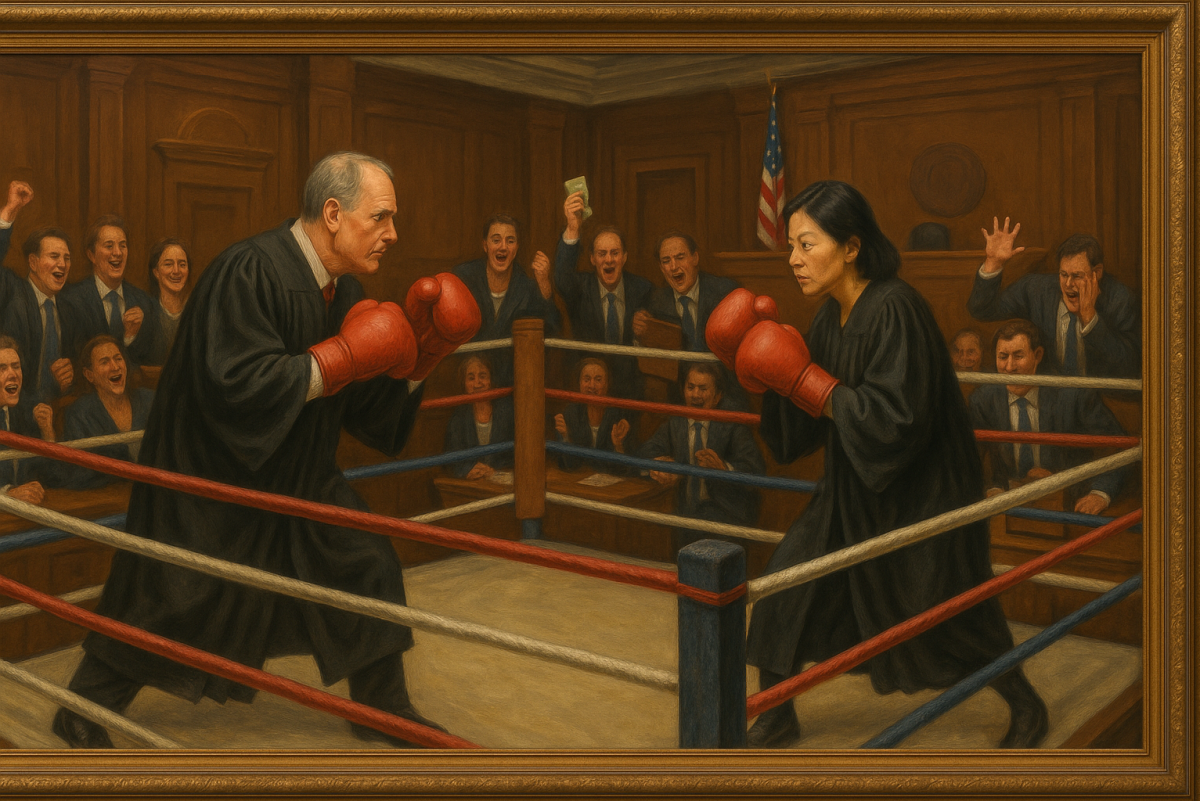
In one sense, this striking piece in The New Digest is an argument that 1) a strong attachment to the value of process and its legitimating role in the rule of law amounts to liberal fetishism; 2) procedure, to offer a tendentious description of the argument, is only good so far as it leads to the results you like; 3) conversely, it is wicked, and “not law,” if it leads to an act of statutory interpretation that requires a government body to “hire a gay man handling children.” (More accurately, that passage should read: “…if it results in government being statutorily prohibited from discriminatorily firing a gay man, albeit a gay man who’s a layperson and not a member of the clergy, who works in a non-child-handling capacity as coordinator of a juvenile court child welfare advocacy program and has helped it win national awards for its work, but who then has the temerity to openly, flagrantly, disgustingly play softball.”)
In another but, I would suggest, equally meaningful sense, the piece is a deployment of wide-ranging, centuries-spanning, “purge”-friendly argument and high-flown language–all in the service of a tussle about who gets to occupy a resume-enhancing position of negligible importance in a student group at an Ivy League law school. Universities, famously, are the place where the arguments are so fierce because the stakes are so small. The saying needs a second part: Ivy League universities are the place where fierce arguments about small stakes get extensive media coverage, and everyone involved in the spat publishes at least one op-ed about it.
It is both pleasing and unsurprising that both senses of the piece–the actual argument it makes, and the relationship of that argument to the actual stakes, which mostly have to do with internecine disputes over the distribution of status goods within the Ivy League–come together, with almost divinely ordered complementarity, in one clear conclusion: The spirit of Critical Legal Studies continues to flourish at Harvard Law School. It’s fitting that this piece appears in The New Digest, because I don’t think anyone currently teaching at Harvard has done more to keep the Crit spirit alive there than Prof. Vermeule.