
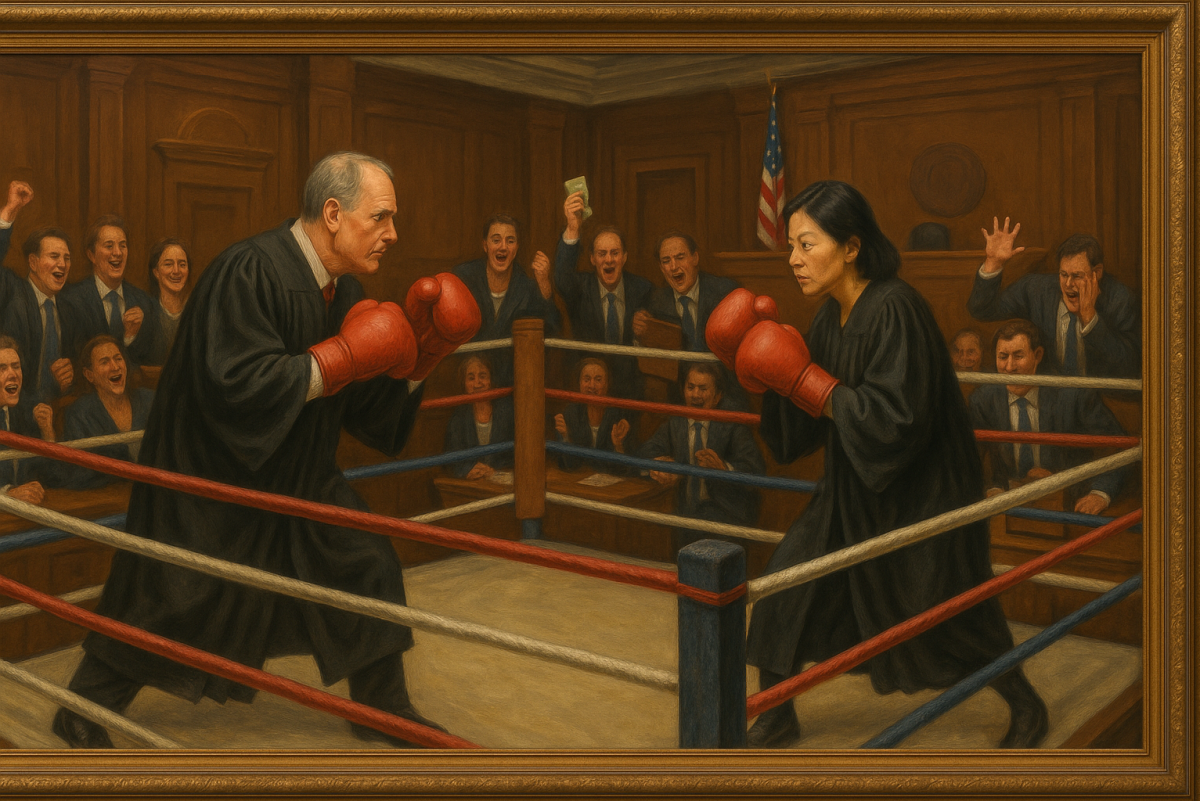
In their casebook The Jurisprudence of Sport, Mitch Berman and Richard Friedman create a course using sports rules to illustrate law, jurisprudence, and legal systems. A unique rules issue arose in last night’s Red Sox-Blue Jays game; the coverage of it illustrates how bad media is at covering law.
The Sox had 1st/3d with one out, but the scoreboard showed two outs (the prior play had created some confusion). The batter flied out to center. Believing there were two outs, the runners ran on contact, with the runner on 3d crossing the plate. Realizing there was only one out, the Jays threw the ball to first base and that runner was called out for the final out of the inning. Then everyone became confused about whether the run counted (since the runner on third crossed the plate before the throw to first). After a discussion, a call to the rules center in New York, and a 15+-minute delay, they decided the run counts.
The controlling rule is Rule 5.09(c)(p.50), which establishes “appeal plays”–plays in which the umpire will call a runner out only if the defensive team “appeals” by doing something to trigger a delayed call. Under (c)(1), the defense can appeal if, after a fly ball is caught, the runner fails to retouch his original base before he or the base is tagged. It follows that if the team fails to appeal (to attempt to tag the base and trigger a call), the umpire will not call that runner out for failing to retouch.
In this case, two runners left before the catch. The Jays appealed to first base and got the out on that runner. They did not appeal to third, since the appeal to first was the final out. Absent an appeal, the runner on third scores. And because he scored before the Jays tagged first base, the run counted. The umpires called this a “time” play; they checked with the replay center to confirm the timing. With that confirmed, the run scores.
The problem was the Jays’ failure to appeal to third. Under text at the end of (c) (p.54), an appeal (the throw to the base he left) must be made before the next pitch or, if the play ends a half-inning, before the defensive team leaves the field.
This raises the possibility of a “fourth out,” as a later paragraph in (c) describes:
Appeal plays may require an umpire to recognize an apparent “fourth out.” If the third out is made during a play in which an
appeal play is sustained on another runner, the appeal play decision
takes precedence in determining the out. If there is more than one
appeal during a play that ends a half-inning, the defense may elect
to take the out that gives it the advantage. For the purpose of this
rule, the defensive team has “left the field” when the pitcher and
all infielders have left fair territory on their way to the bench or
Clubhouse.
So even after the third out on the appeal to first, the Jays could have removed the run by appealing to third. Why didn’t they? Because they already had left the field, as defined.1 That is the key to the entire play.
Yet the announcers never mentioned it or showed it on the replay (the color commentator was lost throughout the play). Most game reports either failed to mention it or buried it. Everyone was too busy laughing at the concept of a “fourth out”2 or criticizing the players for not knowing how many outs there are or shouting about how they had never seen anything like this before (even thought it happened four years ago and “how is it possible to get four outs in an inning” is a common rules-trivia question). I had to read multiple stories before finding one that included that one central fact on which the entire legal controversy turned.
Sounds too familiar.
- Although the Jays’ manager questioned whether their not-fast-moving first baseman had gotten across the field. ↩︎
- A commenter on a sports blog reframed this rule. It is not a “fourth out;” it is a substitute third out. The later, more advantageous appeal at third replaces the appeal at first as the final out of the inning, thereby eliminating the run. Well said. ↩︎