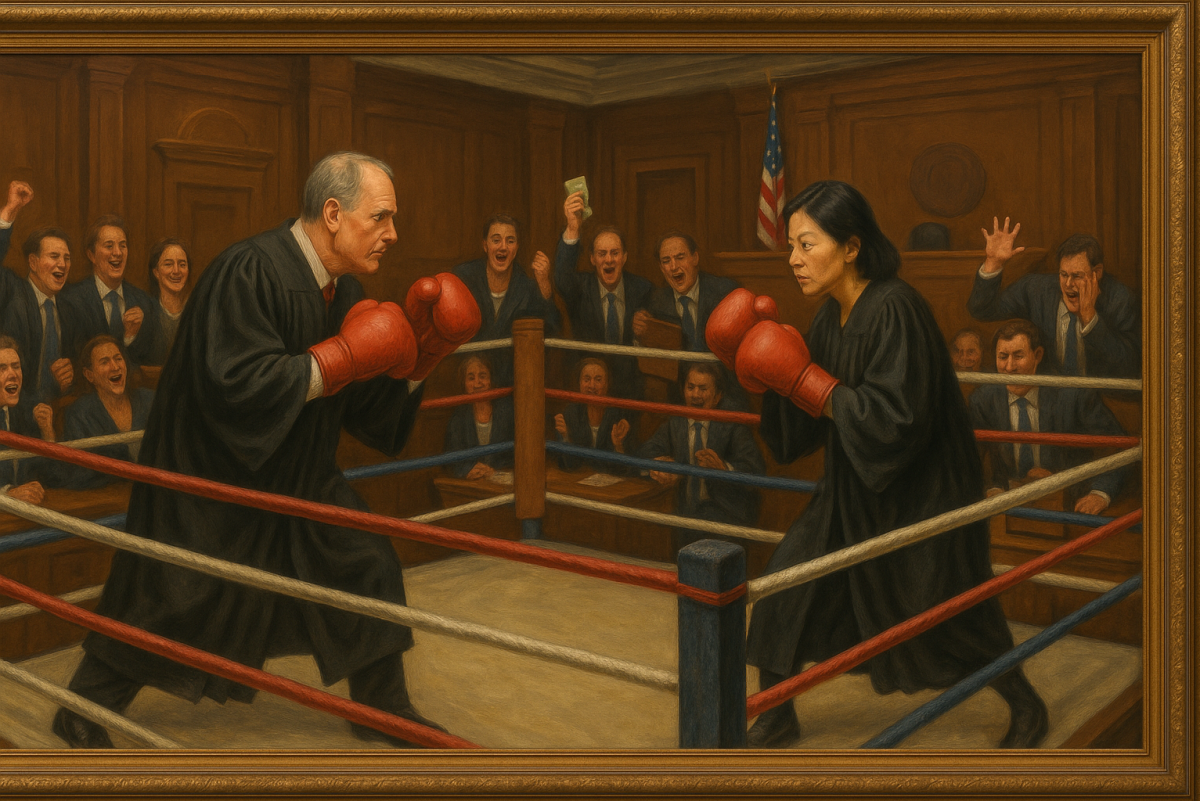
This piece in Sunday’s NYT Magazine is the talk of the blogosphere this week. Even semi-retired uber-blogger Andrew Sullivan is in on the act.
In the piece, Jeff Rosen claims that believers in the Constitution in Exile wish to roll back decades of precedent and return to the Lochner era, and that they may be poised to capture the judiciary. This could mean the end of social security, welfare, environmental laws–in short, the entire regulatory state.
I must admit that I am not the expert on libertarian and conservative jurisprudence that these Volokh conspirators are. (They are doing a tag-team takedown of the central thesis–that a jurisprudential theory that can be labeled “Constitution in Exile” even exists–a project that began months ago.)
Even so, I agree with them that Rosen’s thesis presents, um, difficulties. His biggest mistake, I think, is in lumping together such disparate legal scholars, judges, and practitioners as Michael McConnell, John Roberts, Richard Epstein, Michael Greve, Ginsburg, Michael Luttig, William Pryor, Clarence Thomas, Janice Rogers Brown, Randy Barnett, William Myers, and others, and claiming that they can all be categorized together jurisprudentially.
As near as I can tell, the only thing these folks have in common is that they are (for the most part) principled conservatives who appear to believe that the Commerce Clause and/or some other constitutional provision has been interpreted too broadly.
This is what makes for a secret cabal that is dreaming and/or poised to take over the judiciary?
Posted by Hillel Levin on April 18, 2005 at 10:20 AM
Comments
Ariela: Two points as to why we should apply principles rather than mere politics to the Constitution. 1. On the theoretical level, what use is there for a Constitution that establishes a government and, among other things, safeguards the rights of the minority if it is simply the majority that determines what those safeguards are? However, if you are a committed realist/crit, I don’t suppose I can convince you by reference to democratic theory. And I don’t mean that snidely: the realists and the crits make strong an convincing arguments. 2. On a practical level, if it really is about politics and policies, then the whole ball game comes down to persuasion. Aren’t we more persuasive when we refer to neutral principles that we’d apply elsewhere? If it really IS all about politics, then we ought to abandon all pretenses about adhering to the Constitution. At the very least we should stop lying about it. I’m willing for it to be all about politics rather than principle, but I’m not willing to lie about it. When the conservatives say “all you liberals do is use the liberal activist courts to pursue anti-majoritarian agendas that you could never push democratically; and the constitution has nothing to do with it,” I’ll be forced to say, “That’s right; and it really stinks to lose, doesn’t it?” I think one reason that political liberals lose so frequently at the polls these days is that we have become, on a number of hot-button issues, anti-populist and non-persuasive; and lots of mainstream Americans view us as liars. We have put all our eggs in the courts’ basket. As a consequence of this losing, we will eventually lose the Court too; indeed, in some senses we already have. If we adopt principled constitutionalism we will no doubt lose many important battles; and I certainly don’t suggest that we should shun the courts altogether; but perhaps we stand a chance of winning a long-term war.
Posted by: amosanon1 | Apr 19, 2005 11:58:30 AM
Ariela, the principles have the be the highest goal, the aspirational underpinning of the judiciary. While I have my political views, my view of the legal landscape is based on interpretation of the law first. I have come to conclusions that were very much against my personal beliefs because that is where the interpretation of the law would go. The question that is asked over and over again is whether a new judge is going to follow the rule of law. The question of the method of interpretation will differ, but if we stop thinking that the ideal of a fair and impartial judiciary is the best option then we have lost the integrity of the judiciary. A lawyer, and by extension the entire judiciary, has only their integrity at the end of the day. There was a case recently where Ginsberg concurred with the majority in protecting an HMO, I think, under ERISA because that was the correct legal response. She, however, wrote a concurrence to point out the problems with this line of cases and the fact that it was a problem that Congress needed to fix. This isn’t just about stare decisis or respect for tradition, it is also about the respect for the institution and what will be left of that institution in the future. If that legacy is tarnished by partisan hacks who do not respect the rule of law, on which our nation was founded, then the populace will lose what respect is left for the judiciary as it becomes everything that the idealogues complain it is. In short, the world is a better place when jurists of integrity look to the law and make their decisions with as little of their partisan pre-determinations as possible because the judiciary is the integrity of the nation.
Posted by: Joel | Apr 19, 2005 10:56:08 AM
But WHY should we? How will that make the world better? I have always had a hard time understanding it (unprincipled hack that I am), both in the world of Anglo-Am. jurisprudence and in the world of religious law (which is what my husband does for a living). I’m not asking this flip-ly, I really want to know why people think it’s important.
If conservative jurists agreed to stick neutrally and fairly to legal positivism and precedent (so that we got out of the cycle of “well, but THEY were just being cynical ideologues when they came up with this Eleventh Amendment crap at a Federalist Society meeting”), would you agree to do the same? I’m not sure I would, and I know that makes me a bad lawyer/person, but, again, WHY is it wrong?
Posted by: Ariela | Apr 19, 2005 8:02:44 AM
Ariela has hit the proverbial nail on the head (again). These battles aren’t really about the constitution and principle; they are about politics.
The difference Ariela and I may have (though I’m not certain) is that I consider this state of affairs unfortunate. We really SHOULD care what the 14th amendment means, what the 11th amendment means, and so forth. We should have a principle about precedent, whether pro or con, and we should apply it neutrally. We may not always succeed in divorcing our politics from our jurisprudence, but we ought to try, no?
Posted by: amosanon1 | Apr 19, 2005 7:38:17 AM
Will Baude correctly identifies what I see as deep-seated confusion and a certain amount of self-deception among people I’ll lump together as “liberals” when it comes to the nature of the threat we are facing. Many New York Times readers (including non-lawyers with whom I’ve discussed this) claim to be extremely alarmed that J. Thomas and his minions are ready to throw out decades of precedent and roll back the New Deal. But I wonder how many of those people really care about the precedent part. Call me an unprincipled hack, but I have no more fidelity to stare decisis than Thomas does when it comes to lines of precedent that work against my political values. Most liberals would probably be perfectly happy to toss Seminole Tribe and its progeny out the window in a heartbeat. As a proponent of immigrants’ rights, I would love to chuck the entire doctrine of plenary power and the Chinese Exclusion cases — the doctrine was stupid and racist in the late nineteenth century, and 125 years of xenophobia and red-baiting haven’t done much to improve it. Why should I pretend to be appalled that Justice Thomas feels the same way about an expansive Commerce Clause that is used to prop up programs he feels are damaging to society? Conservatives don’t like civil rights litigation, and they’ll grab any doctrinal hook they can think of to undermine it. Do you really think they care about whether the laws they’re knocking out “enforce” the Fourteenth Amendment? In my opinion, those who want to save the New Deal would do better to focus on convincing the public that the social safety nets are still necessary, not on attacking their opponents for engaging in doctrinal inconsistency or radicalism.
Posted by: Ariela | Apr 19, 2005 4:00:23 AM
Let me be clear: I don’t think the article was noteworthy in any way. Indeed, I was neither inspired nor offended by it. I wouldn’t have had anything to say about it, in fact, if you hadn’t used the article as an opportunity to (1) highlight why conservatives were unfairly treated in the piece and (2) ask if the Constitution doesn’t perhaps forbids all redistributive programs. I thought those moves were worth some resistance from our Center-Left blog.
I mean, I will very much enjoy teaching the differences in the ideas of Richard Epstein, Doug Ginsburg, Michael Luttig, Clarence Thomas, and Randy Barnett someday in an appropriate setting. But I’m not going to get worked up if the New York Times is–heaven forbid–a bit superficial about the content of a movement that is obviously extant, even if slightly mischaracterized in broad strokes.
On Thomas, we actually disagree: I think he’s much more dangerous than a hack. I think he has the courage of his convictions–and they are not (all the time) incoherent ideas either. I very much find his beliefs and modes of interpretation extreme and wrong-headed–but I wouldn’t say they are the products of an unprincipled hack.
Posted by: Ethan Leib | Apr 18, 2005 9:28:24 PM
Here’s the trouble, Ethan. I agree that it is worth thinking about whether the New Deal will be undone by Bush appointees, over and above the brain cells we should be spending on thinking about Roe and Grutter.
But I don’t think that’s a fair read of Rosen’s piece. I don’t think he even mentions Roe or Grutter, and if he does, it is just in passing. The article is about the supposedly imminent activist libertarian takeover of the judiciary, and he goes to great lengths to name names and string together a coherent theory for them. (Mind you, he has written previously–in the NYT Mag and TNR–precisely the kind of piece you are talking about.)
In other words, if he wrote the piece you had just described, I’d have no beef. But he didn’t.
Further, no one can claim to be surprised that Bush’s appointees are going to be conservative jurisprudentially, and that a conservative jurisprudence is one that rolls back the power of the federal government. If it is something to worry about, it is hardly shocking.
Finally, I’m not sure we ought to make hay out of whether a given commentator is to the right or left of Scalia or Thomas. My problem with Thomas is not so much his stated jurisprudential philosophy (though we do disagree), but rather his political hackery in applying it. Don’t forget that same-sex marriage was a crazy fringe idea not two decades ago, and a few decades ago the whole idea of social security was just insane. So the fact that the debate has shifted is not–itself–a normative issue.
Posted by: amosanon1 | Apr 18, 2005 8:10:18 PM
There are many reasons Wickard is questionable both as a matter of originalist jurisprudence and as a matter of policy. Its problems, however, are also analytically separable from simply realizing that Wickard and much more besides are currently on the table in the appointments game.
Posted by: Ethan Leib | Apr 18, 2005 6:45:59 PM
Fine, but there are two (or three) analytically distinct questions here that the article unfortunately conflates. 1: Would overturning Wickard v. Filburn be wrong because it is, as a matter of law, the right way to understand the commerce clause power? [2: Would overturning Wickard v. Filburn be wrong because it is entitled to stare decisis even though wrongly decided?] 3: Would overturning Wickard v. Filburn be wrong because it would lead to the destabilization of legislation that is now overwhelmingly popular?
1 and 3 are very different, and it’s not clear which one Rosen (and like-minded folks) thinks should be considered when appointing new justices. Rosen doesn’t discuss why a restrictive commerce clause program is legally wrong (if it is), but he quotes a lot of academics who presumably disagree with it on the merits, not just because they like the Endangered Species Act.
Posted by: Will Baude | Apr 18, 2005 4:35:59 PM
Yes. Though there is nothing especially secretive about it.
I think it is worth reporting that what was once called called “the lunatic fringe” jurisprudence of Clarence Thomas (see, e.g., http://leiterreports.typepad.com/blog/2004/06/more_on_justice_1.html; http://leiterreports.typepad.com/blog/2004/06/still_more_on_j.html) is actually becoming a position with respectable adherents in the academy, in think tanks, and on the bench. And the prospect of Thomas getting more votes to undo Wickard and other firmaments of the New Deal is nothing short of a political revolution. That deserves some attention.
The question about whether there is a “movement” that has this or that name–and whether he or she is a member of such a movement–is hardly the major issue that Rosen’s article makes salient. The point is, I think, that we shouldn’t only be asking ourselves if Bush’s new appointments want to undo Roe and/or Grutter. We need to question whether they are to the right of Scalia in being willing to undo the New Deal altogether. That, rather than the smoke screen at the VC about nomenclature, was the core of the article as far as I’m concerned.
Posted by: Ethan Leib | Apr 18, 2005 2:13:13 PM